Quarter tones aren’t actually the easiest — here are easier options! (Plus, some tips on how to make quarter tones easier)
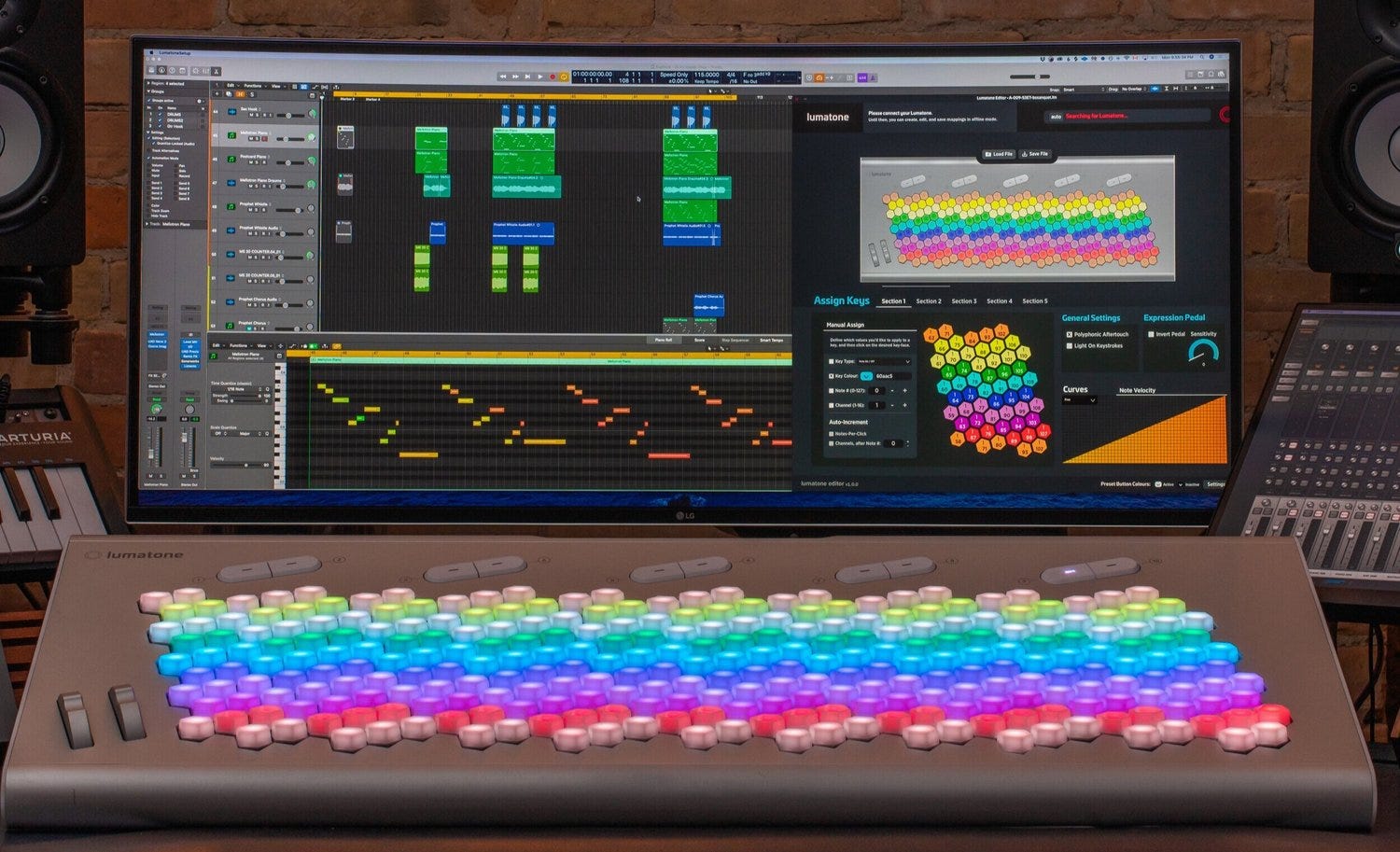
The world of microtonality can look intimidating from the outside. Tuning theory forums are full of mathematical notation, prime limits, and unfamiliar jargon. But the good news is: you don’t need to understand all of that to start making music. You just need a tuning system that makes sense on a practical level, and a way in.
This article picks five microtonal scales (called EDOs — Equal Divisions of the Octave) that are genuinely accessible to musicians who already know basic music theory. We’ll explain what makes each one approachable, what it’s good for, and where to learn more.
A quick note on terminology: an EDO divides the octave into a set number of equal steps, the same way 12-tone equal temperament (12edo) divides it into 12. Working in an EDO keeps things consistent and manageable, especially when you’re starting out.
1. 36edo — The Colourful Extension You Already Know
If you want the gentlest possible entry into microtonality, 36edo is it. Here’s the punchline: 36edo is just 12edo played by three instruments, each tuned about 33 cents apart.
Every note you already know — C, C#, D, and so on — appears three times in 36edo: a “purple” version (normal pitch), a “red” version (33 cents higher), and a “blue” version (33 cents lower). The three colours slot neatly between and around the familiar 12 semitones, giving you a sixth-tone scale.
Because 36 is a multiple of 12, standard 12edo is a perfect subset of 36edo. You can play entirely within the familiar 12 notes and just dip into the coloured notes for flavour and ornamentation — blue notes in blues and jazz, microtonal slides in solos, subtle pitch shadings in chords. The “wrong notes” sound less jarring out of context than some other microtonal scales, because the new intervals are so close to familiar ones that they’re perceived as colourful inflections, not alien pitches.
The practical consequence of this is that you don’t need any new theory to start using 36edo. Bring in a second or third instrument and tune it up or down by a sixth tone. Jacob Barton famously wrote a piece for two clarinets using exactly this approach.
36edo is particularly well-suited to blues, jazz, and music influenced by the 7th harmonic (like barbershop or some folk traditions). The 7/4 harmonic seventh — that slightly flat, bluesy seventh that 12edo only approximates — is much better represented here. It’s also a natural bridge to Indonesian gamelan: 9edo is a subset of 36edo and maps reasonably well onto the pelog scale.
One thing to keep in mind: 36edo doesn’t actually improve on 5-limit harmony (major and minor thirds) compared to 12edo, since those intervals land in the same places. Its strength is in the world of the 7th harmonic and in ornamental microtones. But for a beginner, this is mostly a feature — it means your familiar chord vocabulary still works, and the new notes are there whenever you want to explore.
2. 31edo — All Your Music Theory, But Better
If 36edo is the most comfortable entry point, 31edo is arguably the most rewarding one for musicians who care about harmony.
31edo is a meantone temperament — and so is 12edo. This is a crucial point. Both systems share the same underlying skeleton: a chain of fifths, seven-note diatonic scales, the circle of fifths, functional harmony with dominant and subdominant, major and minor keys, all of it. The music theory you already know transfers directly to 31edo. Scales, modes, chord progressions, voice leading — all of it works the same way.
The difference is that in 31edo, the underlying maths is done more accurately. The major third in 31edo is only about 1 cent away from the pure 5:4 ratio — compared to 14 cents off in 12edo. This makes major chords sound noticeably richer and less “plasticky.” The harmonic seventh (7:4), which 12edo barely approximates at all, is reproduced with almost perfect accuracy. You can write genuine four-voice chords using harmonic sevenths — something that sounds beautiful in barbershop and jazz but is nearly impossible to make pure in 12edo.
The 31-note system was actually proposed by the Renaissance theorist Nicola Vicentino in 1555, and later championed by the Dutch scientist Christiaan Huygens in 1691. The physicist and composer Adriaan Fokker revived it in the 20th century and had a 31-tone organ built, which still stands in Amsterdam. This is not a fringe curiosity — it’s a system with serious historical weight.
From a practical standpoint, 31edo adds 19 extra notes to the octave. On a guitar, that means extra frets; on a keyboard, you need a retuned synthesiser or software. The Xen Wiki has extensive resources on 31edo notation, and the notation is quite natural: you simply add “half-sharps” and “half-flats” (called dieses), and the circle of fifths becomes a spiral.
The key insight for beginners is this: in 31edo, you can write tonal music — functional harmony, modulation, counterpoint — using all the same rules you already know, and it will simply sound better. The sweetness of the pure major thirds is immediately apparent to almost any listener. Once you get comfortable, you can gradually explore the new intervals 31edo offers: neutral thirds, subminor and supermajor chords, the harmonic seventh tetrad. But you’re not required to.
3. 22edo — The Smallest System That Beats 12edo at Its Own Game
22edo occupies a special position in microtonal theory: it is the smallest equal-division tuning that does a better overall job of approximating just intonation (pure harmonic ratios) than 12edo does.
More importantly for a beginner: 22edo has few enough notes to fit on real instruments. A 22-fret guitar is unusual but not exotic — and because guitars standardly have 22 or 24 frets already, a luthier or a skilled hobbyist can refret one for 22edo without the instrument becoming unplayable. A 22-key keyboard octave is cramped but manageable. This makes 22edo one of the few non-12 systems you can actually pick up and hold.
Now, a fair warning: 22edo is not a meantone system. Unlike 31edo (and 12edo), it does not temper out the syntonic comma (81/80). This means that standard music theory doesn’t transfer cleanly. Major thirds and minor thirds sound recognisably like themselves, but they’re generated by a different underlying structure — superpyth temperament rather than meantone. The diatonic major scale still has seven notes arranged LLsLLLs, but the thirds approximate 9/7 and 7/6 (septimal intervals) rather than 5/4 and 6/5. In other words, your major chords will sound different — brighter and more tense than 12edo’s, rather than warmer and more settled as in 31edo.
This is actually a selling point once you adjust your ears. 22edo is extraordinarily rich. It does well in both 5-limit harmony (major/minor thirds closer to pure) and 7-limit harmony, and it also supports porcupine temperament, which organises the scale in a completely different but highly consonant way. It even handles 11-limit intervals. The famous microtonal musician Sevish has called 22edo his favourite tuning: “it has such a variety of sounds from the familiar to the xenharmonic.”
The 22-note chromatic scale also maps onto music notation in a workable way, using sharps, flats, and an additional accidental. If you’re composing rather than performing, software makes it straightforward: just load a 22edo tuning file into your DAW and retune a software instrument.
4. 15edo — Small, Efficient, and Surprisingly Powerful
15edo is the rebel on this list. It sounds wrong before it sounds right — and then it sounds very right.
Here’s the catch upfront: 15edo has a sharp fifth (720 cents, compared to the pure 702 cents or the familiar 700 cents of 12edo). This means that if you’re using instruments with strong harmonic overtones — a bright piano, a bowed string, a sustained organ — the fifths will beat in a way that sounds out of tune. 15edo rewards timbral awareness. Sine-wave-heavy sounds, mallet instruments, plucked strings with quick decay, and many electronic timbres work beautifully. Sustained acoustic instruments need careful voicing.
So why is it on a “beginner” list? Because 15edo is remarkably small — only 15 notes per octave — and yet it packs an enormous amount of 7-limit and 11-limit harmony into those 15 notes. The 7th harmonic (7/4, 7/6, 7/5) is well approximated. The 11th harmonic (11/8, 11/9, 11/6) is decently approximated — 15edo is actually the smallest equal-division tuning that approximates the 11th harmonic at all while still having a usable fifth. The result is that with just 15 pitches, you have access to a wide palette of unusual but consonant chords.
15edo strongly supports porcupine temperament, in which a stack of three “minor whole tones” (each representing roughly 10/9, 11/10, or 12/11) adds up to a perfect fourth. This produces scales and chord progressions that feel logical and harmonious, but don’t follow the circle-of-fifths logic of meantone at all. Porcupine’s eight-note scale (porcupine[8]) gives you a different set of modes to explore, each rich in septimal and undecimal chords.
For beginners, the learning curve of 15edo is mainly about retraining your ears and adjusting your timbre choices. Once you accept that the fifth sounds deliberately wide (rather than out-of-tune), and you start writing around that fact rather than against it, 15edo is genuinely intuitive. There are fewer notes to navigate than in 22edo or 31edo, and the harmonic payoffs arrive quickly.
5. 24edo — The Intuitive Gateway (With an Important Caveat)
24edo — the quarter-tone scale — is probably the most famous microtonal tuning in the world, and it’s the one you’re most likely to have encountered already. It’s used in Arabic and Turkish classical music, it appears in the work of composers from Charles Ives to Julián Carrillo, and it’s the tuning of King Gizzard and the Lizard Wizard’s “microtonal” guitar albums.
The concept is immediately intuitive for any 12edo musician: every semitone is split in half, giving you a “half-sharp” (↑) and “half-flat” (↓) between each pair of existing notes. This looks entirely natural on sheet music — you simply add a new accidental symbol. There are no new organisational principles to learn, no new scale structures to internalise. It’s just more notes.
The practical setup is also straightforward: use two standard instruments tuned a quarter-tone apart (one normal, one tuned 50 cents up), or load a 24edo tuning file into a software instrument. For guitar, the “Sazocaster” tuning popularised by King Gizzard adds quarter-tone frets between some of the existing frets.
Here is the important caveat, though: 24edo is easy to conceptualise, but not necessarily easy to use well. The new intervals it adds — quarter-tones (50¢), neutral seconds (150¢), neutral thirds (350¢), and so on — are highly dissonant in a harmonic context. Quarter-tones are perceived as the most dissonant interval class in harmonic entropy models: they sit exactly between recognisable harmonics, so the ear hears them as something that’s “wrong” rather than something that’s “new.” This is why Arabic and Turkish music doesn’t use quarter-tones as standalone harmonic intervals — they use them as melodic ornaments and building blocks for larger melodic units (like neutral seconds), always within a carefully constructed modal framework.
If you approach 24edo the same way — melodically, ornamentally, modally — it works beautifully. If you try to use it like an expanded version of 12edo chord harmony, you’ll likely find it grating.
One excellent option is to use a 24-tone well temperament rather than strict 24edo. The most well-known is the Catler tuning, developed by guitarist and composer Jon Catler. Catler[24] redistributes the 24 pitches unevenly — slightly adjusting many of them away from equal quarter-tone spacing — so that the harmonically important intervals in the most-used keys are cleaner, while exotic or rarely-used intervals retain some “wildness.” This is exactly what Bach-era well temperaments did for 12-note keyboards, giving each key a distinct character while making all of them playable. The Catler tuning is a great option if you find raw 24edo too dissonant for the music you want to make.
Honourable Mention: Just Intonation Done Right — CPS Scales and Overtone Scales
If you’re drawn less to equal temperament and more to the tradition of pure just intonation — the lineage that runs from ancient Greek theory through Harry Partch and Ben Johnston — there are two families of small, efficient JI scales worth knowing about.
Combination Product Sets (CPS), particularly the hexany (6 notes), dekany (10 notes), and bihexany (12 notes), were developed by the theorist Erv Wilson. A hexany, for instance, is built by taking four harmonic factors (like 1, 3, 5, and 7) and multiplying them in all possible pairs, giving six pitches. These six pitches form eight pure just-intonation triads — an extraordinary density of consonant harmony for such a small scale. Every note in a CPS is equally important; there’s no fixed “tonic,” which gives CPS-based music a floating, symmetrical quality unlike anything in Western tonal music.
Overtone scales (afdo) — particularly 12afdo and 16afdo — are equally compact and consonant. An overtone scale simply takes consecutive harmonics from the harmonic series and reduces them into an octave. 12afdo uses harmonics 12 through 24; 16afdo uses harmonics 16 through 32. These scales contain extraordinarily pure chords (since all the notes are literally part of the same harmonic series), and they require no mathematical background to understand: the notes are just the natural overtones of a single fundamental pitch.
Both CPS scales and overtone scales are very efficient — a small number of notes yields a large number of consonant chords. This makes them far easier to learn and use than larger or more mathematically complex JI systems like Partch’s 43-tone scale.
Where to Go From Here
The best resource for microtonal theory at any level is the Xenharmonic Wiki — it covers every tuning system imaginable with varying degrees of mathematical depth, and the pages for each EDO usually include interval tables, notation guides, and links to actual music.
For software, Scale Workshop (by Sevish) lets you create and play any tuning system in your browser for free. Most major DAWs (Ableton, Bitwig, Reaper, Logic) support microtonal retuning via MIDI Tuning Standard, Scala (.scl) files, or pitch-bend hacks.
If you want to hear what these systems sound like before diving in, search for composers like Sevish (22edo and others), Zhea Erose (31edo), Aaron Wolf (just intonation), or Stephen James Taylor (22edo guitar) on YouTube and Bandcamp. Music is always the best teacher.
Pick one tuning. Load it into a synth. Play something ugly. Then play something beautiful. That’s how it starts.
Comments
Post a Comment