Xenharmonic history from Helmholtz to Erose, and Carillo to Erlich (scroll to the end for a short summary timeline)

The 1850s–1870s: Early Theoretical Stirrings
The modern history of microtonal music begins not with composers but with scientists and theorists whose investigations into acoustics forced a reckoning with the imperfections of equal temperament.
Hermann von Helmholtz, the German physicist and physician, published his landmark On the Sensations of Tone in 1863 — a work that would cast a long shadow over the next century and a half of tuning theory. Helmholtz meticulously analyzed the overtone series, the physics of consonance and dissonance, and the historical divergence of Western music from “natural” tuning. His experimental harmonium, built with his associate Rudolph Koenig, was tuned to just intonation and demonstrated that intervals derived from pure mathematical ratios sounded fundamentally different — often more resonant and stable — than those of standard equal temperament.
It was in the mid-nineteenth century that a systematic engagement with intervals smaller than the semitone began to cohere into something resembling a theoretical discipline. Physicists across Europe were measuring beat frequencies and charting discrepancies between equally tempered and just intervals. These scientific discoveries filtered slowly into musical consciousness.
The quarter-tone — half a semitone — was already a presence in discussions of ancient Greek music and non-Western traditions, and explorers returning from the Ottoman Empire and South Asia brought reports of musical systems that organized pitch in ways incompatible with the European piano. The seeds of a profound disruption had been planted, though the full flowering would wait another half-century.
The 1880s–1900s: The Non-Western World as Theoretical Catalyst
The last two decades of the nineteenth century brought the comparative study of world music into European intellectual life with accelerating urgency. The 1889 Paris Exposition Universelle was a watershed moment: musicians and composers, including the young Claude Debussy, encountered Javanese gamelan music whose bronze instruments were tuned in ways that bore no resemblance to Western equal temperament. The slendro and pelog scales of gamelan divided the octave into five and seven unequal steps respectively, and their sonority — shimmering, resonant, deeply strange to European ears — hinted at vast musical territories beyond the twelve-tone chromatic scale.

Alexander John Ellis, the English phonetician and mathematician who had translated Helmholtz’s Sensations of Toneinto English in 1875, made his most lasting contribution to musical science in 1885 with the publication of “On the Musical Scales of Various Nations” in the Journal of the Society of Arts. Ellis introduced the cent as a unit of musical measurement — one hundredth of an equally tempered semitone, or one twelve-hundredth of an octave. This gave theorists and ethnomusicologists a universal, mathematically precise language for describing and comparing any tuning system in the world, whether equal, just, or entirely irregular. With the cent, a Japanese koto tuning could be compared directly to an Arabic maqam scale or an Appalachian fiddle’s intonation habits. Ellis’s work is arguably the single most enabling technical development in the history of microtonal theory.
During this same period, the American Charles Ives was a teenager learning to play in multiple keys simultaneously from his father George Ives, a bandleader and relentless experimenter who tuned a viola to different pitches and asked his son to sing against it. This domestic education in “wrong” notes would prove formative.
The 1900s–1910s: The First Microtonal Composers
The first decade of the twentieth century saw microtonal music move from theoretical proposition to compositional ambition. The Mexican violinist and composer Julián Carrillo made what he described as a pivotal discovery around 1895 and began systematically composing in divisions of the whole tone smaller than the semitone — eventually settling on a comprehensive system he called Sonido 13 (the “Thirteenth Sound”), representing the first interval beyond the twelve divisions of the octave. By the early 1900s he was actively promoting his ideas, though his most famous works and instruments lay ahead.
In Europe, the Czech composer and theorist Alois Hába was formulating his ideas about quarter-tone music and the philosophical imperative of a music that followed the “natural” expressiveness of the human voice rather than the artificial cage of equal temperament. Though Hába’s landmark compositions in quarter-tones came in the 1920s, his intellectual development was well underway by the 1910s.
Similarly, the Russian aristocrat and composer Ivan Wyschnegradsky became obsessed with quarter-tones after what he described as a mystical experience around 1916, leading him toward a lifelong project of composing in the ultrachromatic, spiritually charged sonic spaces he imagined lying beyond the twelve semitones.
Perhaps most dramatically, Ferruccio Busoni published his Sketch of a New Aesthetic of Music in 1907, a text that crackled with dissatisfaction at the limitations of contemporary musical resources. Busoni argued that the natural scale contained not twelve but “one hundred thirteen tones” and proposed the use of third-tones and sixth-tones. He imagined new electronic instruments that could render these fine gradations without the mechanical limitations of keyboard instruments. Busoni did not himself compose microtonally in any systematic way, but his essay — translated and widely read — served as a philosophical license for younger composers who were already inclined toward experimentation.
The Italian Futurists, meanwhile, led by Luigi Russolo whose Art of Noises manifesto appeared in 1913, did not address microtonality directly but pushed toward a radical expansion of musical material that made the microtonal enterprise seem part of a broader avant-garde assault on the European tradition.
The 1910s–1920s: Quarter-Tones, New Instruments, and the First Compositions
The years surrounding the First World War produced a burst of microtonal activity that in some ways has never been equaled for sheer programmatic ambition.
Alois Hába completed his first string quartet in quarter-tones in 1919–1920, a work widely considered the earliest significant chamber music written in this tuning system. Hába’s aesthetic was rooted in the micro-intervals of Moravian folk music, which he believed expressed an emotional directness that equal temperament smoothed over. He would go on to compose his opera Die Mutter (1929) entirely in quarter-tones, one of the most daunting and singular achievements in the microtonal repertoire.
In Prague, Hába was influential enough to establish, in 1924, a class in quarter-tone composition at the Prague Conservatory — the first such institutional acknowledgment of microtonal music anywhere in the world. His students included Hans Eisler and others who would carry the ideas in quite different directions.

Ivan Wyschnegradsky arrived in Paris in 1920 and spent the remainder of his long life there, composing prolifically in quarter-tones and eventually other divisions of the octave. His strategy for performing quarter-tone music was to use two pianos tuned a quarter-tone apart — a pragmatic solution that allowed the intervals to be rendered on familiar instruments without requiring entirely new keyboard mechanisms. Wyschnegradsky’s music had a mystical, dense, sometimes overwhelming quality, rooted in his belief that “pansonority” — the totality of all pitch relationships — was a kind of spiritual absolute.
Julián Carrillo had by the early 1920s constructed special instruments capable of playing sixteenth-tones and finer divisions, and he was performing and lecturing on Sonido 13 with missionary intensity, particularly in Mexico and the United States. His Preludio a Cristóbal Colón (1922), for soprano, flute, guitar, violin, and cello, each playing in different microtonal divisions, is a landmark of early microtonal composition. Carrillo eventually had a set of fifteen special pianos built to his specifications — instruments whose strings were divided at precise fractional points to produce thirds, quarters, eighths, and sixteenth-tones — and these instruments were exhibited and demonstrated in New York and Mexico City to considerable public fascination.
In the United States, Harry Partch was a young man reading Helmholtz and Ellis and becoming increasingly convinced that Western equal temperament was a historical mistake that had severed music from its natural acoustic roots. He would not publish or perform until the 1930s, but his intellectual formation — marked by a deep reading of ancient Greek theory, Chinese poetry, and American vernacular speech — was taking shape in the 1920s.
The 1920s–1930s: Just Intonation, New Instruments, and American Originals
The interwar period consolidated the microtonal avant-garde in Europe while producing some of its most original American voices.
Alois Hába’s Prague school was at its most active, and his theoretical treatise Neue Harmonielehre (1927) attempted a systematic account of quarter-tone and sixth-tone harmony — the first comprehensive textbook of its kind. The treatise treated micro-intervals not as exotic ornaments but as the natural extension of harmonic logic, and it was taken seriously enough to be taught in the Prague Conservatory’s curriculum.
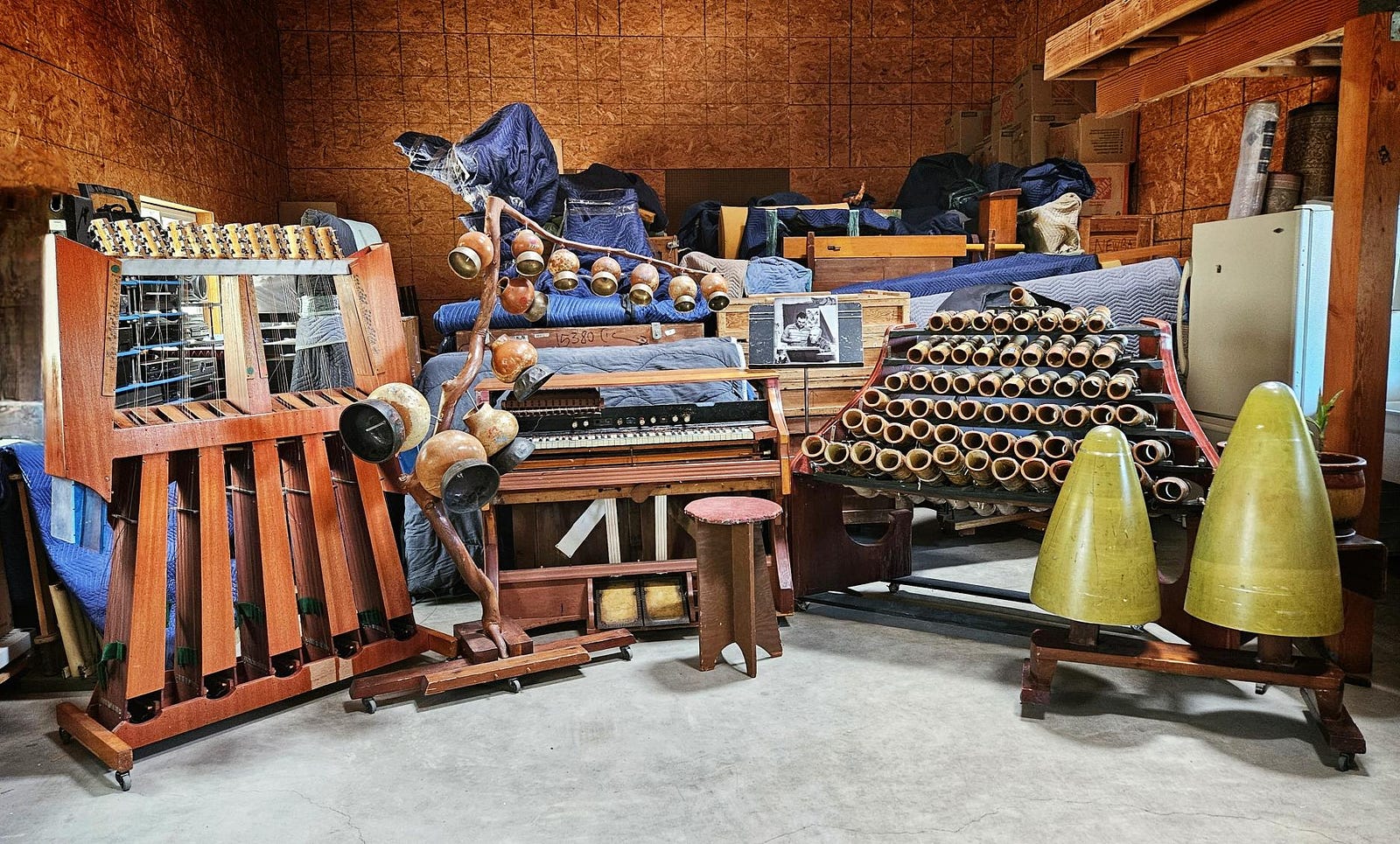
Harry Partch published his foundational work Genesis of a Music in its first form in the early 1940s (revised and expanded in 1974), but the compositional and theoretical work it documented began in earnest in the late 1920s and 1930s. Partch’s system was based not on equal division of the octave but on just intonation extended to the 11-limit — meaning that all his intervals were derived from the ratio relationships of the first eleven harmonics of the overtone series.
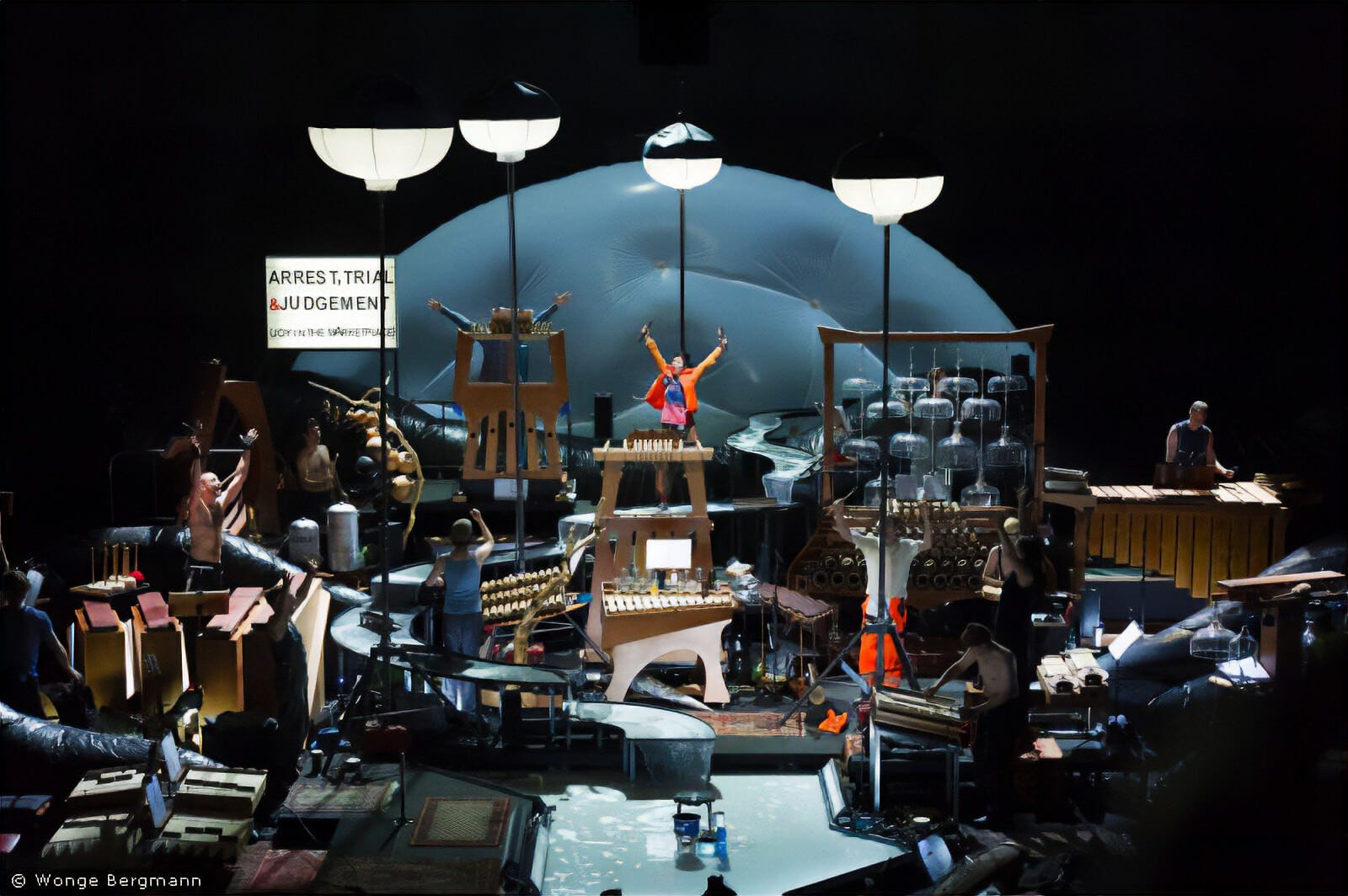
Partch’s scale contained 43 tones per octave, and because no existing instrument could play it, he built his own: the Adapted Viola (with extended fingerboard), the Adapted Guitar, the Chromelodeon (a modified reed organ), and eventually an entire family of instruments whose names — the Quadrangularis Reversum, the Spoils of War, the Boo — became as legendary as the music itself.
Partch’s aesthetic was radically anti-abstractionist; he insisted on the physical, corporeal, theatrical dimensions of music and drew on Greek tragedy, American hobo culture, and Chinese classical poetry equally. His music stands almost entirely outside any tradition or school, a singular monument.
Joseph Yasser, a Russian-born musicologist working in New York, published A Theory of Evolving Tonality in 1932, arguing that music history showed a progressive enrichment of tonal resources — from pentatonic through diatonic to chromatic — and that the logical next step was a 19-tone equal temperament. Yasser’s argument was historical and evolutionary rather than acoustic, and it pointed toward a strand of microtonal theory concerned less with just intonation than with new equal temperaments.
Adriaan Fokker, the Dutch physicist (a student of Lorentz) who would become one of the most important microtonal theorists of the mid-century, was beginning his musical investigations in the 1930s alongside his physics career. He would eventually identify 31-tone equal temperament as the system best reconciling just-intonation approximations with the practical advantages of equal temperament — but that advocacy would come into full force after the war.
The 1940s–1950s: Mid-Century Consolidation and Divergence
The Second World War disrupted the European avant-garde severely, scattering communities and destroying the infrastructure of the Prague school. Hába continued to compose but in diminished circumstances. Wyschnegradsky remained in Paris, increasingly isolated but productive.
In the postwar period, a new generation of composers emerged in Europe — Boulez, Stockhausen, Nono — whose interest lay in serialism and the organization of pitch, rhythm, dynamics, and timbre through predetermined numerical sequences. While serialism in its post-Webern form did not typically involve microtones, it did cultivate a culture of radical pitch consciousness that would eventually make microtonal thinking almost inevitable.
Harry Partch was at his most creatively explosive in the 1940s and 1950s. Barstow (1941), U.S. Highball (1943), Oedipus (1951), and The Bewitched (1955) established him as a genuinely original voice in American music. His ensemble of hand-built instruments — performed by musicians he trained himself, and often staged as theatrical events — was unlike anything else in the concert world. The academic establishment largely ignored him, but a devoted underground following sustained his work.
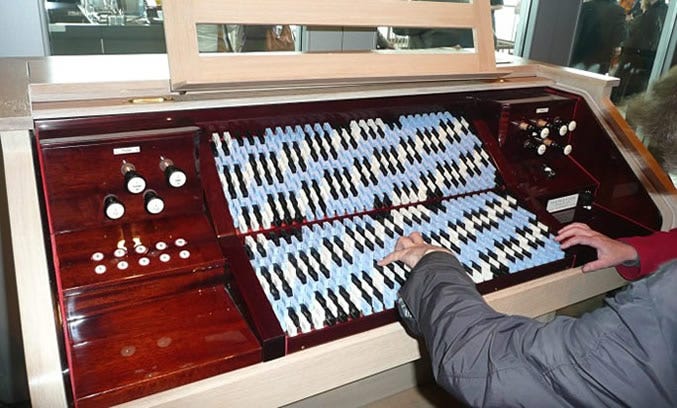
Adriaan Fokker had by the 1940s begun constructing a 31-tone organ in the Netherlands, completed in 1950 and installed in the Teyler Museum in Haarlem, where it still stands. Fokker’s advocacy of 31-equal was theoretically rigorous: the system provides excellent approximations of the 5-limit just intervals (pure thirds and fifths) that Helmholtz had identified as the basis of consonance, and it had been anticipated by the seventeenth-century theorist Christiaan Huygens. Fokker organized Musica Nova concerts in the Netherlands that premiered dozens of works for his organ and ensemble, and his journal Euterpe became a clearing-house for microtonal composition and theory.
Meanwhile, in America, the composer and theorist Lou Harrison was a close friend and collaborator of Harry Partch and shared his commitment to just intonation, though Harrison’s aesthetic was softer, more lyrical, deeply influenced by Asian music — particularly the gamelan of Bali and Java, which he studied intensively. Harrison built his own gamelan ensembles tuned to just intonation and wrote orchestral music with carefully specified just intervals. His partnership with William Colvig, who helped him build instruments, was central to his mature career.
The electronic music studio was beginning to matter for microtonal practice in the 1950s as well. The founding of studios at Cologne (1951), Paris (IRCAM’s forerunner), and later New York offered composers electronic means of producing precisely any pitch they chose, without the mechanical constraints of keyboard instruments. This opened microtonality to a new generation who approached it not as a matter of special instruments or tuning systems but as an incidental feature of working with oscillators and tape.
The 1960s: The American Experimentalists and Spectral Glimmers
The 1960s were transformative for American experimental music, and microtonal thinking ran through several of its most important strands.
La Monte Young, emerging from the New York avant-garde scene, developed an interest in sustained drones and pure intervals that became the foundation of his project The Well-Tuned Piano (begun in 1964 and developed over decades), an extended work for a Bösendorfer piano specially tuned to a complex just intonation system of Young’s devising. The Well-Tuned Piano — performed rarely, never commercially recorded in a standard release, each performance lasting several hours — became something like a sacred object in American minimalism, the purest expression of the idea that pure intervals had a perceptual and even spiritual power that equal temperament had suppressed.
Terry Riley, deeply influenced by Young, composed In C in 1964, a seminal minimalist work that, while not explicitly microtonal, fostered an aesthetic of sustained, process-based music in which the fine gradations of pitch within and around equal temperament became increasingly important to a generation of performers. The interaction between Riley’s and Young’s work and Indian classical music — both were students of Pandit Pran Nath — deepened their engagement with the raga tradition, which employs subtle microtonal inflections as a matter of expressive necessity.
Harry Partch released his major recordings in the 1960s on Gate 5 Records and later on Columbia Masterworks, bringing his work to a wider audience. His influence on younger American composers was considerable, even if it was often inspirational rather than technical — few could replicate his instrument-building practice, but many absorbed his anti-establishment, corporeal, theatrically engaged aesthetic.
In Europe, Giacinto Scelsi was composing works that hovered on and around single pitches, using microtonal fluctuations within a very narrow range as the primary means of expression. His string quartets and orchestral works like Quattro Pezzi (1959) used quarter-tones and other micro-deviations to create a music of extreme interior intensity. Scelsi’s influence on later spectral composers would be immense, though largely posthumous and only gradually recognized.
Krzysztof Penderecki and other Polish avant-gardists of the Sonorismus school were writing orchestral and choral music that used tone clusters — dense aggregations of adjacent pitches including quarter-tones and smaller — as blocks of sound-color rather than harmonic entities. Penderecki’s Threnody for the Victims of Hiroshima (1960) used clusters of quarter-tones across the string orchestra to create a sonic mass of almost physical weight.
On the margins of the American scene, a self-taught theorist named Erv Wilson was beginning to develop an idiosyncratic and original body of work in tuning theory, corresponding with Lou Harrison and a handful of other composers. Wilson, who had grown up partly in Mexico and brought to his work both a visual, diagrammatic sensibility and an indifference to academic convention, was in the 1960s formulating the earliest versions of ideas — about scale symmetry, harmonic combinations, and the geometry of interval space — that would occupy him for the rest of his life. The full fruits of this work would emerge and be shared through the 1970s and beyond, but the 1960s were where his singular theoretical vision took root.
The 1970s: Spectral Music, Just Intonation Advocacy, and the Synthesizer
The 1970s brought several developments that reshaped the microtonal landscape.
In Paris, a loosely affiliated group of composers that would come to be known as the spectralists — principally Gérard Grisey and Tristan Murail — were developing a compositional approach based on the acoustic analysis of sound spectra. Grisey’s Partiels (1975), one of the founding documents of spectral music, derived its harmonies from the actual overtone spectrum of a low E on a trombone, analyzed by computer. Because the overtone series produces intervals that do not correspond to equal temperament — the seventh harmonic is about 31 cents flat of the equal-tempered minor seventh, the eleventh harmonic falls between equal-tempered notes altogether — spectral music is inherently microtonal. Grisey and Murail, along with Hugues Dufourt and Michael Levinas, formed the ensemble L’Itinéraire in Paris in 1973 as a vehicle for performing and promoting this music, and they articulated a sophisticated theoretical justification for treating sound’s acoustic physics as the basis of compositional thought.
Ben Johnston, an American composer who had studied with Harry Partch in the early 1950s, was by the 1970s producing a body of work in extended just intonation that represented perhaps the most systematic expansion of Partch’s harmonic language into conventional concert music. Johnston’s String Quartet №4 (1973), based on the tune “Amazing Grace” and using a just intonation that encompasses the 11th and 13th harmonics, is frequently cited as one of the masterpieces of the microtonal repertoire. Johnston developed his own notation system for just intonation, using arrows, plus and minus signs, and other symbols to indicate departures from equal temperament, and he composed ten string quartets over his career, each exploring different aspects of extended just intonation.
The synthesizer was becoming widely available by the early 1970s, and while most commercial synthesizers were designed for equal temperament, their fundamental architecture made retuning possible. Wendy Carlos — who had demonstrated in Switched-On Bach (1968) that the Moog synthesizer could produce extraordinarily precise pitch control — published “Tuning: At the Crossroads” in Computer Music Journal in 1987, but the foundational experiments were begun in the 1970s. Carlos devised several equal temperament alternatives, including “Alpha,” “Beta,” and “Gamma” tunings that abandoned the octave as a structural interval altogether. This was a radical conceptual move: most microtonal systems retained the octave (the 2:1 ratio, produced by the first overtone) as the basic unit of equivalence, but Carlos argued that other interval ratios could serve just as well or better as structural frameworks.
Ivor Darreg, an American composer and theorist working largely outside academic institutions, was an energetic advocate for what he called “xenharmonic” music — a term he coined to describe any music using tuning systems other than twelve-tone equal temperament. Darreg built a series of specially tuned electric guitars and synthesizers and composed prolifically in dozens of equal temperaments, arguing through recordings and writings that each temperament had its own distinctive “mood” or expressive character. His concepts and vocabulary were taken up by the community of theorists and composers who would gather around him.
The 1970s also saw two theoretical developments that would quietly shape later microtonal thinking: Heinz Bohlen, a German-American microwave engineer with no formal music training, independently devised a new scale in 1972 based not on the octave (the 2:1 ratio) but on the perfect twelfth — the 3:1 ratio, which he called the “tritave.” His scale divided the tritave into thirteen steps, producing a set of consonances built entirely on odd-number ratios. Around the same time and entirely independently, the composer and acoustician John Pierce derived an essentially identical system, which the musicologist Mathews later named the Bohlen-Pierce scale. The Dutch theorist Kees van Prooijen provided further mathematical analysis. The scale attracted limited attention at the time but represented a genuinely radical departure: the octave had been treated as the universal structural unit of musical pitch since antiquity, and Bohlen-Pierce demonstrated that other interval ratios could serve just as well as a framework for consonance and scale construction.
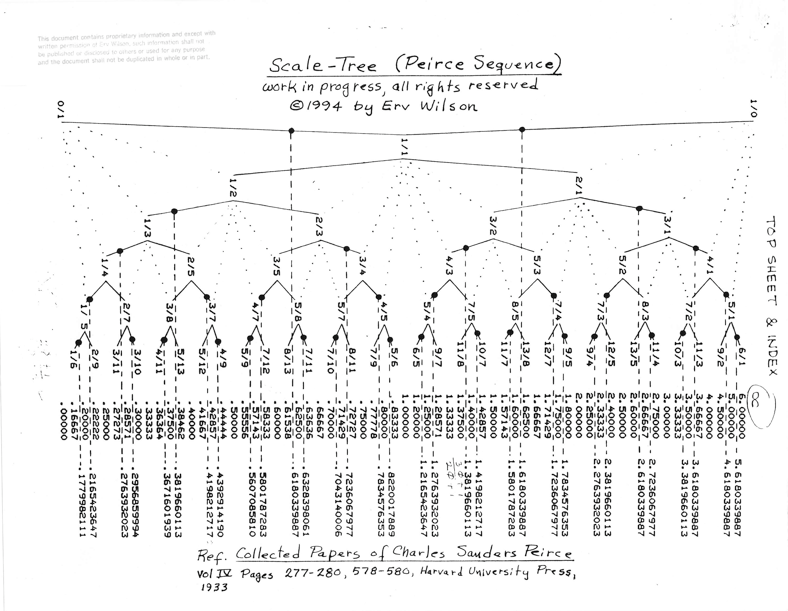
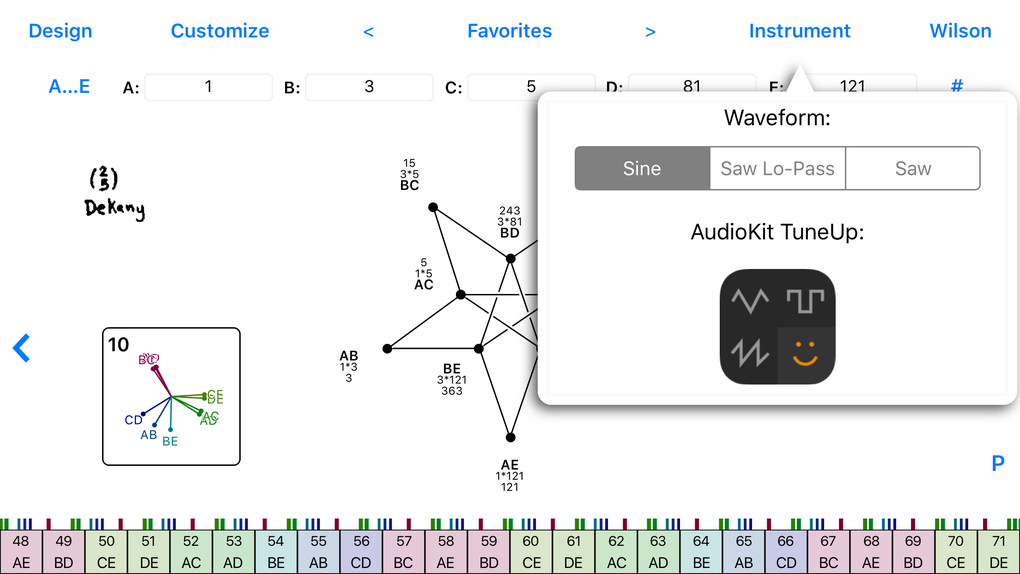
Erv Wilson, a largely self-taught American-Mexican theorist living in Los Angeles, was during the 1970s producing some of the most original and unconventional theoretical work in the history of tuning. Wilson corresponded with a small circle of composers and theorists — including Lou Harrison and later Kraig Grady — and circulated his ideas almost entirely in hand-drawn diagrams and typed letters rather than published papers, which kept him invisible to mainstream academia while making him something of a legendary figure in the underground microtonal world. His concepts were both wide-ranging and deeply original. His Combination Product Sets (CPS) — particularly the hexany, eikosany, and dekatesserany — described elegant, symmetrical structures within just intonation that had no analog in prior theory, arising not from scales in the traditional sense but from all possible products of chosen sets of harmonic factors. His Moments of Symmetry described a family of scales generated by a single interval repeated within a period, capturing in a unified framework the structure of the diatonic scale, the pentatonic scale, and countless others. His Scale Tree (the Stern-Brocot tree applied to musical intervals) mapped the relationships between all possible generator ratios in a single geometric structure. Wilson’s work resisted easy summary and would take decades to be fully appreciated, but it stands as one of the most fertile bodies of original thought in twentieth-century music theory.
The 1980s: Academic Recognition, Computer Music, and the Xenharmonic Community
The 1980s saw microtonal music gain footholds in academic institutions while simultaneously developing a grassroots, non-academic community of practitioners.
The rise of MIDI (Musical Instrument Digital Interface), standardized in 1983, was initially a setback for microtonality — MIDI was designed for twelve-tone equal temperament and its pitch bend messages were often clunky means of achieving other tunings — but it also made the global circulation of microtonal music and theory possible in ways that had not existed before. Composers could now share music as data files, and the personal computer began to make pitch calculation and score preparation tools accessible.
La Monte Young was refining and performing The Well-Tuned Piano in extended, rare, and legendary performances. The piece’s harmonic structure — built around 7-limit just intonation — produced resonance patterns and interference beats of extraordinary density and beauty, and recordings circulated among musicians with almost underground intensity.
Kyle Gann, a young American composer and critic, was encountering the work of Ben Johnston and La Monte Young and beginning the career as advocate, analyst, and composer that would make him one of the most important figures in American microtonal life. Gann was drawn particularly to the just intonation tradition and to the expressive possibilities of the 7th and 11th harmonics, which introduce entirely new shades of consonance and dissonance.
Harry Partch had died in 1974, but his instruments were maintained and his music was performed by ensembles dedicated to his legacy. The Harry Partch Institute (later Ensemble) kept his unique instrument collection together and continued to perform his works. His Delusion of the Fury (1966–69), a large theatrical work based on Japanese Noh theater and an African folk tale, received important productions in the 1980s.
In Europe, the spectral school was gaining considerable prestige. Grisey’s Espaces Acoustiques cycle (1974–1985) was completed and recognized as a major contribution to late twentieth-century orchestral music. Murail was composing works like Gondwana (1980) and Désintégrations (1982) that used computer analysis to generate harmonic fields of great complexity and sensory richness. The spectralists were careful to distinguish their approach from atonality or serialism — they were not anti-tonal but “supra-tonal,” grounding harmony in acoustic physics rather than abstract number systems.
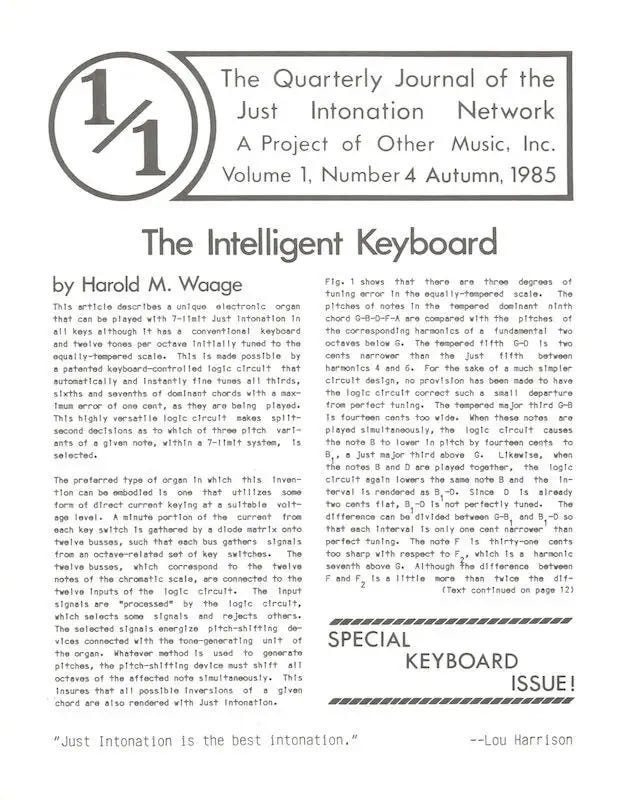
The 1/1 Journal, published by the Just Intonation Network founded by David Doty in San Francisco, became a central organ for the American just intonation community. It published theoretical articles, interviews, and scores, and helped connect composers who often worked in considerable isolation.
Easley Blackwood Jr. (1933–2023), a professor of music at the University of Chicago who had studied with Messiaen, Hindemith, and Nadia Boulanger, made one of the most systematic and analytically rigorous contributions to microtonal music of any composer of his generation.
Funded by a grant from the National Endowment for the Humanities in the late 1970s, Blackwood undertook a comprehensive investigation of all equal temperaments from 13 to 24 notes per octave, composing one etude for each to illustrate the distinctive harmonic and modal properties of the tuning. The resulting Twelve Microtonal Etudes for Electronic Music Media, Op. 28, released in 1980, was performed on a Polyfusion synthesizer and accompanied by a detailed theoretical commentary. Blackwood’s approach was unusual in the microtonal world for being overtly conservative in aesthetic: rather than celebrating the alienness of non-twelve tunings, he was interested in finding the points at which conventional tonal harmonic logic — subdominants, dominants, tonics, recognizable diatonic scales — could still operate within them, likening his project to writing a “sequel” to Bach’s Well-Tempered Clavier.
Blackwood’s 1985 theoretical treatise The Structure of Recognizable Diatonic Tunings provided the mathematical underpinning for this approach, analyzing the conditions under which diatonic scales with familiar interval relationships can exist in any tuning system. The Etudes were reissued on CD in 1994 alongside a Fanfare in 19-note Equal Tuning and a Suite for Guitar in 15-note Equal Tuning performed on a specially refretted instrument. Despite Blackwood’s mainstream academic credentials and the accessibility of his aesthetic, the work remained largely unknown outside specialist circles until internet-era microtonal communities rediscovered it enthusiastically.
The 1990s: The Internet, New Instruments, and Global Connections
The 1990s transformed the social landscape of microtonal music through the internet. Mailing lists, early websites, and eventually newsgroups allowed composers and theorists in different countries to exchange ideas in real time for the first time. The Tuning List, a mailing list founded in 1998, became a hub of extraordinarily detailed theoretical discussion, attracting hundreds of participants from across the world who argued about temperament, ratio theory, notation, history, and perception with a fervor that sometimes resembled a scholarly cult and sometimes a religious schism.
Paul Erlich, a young physicist and music theorist, was one of the central figures on the Tuning List, developing important theoretical tools including the concept of “harmonic entropy” (a measure of the perceived dissonance of an interval based on its approximations to simple ratios) and the “Middle Path” paper that explored the theoretical relationships between different temperaments. Erlich’s work, and that of other theorists on the Tuning List — Gene Ward Smith, Dave Keenan, Graham Breed, and many others — represented a new kind of microtonal theory: internet-collaborative, mathematically sophisticated, and disconnected from any single compositional aesthetic.
On the Tuning List, the concept of Regular Temperament Theory — a systematic framework for classifying and relating all equal and non-equal temperaments based on their approximation of just-intonation intervals — began to take shape in this period, though it would be more fully formalized in the 2000s. The names of temperaments proliferated: “meantone,” “schismatic,” “miracle,” “magic,” “pajara,” “orwell,” “mavila” — each denoting a different mapping of the overtone series onto some grid of generators and periods.
Marc Sabat and other Canadian composers were developing highly sophisticated just intonation notation systems. The Extended Helmholtz-Ellis Just Intonation Pitch Notation, developed by Sabat and Wolfgang von Schweinitz in the late 1990s and early 2000s, systematically represented all prime harmonics up to at least the 61-limit using dedicated accidentals, providing a notational infrastructure for music of extreme just-intonation complexity.
Georg Friedrich Haas, the Austrian composer, was developing his mature style in the 1990s, drawing on microtonality in ways influenced by Scelsi, the spectralists, and his own engagement with the overtone series. His string quartets and orchestral works use microtonal harmonics to create extended sound worlds of great density and strangeness. in vain(2000), for 24 instruments, composed in the early years of the next decade, would become one of the signature works of the early 2000s.
The Bohlen-Pierce scale, which had been developed independently by Heinz Bohlen and John Pierce in the 1970s, attracted renewed and sustained attention in the 1990s as its unusual consonances and non-octave structure appealed to composers looking for genuinely alternative harmonic worlds. A small but dedicated community of composers and instrument builders began actively working within it.
A small but notable footnote to 1990s microtonal history belongs to the world of video game music. “Trees in the Depths of the Earth”, composed by Jun Ishikawa and Dan Miyakawa for Kirby Super Star (Nintendo Super Famicom/SNES, 1996), is a brief but striking piece of ambient game music that deploys unmistakable microtonal intervals — pitches falling between the standard semitones of twelve-tone equal temperament — to evoke an eerie subterranean atmosphere. Ishikawa, HAL Laboratory’s senior composer and the primary musical voice of the Kirby series, appears to have used the SNES sound hardware’s pitch-shifting capabilities deliberately to produce these effects. The piece is a rare example of microtonality appearing in mass-market popular culture not as a theoretical statement but as an expressive atmospheric tool, reaching millions of players who had no framework for what they were hearing, and it has attracted devoted attention from microtonal enthusiasts in the internet era.

The 2000s: Formalization, New Notation, and a Global Community
The 2000s saw microtonal theory reach a new level of mathematical formalization and global community. Regular Temperament Theory, built on the mathematical framework of linear temperaments and vals (mathematical objects that describe how a temperament maps prime intervals), was developed into a comprehensive taxonomy by theorists working collaboratively online. Gene Ward Smith, Dave Keenan, Graham Breed, Herman Miller, and many others contributed to a body of theoretical work that sorted the infinite space of possible tuning systems into named and classified categories, each with its own harmonic logic, characteristic intervals, and historical relationships.
Georg Friedrich Haas completed in vain (2000) and limited approximations (2010, premiered 2011), a concerto for six pianos each tuned a sixth-tone apart, creating a harmonic resource of 72 equally spaced pitches per octave. His opera Melancholia (2008, after Lars von Trier) used microtonality as an expressive language for psychological extremity. Haas became one of the most acclaimed living composers of art music, his mainstream recognition reflecting a broader normalization of microtonal technique in European new music.
Marc Sabat and Wolfgang von Schweinitz published the Extended Helmholtz-Ellis JI Pitch Notation in its more complete form, and it was adopted by a growing number of composers and performers as the standard notation for just intonation music. The notation system was meticulous, open-source in spirit, and extensible — a model of collaborative theoretical infrastructure.
Toby Twining, Michael Harrison, Kyle Gann, and other American composers were producing mature bodies of work in just intonation. Harrison’s Revelation for piano (2001), performed on a piano specially tuned to 7-limit just intonation, received wide acclaim. Gann’s Long Night (1998–2001), a 2-hour work for two pianos in just intonation, was a meditative monument to the tradition stretching back through Young and Partch to Helmholtz.
Kraig Grady, an American composer who had been a close associate of Erv Wilson and a central figure in the Los Angeles microtonal scene, was developing his concept of Anaphoria — an imaginary island civilization whose music, language, and cosmology he used as a frame for his own compositional world, drawing on Wilson’s just intonation structures (particularly the Combination Product Sets Wilson had developed), non-Western musical philosophies, and an aesthetic of sustained, ritualistic sound. Grady was also one of the most dedicated advocates for Wilson’s largely unpublished theoretical work, helping to keep Wilson’s ideas in circulation and building instruments and compositions that demonstrated their musical potential.
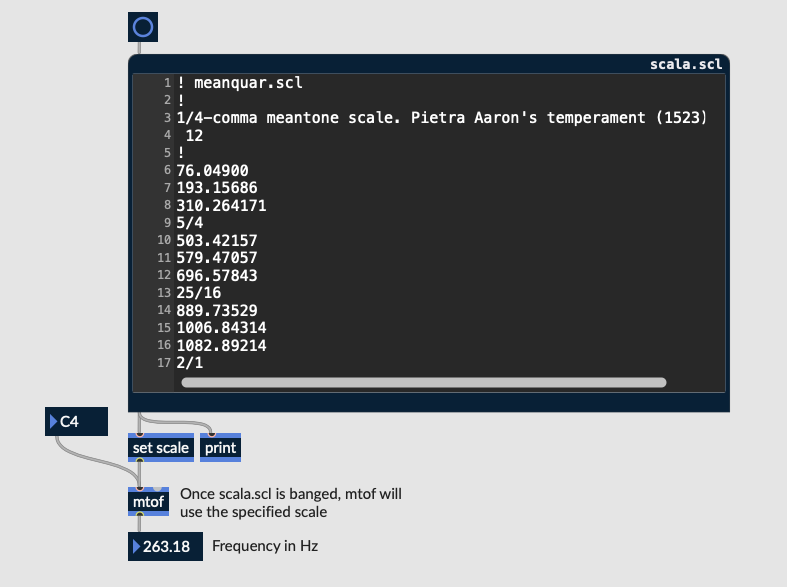
The computer software Scala, developed by Manuel Op de Coul, was by the 2000s the universal tool of the microtonal community — a free program that could calculate, compare, and analyze any tuning system, generate MIDI files in arbitrary tunings, and access a database of thousands of named scales from across the world. Scala gave anyone with a computer access to tools that had previously required advanced mathematics and custom hardware.
The 2010s: Microtonality Mainstream, New Software, and Renewed Diversity
By the 2010s, what had been a marginal and technically demanding pursuit was becoming, if not mainstream, then at least a recognized and growing strand of contemporary music practice. Several converging forces drove this: better software, more widespread music theory education online, a renewed interest in non-Western tuning traditions, and the influence of electronic music production culture.
The Xenharmonic Alliance became a community hub where theorists, composers, and instrument builders — many of them entirely outside academic institutions — shared work, debated theory, and built collaborative resources.
One of those resources, the Xenharmonic Wiki, documented hundreds of tuning systems, temperaments, and scales with a thoroughness that no single institution could have achieved.
Software development accelerated. Max/MSP, SuperCollider, Pure Data, and Ableton Live (with microtonal plugins) made arbitrary tuning systems accessible to any musician with a laptop. The MTS-ESP standard (MIDI Tuning Standard — ESP, developed by Odessa Sound and others) began to allow DAW-integrated microtonal tuning across compatible synthesizers, solving a longstanding practical problem. LMSO (Little Miss Scale Oven), Scale Workshop, and other web-based tools made scale design and exploration immediate and intuitive.
In the realm of new music composition, a generation of younger composers — Chaya Czernowin, Klaus Lang, Enno Poppe, Bernhard Gander, Catherine Lamb — were treating microtonality not as a special technique requiring justification but as a natural part of a compositional vocabulary. Catherine Lamb’s work, in particular, drew on combination tones, just intonation, and the acoustic physics of small-number ratios to create a music of extraordinary perceptual subtlety, performed by ensembles trained to hear and produce fine distinctions in pitch with great precision.
The Ensemble Nikel, Quatuor Bozzini, Elision Ensemble, and other new music groups were commissioning and performing microtonal works as part of their regular programs. The idea that performing in just intonation or other non-equal temperaments required exotic instruments or was practically impossible for standard ensembles was steadily being dismantled by the accumulated experience of thousands of performances.
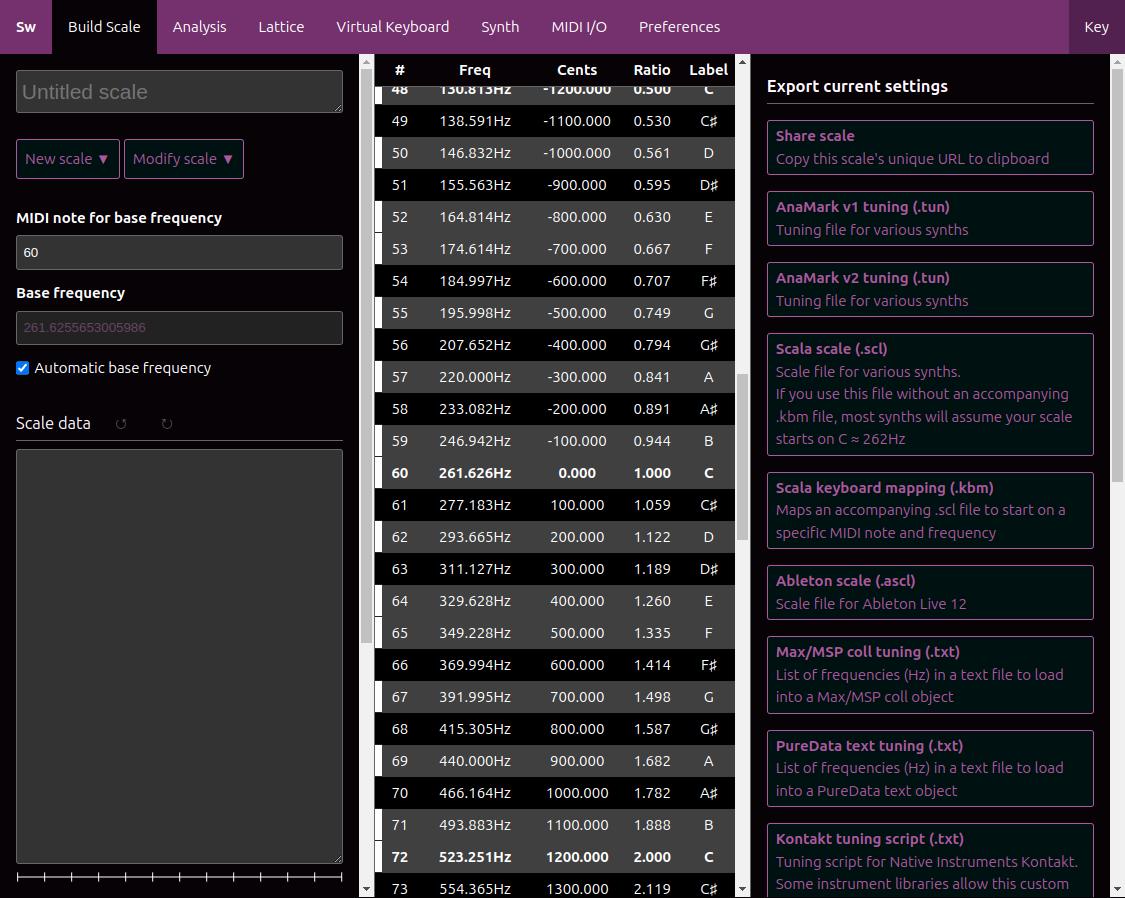
Sevish (Sean Archibald), a London-based electronic musician, was among the most prominent online microtonal artists of the decade, reaching audiences far outside the new music world. Sevish worked across a broad palette of tunings — particularly 22-EDO, which became his signature system, alongside 15-EDO, 10-EDO, 13-limit just intonation, and the Bohlen-Pierce scale — weaving them into drum and bass, house, and ambient music with high production quality and an explicit ambition to make microtonality accessible to listeners who had never encountered it. He also founded Scale Workshop, the web-based scale design tool, and founded the Now & Xen podcast about microtonal music.
Cryptic Ruse (Deja Igliashon), a Portland-based experimental metal project, built a reputation for applying equal divisions of the octave to metal idioms, with albums like Chains of Smoke (2014) using 13-EDO, 15-EDO, and 23-EDOto generate harmony systems with a distinctly alien timbral character, and later works exploring 17-EDO and 22-EDO in atmospheric doom and progressive metal contexts. The Xenharmonic Alliance Facebook group and associated YouTube channels accumulated tens of thousands of subscribers interested in microtonal music not as an academic project but as a practical creative tool.
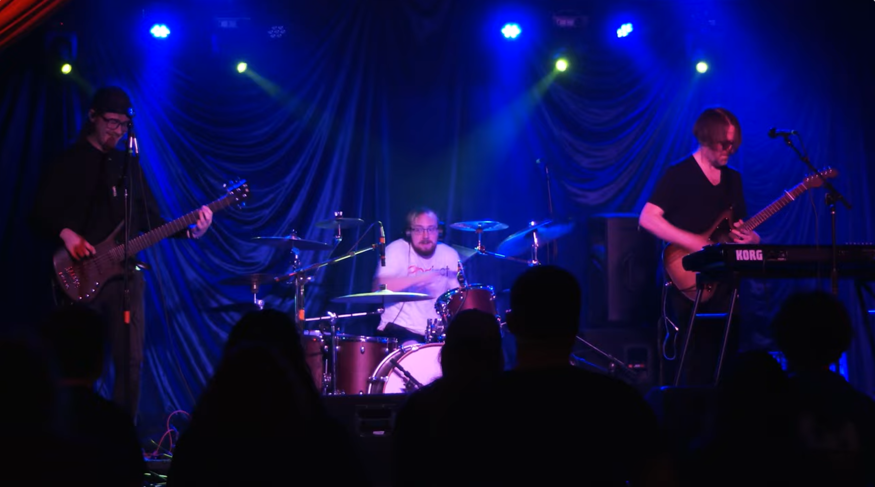
The Mercury Tree, a Portland-based progressive rock band led by guitarist Ben Spees, became one of the most sustained and ambitious microtonal acts in rock music during this period. Beginning with quarter-tone experiments on their 2014 album Countenance, they moved through Carlos Alpha tuning on Permutations (2016) before committing to 17-EDO as their primary tuning system from Spidermilk (2019) onward, with the 2023 album Self Similar also exploring 34-EDO and 68-EDO. Their 2018 collaborative EP Cryptic Tree with Cryptic Ruse’s Igliashon Jones brought additional theoretical depth to their work, and their practice of commissioning and playing custom-fretted guitars in specific equal temperaments demonstrated that microtonal rock was possible at a high level of compositional sophistication.
Brendan Byrnes, a Los Angeles composer, guitarist, and CalArts MFA graduate who had studied just intonation with Wolfgang von Schweinitz, released Micropangaea in 2012 to considerable acclaim within the microtonal community. The album was a concept work in which each of its eight tracks was composed in a different tuning system — ranging across various EDOs and just intonation scales — each representing an imaginary location on a fictional supercontinent. The follow-up Neutral Paradise leaned heavily on 22-EDO, which Byrnes identified as a favorite for its capacity to provide familiar-sounding harmonic structures alongside neutral intervals, 7-limit and 11-limit harmonics, and quarter-tone-like inflections. Byrnes’s music was noted for making microtonal harmony immediately sensory and engaging rather than abstract, and he became an influential figure in the online xenharmonic community.
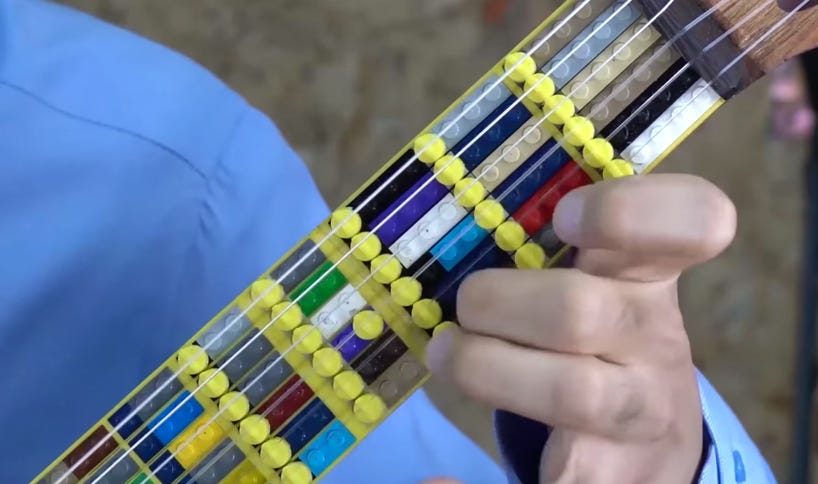
Tolgahan Çoğulu, a Turkish classical guitarist and professor at Istanbul Technical University, had designed his adjustable microtonal guitar in 2008 — an instrument whose frets sit in individual channels under each string and can be repositioned or supplemented to produce any tuning system, making it possible to play Ottoman maqam music, Anatolian folk music, just intonation, and historical temperaments on a single instrument. By the 2010s he was performing internationally at universities and festivals in nearly thirty countries. He won first prize at the Guthman Musical Instrument Competition at Georgia Tech in 2014, bringing wide attention to the instrument, and built a repertoire through commissions from composers worldwide. His work represented a distinctive approach to the microtonal project: not the invention of new systems for their own sake, but the recovery of non-Western tuning traditions that equal temperament had rendered unplayable on the guitar, and the construction of a bridge between Ottoman and Western classical practice. A later iteration co-designed with his son Atlas using 3D-printed Lego-compatible fretlets won the People’s Choice Award at the 2021 Guthman Competition.
King Gizzard and the Lizard Wizard, the prolific Australian psychedelic rock band, brought microtonal music to a genuinely mass audience with Flying Microtonal Banana (2017), subtitled Explorations into Microtonal Tuning, Volume 1. The album was made after guitarist Stu Mackenzie acquired a custom-built guitar with additional frets dividing the octave into 24 equal steps (quarter-tone tuning), and the band gave each member a modest budget to have their instruments similarly modified. Inflected by Turkish and Persian musical sounds — with zurna, microtonal harmonica, and the bağlama alongside guitar and bass — the album reached number two on the Australian charts and charted on the US Billboard 200, an almost unprecedented achievement for openly microtonal music. The band returned to microtonal territory with K.G. and L.W. (both 2020), completing their trilogy of microtonal explorations.
Adam Neely, a New York bassist, composer, and YouTuber with over a million subscribers, became an important conduit between the microtonal world and a broad online music-theory audience. Though not primarily a microtonal composer, Neely discussed microtonality in multiple widely-watched video essays, enthusiastically recommended Sevish as an entry point for listeners curious about xenharmony, and situated microtonal practice within his broader project of expanding what general audiences understood music theory to encompass. His influence as an educator helped route significant new audiences toward the microtonal community.
Dolores Catherino, an Alaska-based composer and multi-instrumentalist whose academic background spans undergraduate music study and graduate medical training, emerged in the 2010s as one of the most distinctive voices in high-density microtonal composition. Catherino developed what she calls polychromatic music — a system of composing with pitch palettes of 72 or 106 equal divisions of the octave, which she frames through an analogy to visual perception: just as color vision resolves a continuous spectrum into rich, differentiated experience, polychromatic pitch systems allow the ear to navigate a far richer continuum of harmonic color than the twelve-tone scale permits. Her primary instrument was the Tonal Plexus, a specialized isomorphic keyboard capable of rendering such fine pitch divisions, and her compositions — atmospheric, ambient, and harmonically dense — were distributed through Bandcamp and YouTube to audiences in over 175 countries. A TEDx Talk she delivered in 2016 on polychromatic music, asking what music would sound like with 106 notes per octave, reached wide audiences and became one of the more effective introductions to extreme high-density microtonality for general listeners. Catherino’s theoretical writing, published through her Polychromatic Music platform, argued for a paradigm shift away from what she called “monochromatic” music — the twelve-tone system’s coarse linear grid — toward dynamically relational, high-resolution pitch environments capable of engaging the full sensitivity of human auditory perception.
Erv Wilson, who had been quietly developing his extraordinary body of theory since the 1960s and 1970s, was by the 2010s finally receiving wider recognition. His Combination Product Sets, Moments of Symmetry, and Scale Tree — long circulated only in handwritten and typed documents among a small circle — were being transcribed, digitized, analyzed, and taught by a new generation. Kraig Grady remained the most tireless advocate for Wilson’s ideas, maintaining an archive of his writings and building instruments and compositions that made the theory audible. The online microtonal community embraced Wilson’s concepts with particular enthusiasm, finding in them a deep theoretical framework that was rigorous yet wholly independent of the academic mainstream. Wilson died in 2016, but the posthumous documentation and extension of his work has continued to accelerate.
Chuckk Hubbard and Cris Forster published major theoretical works. Forster’s Musical Mathematics (2010) was a comprehensive, 900-page treatment of tuning theory from ancient Greek mathematics through contemporary just intonation, written with a scientist’s precision and a musician’s love of the concrete.
The 2020s: Democratization, Synthesis, and New Frontiers
The 2020s have, so far, represented a moment of synthesis and broad democratization in microtonal music. The global disruptions of the COVID-19 pandemic paradoxically accelerated the online community’s growth, as musicians who could not perform together in person turned to internet-based collaboration, tutorials, and theoretical discussion. YouTube channels dedicated to microtonal music accumulated substantial followings, and video essays explaining the mathematics of tuning, the history of just intonation, and the aesthetics of different temperaments reached audiences of hundreds of thousands.
The theoretical work of the Tuning List era is being consolidated and taught more widely. Regular temperament theory, once the province of a small group of obsessive specialists, is now the subject of accessible online tutorials and YouTube explanations. Xenharmonic Wiki continues to grow. The diversity of approaches — just intonation, regular temperament, spectral harmony, non-octave scales, procedurally generated scales, microtonally inflected pop and electronic music — is greater than at any previous moment.
Mainstream contemporary composers continue to deepen their engagement with microtonality. Georg Friedrich Haasremains one of the most performed living composers in Europe. Caroline Shaw, Nico Muhly, and other composers with wide audiences occasionally engage with just intonation and spectral harmony. The Diotima Quartet, the JACK Quartet, the Arditti Quartet, and other string ensembles have developed an extraordinary collective expertise in performing music with microtonal notation to a standard that would have seemed unimaginable fifty years ago.
Microtonal music outside the Western art music tradition continues to assert its importance. The legacy of Indian classical music, maqam traditions of the Arab world and Turkey, Persian dastgah, and Indonesian gamelan — all of which use interval structures incompatible with twelve-tone equal temperament — is increasingly recognized not as exotic material to be borrowed but as a set of fully developed, theoretically sophisticated traditions with their own internal logic. Cross-cultural collaboration between Western microtonal composers and musicians trained in these traditions has become more common and more musically serious.
Scale Workshop 2.0 and successor tools have made scale design available in a browser with no downloads, and the integration of microtonal tuning into software synthesizers and DAWs is more complete than ever before. Surge XT, Vital, Pianoteq, and other popular synthesizers support MTS-ESP or other microtonal tuning protocols natively, making it possible to compose in arbitrary temperaments with production-grade instruments without writing any code.
On the hardware side, the Lumatone Isomorphic Keyboard — unveiled at the NAMM Show in January 2020 and shipped to its first customers later that year — represented the most significant new microtonal keyboard instrument in decades. The Lumatone is a large MIDI controller featuring 280 hexagonal, color-illuminated keys arranged in a rising isomorphic grid, designed and built in Toronto by industrial designer Dylan Horvath and a small team of collaborators including Garnet Willis and Bo Constantin. Its concept drew on a centuries-old tradition of generalized keyboard design — instruments whose note layouts repeat identically in every key so that a given chord or scale always has the same fingering regardless of transposition — but realized it with full individual programmability: every key can be assigned any MIDI note number and channel, any tuning, and any RGB color, allowing the instrument to be mapped to 31-EDO, 22-EDO, just intonation, the Bohlen-Pierce scale, or any other system the player devises. The color-coding feature proved particularly significant for microtonalists: it allowed the “notes between the notes” to be visualized on a physical keyboard surface in an intuitive, spatially consistent way for the first time. The Lumatone had antecedents in the Terpstra Keyboard, an earlier prototype developed through a 2013 Indiegogo campaign with backing from Joel Mandelbaum and Johnny Reinhard among others, which had never reached production. The production Lumatone found a devoted user community, including prominent xenharmonic musicians like Sevish and Levi McClain who demonstrated its capabilities extensively, and it stood as the clearest sign yet that the practical infrastructure for microtonal performance was catching up with the theoretical ambitions of the previous century.
L4MPLIGHT, a Japanese microtonal composer and conlanger active primarily online, represents one of the more unusual intersections the 2020s microtonal community has produced: a practice in which microtonal music and constructed languages (conlangs) are developed together as parallel expressive systems, with tuning choices and invented phonologies informing each other. Working in a range of non-twelve tunings and distributing music through SoundCloud and YouTube, L4MPLIGHT is a reminder that the global, internet-native microtonal community now extends far beyond its historical centers in North America and Europe, and that the reasons artists are drawn to alternative tuning systems continue to multiply and diversify.
Zhea Erose (Amelia Huff), a Los Angeles-based composer, theorist, and performer, represents one of the most distinctive voices to emerge from the online microtonal community in the 2020s. Working at the intersection of just intonation, electronic production, and a self-described “harmonic witch” aesthetic that blends ambient, dream-bass, and experimental electronica, Erose has developed her own theoretical framework centered on what she calls “near equal just intonation”(NEJI) — a method of constructing scales from high-prime integer ratios arranged to approximate equal-division spacing while retaining the acoustic distinctiveness of just intervals. Her tuning systems, including her novemdecimal (19-prime-based) scales with extensions into the 11th and 13th harmonics, are among the most harmonically complex being used in contemporary composition. Works like WXTCHCRXFT (2020) and Eurybia (2020) demonstrated that microtonal just intonation could coexist with electronic production aesthetics in ways that reached listeners far outside the academic new music world. Erose has also been a significant popularizer of microtonal ideas through YouTube, where she has explained tuning theory to large audiences, and her parallel work as a voice educator through her TransVoiceLessons channel has made her a prominent figure across multiple communities simultaneously.
Levi McClain, a Pennsylvania-based bassist, composer, music theorist, and content creator who began making videos in 2021, became one of the most effective popularizers of microtonal ideas for general audiences in the early 2020s, reaching tens of thousands of followers across YouTube, TikTok, and Instagram. McClain’s primary advocacy is for 31-EDO, which he frames not as an exotic departure from Western music but as its natural extension — a system that preserves and enriches familiar harmonic logic while adding neutral thirds, septimal intervals, and the diesis (the small interval by which 31-equal distinguishes between, for instance, C♯ and D♭, collapsed to unison in twelve-tone equal temperament). His video essays range from accessible introductions to 31-tone harmony to more adventurous investigations of polymicrotonality (stacking multiple tuning systems simultaneously), double modes (a framework Zhea Erose developed for navigating 31-EDO’s expanded modal resources as extensions of familiar diatonic scales), and the historical recovery of ancient Greek enharmonic genera. Because standard instruments cannot play 31-EDO, McClain has built his own soft-synth instruments and workflows, and the hands-on, problem-solving quality of his content — grounded in the practical question of how to actually make this music — has connected with audiences who find purely theoretical treatments opaque.
The history of microtonal music is, in a sense, the history of a permanent revolution — a persistent refusal to accept that any particular division of the pitch continuum is natural, necessary, or final. From Helmholtz’s vibrating strings to Partch’s cloud-chamber bowls, from Hába’s quarter-tone opera to La Monte Young’s just-tuned piano resonating for hours in a loft on Church Street, from Grisey’s computer-analyzed spectra to the xenharmonic producer tuning their laptop synthesizer in 17-equal in a bedroom studio, microtonal music has insisted that the universe of sound is larger, stranger, and more beautiful than any twelve notes can contain. That insistence shows no signs of quieting.
Summary timeline
I. 1850s–1900: Theoretical & Scientific Foundations
The movement begins with physicists and acoustic theorists proving that the standard 12-tone equal temperament (12-TET) is a mathematical compromise rather than a natural law.
- 1863: Hermann von Helmholtz publishes On the Sensations of Tone, analyzing the overtone series and just intonation. He argues that 12-TET sacrifices the “purity” of natural harmonic intervals.
- 1885: Alexander John Ellis invents the cent (1/100th of a semitone) as a universal unit to measure pitch, allowing for the precise comparison of any tuning system.
- 1889: The Paris Exposition exposes Western composers like Debussy to Javanese gamelan, proving that non-Western scales (like slendro and pelog) offer sophisticated alternatives to the piano’s grid.
- 1895: Julián Carrillo (Mexico) discovers the “Thirteenth Sound” (Sonido 13), beginning his lifelong exploration of sixteenth-tones.
II. 1900s–1930s: The First Pioneers & Custom Instruments
Composers move from theory to practice, building the first specialized instruments to house new scales.
- 1907: Ferruccio Busoni publishes Sketch of a New Aesthetic of Music, predicting electronic instruments and advocating for the division of the octave into 113 tones.
- 1919–1924: Alois Hába composes the first quarter-tone string quartet and establishes the first formal microtonal department at the Prague Conservatory.
- 1920s: Ivan Wyschnegradsky pioneers “pansonority” by using two pianos tuned a quarter-tone apart.
- 1930s: Harry Partch rejects Western tradition to develop a 43-tone just intonation system. He begins building a legendary ensemble of sculptural instruments (e.g., Cloud-Chamber Bowls) to perform his works.
III. 1940s–1970s: Expansion, Spectralism, & “Xenharmonics”
The movement bifurcates into mathematical systems (EDO) and acoustic physics (Spectralism), while the US and Netherlands become hubs of innovation.
- 1940s: Dutch physicist Adriaan Fokker champions 31-TET (31-tone equal temperament) and builds a 31-tone organ, bridging the gap between just intonation and equal temperament.
- 1960s: Ivor Darreg coins the term “xenharmonic” (from xenos, meaning strange/foreign) to describe music that consciously avoids the 12-tone sound.
- 1964: La Monte Young begins The Well-Tuned Piano, a minimalist landmark utilizing 7-limit just intonation.
- 1970s: Spectral Music emerges in Paris (Gérard Grisey, Tristan Murail). These composers use the acoustic analysis of sound spectra to dictate orchestral tuning, making microtonality inherent to the timbre itself.
- Late 1970s: Erv Wilson develops influential tuning theories, including Combination Product Sets and Moments of Symmetry, which remain foundational for modern theorists.
IV. 1980s–1990s: Digital Synthesis & Collaborative Networks
Computers remove the physical barrier of building instruments, while the early internet connects a fragmented community.
- 1980: Easley Blackwood Jr. releases Twelve Microtonal Etudes, systematically exploring equal temperaments ranging from 13 to 24 notes.
- 1983: The MIDI standard is introduced; while initially restricted to 12 notes, it eventually enables global data exchange for microtonal tuning.
- 1980s: Wendy Carlos uses synthesizers to experiment with asymmetrical scales (like Alpha, Beta, and Gamma scales) that lack traditional octaves.
- 1990s: Ben Johnston pushes the boundaries of string notation with his extended just intonation works.
- 1998: The Tuning List mailing list is founded, becoming the primary hub for Regular Temperament Theory (RTT), popularized by theorists like Paul Erlich.
V. 2000s–2020s: Democratization & the Global Subculture
Microtonality enters the mainstream through software accessibility, YouTube education, and popular music.
- Software Revolution: Tools like Scala, Scale Workshop, and the Xen Wiki allow any musician to retune digital instruments instantly and access a massive library of scales.
- Notation: The Extended Helmholtz-Ellis Just Intonation Pitch Notation is standardized, allowing complex microtonal scores to be read globally.
- Popular Music: Microtonality breaks into rock and electronic genres: King Gizzard & the Lizard Wizard release Flying Microtonal Banana (2017). Artists like Sevish (electronic), The Mercury Tree (prog-rock), and Brendan Byrnes (synth pop) gain dedicated followings.
- Hardware: New interfaces like the Lumatone Isomorphic Keyboard provide visual, programmable layouts for any imaginable tuning.
- Modern Education: Online creators like Adam Neely, Zhea Erose, and Levi McClain bring concepts like “just intonation” and “31-EDO” to millions of listeners.
Comments
Post a Comment