If you’re writing a Japanese-influenced soundtrack, you need to know about intonation and ornamentation
Subtle pitch inflections and timbral variation are the beating heart of traditional Japanese music
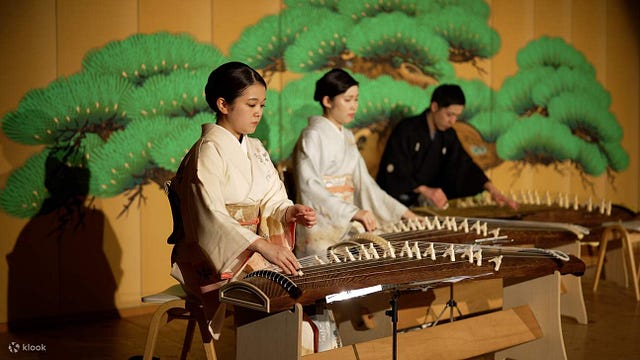
If you’ve ever scored a scene set in feudal Japan, a Zen garden, or a modern anime, you’ve probably reached for a pentatonic scale and called it a day. The notes were “right,” but something still sounded off — too clean, too Western, too karaoke. That’s because in traditional Japanese music (called Hōgaku, 邦楽), what makes the music actually feel Japanese isn’t the scale. It’s everything happening between and around the notes.
In Western 12-tone equal temperament, a C# is always a C#. Every semitone is exactly 100 cents, every note is a fixed point on a grid. Japanese traditional music doesn’t think this way. Pitch is a fluid spectrum, and a great performer shapes notes the way a calligrapher shapes a brushstroke — with weight, hesitation, breath, and direction. This article is a primer for composers and producers who want to write Japanese-influenced music that sounds like more than a sample-pack cliché.
The foundation: the In scale
Most of the “Japanese” sound you hear in film scores comes from the In scale (also called Miyako-bushi in koto and shamisen contexts). Its most famous example is the folk song Sakura Sakura. In one common form, starting on D, it’s: D — E♭ — G — A — B♭.
What gives the scale its dark, pensive quality is the way it’s organised: two clusters of close-together notes (D–E♭ and A–B♭) separated by perfect fourths. The half-steps create the tension; the wide gaps create the air.
Now here’s where the fact-checking matters. You’ll sometimes read that the second and sixth degrees are played “lower than a standard Western semitone.” That’s not really a feature of the scale itself — on paper, the In scale uses ordinary semitones. But in actual performance, especially on the koto, acoustic studies have shown that the minor seconds tend to drift toward a Pythagorean limma of around 90 cents (rather than 100). It’s not a deliberate microtonal choice so much as the natural consequence of tuning by ear, by simple ratios derived from perfect fifths and fourths instead of from a piano. This is the case for many just intonation traditions around the world.
So if you’re sequencing a koto sample library, leaving everything in 12-TET is “fine,” but bending the b2 and b6 down by 5–10 cents will get you closer to how an actual performer would sound.
What “microtonality” actually means here
A quick orientation for anyone who hasn’t crossed into microtonal territory before: a cent is 1/100th of an equal-tempered semitone. So 50 cents is exactly halfway between two adjacent piano keys. The smallest pitch difference most people can reliably hear is around 5–10 cents in melodic context.
When we talk about Japanese microtonality, we’re rarely talking about a fixed alternative scale. We’re talking about intonation (where exactly inside a note’s “zone” you place it) and ornamentation (how you approach, leave, and shade the note). Two players hitting the same nominal pitch can produce wildly different musical results depending on how they get there.
The shakuhachi: the king of microtonal expression
The shakuhachi (Japanese bamboo flute) has only five finger holes — four on the front, one on the back. Its default scale is a minor pentatonic with no half-steps. To play any other note, the performer has to physically alter the instrument’s behaviour. This is done through two complementary techniques:
Meri (メリ) lowers the pitch. The player tilts the chin downward, narrows the angle of the air stream, and often partially shades a finger hole with a finger. A “deep meri” (dai meri) can drop a note by a whole tone or more.
Kari (カリ) raises the pitch. The chin lifts and the air stream opens up.
The crucial thing — and this is what most fake-shakuhachi VST writing misses — is that meri isn’t just used to reach pitches outside the basic scale. A meri note has a completely different timbre from an open note. It’s breathier, slightly muffled, sometimes a bit rough at the edges. In the shakuhachi tradition, that “imperfect” sound isn’t a side-effect; it’s the desired aesthetic. Composers who treat meri purely as a pitch-bend miss half the point.
If you’re working with a sampled shakuhachi, look for libraries that distinguish between “open” and “meri” articulations, or layer in a touch of breath noise and high-end roll-off when you bend down to a non-pentatonic tone.
The koto: pressing the strings
The koto is a 13-string zither with movable bridges. The strings are tuned to a pentatonic scale (most commonly hira-jōshi, derived from the same Miyako-bushi material as the In scale), and you tune the instrument before each piece by sliding the bridges along the body.
Because the bridges are fixed during performance, you might assume the koto is locked to a single scale once you start playing. It isn’t. The left hand applies a technique called oshide (押し手, “pressing hand”). The player presses down on the string to the left of the bridge, increasing tension and raising the pitched note by anywhere from a few cents to a full semitone or whole tone, depending on how hard they press.
(Note: a common confusion in casual writing is to describe oshide as producing “lower” pitches. It’s the opposite — oshide always raises the pitch from the string’s tuned baseline. What you can do is press first, pluck, then release the pressure to produce a downward bend from the higher pitch back to the open one.)
Other left-hand techniques worth knowing:
Hiki-iro (引き色) — pulling the string to gradually lower the pitch by roughly a half-tone after plucking.
Yuri (ユリ) — gentle vibrato created by oscillating left-hand pressure (sometimes called yuriiro in older texts).
If you’re sequencing koto in a DAW, these techniques are essentially impossible to fake with standard pitch-bend on a 12-TET grid. You need either an MPE-compatible setup or a tool that lets you assign bends per note. We’ll come back to this.
The shamisen: sawari and the buzz that defines it
The shamisen is a three-stringed, fretless lute. Without frets, the player can place each note anywhere on the neck — meaning they have total control over intonation and can slide between pitches at will.
The instrument’s most distinctive feature is the sawari (さわり) — a buzzing, sympathetic resonance produced by the lowest string. Here’s how it actually works (and where the popular description often goes wrong): the lowest string sits slightly lower at the nut than the other two, so when it’s plucked, it vibrates against a small carved notch in the neck called the sawari yama. The buzz is a constant feature of the open low string, not something the player creates by precise fingering.
What’s true is that the sawari resonates sympathetically when the player plucks the upper strings. Notes that are simple harmonic ratios above the open low string — octaves, fifths, fourths — make the sawari ring out brilliantly. Notes that aren’t well-related ratios produce a duller resonance. Because equal-tempered intervals are slightly off from pure ratios, traditional shamisen players tend to gravitate toward just-intonation-leaning fingerings to maximise the buzz. So in a roundabout way, the original claim is right: precise pitch placement does affect the sawari, but indirectly, through sympathetic resonance with the open string.
The sawari is essentially the Japanese cousin of the Indian jivari on the sitar. If you’ve ever wondered why a “real” shamisen sounds so much fuller than a piano playing the same notes, that drone-buzz is the missing piece.
The aesthetic philosophy: Ma and the living note
Two concepts tie all of this together.
Ma (間) is one of the central ideas in Japanese aesthetics — the meaningful interval between things. In music it’s the silence between notes, but it’s not a “rest” in the Western sense of “absence of sound waiting to be filled.” It’s an active, charged space. The pitch-slides, the breath sounds before a note, the gradual decay of a koto string — these don’t fill the ma so much as define its edges. Composer Tōru Takemitsu built much of his work around this concept.
The “living note.” In Western tradition we often pursue purity: clean tone, stable pitch, no noise. Japanese tradition tends to invert this hierarchy. A pure sine-wave tone with no character is considered lifeless. A note with breath, buzz, vibrato, or pitch movement is alive. The breathiness of meri, the buzz of sawari, the fingertip noise on a shamisen string — these aren’t flaws being tolerated. They’re the music.
This is why playing Sakura Sakura on a piano always sounds slightly hollow. The piano is a magnificent instrument, but it can’t shade, slide, buzz, or breathe between notes. The emotional weight of Japanese music lives in exactly those things.
Composing this digitally: Entonal Studio
If you’re a digital composer wanting to write music that respects these traditions — even partially — you’ll quickly run into the limits of standard DAWs. Most of them assume 12-TET, with limited per-note pitch control, no native support for alternative tunings, and no easy way to load a Scala (.scl) file or apply just intonation to your existing soft synths.
Entonal Studio, made by Node Audio, is one of the more approachable solutions for this. It’s a microtonal plugin host: you load any AU/VST2/VST3 instrument inside it, and Entonal applies the tuning system of your choice via MTS-ESP or MIDI pitch-bend. So your favourite soft synths, sample libraries, or even hardware synths suddenly become microtonal.
A few features that are particularly relevant to Japanese-style scoring:
You can build custom scales by typing values in cents, frequency ratios, or EDO degrees. So you could build a koto-tuning preset where each note is a justly-tuned ratio above the tonic.
It supports importing Scala files, so any of the existing JI or Japanese-influenced scales floating around online can be dropped straight in.
A radial graph view lets you drag notes around visually rather than typing numbers, which is friendlier if you’re more of a “feel” composer than a math one.
It supports MPE per-note pitch-bends, which is the closest you’ll get to oshide-style note bending in a DAW workflow — you can glide between scale degrees on an MPE controller and have each finger bend independently.
There’s a 14-day free trial, the full version is £79, and there’s a 50% educational discount if you’re a student.
It’s not a magic button — you’ll still need to design the bends, breath layers, and timbral shading yourself — but it removes the biggest barrier, which is the rigidity of 12-TET in the rest of the modern music software stack.
Where to go from here
Reaching for a hira-jōshi tuning preset is the easy part. The harder, more rewarding part is internalising that in this tradition, the pitch grid is not the music. The music is in the slide into the note, the breath wrapped around it, the buzz that gives it body, and the silence that lets it land.
Listen to recordings before you write. Watanabe Kazuko on koto, Yamamoto Hōzan on shakuhachi, the Yoshida Brothers on shamisen — pay attention to how often the “main note” is actually a moving target. Then go back to your DAW with that in your ears, and the difference between Japanese-flavoured music and Japanese-influenced music will start to make itself heard.
Comments
Post a Comment