How to play microtones on a real keyboard today
If you make music on a keyboard, every key under your fingers is locked to a tuning system that has been the default in Western music for roughly two centuries: 12-tone equal temperament, or 12-EDO. Twelve evenly spaced steps to the octave, every semitone exactly 100 cents apart. It’s a great compromise — but it is a compromise, and there is a whole universe of music that lives outside of it.
That universe is what microtonalists (and the broader xenharmonic community) call home. It includes just intonation (tunings based on whole-number frequency ratios), historical meantone and well temperaments, non-Western maqam and gamelan systems, and modern equal divisions like 19-EDO, 22-EDO, 31-EDO, or even non-octave systems like Bohlen–Pierce.
The good news for the curious is that you don’t need to build a custom instrument from scratch. A surprising number of mainstream hardware synths and keyboards now support custom tunings — usually via Scala files (the open standard for tuning data), the MIDI Tuning Standard, or built-in scale editors. Here are nine of them, ranging from accessible polysynths to dedicated microtonal controllers.
A quick note on terminology: “microtonal” doesn’t necessarily mean “very small intervals” — it just means using pitches outside standard 12-EDO. A guitar tuned to quarter-comma meantone is microtonal. An oud playing maqam Rast is microtonal. So is a Wendy Carlos piece in her Alpha scale.
1. ASM Hydrasynth (Keyboard, Desktop, Explorer, Deluxe)
ASM’s Hydrasynth is a wave-morphing digital polysynth with one of the most usable interfaces in the business — a knob-per-function front panel, polyphonic aftertouch on the keyboard versions, and deep modulation. It also has serious microtonal chops. A firmware update added Scala file support, and you can store up to 32 user microtonal scales onboard, recalled per patch.
That makes the Hydrasynth one of the more complete microtonal-ready hardware synths under USD $1,500. The Explorer (37 keys, smaller form factor) is the cheapest entry point; the Deluxe is a dual-engine 73-key flagship if you want polyphony to spare.
Why it’s a good first microtonal synth: the workflow is genuinely straightforward, the polyphony is enough to actually play chords in unfamiliar tunings, and the polyphonic aftertouch makes microtonal chords feel expressive in a way that fixed-velocity synths don’t.
2. Korg Minilogue XD (and the Monologue / Prologue family)
Korg’s “logue” series synths all support per-key microtuning. The Minilogue XD ships with 23 preset tunings — including ones designed by Dorian Concept and Taylor McFerrin — plus six user scale slots and six user octave slots that you can edit on the synth or import via the Korg Sound Librarian.
Two caveats worth knowing about up front. First, each key can only be detuned by ±50 cents from its standard 12-EDO position. That means you can comfortably do tunings like 24-EDO (quarter tones), well temperaments, just intonation in 12 notes per octave, and most maqam-friendly Middle Eastern scales — but you can’t natively do something like 19-EDO or 31-EDO without remapping notes. Second, you’re stuck at 12 notes per octave on the keyboard.
Within those limits, this is one of the cheapest ways to get into custom tunings on real analog hardware, and Sevish’s Scale Workshop has a “Korg ‘logue” exporter that hands you ready-to-load tuning files. The Monologue (mono) and the discontinued-but-still-around Prologue (8/16-voice) work the same way.
3. Sequential Prophet-6, OB-6 and Trigon-6
Sequential’s modern analog flagship trio — the Prophet-6, the Oberheim-flavoured OB-6, and the three-oscillator Trigon-6 — all share the same approach to alternative tunings. Each one ships with one fixed 12-EDO tuning plus 16 alternative tuning slots that come pre-loaded with classics: Wendy Carlos’s Harmonic and Beta scales, Harry Partch’s 11-limit 43-tone just intonation scale, Dan Schmidt’s Pelog/Slendro, quarter-comma meantone, several historical well temperaments, and more.
All 16 slots are user-replaceable. You load new tunings as MIDI SysEx files, and there’s a healthy community archive of converted Scala files floating around. Like the Korg synths, the Prophet/OB/Trigon family limits you to 12 notes per octave on the keyboard, but the SysEx format itself supports full keyboard remapping, so larger scales work — they just spread across the keyboard differently than you’d expect.
If you want analog VCOs and warm filters more than you want exotic tunings, this family lets you have both without compromise.
4. Novation Summit and Peak
The Summit is essentially two Peak synths in one box with a five-octave keyboard, and both share the same microtuning implementation: 16 user-editable tuning tables with very high resolution (256 divisions per semitone, which works out to about 0.4 cents — way finer than the more common 1-cent grid). You can edit tuning tables directly on the synth itself or import Scala files via the Novation Components software, and both synths also respond to real-time MTS messages over MIDI.
That MTS support is genuinely useful: it means you can use a tool like ODDSound’s MTS-ESP (which has become the de facto modern standard for tuning DAWs and plugins) to drive the Summit or Peak from your computer, switching tunings on the fly without reloading anything on the synth. The same microtuning capability is also available on Novation’s affordable Bass Station II monosynth.
5. Waldorf Iridium (and Quantum)
The Iridium and its bigger sibling the Quantum are Waldorf’s flagship hybrid digital synths, with five different oscillator engines per voice (wavetable, granular, sample, virtual analog, and Kernel FM) and a touchscreen-driven interface. They support Scala file import, and a built-in tuning editor lets you generate any equal division of the octave with a few taps — handy if you want to sketch out an N-EDO tuning without leaving the instrument.
The Iridium comes in a desktop module, a keyboard version, and a stripped-down “Core” rack version; the Quantum is the keyboard model with hybrid analog filters. They are not cheap (the Quantum is the priciest synth on this list by a fair margin), but if you’re already shopping in this tier, the microtuning support is a meaningful bonus rather than an afterthought.
6. Yamaha Montage M (and MODX M)
Yamaha’s Montage M is the current flagship workstation — three sound engines (sample-based AWM2, FM-X, and the new AN-X virtual analog), 88/76/61-key versions, the works. It supports microtuning per Performance, and you can build and store custom user scales directly on the instrument. The cheaper MODX M shares the same engines and microtuning implementation in a lighter, more affordable package.
This route makes the most sense if you want microtonal capability inside a workstation that also handles your stage piano, organ, and orchestral duties. Yamaha’s microtuning has historically been popular with players working in maqam-based traditions for exactly this reason — it lets a working keyboardist switch between 12-EDO pop sets and quarter-tone Middle Eastern sets without changing instruments.
7. Lumatone
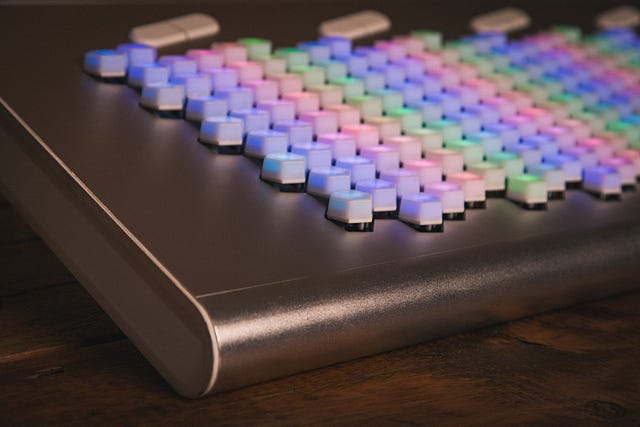
The Lumatone is the most “purpose-built for microtonality” instrument on this list. It’s a 280-key isomorphic MIDI controller laid out in a hexagonal grid (a modern descendant of the Bosanquet generalised keyboard idea), with every key individually addressable for MIDI note number, channel, and colour. Each key is velocity-sensitive with polyphonic aftertouch, and there’s a soft “Lumatouch” expression mode on top of that.
Because the layout is isomorphic — meaning the same chord shape gives you the same chord anywhere on the grid — it’s especially well suited to large EDOs (31, 41, 53 and beyond) where a normal piano keyboard simply runs out of keys. The community has built up a sizable library of mappings for popular tunings; you can also build your own in the Lumatone Editor software.
Two things to know: it ships from Toronto in small batches and is built to order (lead times can be months), and at around USD $3,995 retail it is firmly in the “serious commitment” tier. It is also a controller, not a sound source — you’ll need a microtonal-capable synth or softsynth to plug it into.
8. LinnStrument
Roger Linn’s LinnStrument is an MPE controller built around a grid of velocity-, pressure-, and X/Y-sensitive pads. By default the rows are tuned in fourths like the lower strings of a guitar, but the row offset is freely configurable from -16 to +16 semitones, and each row can be independently tuned to any pitch you like. Combined with MPE (MIDI Polyphonic Expression) and per-note pitch bend, that effectively lets the LinnStrument handle any tuning you can describe — including non-octave scales and full-keyboard non-12 EDOs.
The 200-pad LinnStrument and the smaller 128-pad version are both still in production and shipped direct from Roger Linn Design. Like the Lumatone, it’s a controller — pair it with an MPE-capable synth (Surge XT free, Logic, or any of the hardware synths above that support MPE) and you’re set.
9. Striso Board
The Striso board is a small wooden hexagonal MPE controller (61 silicone keys covering 3.6 octaves) with a layout closely related to the Wicki–Hayden note arrangement. It has built-in tunings for 12-EDO, 19-EDO, 31-EDO, 5-EDO, 7-EDO, quarter-comma meantone, Pythagorean, 7-limit just intonation, Indian shruti, Bohlen–Pierce, and user-defined scales. Deviations from 12-EDO are sent out as polyphonic pitch bends, so it works with any MPE-capable synth.
It also has a stereo audio output and a small internal synthesiser, so you can sit down and play microtonally without any other gear at all — which is the friendliest entry point on this list. At around €450–€540 it’s also priced accessibly compared to the Lumatone.
How to actually get sound out of a microtonal controller
The Lumatone, LinnStrument and Striso are MIDI controllers (with the Striso doubling as a small standalone instrument). To use them properly you need a sound source that understands custom tunings. Three easy options:
- One of the synths above — every Hydrasynth, Sequential, Novation Summit/Peak, Waldorf Iridium and Yamaha Montage M on this list will receive MTS or per-note MIDI tuning data and play in tune.
- A softsynth that supports Scala or MTS-ESP — Surge XT (free), Pianoteq, u-he Diva and Repro, Bitwig’s native synths, and many others.
- An MPE-capable synth — anything that handles per-note pitch bend will work, because MPE controllers can send the microtonal offsets as bends per voice.
Where to go next
Once you’ve picked a synth, the rabbit hole is enormous and friendly. Sevish’s Scale Workshop is a free browser tool for designing and exporting scales in every relevant format. The Xenharmonic Wiki has detailed pages on every EDO and tuning system you can think of, plus a curated hardware synths page. And the Xenharmonic Alliance Discord and Facebook group are excellent places to ask questions when you inevitably get stuck on something.
There’s never been a better time to leave 12-EDO behind for an afternoon and see what you find.
Comments
Post a Comment