A straightforward comparison of which ones are better and why
The Harmonic Series and Why Tuning Matters
Every musical note is more than a single frequency. When a string vibrates, a column of air resonates, or a vocal cord oscillates, the sound produced is actually a stack of frequencies layered on top of each other. The lowest of these is the fundamental — the pitch you consciously hear — but above it ring a series of quieter tones called overtones or harmonics. These follow a simple mathematical pattern: if the fundamental is frequency f, the harmonics ring at 2f, 3f, 4f, 5f, 6f, and so on. This ladder of frequencies is called the harmonic series.
What makes this musically important is that our brains have evolved to interpret intervals that align with these ratios as consonant — smooth, restful, in tune. Intervals that clash with them tend to feel rough or tense. So when we build a tuning system, we are essentially trying to pack as many of those consonant harmonic relationships as possible into a repeating scale.
Why 12 Notes?
The tuning system used almost everywhere in Western music today — 12-tone equal temperament (12edo) — divides the octave into 12 equal steps of 100 cents each. It has dominated music for a few centuries, and for good reason: it approximates several key odd harmonics with impressive accuracy.
The harmonic relationships that matter most are the odd-numbered ones. Even harmonics (2, 4, 8, 16…) are just octave doublings of the fundamental, and since we are dividing the octave equally, every equal division of the octave handles those automatically. So we can ignore them and focus entirely on the odd harmonics: 3, 5, 7, 9, 11, 13, 15.
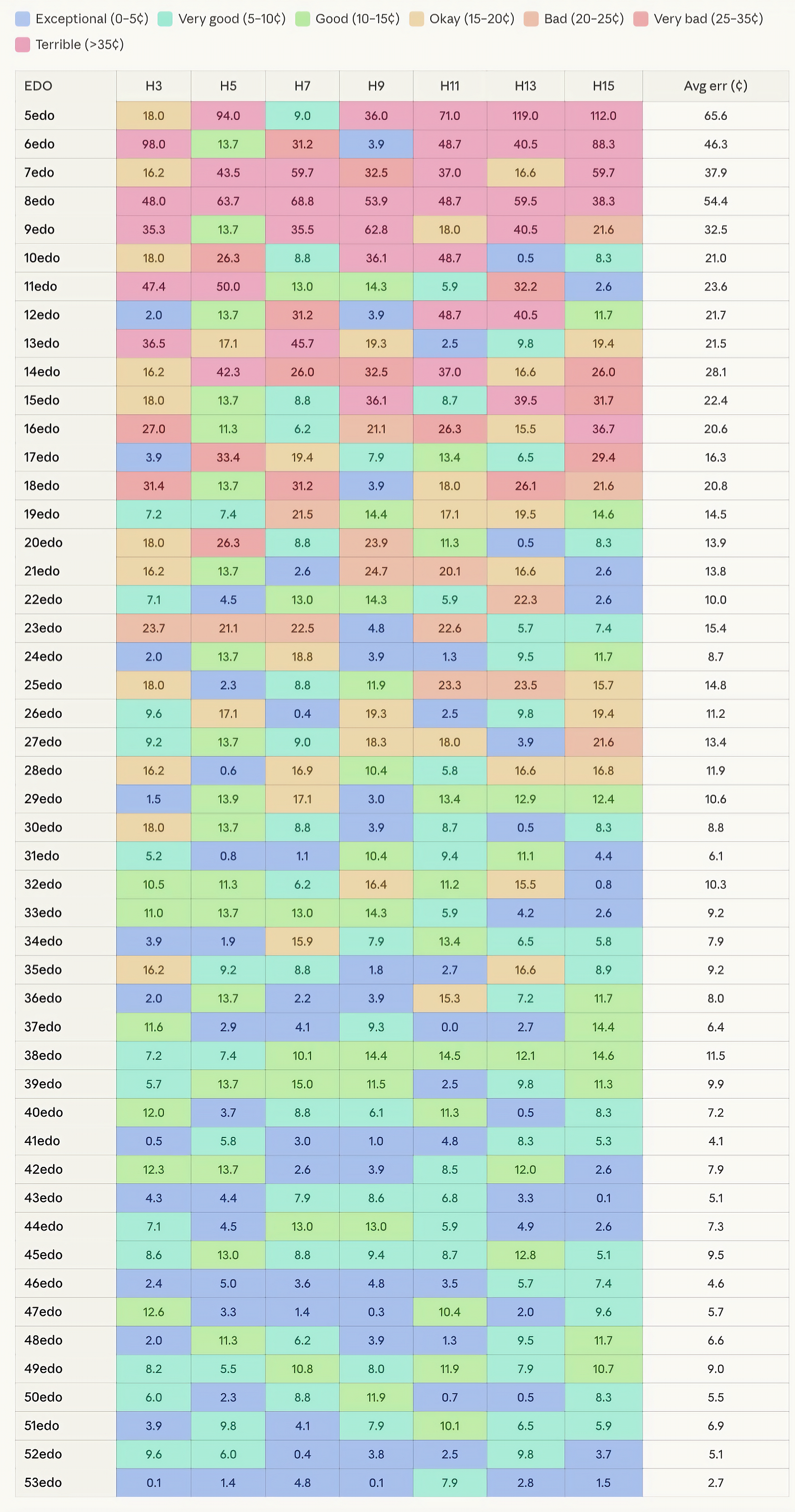
12edo hits harmonics 3, 5, 9, and 15 very well. The perfect fifth (harmonic 3) is only 2 cents flat. The major third(harmonic 5) is 14 cents sharp — a noticeable stretch, but one Western ears have long since accepted. Harmonic 9 (the major second, a compound perfect fifth) is similarly close. The result is a system that handles triadic harmony and tonal counterpoint beautifully.
But 12edo is poor at harmonics 7, 11, and 13. The seventh harmonic — a bluesy, mellow interval sitting between a minor and major seventh — is 31 cents away from the nearest 12edo pitch. That’s nearly a third of a semitone. Harmonic 11 is 49 cents off, almost exactly halfway between two notes, and harmonic 13 is 41 cents off. These harmonics simply don’t exist in 12edo in any usable form.
So what happens if we go looking for systems that fill in these gaps?
Exploring Beyond 12: The Logic of the Search
If we want to explore tunings beyond 12, we are looking for equal divisions of the octave that do a good job approximating a useful set of odd harmonics without requiring an unwieldy number of notes. A tuning with 200 notes per octave might theoretically hit everything, but it would be impossible to navigate on an instrument. The sweet spot is a system that is small enough to be practical but rich enough in harmonic colour to be musically expressive.
One more thing to keep in mind as we go: smaller harmonics are more important than larger ones. Harmonic 3 (the perfect fifth) is the most fundamental consonance in music after the octave. Harmonic 5 gives us the major third. Harmonics 7, 9, 11, 13, and 15 add increasingly exotic flavours. A tuning that handles harmonic 3 badly but harmonic 13 brilliantly is much less useful than one that gets harmonic 3 right and ignores everything else.
Five equal steps per octave gives each step 240 cents — nearly two and a half semitones. This is a pentatonic system, and while it sounds radically foreign to Western ears at first, it is not without harmonic logic. 5edo is a surprisingly decent 2.3.7 subgroup system: it approximates harmonic 3 (the fifth) with only 18 cents of error, and harmonic 7 with just 9 cents. For a five-note system, that is a meaningful amount of consonance. Harmonic 5 is a lost cause at 94 cents off — almost half a step — but 5edo was never trying to be a major-third system. Think of it as a melodic skeleton tuned to pure fifths and seventh harmonics.
Six equal steps gives 200 cents per step — a whole-tone scale. 6edo is a reasonable 2.5.9 subgroup system: harmonic 5 lands within 14 cents, and harmonic 9 is only 4 cents off. It is famously used in impressionist music for its dreamy, ambiguous quality. Its weakness is harmonic 3, which is nearly 98 cents flat — essentially a tritone instead of a fifth. That means traditional tonal harmony is entirely out of reach.
Seven equal steps, each 171 cents wide. 7edo is a good 2.3.13 subgroup system: harmonic 3 is only 16 cents away, and harmonic 13 is within 17 cents. It has a distinctive, vaguely Indonesian quality — not coincidentally, some gamelantunings float in this neighbourhood. Harmonic 5 is 44 cents off, so major thirds are not available, but the strong fifth gives it a melodic backbone.
Eight notes per octave, steps of 150 cents each. Bluntly: 8edo is extremely dissonant. Every harmonic of interest is badly approximated — harmonic 3 is 48 cents off, harmonic 5 is 64 cents off, harmonic 7 is a staggering 69 cents away. It has been explored by composers seeking extreme dissonance as an aesthetic goal, but there is very little natural consonance to find here.
Steps of 133 cents. 9edo recovers some dignity as a 2.5.11.15 subgroup system: harmonic 5 is only 14 cents off, harmonic 11 is 18 cents away, and harmonic 15 (the major seventh) lands within 22 cents. Harmonic 3 is 35 cents off — not great — but the upper harmonics give 9edo a distinctive, slightly jazzy palette with accessible minor sevenths and eleventh colours.
Steps of 120 cents. 10edo is a genuinely capable 2.3.7.13.15 subgroup system: harmonic 3 sits 18 cents sharp, harmonic 7 is a very tidy 9 cents flat, harmonic 13 is essentially perfect at half a cent off, and harmonic 15 is 8 cents away. For a ten-note system this is impressive range. Harmonic 5 is 26 cents off — a shortcoming — but the seventh and thirteenth harmonics give 10edo a distinctly bluesy, quartal flavour.
Steps of 109 cents. 11edo is a solid 2.7.9.11.15 subgroup system: harmonic 7 is 13 cents off, harmonic 9 is 14 cents away, harmonic 11 sits within 6 cents, and harmonic 15 is barely 3 cents off. The eleventh harmonic — a bright, raised fourth — is this system’s speciality. However, harmonic 3 is nearly 47 cents flat, making anything resembling a traditional perfect fifth unavailable. 11edo lives in its own world.
The familiar standard. As discussed above, 12edo is an excellent 2.3.5.9.15 subgroup system: harmonic 3 is only 2 cents flat, harmonic 5 is 14 cents sharp, harmonic 9 is 4 cents off, and harmonic 15 is 12 cents away. Its weakness — harmonics 7, 11, and 13 — is precisely what motivates all the systems that follow.
Steps of 92 cents. 13edo is an underrated 2.5.11.13 subgroup system: harmonic 5 is 17 cents off (okay), harmonic 11 is only 3 cents away, and harmonic 13 is a fine 10 cents. Harmonic 3 is 37 cents flat — once again, no usable fifth — but the 11th and 13th harmonics are bright and clear. 13edo has a distinctly exotic, quarter-tone-adjacent sound with some surprisingly pure high harmonics.
Steps of 86 cents. 14edo is essentially a double of 7edo, and it does not offer much that 7edo doesn’t already provide. The harmonic errors are similar, and the added notes do not unlock new harmonic territory in a compelling way. It is not a system most xenharmonic explorers spend much time with.
Steps of 80 cents. 15edo is a decent 2.5.7.11 subgroup system — and stretching a little, an okay 2.3.5.7.11 subgroupsystem: harmonic 5 is only 14 cents off, harmonic 7 is 9 cents flat, and harmonic 11 is less than 9 cents away. Harmonic 3 is 18 cents sharp — on the edge of usable. If you are willing to accept slightly impure fifths, 15edo opens up a colourful landscape of seventh and eleventh harmonics in a compact 15-note package.
Steps of 75 cents. 16edo is a good 2.5.7.13 subgroup system: harmonic 5 is 11 cents off, harmonic 7 is only 6 cents sharp, and harmonic 13 is 16 cents away. Harmonic 3 is 27 cents flat — fifths are quite poor here — but the seventh harmonic is particularly clean. Composers drawn to septimal harmony (the sound world of harmonic 7) will find 16edo a compact and accessible gateway.
Steps of 71 cents. 17edo is a fine 2.3.9.11.13 subgroup system: harmonic 3 is within 4 cents — a very good fifth — harmonic 9 is 8 cents off, harmonic 11 is 13 cents away, and harmonic 13 sits just 7 cents flat. Harmonic 5 is 33 cents off, so major thirds are poor, which gives 17edo an almost medieval quality — rich in fifths and exotic high harmonics, but without the sweetness of a pure major third.
Steps of 67 cents. 18edo is a good 2.5.9.11 subgroup system: harmonic 5 is 14 cents off, harmonic 9 is only 4 cents away, and harmonic 11 is 18 cents sharp. Harmonic 3 is 31 cents flat — fifths are a significant weakness. 18edo overlaps with 6edo in character (it contains a 6edo subset) but adds cleaner access to the ninth and eleventh harmonics.
Steps of 63 cents. 19edo is a rich 2.3.5.9.11.15 subgroup system and one of the most celebrated compact tunings. Harmonic 3 is only 7 cents flat — an excellent fifth — harmonic 5 is 7 cents off, harmonic 9 is 14 cents away, harmonic 11is 17 cents sharp, and harmonic 15 is just 15 cents off. 19edo sounds remarkably similar to 12edo — it has the same step structure of tones and semitones — but with smoother minor thirds and a slightly sweeter overall character. It is often recommended as a first step for musicians exploring microtonality precisely because it is so approachable.
Steps of 60 cents. 20edo is a decent 2.7.11.13.15 subgroup system — and an okay 2.3.7.11.13.15 subgroup system if you accept harmonic 3 at 18 cents. Harmonic 7 is 9 cents flat, harmonic 11 is 11 cents off, harmonic 13 is essentially perfect at half a cent, and harmonic 15 is 8 cents away. 20edo has a somewhat chromatic, Debussy-adjacent feel with strong access to blue-note harmonics.
Steps of 57 cents. 21edo is a good 2.5.7.13.15 subgroup system — and an okay 2.3.5.7.13.15 subgroup system with harmonic 3 at 16 cents. Harmonic 5 is 14 cents off, harmonic 7 is only 3 cents sharp, harmonic 13 is 17 cents away, and harmonic 15 is 3 cents off. The near-perfect seventh and fifteenth harmonics give 21edo a wonderfully smooth, mellow quality in the right register.
Steps of 55 cents. 22edo is, by the numbers, a standout. It is an excellent 2.3.5.7.9.11.15 subgroup system: harmonic 3 is 7 cents off, harmonic 5 is 5 cents away, harmonic 7 is 13 cents flat, harmonic 9 is 14 cents off, harmonic 11 is only 6 cents sharp, and harmonic 15 is 3 cents away. Every one of those approximations is good or very good. The only significant gap in 22edo’s harmonic palette is harmonic 13, which it handles poorly — but across every other dimension it is remarkably balanced. For this reason, 22edo is widely regarded as a gold standard among compact microtonal systems: it offers harmonic richness comparable to much larger tunings in just 22 notes per octave.
Steps of 52 cents. 23edo is a more specialist system, functioning as a good 2.9.13.15 subgroup system: harmonic 9 is 5 cents off, harmonic 13 is 6 cents away, and harmonic 15 is 7 cents sharp. Both harmonics 3 and 5 are poorly approximated (24 cents and 21 cents respectively), so 23edo sits in an unusual niche — poor at the basics, but surprisingly pure at a select group of upper harmonics.
Steps of 50 cents — the quarter-tone system. 24edo is a strong 2.3.5.9.11.13.15 subgroup system (notably without 7): harmonic 3 is 2 cents flat, harmonic 5 is 14 cents off, harmonic 9 is 4 cents away, harmonic 11 is only 1 cent sharp, harmonic 13 is 10 cents off, and harmonic 15 is 12 cents away. It is essentially 12edo with a full set of quarter-tones inserted between every existing note. Where 12edo is weak at 11 and 13, 24edo fixes both. Harmonic 7 remains a problem at 19 cents — not terrible, but the weakest link. Quarter-tone music has a long tradition in Arabic maqam music, and 24edo makes a coherent theoretical home for it.
Steps of 48 cents. 25edo is a decent 2.5.7.11 subgroup system — and an okay 2.3.5.7.11.15 subgroup system with harmonic 3 at 18 cents. Harmonic 5 is only 2 cents off (excellent), harmonic 7 is 9 cents away, and harmonic 11 is 23 cents sharp — a marginal but usable approximation. It shares some of 15edo’s flavour but with a purer major third.
Steps of 46 cents. 26edo is a solid 2.3.7.11.13 subgroup system — and, stretching further, an okay 2.3.5.7.9.11.13.15 subgroup system if you include the more marginal approximations. Harmonic 3 is under 10 cents off, harmonic 7 is essentially perfect at 0.4 cents, harmonic 11 is 3 cents sharp, and harmonic 13 is 10 cents away. The near-perfect seventh harmonic is 26edo’s headline feature — it is one of the cleanest harmonic-7 approximations in this entire tour.
Steps of 44 cents. 27edo is a good 2.3.5.7.13 subgroup system — and an okay 2.3.5.7.9.11.13.15 subgroup system across the board. Harmonic 3 is 9 cents off, harmonic 5 is 14 cents away, harmonic 7 is 9 cents sharp, harmonic 13 is 4 cents off. It is a well-rounded system without an obvious headline harmonic — more of a workhorse than a specialist — but its broad coverage makes it a capable general-purpose tuning.
Steps of 43 cents. 28edo returns to a narrower focus as a good 2.5.9.11 subgroup system: harmonic 5 is barely 1 cent flat, harmonic 9 is 10 cents off, and harmonic 11 is only 6 cents away. Harmonic 3 is 16 cents flat — an acceptable fifth in a pinch — but the headline is that extraordinarily pure harmonic 5. If you want sweetly tuned major thirds without the full complexity of a larger system, 28edo is worth a listen.
Beyond 28edo: The Upper Tier
Every EDO from 29 upward tends to be reasonably capable across all seven harmonics — the errors simply shrink as the steps get finer. But some stand out from the crowd as genuinely exceptional across the full harmonic palette:
31edo — a historical favourite, championed by Renaissance theorist Nicola Vicentino. Outstanding across harmonics 3, 5, 7, 9, 11, and 15.
37edo — an underappreciated gem with near-perfect approximations of harmonics 5, 7, 11, and 13.
41edo — a remarkably accurate system across all harmonics, with only modest errors throughout.
43edo — another broad achiever, with especially clean harmonics 5, 13, and 15.
46edo — very low errors across the board, particularly strong on harmonics 3, 7, 9, and 11.
53edo — a legendary system in music theory, with errors so small across harmonics 3, 5, 7, and 9 that it essentially provides just intonation in a usable format. Its approximation of harmonic 3 (0.07 cents) is barely distinguishable from a pure perfect fifth.
A Note on Wolf Intervals
There is a practical consideration that tempers enthusiasm for larger systems: wolf intervals. In any equal temperament, the notes that don’t participate in your target harmonics still exist — they sit in the gaps, forming intervals that don’t correspond to anything clean in the harmonic series. As a tuning grows larger, the proportion of these harmonically inert intervals tends to grow too. A 40- or 50-note instrument is a formidable thing to navigate, and many of its possible intervals are dissonant dead weight that don’t add meaningful new colour.
This is why smaller EDOs are often preferred — not just for practical playability, but because a compact system forces you to work with a high density of useful intervals relative to total notes. The question is always: does this system do a good enough job with at least a few small odd harmonics to justify its existence?
Closing Thoughts
If you want a single recommendation for a general-purpose microtonal system that offers the greatest harmonic richness for its size, the answer is clear: 22edo. It handles harmonics 3, 5, 7, 9, 11, and 15 with good-to-excellent accuracy, it is compact enough to be navigable on real instruments, and it opens up an entire universe of harmonic colour that 12edosimply cannot access.
That said, every EDO in this list has genuine musical potential — even the seemingly inhospitable ones. The key is to meet each system on its own terms. An EDO that handles harmonic 7 beautifully and ignores harmonic 5 is not a failed 12edo; it is a different instrument entirely, one that calls for a different kind of music.
This is especially true when you choose your timbres carefully. Most acoustic instruments have overtone structures tuned to the harmonic series — which is why they sound most natural in systems that approximate it well. But synthesized sounds need not follow that constraint at all. With additive synthesis in particular, you can construct a timbre whose overtones are tuned to match exactly the harmonics your chosen EDO approximates well, and mismatch anywhere else. The result is an instrument that is native to its tuning — consonances ring with a purity that no retuned acoustic instrument can match, and the full harmonic character of the system becomes audible in a way that is impossible to achieve otherwise.

Comments
Post a Comment