Comparison of EDOs: which offers the most variety of consonances in the least amount of notes?
There’s a central tension at the heart of xenharmonic theory and just intonation: the pursuit of harmonic accuracy versus the need for efficiency. The more notes you pack into an octave, the more precisely you can approximate pure, resonant intervals — but the more “dead weight” you accumulate: notes that don’t approximate anything meaningful and only add harshness to the palette.
This post lays out a rigorous framework to test how well a range of equal divisions of the octave (EDOs) handle the full spectrum of consonant intervals, and crowns a winner.
The Target Intervals
The consonant intervals available within an octave include:
9/8 (major 2nd), 7/6 (subminor 3rd), 6/5 (minor 3rd), 5/4 (major 3rd), 9/7 (supermajor 3rd), 4/3 (perfect 4th), 11/8(undecimal 4th), 7/5 (small tritone), 10/7 (large tritone), 3/2 (perfect 5th), 11/7 (subminor 6th), 8/5 (minor 6th), 5/3(major 6th), 12/7 (supermajor 6th), 7/4 (harmonic 7th), 9/5 (minor 7th), 11/6 (neutral 7th), and 2/1 (octave).
A truly universal tuning system needs to approximate as many of these as possible, as closely as possible, with as few notes as possible. Any note that doesn’t approximate one of these is dead weight — it adds nothing harmonically and can make the tuning feel more dissonant, not less.
The Tolerance Tiers
Not all intervals are equally critical. Here’s a practical hierarchy:
Tier 1 — Must be within 10 cents: The perfect 5th (3/2) and perfect 4th (4/3). These are the harmonic backbone of virtually all music. A fifth that is more than 10 cents off will produce audible beating and feel unstable in sustained chords.
Tier 2 — Must be within 20 cents: The major 3rd (5/4), minor 3rd (6/5), major 6th (5/3), minor 6th (8/5), and the harmonic (otonal) 7th (7/4). These are the intervals that define whether a chord sounds lush or sour.
Tier 3 — Should be within 30 cents: All the other intervals like 11/8. A 30-cent miss is noticeable but workable.
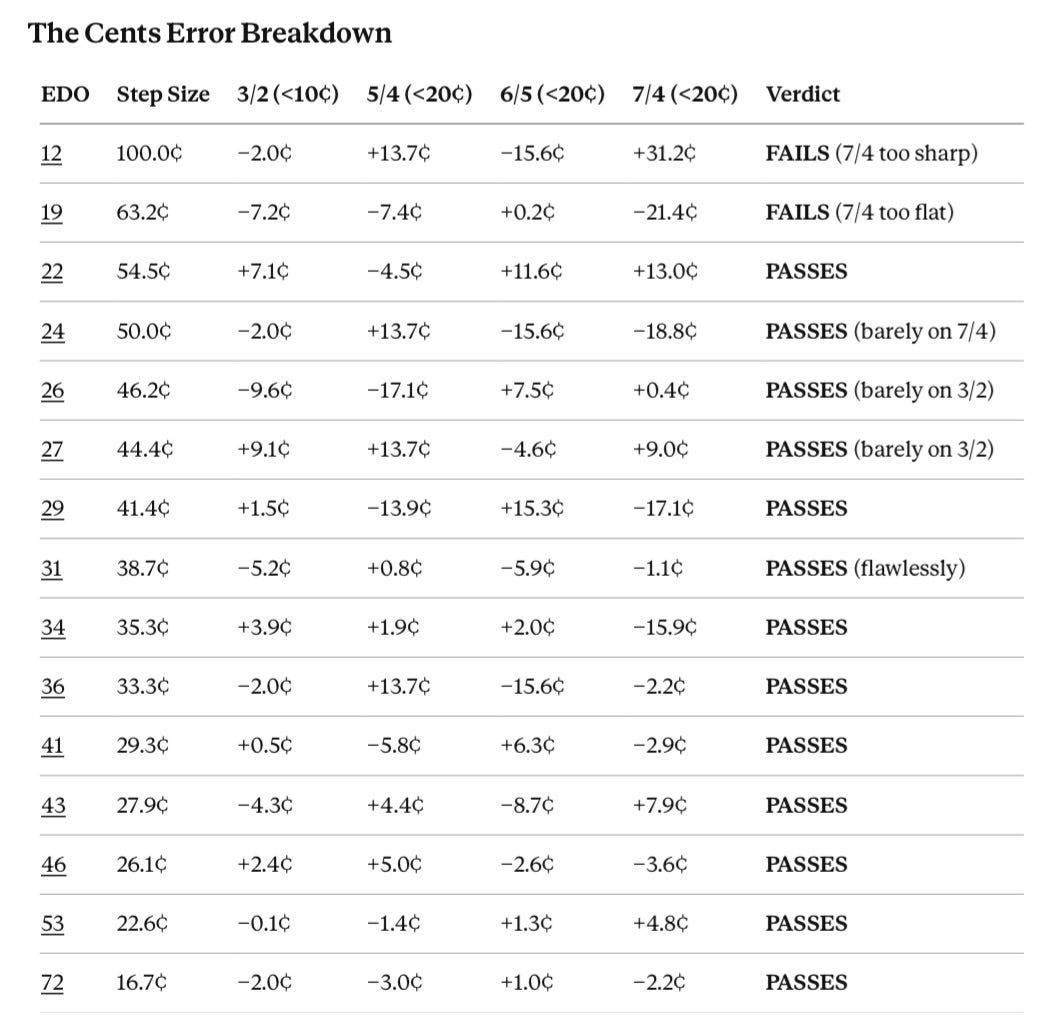
Note: Because the perfect 4th and major 6th are the octave complements of the perfect 5th and minor 3rd, their error will always be identical to their partners. The table below focuses on the four core harmonic building blocks.
The “Goldilocks” Zone (22, 29, 31, 34, 36)
This is where efficiency and accuracy meet. These EDOs balance strict harmonic coverage with reasonable note counts. If you want a truly universal tuning, this is the tier to look at.
22edo: Widely considered the ultimate low-integer universal tuning. It hits the 3/2 cleanly (+7.1¢), and lands the 5/4, 6/5, and 7/4 all within 13 cents. It also delivers strong 11-limit approximations — the 11/8 is off by less than 6 cents. Superpythand porcupine temperaments both live here. Utility per note is extraordinarily high.
31edo: The historical meantone champion, advocated by Christiaan Huygens and Adriaan Fokker. It flattens the 5th by 5 cents — the standard meantone compromise — but in exchange gives you a virtually perfect major 3rd (+0.8¢) and an astonishingly clean harmonic 7th (−1.1¢). Its 11/8 is off by 9 cents. Almost every note in 31edo can be placed in a consonant chord, making dead weight a near non-issue.
29edo: Offers an incredibly pure 5th (+1.5¢) alongside workable — if not spectacular — 3rds and 7ths. Good all-rounder, particularly strong in the Pythagorean/3-limit sense.
34edo: Gorgeous 5-limit accuracy, with both major and minor thirds within 2 cents of just. The 7/4 is somewhat flat (−15.9¢), but well within tolerance. A strong contender if 5-limit purity is your priority.
36edo: An interesting case. Because it contains 12edo as a subset (36 = 3 × 12), it inherits all of 12edo’s 5-limit performance — same 5th, same major third. What makes 36edo special is its 7-limit: the 7/4 is only −2.2¢ off, making it one of the most accurate 7-limit EDOs of this size. The 7/6 subminor third is similarly well-served. This makes 36edo a compelling “bridge” tuning for blues, jazz, and other genres where septimal intervals occur naturally, without sacrificing any of the familiar 12-tone harmonic vocabulary. The flip side: it offers no improvement over 12edo on the 5-limit — the major third is still +13.7¢ — and its 33-cent step is narrow enough that many adjacent notes will feel like out-of-tune versions of each other.
The Efficient Compromises (12, 19, 24, 26, 27)
These EDOs prioritize low note counts, meaning very little dead weight. Every note is intended to serve a structural purpose. However, they struggle to meet all the strict criteria simultaneously.
12edo: The global standard. It has an excellent 5th (−2¢) and acceptable 3rds (±14–15¢), but it completely fails to represent the 7-limit. The 7/4 is off by over 31 cents, making it sound like a sour minor 7th rather than a consonant harmonic 7th.
19edo: A beautiful tuning for minor-key music, boasting an essentially perfect minor 3rd (+0.2¢). However, it drags the 5th down (−7.2¢) and pushes the 7/4 just outside the 20-cent limit (−21.4¢), failing the stress test.
24edo (quarter-tone): The most widely known microtonal system, beloved in Arabic and Persian music. Its 5/4 and 6/5 are inherited directly from 12edo, so they’re no better than before. The 7/4 scrapes through at −18.8¢ — technically within the 20-cent limit, but only just. Its real strength lies elsewhere: the 11/8 is approximated to within 1.3 cents, making it genuinely excellent for 11-limit harmony. Conversely, 24edo’s 50-cent step sits near the peak of harmonic entropy — it’s one of the most intrinsically dissonant intervals possible, meaning a significant fraction of the scale’s intervals are pure dead weight.
26 and 27edo: Both technically pass, but dangerously close to the edge. 26edo flattens the 5th by nearly 10 cents, which fundamentally alters the stability of triads, yet offers a stunning 7/4 (+0.4¢). 27edo is essentially 12edo with a usable 7-limit bolted on, but its very sharp 5th (+9.1¢) gives chords a tense, unstable quality.
The High-Precision Giants (41, 43, 46, 53, 72)
As we move into higher EDOs, accuracy becomes extraordinary — but the dead weight problem grows severe. In 53edo and 72edo, you’ll find clusters of adjacent notes that differ by less than 25 cents: micro-inflections that serve melodic and JI-mapping purposes, but contribute nothing structurally to standard harmonic frameworks.
41edo: Often called the schismatic EDO. A near-perfect 5th (+0.5¢) and excellent 7-limit. High utility for composers who want maximum accuracy without jumping to 53+.
46edo: Remarkably balanced across all four critical intervals, with no single error exceeding 5 cents. One of the most evenly distributed higher EDOs.
53edo: The holy grail of 5-limit tuning. The 3/2, 4/3, 5/4, and 6/5 are all accurate to within 1.5 cents — essentially just intonation in equal-tempered form. The 7/4 misses by only 4.8 cents. Acoustically stunning, but the sheer number of notes means only a fraction can be used in any given compositional context without encountering clusters of barely-distinguishable pitches.
72edo: The Byzantine and microtonal standard. Because 72 is divisible by 12, it extends standard 12edo by filling in the gaps with six-fold subdivision. It nails the 3, 5, 7, and 11 limits with precision that borders on the absurd (11/8 is off by barely 1.3 cents). But 72edo is the diametric opposite of an efficient tuning — it is maximally accurate and maximally dense.
The Verdict
Based on this framework — approximating 3-, 5-, 7-, and 11-limit consonances within strict 10¢/20¢/30¢ tolerances, while minimising dead weight — two EDOs stand clearly above the rest:
22edo — the winner for efficiency. It captures the harmonic essence of all required consonances with only 22 notes. If you want the maximum musical return on the minimum number of pitches, 22edo is the answer.
31edo — the winner for harmonic purity. It costs 9 more notes than 22edo, but delivers practically beatless thirds and sevenths, making it one of the most acoustically sweet universal tunings available to musicians today.
The two notable failures are instructive: 12edo loses out purely on 7-limit coverage — the harmonic 7th is simply too far off to function as a consonance. And 19edo, despite its gorgeous minor 3rd, cannot quite close the gap on the 7/4 either. Both are excellent tunings within their limits; they just don’t qualify as universal under this definition.
For composers who want something in between — familiar but extended — 36edo deserves a closer look than it usually gets, offering 12edo’s complete vocabulary plus near-perfect 7-limit intervals, at the cost of 5-limit performance that goes no further than 12.
Comments
Post a Comment