There’s a good chance your favourite VST already supports microtonality — even if not, read to the end for a workaround!
Western music has settled on a system called 12-tone equal temperament, where the octave is sliced into exactly 12 equal semitones. But most of the world’s music — and a growing number of Western producers and composers — uses pitches that fall between those 12 notes. That’s microtonality.
Microtonality doesn’t have to mean atonal weirdness. It can be as subtle as tuning your chords to sound purer and more resonant (what’s called just intonation), or as adventurous as dividing the octave into 22 or 31 steps instead of 12. Musicians like Aphex Twin, Jacob Collier, and Sevish have all explored microtonal tuning to great effect, and the tools for doing it in a normal DAW have never been more accessible.
Here’s the good news: you may already own a VST that supports microtones. Let’s look at some well-known ones.
A Quick Note on How Microtonal Tuning Works in Plugins
Most microtonal-capable VSTs accept tuning files — small text files that describe a scale or temperament. The two most common formats are:
- .scl and .kbm files — part of the Scala format, the most widely supported standard. Scala files describe the intervals of a scale; the .kbm “keyboard mapping” file tells the plugin which MIDI note corresponds to which degree of the scale.
- .tun files — a simpler alternative tuning format supported by many synths.
A newer approach is MTS-ESP (MIDI Tuning Standard — Extended Plugin), a system where a single “master” plugin broadcasts a tuning to all compatible instruments in your DAW at once. This is especially handy because you only need to define your tuning in one place, and all your synths follow automatically.
1. u-he Diva, Zebra 2 / Zebra 3, and Hive 2
Website: u-he.com
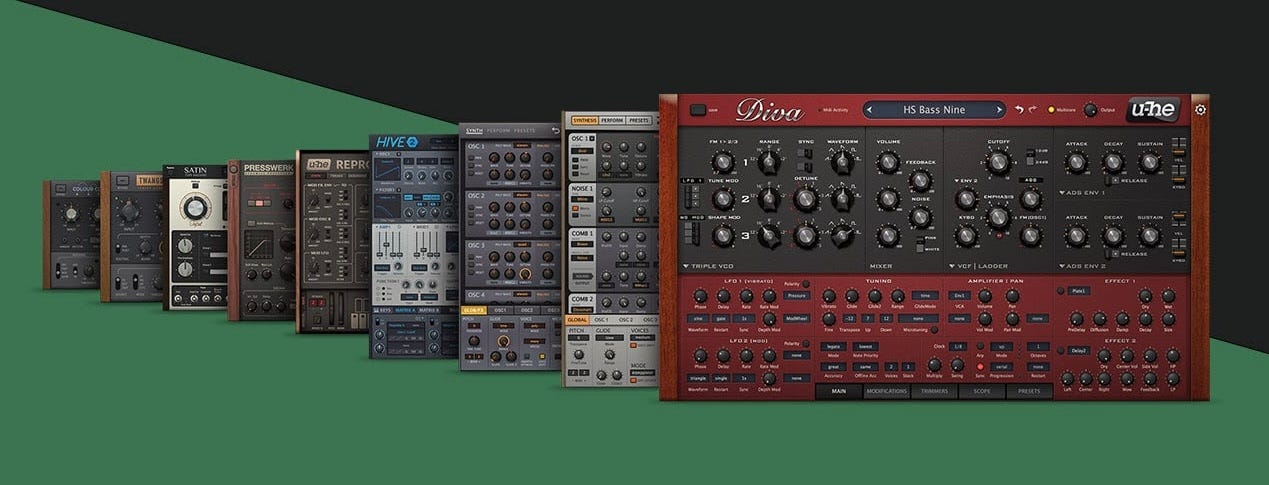
u-he are one of the most respected soft synth developers around, known for their painstakingly accurate analog emulations and creative synthesis tools. What you might not know is that their flagship instruments — Diva (the beloved “dinosaur” virtual analog), Zebra (the flexible wireless modular synth, now available as the brand-new Zebra 3), and Hive 2 (their speedy wavetable synth) — all support microtonal tuning.
The u-he synths support tuning via .tun files, which you can generate from a free tool like Scale Workshop. Drop your .tun file into the synth’s tuning section and your entire keyboard remaps to your chosen scale. They also support MTS-ESP, meaning you can control the tuning of all your u-he synths simultaneously from a single master plugin. Other u-he instruments with microtonal support include ACE, Bazille, Repro-1, and Repro-5.
The Xen Wiki’s list of microtonal software specifically calls out u-he’s suite as some of the most well-supported microtonal synths available. If you already own any of these, you’re closer to microtonal music than you think.
2. Xfer Records Serum (and Serum 2)
Website: xferrecords.com
Serum is probably the most popular soft synth in electronic music production. Its wavetable engine is everywhere, from EDM to film scoring to experimental pop. And yes, it supports microtuning — something a lot of Serum owners don’t know.
Serum accepts .tun files for full-keyboard microtuning. Serum 2 also works with Dorico’s microtuning system out of the box, making it a useful choice for composers working in notation software. One thing to be aware of: there are reports that portamento (pitch glide) can behave unexpectedly when microtuning is active in Serum, so it’s worth testing that aspect of your patch if smooth glides are important to you.
If you already have Serum, just grab a .tun file for the scale you want to try — the Scale Workshop web app will generate one for free — and load it into Serum’s tuning menu. It’s that simple.
3. Arturia Pigments, MS-20 V, Prophet-5 V, and SQ80 V
Website: arturia.com
Arturia makes two broad categories of products: original soft synths like Pigments, and their V Collection of vintage instrument emulations. A number of these support microtuning.
Pigments, Arturia’s flagship modern synthesizer, supports both .scl files and .tun files, making it one of the most flexible microtonal instruments around. You can import scales from the enormous Scala archive, which contains thousands of historical, cultural, and experimental tunings, and Pigments will apply them across the full keyboard range. There’s even a YouTube tutorial by producer John Selway demonstrating microtonal techno made specifically with Pigments.
From the V Collection, several instruments also support microtuning, including the MS-20 V (Korg’s famous semi-modular analogue emulation), the Prophet-5 V (the Sequential Circuits legend), and the SQ80 V (Ensoniq’s gritty digital/analogue hybrid). Like the hardware originals, these plugins allow you to retune individual notes — great for exploring historical temperaments or world music scales.
4. Madrona Labs Aalto and Kaivo
Website: madronalabs.com
Madrona Labs make some of the most sonically distinctive plugins available. Aalto is a semi-modular synthesizer inspired by Buchla-style west coast synthesis, and Kaivo is a physically modelled instrument with a uniquely organic, resonant sound. Both were built with microtonality in mind from the very beginning — the developer Randy Jones has spoken about alternate tunings being a core design priority.
Both Aalto and Kaivo support .scl files natively, and come with a library of scales pre-installed, including Harry Partch’s 43-tone just intonation system, various historical meantone temperaments, and dozens of equal temperaments beyond 12. You simply choose a scale from the dropdown in the plugin’s tuning panel.
A note for the detail-oriented: users have found that Aalto and Kaivo map the root of the scale to A4 rather than the more common C4 standard. This is easy to work around by including a matching .kbm keyboard mapping file alongside your .scl file, which explicitly sets the root. The developer is aware of this and responsive to feedback — Madrona Labs is a small, dedicated team. The instruments are simply too beautiful-sounding to leave off this list.
5. Soniccouture Pan Drums II, Array Mbira, Balinese Gamelan II, and more
Website: soniccouture.com
Soniccouture is a UK-based developer known for exceptionally well-sampled world instruments and unusual acoustic oddities. Several of their instruments have microtuning built right in — which makes perfect sense, because many of them are recordings of instruments that were never designed to play in 12-tone equal temperament in the first place.
Pan Drums II samples a range of handpan instruments (the distinctive “UFO drum” heard in ambient and world music). It includes a microtuning module with tuning presets, and the drums are mapped chromatically by default so you can explore non-equal tunings across the full keyboard.
Array Mbira is a five-octave thumb piano built by Array Instruments, sampled with extraordinary depth. The mbira is an African instrument with roots in tuning systems very different from Western equal temperament, and Soniccouture’s implementation lets you explore that through Kontakt’s built-in microtuning capabilities.
Balinese Gamelan II is perhaps Soniccouture’s most famous product. Balinese gamelan instruments are traditionally tuned to specific scales — pélog and sléndro — that don’t map neatly onto the 12-note keyboard. Balinese Gamelan II includes full tuning control with both the original Balinese tuning and a Western-friendly “concert” pitch option, plus full microtuning support so you can dial in the authentic shimmer of the original instruments.
The Scale Workshop app also specifically exports a Soniccouture-compatible tuning format (.nka), showing just how integrated these instruments are with the broader microtonal ecosystem.
6. Spectrasonics Omnisphere 2
Website: spectrasonics.net
Omnisphere is Spectrasonics’ flagship synthesizer — a behemoth of sound design used across virtually every genre of professional music. With its vast library of sounds, hardware synth integration, and deep modulation system, it’s a staple in studios worldwide.
What many users don’t know is that Omnisphere has one of the more comprehensive built-in microtuning systems of any commercial synth. Each of Omnisphere’s eight Parts can have its own independent scale, meaning you can have up to eight different tuning systems running simultaneously in one Multi preset.
Out of the box, Omnisphere includes historical temperaments, Arabic maqam scales, Javanese and other world music tunings, scales by composers like Wendy Carlos and Harry Partch, and African kalimba tunings that even include ascending/descending note layouts to mimic how real mbiras are played. It also accepts custom .tun files, so you can import any tuning you create with Scale Workshop or Scala.
7. Bitwig Studio (Not a VST, But Too Good to Ignore)
Website: bitwig.com
Strictly speaking, Bitwig Studio is a DAW (Digital Audio Workstation) rather than a plugin — but its microtonal features are so integrated and well-designed that it deserves a place on this list.
Since version 3.1, Bitwig has included a Micro-pitch device — a Note FX device that sits in your instrument chain and retunes incoming MIDI notes before they reach the synth. It comes with over 30 built-in tuning presets covering historical temperaments (Pythagoras, Werckmeister), cultural scales (Chinese, Javanese), and composer-specific systems from Harry Partch and Wendy Carlos. And it accepts .scl files directly, so you can drag any Scala file into the device and you’re immediately playing in that tuning.
What makes Bitwig especially powerful is that its built-in instruments (like Polysynth, Phase-4, FM-4, and the Sampler) support per-note pitch bend via MPE, meaning the Micro-pitch device can retune each note of a chord independently — true polyphonic microtonality without the usual workarounds. The Micro-pitch device also works with MPE-compatible VST plugins and even hardware synthesizers via CV output.
Bitwig is also one of the very few major DAWs available natively on Linux, making it a favourite in the microtonal community where open-source tools are common.
What If Your Favourite VST Isn’t on This List?
The plugins above all have microtonal support built in — but what about the thousands of synths that don’t? This is where Entonal Studio becomes your best friend.
Entonal Studio is a plugin that acts as both a MIDI processor and a plugin host. You load your favourite VST instruments inside Entonal Studio, and it handles all the retuning automatically — sending the right pitch bend data to each note so that your synth plays in whatever microtonal scale you’ve chosen. It supports VST2, VST3, and AU formats.
You design your scale using Entonal’s built-in scale editor (which can import and export Scala files), and Entonal takes care of the rest. It even has a Group function, so if you have multiple instances of Entonal running across different tracks, you can update all their tunings simultaneously from a single control. There’s also a built-in simple synth so you can start exploring microtonality straight away without loading any third-party instruments.
In short: even if none of the synths above are in your toolkit, Entonal Studio can make almost any VST microtonal.
Where to Go Next
If you want to dive deeper into microtonal theory and get a sense of what’s possible, the Xenharmonic Wiki (Xen Wiki) is the best free resource available. It covers everything from introductory concepts like cents and equal temperaments to advanced topics like rank-2 temperaments, just intonation lattices, and the harmonic series.
For actually creating and converting tuning files, Scale Workshop by Sevish is a free web app that lets you design any scale and export it as a .scl, .tun, or .kbm file. And the musician Sevish himself has a website at sevish.com full of microtonal tutorials and music that will genuinely surprise you with how beautiful “out of tune” can sound.
The world of tuning is vast — you’re not running out of things to explore anytime soon.
Comments
Post a Comment