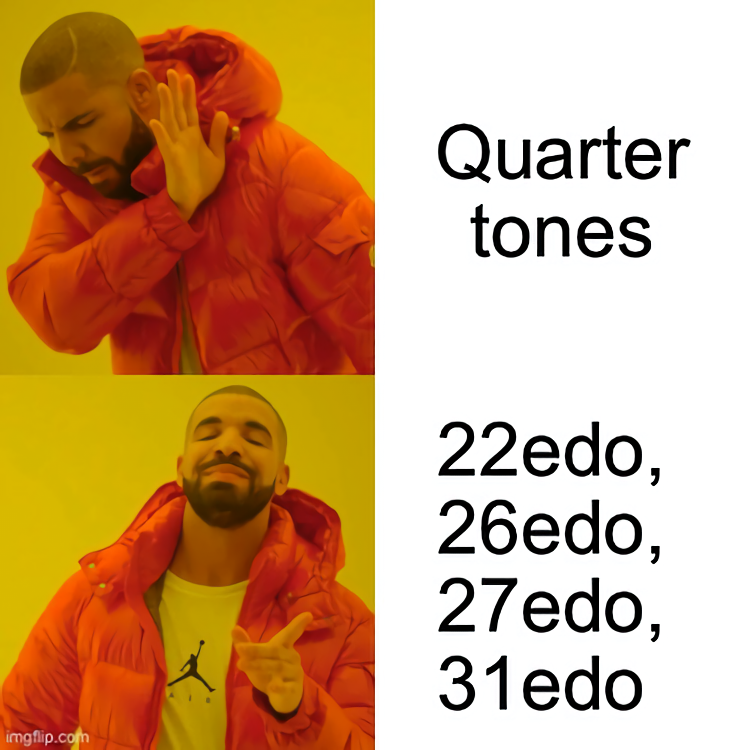
Most people’s first encounter with microtones is quarter-tone music — one of the least musically rewarding types of microtones — there’s a much richer landscape out there, and this guide will walk you through it from the ground up
What microtones are actually for
Standard Western tuning gives us 12 notes per octave, and those 12 notes produce a specific set of intervals — the frequency ratios between any two pitches you can play. The motivation for microtones isn’t just to add “weird in-between notes.” It’s to access entirely new intervals that the 12-note system can’t produce at all.
Think of it like colour. 12edo gives you a palette of 12 colours. Microtonal systems don’t just add slightly-off versions of those colours — they can introduce genuinely new hues that weren’t there before. That’s the goal.
The question then becomes: which alternative tuning systems do the best job of adding useful new intervals, while still keeping the familiar ones you already know?
Why quarter tones aren’t the answer
24-tone equal temperament (24edo) — “quarter tones” — is what you get when you insert a new note exactly halfway between each of the 12 existing ones. It sounds reasonable in principle. In practice, the new notes it adds are acoustically awkward. They land in musical no-man’s-land: not quite close enough to the just-intonation intervals that make chords ring clearly. The result is a system with twice the notes but not twice the musical resources.
The four gold-standard systems
If you’re serious about microtonality and want a system that works well across a wide range of instruments, these are the four most recommended options:
22edo is the most instrument-friendly of the four because it has the fewest notes — which means fewer strings to retune, fewer keys to manage, fewer wolf intervals to avoid. The trade-off is that its harmonic and melodic structure is quite different from 12edo, so your intuitions about how scales and chords work won’t carry over. The recommended entry point is the Pajara[12] scale, which gives you a 12-note subset that’s more navigable than the full system.
26edo lands on familiar ground more easily. It’s genuinely approachable for musicians coming from 12edo because some of its scales behave similarly to what you already know. Start with the flattone[12] scale. The main weakness: its fourths and fifths are slightly flat, which means power chords don’t have the same punch.
27edo has a very different internal structure from 12, so expect to rebuild your harmonic intuitions from scratch. The Augmented[12] scale is the recommended starting point. Despite the unfamiliarity, it’s a rich and musically productive system.
31edo has the most notes of the four, but paradoxically it’s often considered the easiest for 12edo musicians to approach. Its scale structure is the most similar to what you already know — the meantone[12] scale in 31edo will feel surprisingly familiar — while still opening up a host of new harmonic possibilities. If you want to keep as much of your existing musical knowledge intact as possible while venturing into microtonality, 31edo is the natural first stop.
All four systems can be played using an isomorphic keyboard (the Lumatone is the most popular option) or by refretting a guitar with skip-fretting to access the relevant notes. Any of them can produce genuinely great microtonal music.
If you want cross-compatibility: 36edo
If the systems above feel too complex, or if you need your microtonal instrument to work alongside standard 12edo instruments, there’s an intermediate option worth knowing: 36-tone equal temperament, sometimes called “sixth tones.”
36edo is a superset of 12edo — it contains all the standard 12 notes, plus new ones in between. That makes it cross-compatible with ordinary instruments. And importantly, the new pitches it adds are more musically useful than those in 24edo. It’s not in the same league as 22, 26, 27 or 31 for overall musical richness, but it’s a reasonable stepping stone.
A complete rundown of every EDO up to 41+
The chart above gives a visual overview, but here’s the full commentary on each system:
1, 2, 3, 4, 6edo — These aren’t microtonal at all. They’re just subsets of standard 12edo.
5edo — A genuinely lovely pentatonic scale, but not a full tuning system on its own. It makes more sense as a scale you’d use within a larger multiple-of-5 system (10edo, 15edo, 20edo, and so on).
7edo — An intriguing 7-note scale with a distinctive “out of tune” quality. Rather than working in pure 7edo, consider approximating it within 26edo or 33edo (flattertone tunings) or 22edo (a porcupine tuning), where it sits more comfortably.
8edo — Has a very bitter, dissonant character on most instruments.
9edo — The first system that feels like a complete tuning rather than a single scale. Still bitter-sounding on conventional instruments, but can be rewarding on metallophones or with custom additive synthesiser timbres designed to match the tuning.
10, 11edo — Similar to 9edo: challenging on conventional instruments, but potentially interesting with custom synth timbres.
12edo — The standard 12 notes.
13, 14edo — Bitter on conventional instruments. Additive synthesis can help.
15, 16edo — Bitter on most instruments; can work on metallophones or with additive synths.
17, 18edo — Bitter on conventional instruments; additive synthesis recommended.
19edo — Sounds fine, but doesn’t deliver the goods: the new intervals it adds over 12edo aren’t particularly useful, and it introduces wolf intervals without compensating with new musical resources.
20, 21edo — Bitter on most instruments; metallophones and additive synths are your best bet.
22edo — Gold standard. See above.
23edo — Bitter on most instruments; metallophones and additive synths recommended.
24edo — “Quarter tones.” Sounds fine on a surface level, but the new intervals it adds are acoustically weak. A common starting point for microtonal exploration, but not a destination.
25edo — Bitter on most instruments; metallophones and additive synths recommended.
26edo — Gold standard. See above.
27edo — Gold standard. See above.
28edo — Bitter; additive synths recommended.
29edo — Serviceable, but its thirds and sixths sound slightly off — just enough to be noticeable.
30edo — Bitter on most instruments; metallophones and additive synths can work. Has some interesting internal symmetries that are fun to explore compositionally.
31edo — Gold standard. See above.
32, 33, 34, 35edo — These have niche applications but aren’t strong general-purpose systems.
36edo — “Sixth tones.” The best cross-compatible option if the gold-standard four feel too daunting. Not as musically rich, but more practical in mixed-instrument settings.
37, 38, 39, 40edo — Niche uses; not strong general-purpose systems.
41, 46, 53, 72edo — These are extremely accurate systems for musicians who want something close to just intonation — the pure mathematical ratios that make chords ring most clearly. The trade-off is the sheer number of notes, which makes wolf intervals more numerous and instrument design more complex. For composers who want near-perfect harmonic accuracy and are willing to manage that complexity, these systems are genuinely powerful.
A note on unequal tunings
Everything discussed here falls under the category of equal temperament — systems where the octave is divided into a fixed number of equal steps. There’s a whole parallel universe of unequal tunings (historical meantone, well-temperament, just intonation, adaptive tuning systems, and more) with their own logic and beauty. That’s a conversation for another day.
Where to start
If you’re new to microtonality and want a clear recommendation:
- Start with 31edo if you want the gentlest transition from 12edo. Its meantone[12] scale will feel familiar, and you can expand from there.
- Start with 22edo if you want to build a physical instrument or work with the simplest system. Accept that you’ll need to rebuild your harmonic intuitions.
- Try 36edo if you need compatibility with standard instruments and want something more musically interesting than quarter tones.
- Don’t start with 24edo unless you have a specific stylistic reason to — it’s the most widely known option but one of the least musically rewarding.
The world beyond 12 notes is vast, and most of it remains unexplored. Any of the four gold-standard systems will give you more than enough new harmonic and melodic territory to spend a lifetime in.
Comments
Post a Comment