What we know, and don’t know, about how Aboriginal Australian music is tuned — the microtonal tradition that white settlers couldn’t erase
You likely know that Western music divides the octave into twelve equal steps — this system is called twelve-tone equal temperament, or 12-TET.
That system is so pervasive that it can start to feel like a law of nature rather than a design choice. It isn’t.
And few musical traditions make that clearer than the music of Aboriginal Australians — one of the oldest continuous musical cultures on Earth.
A Quick Primer: What Is a Cent, and What Is a Microtone?
Before diving in, let’s get on the same page about measurement. Musicians use cents to describe the size of intervals with more precision than “semitone” or “tone” allows. There are 1,200 cents in an octave, and in 12-TET each semitone is exactly 100 cents. A microtone is any interval that is not a multiple of 100 — for example, a 50-cent interval, a 133-cent interval, or a 425-cent interval would all be examples of microtones.
When you hear a blues guitarist bend a string, or a singer slide between notes in a way that feels emotionally raw, you’re hearing the edges of microtonality. The “blue notes” in blues music, for example, are microtonal inflections that sit between the major and minor thirds. Aboriginal Australian music, however, doesn’t just visit that space occasionally — it is built there.
Aboriginal Music Is Not One Thing
This is perhaps the most important point to establish at the outset: “Aboriginal Australian music” is not a single tradition. Australia’s First Peoples comprise hundreds of distinct nations, each with their own language, law, and musical practice. The music of the Yolŋu people of northeast Arnhem Land, for instance, is quite different from that of the Arabana people of South Australia or the Noongar people of the southwest. Treating all of this as one category would be like lumping together flamenco, Gregorian chant, and Norwegian folk music because they all come from “Europe.”
With that in mind, what researchers have documented across many different communities is a broad tendency: Aboriginal Australian music consistently uses intervals that do not map onto the 12-TET grid. Each community’s tuning system is its own, and that is precisely what makes the tradition so musically rich — and so difficult to represent in Western notation.
The Research: What Pitch Measurements Reveal
In a 1983 doctoral dissertation — Musical Scales in Australian Aboriginal Songs: Structure and Social Implications — researcher Jan Lauridsen made one of the most systematic attempts to measure the pitch content of traditional Aboriginal music. Analysing recordings of 146 songs from 32 Aboriginal groups across northern Australia, and using a pitch-measurement device to track the frequency and duration of each sung note, Lauridsen found consistent patterns.
Two findings stand out. First, microtones were not occasional ornaments — they were dominant features of the music. Second, and particularly interesting for music theorists, the neutral third was especially prominent.
If you know your intervals, you know that a minor third in 12-TET is 300 cents, and a major third is 400 cents. A neutral third falls roughly in between — somewhere around 340–360 cents. It’s not the minor third you’d find in a minor scale, and it’s not the major third of a major chord. It’s its own thing, sitting in a space that the piano keyboard simply cannot express. This kind of interval is well-known in Arabic maqam music and Persian classical music, but it is also a structural building block of traditional Aboriginal singing.
Lauridsen also found a slight but notable tendency for vocal pitches to align with the upper harmonics of the didgeridoo’s fundamental drone. This makes intuitive sense when you understand how the instrument works acoustically — and it points to a deep integration between the instrument and the voice in this music.
The Didgeridoo and the Harmonic Series
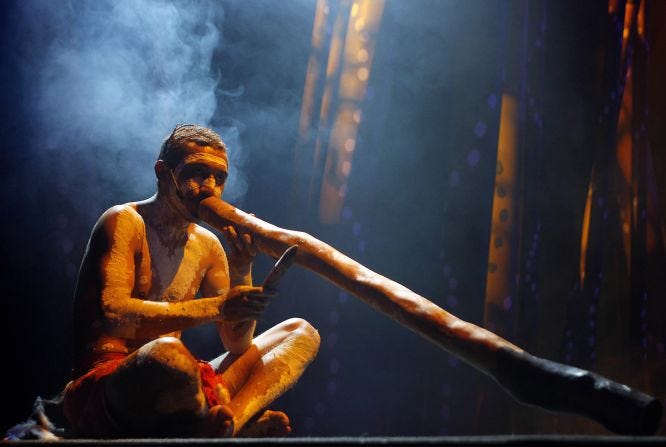
The didgeridoo (known as yiḏaki in the Yolŋu languages of northeast Arnhem Land, and by at least 45 other regional names across Australia) is one of the oldest wind instruments in the world, with archaeological evidence suggesting it has been played in the Kakadu region for close to 1,000 years, possibly longer.
Acoustically, it is a fascinating object. The instrument is traditionally made from eucalyptus trunks hollowed out by termites, producing a shape that is slightly conical and highly irregular inside. The player seals the blowing end with the muscles of the mouth and lips, vibrates the lips to create a sound source, and uses circular breathing — filling the cheeks with air while simultaneously inhaling through the nose — to maintain an unbroken drone.
Because the didgeridoo is slightly conical and its interior is irregular, it does not behave like a perfect open or closed pipe. Its resonances produce what researchers describe as a “stretched quasiharmonic sequence” — meaning the overtones it amplifies are close to, but not perfectly aligned with, the whole-number ratios of the harmonic series. This gives the instrument its distinctive, slightly inharmonic richness.
The fundamental drone of the didgeridoo typically sits around 70 Hz. But the musical interest lies in the timbre, not the pitch. By changing the shape of the vocal tract — raising or lowering the tongue, opening or closing the mouth — the player amplifies different formants, or bands of frequencies, creating the rhythmic, vowel-like sounds characteristic of skilled playing. There are two resonators at work simultaneously: the instrument itself and the player’s vocal tract. Changing either one shifts the sound. This is why no two players, and no two didgeridoos, sound quite alike.
What matters for our discussion of tuning is this: the harmonic content of the didgeridoo drone extends well into the upper reaches of the overtone series, where intervals become increasingly compressed and fall in the “gaps” between 12-TET pitches. If the voice tends to align with those overtones, as Lauridsen’s research suggests, then the interval relationships in Aboriginal music are being shaped at least in part by the physics of the instrument — not by any grid of evenly-spaced semitones.
Each Community Has Its Own Tuning
One of the most striking things about Aboriginal Australian tuning is its diversity and locality. Dr Dylan Crismani, an Indigenous Australian composer and researcher leading the ARC-funded project A Reconciliation of Indigenous and Western Musical Traditions, puts it plainly: each song from one community can be completely different from one in the neighbouring community, and the tuning systems are also completely unique from one song to the next.
This is almost the polar opposite of how 12-TET works. The whole point of equal temperament is uniformity — every semitone is identical, every key is equivalent, and any instrument can play with any other instrument in any key without retuning. That interoperability was enormously practical for the development of Western orchestral and popular music. But it comes at a cost: all the intervals that don’t fit into those twelve slots get left out.
Aboriginal tuning systems were never built around interoperability in the Western sense. They were built around specificity — a particular country, a particular ceremony, a particular community. The tuning of a song is part of what makes it that song from that place. As Dr Crismani observes, this is just fundamentally different from Indigenous music, where each tradition is its own complete system.
Trying to transcribe this music using a standard five-line staff is, as Dr Crismani describes, like converting a 4K video into 8-bit. You get the rough shape, but you lose most of the information that matters.
Why 12-TET Is a Recent and Local Idea
It’s worth pausing to note that 12-TET’s global dominance is a relatively recent development. Dr Crismani points out that it has only been the globally dominant tuning system for around 100 to 200 years. Before that, European music used a range of meantone temperaments and just intonation systems, many of which preserved more acoustically pure intervals — like the pure major third at 386 cents — at the cost of not being able to play equally well in every key.
Aboriginal Australian music, meanwhile, has been developing for tens of thousands of years without any pressure to conform to a twelve-step grid. Its scales were never designed to allow transposition between keys on a keyboard. They were designed to carry specific knowledge — cultural, geographical, spiritual — and pass it from one generation to the next with precision.
Songlines: When Tuning Carries a Map
To understand why this matters beyond music theory, you need to understand what Aboriginal music is for. The concept of Songlines — dreaming tracks that traverse the Australian continent — gives music a role that most Western musicians would find extraordinary.
Songlines encode knowledge about history, spiritual law, the locations of waterholes, travel routes, and food sources. They allow a knowledgeable person to navigate across vast distances by following the melodic and textual contour of a song cycle. The Seven Sisters Songline, for example, covers more than half the width of the Australian continent, passing through multiple language groups and being sung in multiple languages as the journey progresses.
For these songs to function as precise knowledge systems passed down across generations, they need to be exact. The pitch content of a song — including its microtonal inflections — is not ornamentation that can be approximated. It is part of the content. This is why Dr Crismani and his team speak about understanding Aboriginal tuning systems with enough rigour that they can actually be applied by Arabana and APY musicians in contemporary ensembles, and ultimately in newly composed works for the Adelaide Symphony Orchestra.
Getting the tuning wrong doesn’t just make the music sound different. In a tradition where music is knowledge, it means the knowledge gets corrupted.
What This Means for Microtonalists
If you are a musician who has started exploring the world beyond 12-TET, Aboriginal Australian music offers some fascinating points of contact. The prominence of neutral thirds aligns with tuning systems like 24-TET or 17-TET, which include steps at roughly 150 cents (the neutral second) and have neutral thirds as natural structural intervals. The vocal alignment with didgeridoo harmonics suggests a connection to just intonation principles, where interval ratios are drawn from the harmonic series rather than imposed by an external grid.
None of this is to say that Aboriginal music is just intonation or that it fits into any neat microtonal category. It doesn’t, and forcing it into one would miss the point entirely. But for musicians who are just beginning to notice that there’s a whole musical universe outside the piano keys, Aboriginal Australian music is a powerful reminder that those “in-between” pitches are not exotic curiosities or modern experiments — they are the natural material of some of the world’s oldest and most sophisticated musical cultures.
The Didgeridoo, Cultural Ownership, and What Composers Owe
There is one more thing that needs to be said, especially for composers and musicians who find this tradition inspiring.
The didgeridoo is not simply an instrument anyone can pick up and use. In traditional contexts, the instrument is played only by men, as an accompaniment to ceremonial singing or — more rarely — as a solo instrument. Many Aboriginal people across northern Australia strenuously object to its use by non-Aboriginal players, and the use of ceremonially significant instruments in public festivals can cause genuine offence and harm within communities. As Wukun Waṉambi of the Yolŋu has explained, maintaining the cultural integrity of clan instruments matters deeply, and casual appropriation of their use transgresses Yolŋu law.
The situation is complex — there is genuine debate within different Aboriginal communities about context and permission — but the broad principle is straightforward: the didgeridoo belongs to a living culture. It is not a prop or a sound effect. Using it without understanding, permission, and proper attribution is cultural theft.
For composers who want to engage with Aboriginal instruments or musical traditions, the ethical path is clear: hire Aboriginal musicians. Pay them for their cultural knowledge. Collaborate with communities rather than extracting from them. Projects like Dr Crismani’s ARC-funded work — built on genuine community engagement with Arabana and APY peoples, with cultural repatriation and archival work as core components — show what that looks like in practice.
Catherine Ellis, one of the most important musicologists to work with Aboriginal music, wrote in 1991 that very few composers had taken the trouble to examine the structural intricacies of Aboriginal music, preferring instead to reach for superficial signifiers: a descending melody, a stick beat, a didgeridoo-like sound. More than thirty years later, with the tools and the research now available, there is no excuse for that laziness — and even less excuse for using Aboriginal musical culture without properly compensating the people it belongs to.
The music is extraordinary. The tuning systems are genuinely unlike anything in the Western tradition. But the people who carry this knowledge have been doing so for tens of thousands of years, and they deserve to be at the centre of any story told about it.
Sources and further reading:
- Lauridsen, Jan. Musical Scales in Australian Aboriginal Songs: Structure and Social Implications (Ph.D. dissertation, University of Maryland, 1983). Available via the National Library of Australia catalogue.
- Australian Research Council. “Forging a new way forward for Aboriginal music traditions” (2025).
- Tarnopolsky et al. “Vocal tract resonances and the sound of the Australian didjeridu (yidaki), I: Experiment.” Journal of the Acoustical Society of America 119(2), 2006.
- Fletcher et al. “Vocal tract resonances and the sound of the Australian didjeridu (yidaki), II: Theory.” Journal of the Acoustical Society of America 119(2), 2006.
- Wikipedia: Indigenous music of Australia
- Wikipedia: Didgeridoo
- Hollow Log Didgeridoos. “Taking the sound away: a case study of the cultural appropriation of the didgeridoo”(2022).
- UBC Wiki, Physics 341: Course:Phys341 2020/Didgeridoo
- Xen Wiki: 12edo, Neutral third, Just intonation, Cent
Comments
Post a Comment