22edo is one of the most musically rich and practically accessible alternatives to the 12-tone system we’ve all grown up with.
First, a Quick Refresher: What Is an EDO?
The tuning system you’ve spent your whole life in — standard Western tuning — is called 12edo, or 12 Equal Divisions of the Octave (also written 12-TET, 12-ET, or just “12 equal”). It works by slicing the octave into 12 equal pieces of 100 cents each. Every semitone is identical.
22edo does the same thing, but with 22 equal slices instead of 12. Each step is about 54.5 cents — roughly half a semitone. That makes 22edo a genuinely microtonal system: it has notes that fall between the notes you’re used to.
The natural question is: why 22? Why not 15, or 30, or 100? The answer is that 22 is a remarkably special number when it comes to representing the overtone series — the physics underlying all harmony.
The Overtone Series and Why It Matters
Every pitched sound in nature consists of a fundamental frequency plus a series of overtones (also called harmonics) at integer multiples of that frequency: 2×, 3×, 4×, 5×, 6×, 7×, 8×… These form the harmonic series, and they’re the ultimate source of what makes intervals sound consonant or dissonant.
In 12edo, we approximate these ratios with varying degrees of accuracy:
- The perfect fifth (3:2 ratio) is only 2 cents off — nearly perfect.
- The major third (5:4 ratio) is about 14 cents sharp — noticeably off if you listen closely.
- The harmonic seventh (7:4 ratio) — a flatter, bluesier minor seventh — is about 31 cents flat, so 12edo essentially ignores it entirely.
22edo does something remarkable: it approximates the 5th, 7th, and even 11th harmonics all within a reasonable margin of error, simultaneously. In technical terms, it handles the 11-odd-limit consonances, and it is in fact the smallest equal temperament that does so consistently. That’s a big deal. It means 22edo opens up a whole universe of harmony that 12edo can’t access.
The Most Important Thing to Know: 22edo Is NOT Meantone
If you’ve ever read about historical tunings, you’ll have come across meantone temperament — the family of tunings (including 12edo, 19edo, and 31edo) that treats the syntonic comma as zero. The syntonic comma is the tiny 21.5-cent gap between two whole tones (9/8 × 9/8) and a pure major third (5/4). In meantone systems, D♯ and E♭ are the same note, and your standard diatonic scale works the way you’d expect.
22edo is not a meantone system. This is probably the single most important thing to understand about it.
In 22edo, the two whole tones — 9/8 (about 204 cents) and 10/9 (about 182 cents) — are different intervals. D♯ and E♭ are not the same note; they’re actually about 55 cents apart, a full step in 22edo. This might sound like a limitation, but it’s actually a feature — it means 22edo forces you to engage with new harmonic territory that meantone simply can’t reach.
The Diatonic Scale in 22edo: Familiar But Twisted
22edo does have a diatonic scale with the same letter names and the same melodic structure (TTSTTTS, or Large-Large-small-Large-Large-Large-small). You can still play a major scale, a minor scale, all seven modes. The step pattern in 22edo is 4–4–1–4–4–4–1 (in units of 22edo steps), compared to 12edo’s 2–2–1–2–2–2–1.
But here’s the twist: the thirds are different. Instead of a major third approximating 5:4 (pure: 386¢, 12edo: 400¢), the major third in 22edo’s diatonic scale approximates 9:7 — the supermajor third, at about 436 cents. And the minor third approximates 7:6 — the subminor third, at about 267 cents.
This diatonic system is called Superpyth temperament, and it gives 22edo a distinctly different harmonic flavour even when playing simple major-minor music. Chords sound brighter and more dissonant — some describe it as “hyper-jazz” or “jangly.” The dominant seventh chord in superpyth has a pure harmonic seventh (7:4) rather than the approximated minor seventh of 12edo, which gives it an especially strong, resonant pull.
For a sense of what this sounds like, listen to Sevish’s track “Gleam” — a pop/electronic piece written in 22edo that’s often cited as an entry point for newcomers.
Three Different Musical Universes in One Tuning
One of the most fascinating things about 22edo is that it isn’t just one musical system — it supports several quite different frameworks for organizing harmony and melody. Think of them like different “lenses” you can use to view the same 22 notes.
1. Superpyth: The Familiar-but-Strange Diatonic World
As described above, you can use 22edo just like 12edo, with scales, modes, and chords built from the standard diatonic framework. The catch is that your triads use 7-limit intervals (7:6 minor thirds and 9:7 major thirds) rather than 5-limit ones. It’s recognisably “tonal” music, but with an alien harmonic colour. Great for composers who want something that feels familiar but sounds fresh.
2. Porcupine: A Completely New Tonal Framework
Porcupine temperament is one of the most celebrated features of 22edo. Its generator is a flat whole tone of about 163 cents — that unusual interval that sits between a semitone and a regular tone. Stack this interval repeatedly and you get a series of evenly-spaced 7- or 8-note scales where every step is nearly equal in size.
The 7-note porcupine scale has the step pattern 3–3–3–3–3–3–4 (and its rotations). It sounds very different from a standard diatonic scale — there’s no clear dominant or leading tone — but it has its own internal logic and can support rich 5-limit harmony. The “Zarlino” or “just major” scale (the one with pure 5:4 major thirds and 6:5 minor thirds) can actually be notated using porcupine, which is quite elegant.
Porcupine is notable for being the simplest 5-limit temperament that isn’t approximated by 12edo, which makes it one of the most accessible entry points into genuinely non-12 harmonic thinking.
3. Pajara / Decatonic: A 10-Note Tonal System
Perhaps the most ambitious framework for 22edo is pajara temperament and the decatonic scales theorized by music theorist Paul Erlich in his landmark 1998 paper Tuning, Tonality, and Twenty-Two-Tone Temperament.
The idea is elegant: just as the diatonic scale (7 notes) is the natural scale for 5-limit (major/minor) harmony, Erlich proposed that 22edo naturally supports a 10-note (decatonic) scale for 7-limit harmony — the world of pure harmonic seventh chords. The decatonic scale comes in several modes (Standard Pentachordal Major, Dynamic Symmetrical Minor, etc.) and treats the 7:4 harmonic seventh as a fully consonant interval, the way we treat the perfect fifth.
In this framework, the basic tonic chord is not a triad but a tetrad (4-note chord): the 4:5:6:7 chord, which includes the pure harmonic seventh. This is somewhat analogous to how barbershop quartets tune their dominant seventh chords — that ringing, resonant “locked” sound. In decatonic music, that chord is home base.
Erlich’s decatonic modes sometimes feature symmetry around the tritone, and they treat the harmonic 7th as an essential part of the harmony — with the tonic chord itself being a tetrad rather than the usual triad.
The Intervals: What’s New, What’s Familiar
Here’s a quick tour of how 22edo’s intervals map onto things you already know, using cents values:
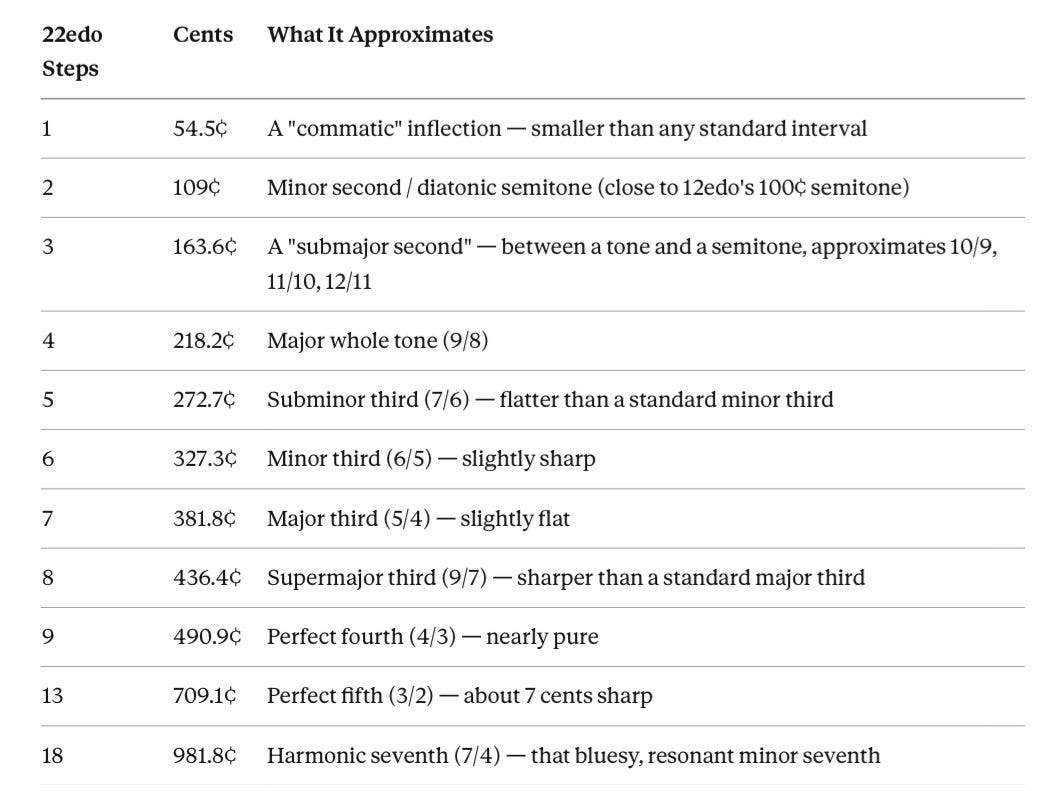
That 163.6¢ “submajor second” (step 3) deserves special mention. It is an extremely ambiguous and flexible interval: it sits in the cracks of the 12-equal piano and functions as no fewer than three different consonant ratios — 10/9, 11/10, and 12/11. It takes some acclimatisation for 12edo-trained ears, but once you’re used to it, it becomes one of the most expressive tools in the 22edo palette.
The perfect fourth and fifth are close to pure — a 4th is within 1 cent of just, while the fifth is about 7 cents sharp. That slightly sharp fifth is actually one of the defining features of 22edo’s harmonic character: it’s what makes the septimal harmony work so well, and what makes it unsuitable for traditional meantone-based counterpoint.
The Syntonic Comma: Why Two Whole Tones Matters
Here’s a piece of music theory that usually flies under the radar in 12edo: the syntonic comma (81:80, about 21.5 cents) is the difference between a Pythagorean major third (built from four perfect fifths: 81:64, about 408¢) and a pure major third (5:4, 386¢). In 12edo and all meantone systems, this comma is tempered out — treated as zero — which is why D♯ = E♭.
In 22edo, the syntonic comma equals one step (54.5¢). This means:
- Going up by two whole tones (C→D→E) and going up by a pure major third (C→E) land on different notes.
- The “E” you reach by stacking two fifths from C is different from the “E” that completes a pure major chord.
- This opens up entirely new harmonic progressions — what theorists call comma pumps — that simply don’t exist in 12edo.
For composers, this is both a challenge and an opportunity. You can’t just translate existing 12edo music into 22edo and expect it to sound the same. But you can write music that exploits these new harmonic pathways in ways 12edo cannot.
A Brief History
The idea of dividing the octave into 22 equal steps goes back to the 19th-century British music theorist R.H.M. Bosanquet, who was inspired by Indian music theory’s traditional division of the octave into 22 unequal intervals (called shrutis). Bosanquet noted that an equal 22-division could represent 5-limit harmony tolerably well.
In the 20th century, the idea was picked up again by theorist José Würschmidt, and later by J. Murray Barbour in his survey Tuning and Temperament. But it was the work of Paul Erlich in the 1990s — especially his 1998 paper on decatonic scales — that sparked the modern wave of 22edo composition and theory that continues to this day.
Notation: How Do You Write This Down?
Notating 22edo is a genuine challenge, and there are several competing systems. Here are the main approaches:
Ups and Downs Notation is the most widely used general-purpose system. You use standard staff notation with familiar note names, but add arrows (↑ for “up” and ↓ for “down”) to indicate a note raised or lowered by one 22edo step (54.5¢). So if E♭ and D♯ are different notes, you notate them differently: E♭ is lower, D♯ is higher. Read more about ups and downs notation on the Xenharmonic Wiki.
Sagittal Notation is a more sophisticated universal microtonal notation system that uses special arrow-shaped accidentals to indicate precise microtonal inflections. It can represent 22edo cleanly with three pairs of symbols. See Sagittal notationfor details.
Porcupine Notation is designed specifically for 22edo’s porcupine temperament, where the natural notes ABCDEFG represent a chain of the porcupine generator (that ~163¢ interval) rather than a chain of fifths. It’s the most “native” notation for porcupine music, though it requires learning new interval names.
Decatonic Notation uses a 10-letter alphabet (mixing Latin and Greek letters) designed by Paul Erlich for pajara/decatonic music, escaping the heptatonic thinking patterns entirely.
For most musicians starting out with 22edo, ups and downs notation is the most practical entry point, since it builds on existing literacy.
Practical Entry Points: How to Actually Use 22edo
Software
The easiest way to experiment with 22edo is through software that supports microtuning:
- Scale Workshop (free, browser-based) — lets you hear any EDO scale in your browser with a virtual keyboard. Great for exploration.
- Surge XT, Vital, and many other free VSTs support MTS-ESP or per-note pitch bend, allowing you to load 22edo tunings.
- Bitwig Studio has a built-in EDO mode — just type in 22 and you’re done.
- Reaper with the ReaTune or MTS plugins can retune any MIDI instrument.
Sevish (one of the most prolific 22edo composers) has compiled a resources page with tuning files, instruments, and guides specifically for 22edo.
Physical Instruments
22edo guitars exist! They have 22 frets per octave instead of the standard 12, and they’re playable in a standard guitar technique — just with a lot more frets. Brendan Byrnes is one guitarist who has released extensive work on 22edo guitar. There are also Lumatone keyboard layouts mapped to 22edo, and quarter-tone keyboards (which approximate 22edo reasonably well for certain scales).
Where to Start Listening
The best way to get your ears around 22edo is simply to listen. Here are some recommended entry points:
- Sevish — “Gleam” and “Guano Sequence” (from Rhythm and Xen, 2015) are accessible electronic pieces. Sevish himself describes 22edo’s character as “chill, trippy, hyper-jazz.”
- Paul Erlich & Ara Sarkissian — “Decatonic Swing” — a jazz piece that demonstrates the decatonic framework in action.
- Francium — The Decatonic Album (2024, on Spotify) — a full album exploring pajara/decatonic harmony in 22edo.
- Brendan Byrnes — Neutral Paradise (2017) — indie/rock written for 22edo guitar.
- JUMBLE — A prolific composer with dozens of 22edo tracks spanning multiple genres, from brass ensemble to pop.
- Nick Vuci — “Porcupine Preludes” (2023) — keyboard pieces showcasing porcupine temperament specifically.
You can find a much larger catalogue at the 22edo music page on the Xenharmonic Wiki.
Why 22edo and Not Something Else?
There are other microtonal systems worth exploring — 19edo has purer major thirds and is easier to transition to from 12edo; 31edo is highly accurate and beloved by Renaissance music enthusiasts; 24edo (quarter tones) is widely used in Middle Eastern music. So why does 22edo hold such a special place in the xenharmonic community?
A few reasons:
- It’s the smallest EDO that handles 11-limit harmony consistently. That’s a mathematical fact, not an aesthetic preference. If you want all the consonances up to the 11th harmonic — fifth, major third, minor third, harmonic seventh, and the 11:8 “super-fourth” — 22 is the most compact equal temperament that gets you there with acceptable accuracy.
- It’s small enough to be practical. 22 notes per octave is manageable on a guitar, keyboard, or in notation. Compare that to 31edo (31 frets per octave) or 53edo (53 keys per octave).
- It supports multiple distinct musical frameworks. Superpyth, porcupine, pajara, orwell, hedgehog, magic — these are all viable compositional universes within the same 22-note system. You’re not locked into one aesthetic.
- It has a rich existing repertoire and a thriving community. Thanks to Paul Erlich’s theoretical groundwork and decades of composers building on it, 22edo has more composed music, more theory, and more learning resources than almost any other non-12 equal temperament.
Final Thoughts
If you approach 22edo expecting it to be “12edo plus some extra notes,” you’ll be disappointed and confused. But if you approach it as a new harmonic language — one that shares some vocabulary with what you know (scales, modes, chords, voice leading) but has genuinely different harmonic physics — it opens up in remarkable ways.
Start by listening. Then experiment with software. Pick one framework (porcupine is a popular first choice because its scales are distinctive and its 5-limit harmony is approachable). Learn its characteristic intervals and chords. Write a short piece. And when you hear that resonant, ringing 7:4 harmonic seventh chord land perfectly in tune for the first time, you’ll understand why this tuning system has captivated so many musicians.
Further reading:
- Tuning, Tonality, and Twenty-Two-Tone Temperament by Paul Erlich (1998) — the foundational academic paper on 22edo’s decatonic scales
- The 22edo page on the Xenharmonic Wiki — comprehensive reference
- The 22edo modes page — full listing of scales and their step patterns
- Sevish’s 22edo resource page — practical tools for composers
Comments
Post a Comment