
Regular temperament theory, developed by theorists such as Graham Breed, Dave Keenan, Paul Erlich, Gene Ward Smith, and others in the early 2000s, gives composers and tuning theorists a rigorous common language for describing, comparing, and composing in the vast landscape of possible tuning systems beyond 12-tone equal temperament.
At its core, a regular temperament is a tuning system in which all intervals are generated by a fixed set of basis intervals — a period (usually the octave) and one or more generators (such as a fifth or a third) — combined in integer multiples. The "regular" in the name refers to this consistency: every interval in the system arises from the same small set of building blocks applied uniformly, with no ad hoc adjustments. The central act of temperament is the deliberate "tempering out" of small just intonation commas — tiny frequency ratios like the syntonic comma (81/80) or the diaschisma (2048/2025) — by equating intervals that differ by those amounts. This transforms the infinite, non-repeating lattice of just intonation into a finite, navigable system that can be realized on a physical instrument or within an equal division of the octave.
Meantone
Meantone is the historical cornerstone of Western microtonality, arising from the desire to make thirds pure (or near-pure) at the cost of slightly shrinking the perfect fifth. In its most common form, the fifth is tempered to approximately 696–697 cents, causing four of them to produce a nearly just major third of around 386 cents. This gives Meantone its warm, smooth harmonic quality that defined European keyboard music from the Renaissance through the Baroque era. The system supports the familiar diatonic scale and all its modes, and its tunings range from quarter-comma (which purifies the 5/4 major third exactly) to third-comma and sixth-comma variants. Its "wolf fifth" — the badly out-of-tune fifth that closes the cycle — is the temperament's one notorious flaw, though equal temperaments like 12-EDO and 31-EDO can be understood as meantone systems that eliminate the wolf by closing the spiral.
Porcupine
Porcupine is a temperament built around a generator of roughly 163 cents, with seven of these generators approximating a 3/2 perfect fifth and three approximating a 4/3 perfect fourth. Its most striking characteristic is a MOS scale structure that divides the octave into segments quite unlike the familiar diatonic, producing a seven-note scale with an unusual, evenly spread quality. Porcupine tempers out the comma 250/243, meaning it equates intervals that differ by that small ratio, resulting in a tonal world where major seconds and minor thirds feel closer in size than in conventional tuning. It is well-supported by 15-EDO and 22-EDO, and its scales have a distinctly non-Western flavor, making it a popular choice for composers seeking to escape the gravitational pull of heptatonic diatonicism.
Superpyth
Superpyth (short for "Super-Pythagorean") is a temperament that extends the Pythagorean tradition by using fifths significantly wider than 702 cents — typically around 704–711 cents. Where standard Pythagorean tuning produces very wide major thirds (around 408 cents), Superpyth leans into this even further, mapping the 7/4 harmonic seventh via a chain of major thirds rather than minor sevenths. This creates a harmonic language where septimal (7-limit) intervals are approximated through stacked large fifths, giving chords a bright, tense, and distinctly non-meantone color. It is naturally supported by tunings like 22-EDO and 27-EDO, and suits musical styles that favor strong leading tones and the edgy sonority of wide thirds, sitting at a fascinating harmonic crossroads between Pythagorean austerity and septimal richness.
Magic
Magic temperament takes its name from its defining comma, the "magic comma" (3125/3072), and is built on a generator of approximately 380 cents — very close to a just 5/4 major third. Five of these generators stack to produce a near-perfect 3/2 fifth, meaning Magic essentially treats the major third as its primary interval of harmonic construction rather than the fifth. This inversion of the usual generator hierarchy gives Magic a lush, thirds-saturated harmonic palette, and its MOS scales — particularly the 10- and 13-note versions — have an otherworldly, floating quality. Magic is well-supported by 19-EDO and 41-EDO, and its scales tend to cluster into dense chromatic regions punctuated by large leaps, making voice leading an adventurous compositional challenge that rewards careful navigation.
Mavila
Mavila is a temperament in which the perfect fifth is so narrow — around 675–685 cents — that the usual diatonic major scale inverts its pattern of tones and semitones, producing what is effectively an "anti-diatonic" structure where the large and small steps swap roles. Named after a village in Cameroon where a related tuning tradition was documented ethnomusicologically, Mavila produces a seven-note scale that resembles the diatonic scale in size but feels harmonically alien to Western ears, with flat, compressed thirds and a pervasive sense of tonal gravity pulling in unexpected directions. It is well-represented by 9-EDO and 16-EDO, and has attracted interest from microtonalists drawn to its connection to non-Western musical practice and its capacity to produce genuinely novel modal colors that cannot be approximated within standard 12-EDO harmony.
Miracle
Miracle is one of the most celebrated temperaments in the modern microtonality community, built on a generator called the "secor" of approximately 116–117 cents — roughly a neutral second. Six secors approximate a 3/2 fifth, and the temperament achieves remarkably accurate approximations of 7-limit and 11-limit just intonation intervals with great efficiency. Its 10-note MOS scale (the "Miracle scale" or "Blackjack" in its 21-note form) is widely regarded as one of the most harmonically rich and compositionally practical scales in the xenharmonic repertoire. Miracle is best supported by 31-EDO and 72-EDO, and its combination of smooth 5-limit triads, in-tune septimal intervals, and accessible 11-limit harmonics makes it a kind of Swiss Army knife for composers who want to explore extended just intonation within a manageable equal or near-equal framework.
Orwell
Orwell temperament is generated by an interval of approximately 271–272 cents — roughly a subminor third or a very flat minor third — and derives its name from the novelist George Orwell, maintaining the whimsical naming conventions of the xenharmonic community. Seven of these generators approximate a 3/2 fifth, and the temperament provides good approximations of 7- and 11-limit intervals, particularly the 11/8 tritone and the 7/6 subminor third. Its MOS scales — especially the 9- and 13-note varieties — have a rich, chromatic density that suits elaborate contrapuntal writing, and the generator's size places it in an interesting harmonic no-man's-land between a tone and a minor third. Orwell is well-supported by 31-EDO and 53-EDO, and tends to appeal to composers who favor a complex, slightly pungent harmonic texture with strong septimal and undecimal coloring.
Blackwood
Blackwood temperament, named after composer Easley Blackwood who extensively studied and composed in it, is defined by the division of the octave into five equal parts, with a generator that subdivides each of those five steps into two unequal pieces. The result is a system that is fundamentally pentatonic in its symmetry, where every mode of every scale has a five-fold rotational structure, and harmonic motion tends to feel cyclic and enclosed. Blackwood is best realized in 10-EDO, 15-EDO, and 20-EDO, and its major thirds are tuned extremely pure while its fifths are notably narrow, creating a hazy, ambiguous harmonic color that is simultaneously familiar (owing to the recognizable triadic structures) and deeply strange. Blackwood's music has a hypnotic, kaleidoscopic quality, cycling through all five tonal centers with mechanical elegance, and the temperament has become an important reference point for discussions of non-diatonic equal temperament composition.
Flattone
Flattone is a close relative of Meantone that pushes the fifth even further below just — to around 693–694 cents — resulting in major thirds that overshoot pure and land near 390 cents, and minor thirds that are correspondingly very flat. This extra tempering compresses the diatonic scale in a way that gives Flattone a distinctly darker, more melancholy harmonic character compared to standard meantone, with a slightly queasy quality to its major triads that some composers find expressively compelling. Flattone is well-supported by 26-EDO, and while it retains the familiar diatonic scale structure and all of meantone's linear logic, its emotional register feels subtly but persistently off-kilter, like a familiar landscape seen through slightly distorting glass. It occupies an interesting niche for composers who want diatonic familiarity with an unsettling undertone.
Sensi
Sensi (sometimes called Sensipent) is a temperament whose generator is approximately 443–444 cents, close to a 9/7 supermajor third. Eight of these generators approximate a 3/1 perfect twelfth (an octave plus a fifth), and the temperament achieves good approximations of 7-limit just intonation intervals with a relatively small number of generators. Its MOS scales, particularly the 8- and 11-note versions, have an exotic, asymmetric quality that doesn't map neatly onto any familiar Western scalar archetype, making Sensi a productive tool for composers seeking genuinely unfamiliar melodic territory. Supported well by 19-EDO and 27-EDO, Sensi's harmonic world is dominated by wide thirds and compressed fifths, giving it a bold, declarative sound that suits music built on strong intervallic contrasts rather than smooth voice leading.
Pajara
Pajara is a temperament that divides the octave into two equal halves (tritones of exactly 600 cents) and uses a generator of approximately 106–109 cents to fill in the remaining structure, tempering out the comma 50/49 (which makes the two different 7-limit tritones — 7/5 and 10/7 — equivalent). This tritone-symmetry gives Pajara a distinctive harmonic ambiguity, and its characteristic 10-note "Pajara" scale is sometimes described as a "double diatonic" structure owing to its two interlocking five-note groups. Pajara is the natural temperament of 22-EDO and also fits 12-EDO (though imperfectly), and it achieves remarkably efficient 7-limit harmony, making dominant seventh-type chords available in a dense, closely spaced network. Its sound is punchy, chromatically rich, and well-suited to music that exploits tritone substitution and symmetrical harmonic motion.
Slendric
Slendric is a temperament inspired loosely by the Javanese pelog and slendro gamelan tuning traditions, though it is defined more precisely in the xenharmonic context by its generator of approximately 231–234 cents — a large major second or small minor third — and the tempering out of the comma 1029/1024. Three generators approximate a 3/2 fifth, and the resulting scales have a pentatonic skeleton that echoes the five-tone world of slendro while existing in a wholly distinct mathematical framework. Slendric is well-supported by 5-EDO and 31-EDO, and its scales carry a spacious, gong-like quality that feels simultaneously ancient and alien to ears trained on diatonic music. For composers interested in cross-cultural microtonality or in building scales that aurally evoke metallic, resonant timbres, Slendric offers a richly atmospheric starting point.
Valentine
Valentine temperament is built on a generator of approximately 77–78 cents — a small semitone or large third-tone — making it one of the more finely grained linear temperaments in common use. Sixteen of these tiny generators approximate a 3/2 fifth, and the system achieves good 7- and 11-limit approximations through a dense lattice of small steps. Its MOS scales, particularly the 15- and 16-note varieties, provide a chromatic abundance that suits highly chromatic or microtonal counterpoint where smooth semitonal voice leading is desirable. Valentine is well-supported by 31-EDO and 46-EDO, and its minute generator size means that composers working within it have access to a wide variety of interval sizes from a single chain, making it one of the more versatile temperaments for composers who want the expressive freedom of near-continuous pitch space without abandoning a coherent scalar framework.
Würschmidt
Würschmidt (named after music theorist José Würschmidt) is a temperament generated by an interval of approximately 387–388 cents — essentially a pure or near-pure major third — in which eight generators produce a near-just perfect twelfth. It is closely related to Magic temperament but differs in its comma basis, tempering out the würschmidt comma (393216/390625), and achieves very accurate 5-limit harmony with a modest number of generators. Its MOS scales, particularly the 9- and 10-note versions, are dense with thirds-based harmony, and the temperament's defining characteristic is its ability to chain major thirds to create an extended, smooth harmonic progression that slowly traverses a wide range of tonal centers. Würschmidt is well-supported by 31-EDO and 65-EDO, and its sound is warm, rounded, and saturated with the pure intervals that defined Renaissance polyphony — an ideal tool for composers who love 5-limit harmony but want to escape the constraints of standard meantone.
Negri
Negri is a temperament generated by an interval of roughly 126–127 cents — a small neutral second — in which nine generators approximate a 3/2 fifth. Its name comes from the Italian dancing master Cesare Negri, following the whimsical convention of naming temperaments after historical figures, and it tempers out the comma 16875/16384. Negri's most characteristic scale is a 9-note MOS that divides the octave with remarkable evenness, giving it an almost maximally smooth step-size distribution that creates a very consistent, equitable melodic texture. Well-supported by 9-EDO and 19-EDO, Negri is notable for producing nine nearly equal scale steps, making it a favorite among microtonalists interested in equal-step scales with richer harmonic resources than 9-EDO alone provides. Its sound is glassy, neutral, and distinctly non-triadic, lending itself to modal and contrapuntal styles over conventional chord-root harmony.
Tetracot
Tetracot is a temperament whose generator is approximately 176 cents — a large neutral second — and in which four generators produce a 3/2 fifth (hence the "tetra" in its name). It tempers out the comma 20000/19683, and its defining scalar structure is a seven-note MOS that, while superficially resembling the diatonic scale in note count, has a very different step-size hierarchy that gives melodies a restless, slightly lurching quality. Tetracot is well-supported by 27-EDO and 34-EDO, and its harmonic resources include decent 5-limit triads alongside the characteristic neutral intervals that arise from the generator's size. The temperament occupies a useful middle ground between fine-grained chromatic systems and bold, wide-interval pentatonic ones, offering composers a workable seven-tone palette whose unfamiliarity is subtle enough to be suggestive rather than alienating.
Mohajira
Mohajira is a temperament deeply connected to the Arab and Turkish maqam traditions, built on a generator of approximately 232–234 cents that closely approximates a 3/2 half-augmented second — the neutral second that is central to maqam melody. Three of these neutral seconds approximate a perfect fourth, and the system naturally generates scales rich in the half-flat and half-sharp pitches that define the maqamat. Its 7-note MOS is often described as a "neutral diatonic" and closely mirrors the pitch material of maqam scales like Rast and Bayati when realized in 24-EDO or 31-EDO. Mohajira provides a coherent algebraic framework for the intuitive microtonality of Middle Eastern music, and it has attracted significant interest from composers seeking to bridge Western harmonic theory and maqam practice — offering a temperament whose roots are as much ethnomusicological as they are mathematical.
Compton
Compton is a temperament that divides the octave into twelve equal parts — like 12-EDO — but uses a very slightly adjusted fifth as its generator, so that the twelve-fold symmetry of the octave is preserved while achieving much more accurate 5-limit (and higher-limit) approximations than standard 12-EDO provides. In practice, Compton can be thought of as a "supercharged 12-tone" system in which each step of the familiar chromatic scale is retained but the harmonic accuracy of major thirds and other intervals is dramatically improved. It tempers out the Pythagorean comma (531441/524288) in the usual way but handles the syntonic comma differently, making it a useful bridge for composers and theorists who want to discuss 12-tone structures in a just-intonation context. Compton is well-supported by 72-EDO, and it provides a theoretically elegant account of why certain 72-EDO chord voicings sound so harmonically transparent compared to their 12-EDO counterparts.
Amity
Amity is a temperament generated by an interval of approximately 339–340 cents — close to a Pythagorean minor third or a wide neutral third — in which five generators produce a near-just major third and nine produce a near-just perfect fifth. It tempers out the small comma 1600000/1594323, and its approximations of 5-limit just intonation are exceptionally accurate, making it one of the more "harmonically honest" linear temperaments available. Its MOS scales, particularly the 9- and 14-note varieties, provide dense harmonic resources while maintaining good melodic differentiation between step sizes. Amity is well-supported by 53-EDO and is sometimes favored by just-intonation purists who want to work in a tempered system without straying far from pure acoustics — the temperament's very small comma means its fifths and thirds are only marginally different from just, giving its chords an unusually clean, resonant quality.
Diaschismic
Diaschismic (also called Srutal in some contexts) is a temperament that tempers out the diaschisma (2048/2025), the small comma that measures the difference between two just minor thirds and a perfect fifth minus an octave. The practical result is that Diaschismic divides the octave into two equal tritones and uses a generator of approximately 104–105 cents to fill in the scale, providing good approximations of 5-limit — and with extensions, 7- and 11-limit — just intonation. It has a natural affinity with 12-EDO (which is a degenerate form of it), and its full expression is found in 46-EDO and 58-EDO, where its harmonic accuracy becomes considerable. Diaschismic's characteristic sound is rich and smooth, with a dual tritone symmetry that gives its harmony a balanced, mirror-like quality, and it has been a useful framework for theorists trying to understand why certain 12-EDO chord progressions work as well as they do — the temperament effectively explains much of common-practice harmony from a comma-tempering perspective.
Garibaldi
Garibaldi is a temperament based on a generator of approximately 498 cents — a near-just perfect fourth — in which the system achieves accurate 5- and 7-limit approximations by allowing the chain of fifths and fourths to approximate septimal intervals after enough steps. Named after the Italian general and nationalist Giuseppe Garibaldi, it tempers out the small comma 2401/2400 (the breedsma), which makes two slightly different 7-limit intervals equivalent and enables an efficient lattice of septimal harmony. Garibaldi is well-supported by 41-EDO and 53-EDO, and because its generator is so close to a pure fourth, its scales are in many ways the most "conservative" of the advanced 7-limit temperaments — melodies sound nearly Pythagorean while the harmony secretly extends deep into septimal territory. This makes Garibaldi a compelling choice for composers who want to introduce 7-limit color gradually and almost imperceptibly into otherwise traditional-sounding contrapuntal or modal textures.
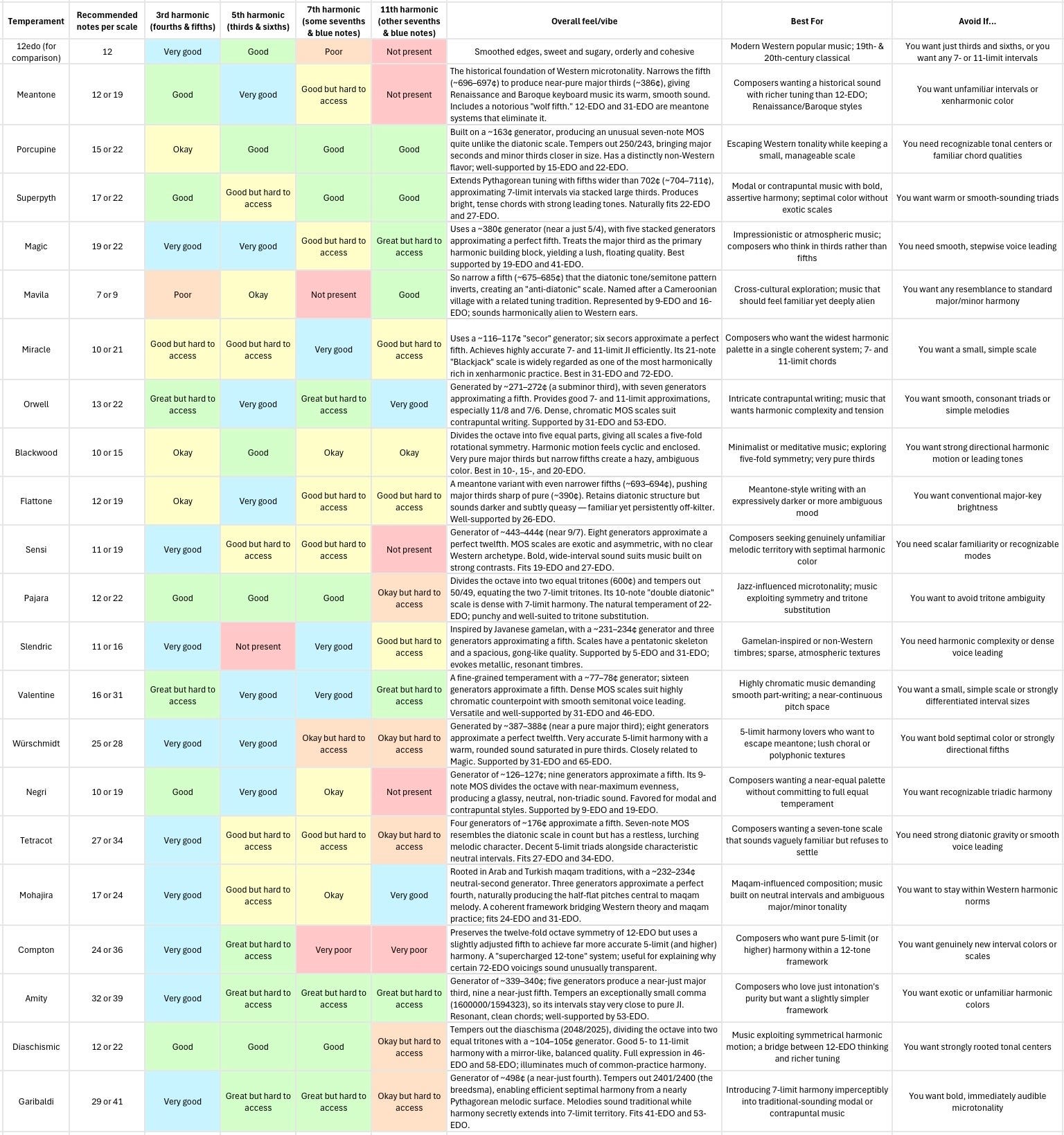
Summary table
Comments
Post a Comment