12-TET vs nearby tunings (9edo, 10edo, 11edo, 13edo, 14edo) — why 12 is better than its closest neighbors, but they’re still worth exploring
We’re going to look at the six tuning systems closest in size to 12-TET — specifically 9edo, 10edo, 11edo, 12edo (the one you already know), 13edo, and 14edo — and understand why 12 performs so well, and what each of its neighbors uniquely offers if you’re willing to explore.
Some Groundwork: What Is an EDO?
EDO stands for Equal Division of the Octave. It just means: take an octave, slice it into n equal pieces, and use those as your notes. Our familiar 12-TET (twelve-tone equal temperament) is 12edo — twelve equal slices. 9edo gives you nine slices, 13edo gives you thirteen, and so on.
Each slice is measured in cents, where 1200 cents = one octave. So:
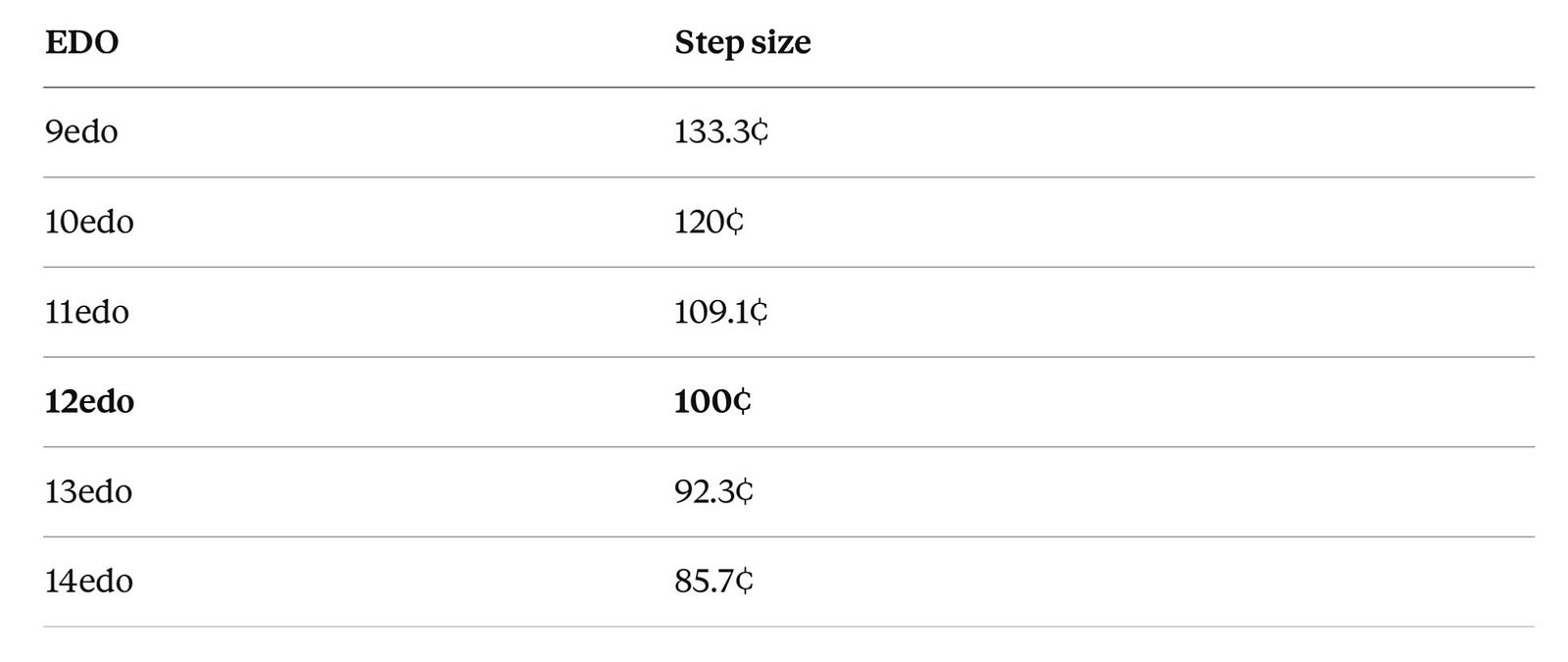
The question is: how well does each system approximate the natural intervals that our ears evolved to find consonant?
The Harmonic Series: Nature’s Tuning Template
When a string vibrates, it doesn’t just produce one frequency — it produces a whole stack of frequencies called the harmonic series: the fundamental, then twice the frequency (an octave), then three times (a fifth above that octave), then four times, five times, and so on.
The intervals we hear as most consonant correspond to simple whole-number ratios from this series. Rather than listing every possible interval, tuning theorists focus on the prime harmonics — primes being the irreducible building blocks from which all other ratios are constructed:
- Prime 3 → the ratio 3/2, a perfect fifth (701.955¢)
- Prime 5 → the ratio 5/4, a major third (386.314¢)
- Prime 7 → the ratio 7/4, the harmonic (or “barbershop”) seventh (968.826¢)
- Prime 11 → the ratio 11/8, a neutral fourth — right between a perfect fourth and a tritone (551.318¢)
- Prime 13 → the ratio 13/8, a neutral sixth — between a minor and major sixth (840.528¢)
How close each EDO gets to these targets tells us a lot about its harmonic character. Errors under about 15¢ are generally considered usable; under 7¢ is very good. Beyond 20–25¢, most listeners will clearly hear the interval as “off” from its just counterpart.
12edo: Why It’s the Sweet Spot (for Now)
Let’s start with home base. Here’s how 12edo approximates each prime:
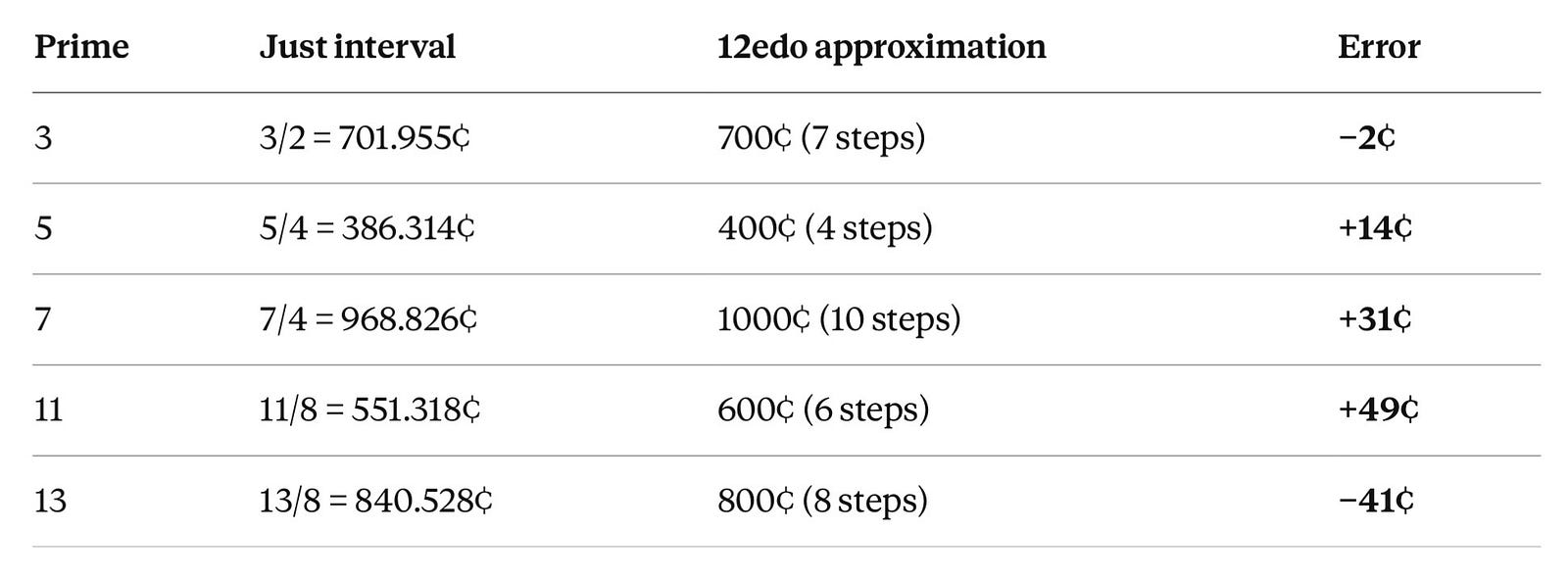
The story here is immediately clear. 12edo is spectacular at prime 3 (the perfect fifth is off by less than 2 cents — virtually perfect). It’s decent at prime 5 (the major third is 14 cents sharp, which most ears tolerate though it causes noticeable beating on sustained chords). And then it falls off a cliff: primes 7, 11, and 13 are all approximated very poorly — 31, 49, and 41 cents off respectively.
In other words, 12edo is essentially a 5-limit tuning system — it handles thirds and fifths, which is exactly what Western classical and pop music needs. Everything built on 7, 11, and 13? Those colours are simply absent from the palette.
But here’s why 12 is the sweet spot among small EDOs: it is the smallest EDO that can seriously claim to represent 5-limit harmony. Its fifth is nearly perfect, and its major third, while not perfect, is close enough to have powered centuries of Western music. No smaller EDO manages this combination. The next smallest ones to do similarly well are 19edo and 22edo.
9edo: The Antidiatonic Wild Card
9edo divides the octave into 9 steps of 133.3¢ each.
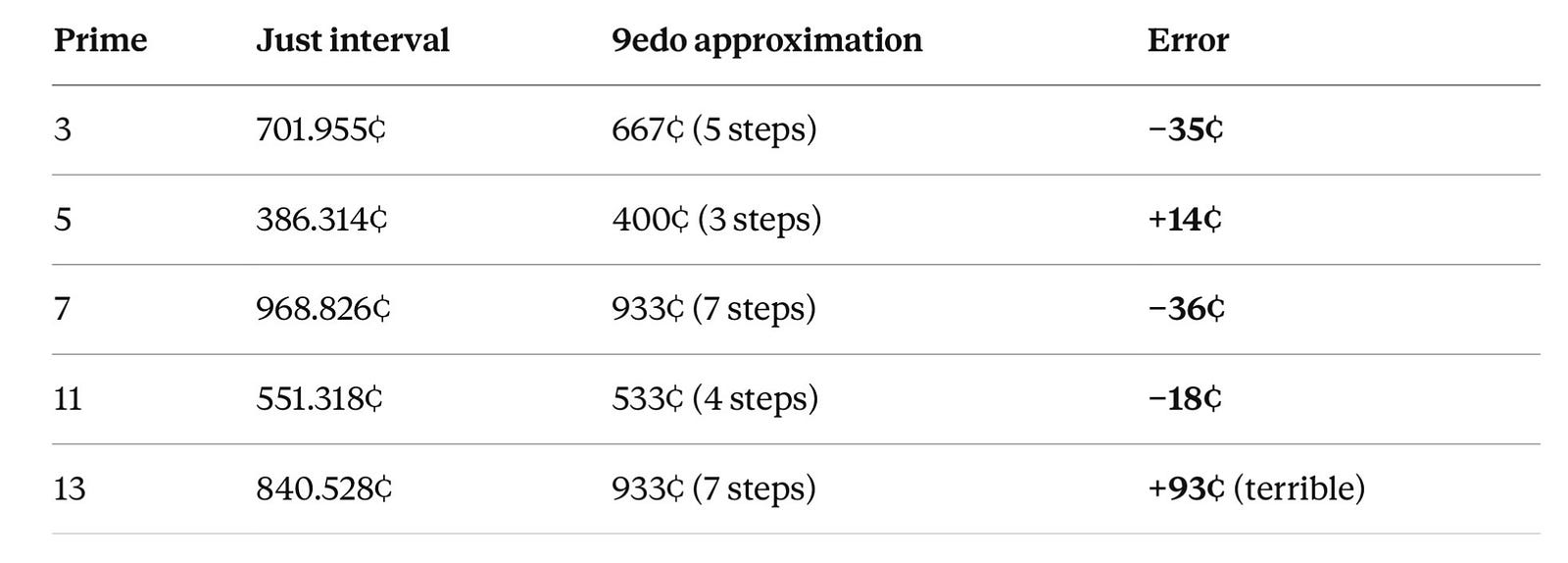
The big problem: 9edo’s “perfect fifth” lands at 667 cents — that’s 35 cents flat. You’ll hear immediately that it doesn’t sound like a fifth. The familiar tonal pillars of Western music — dominant–tonic resolution, power chords, the sonority of a major triad — all depend on a convincing fifth, and 9edo can’t provide one.
The upside: 9edo shares exactly 12edo’s major third error (both are +14¢ from a pure 5/4). And, 9edo has a very close approximation to the ratio 7/6 (a septimal subminor third) and its octave complement 12/7.
The scale 9edo generates is called the antidiatonic scale — structurally it mirrors the diatonic scale but with major and minor swapped. It has a curious, unmoored quality: dreamy, slightly suspended, like music that refuses to resolve. Some composers describe 9edo as perfect for music that lives in a state of perpetual ambiguity. Indonesian gamelan music also uses scales that can be (loosely) approximated by subsets of 9edo.
Who should explore it: Composers looking for a pentatonic-like simplicity with an alien sound. 9edo is also famously one of the easiest EDOs to tune by ear, since stacking nine 7/6 subminor thirds closes almost exactly back to an octave.
10edo: The Seventh-Limit Dark Horse
10edo gives us 120-cent steps.
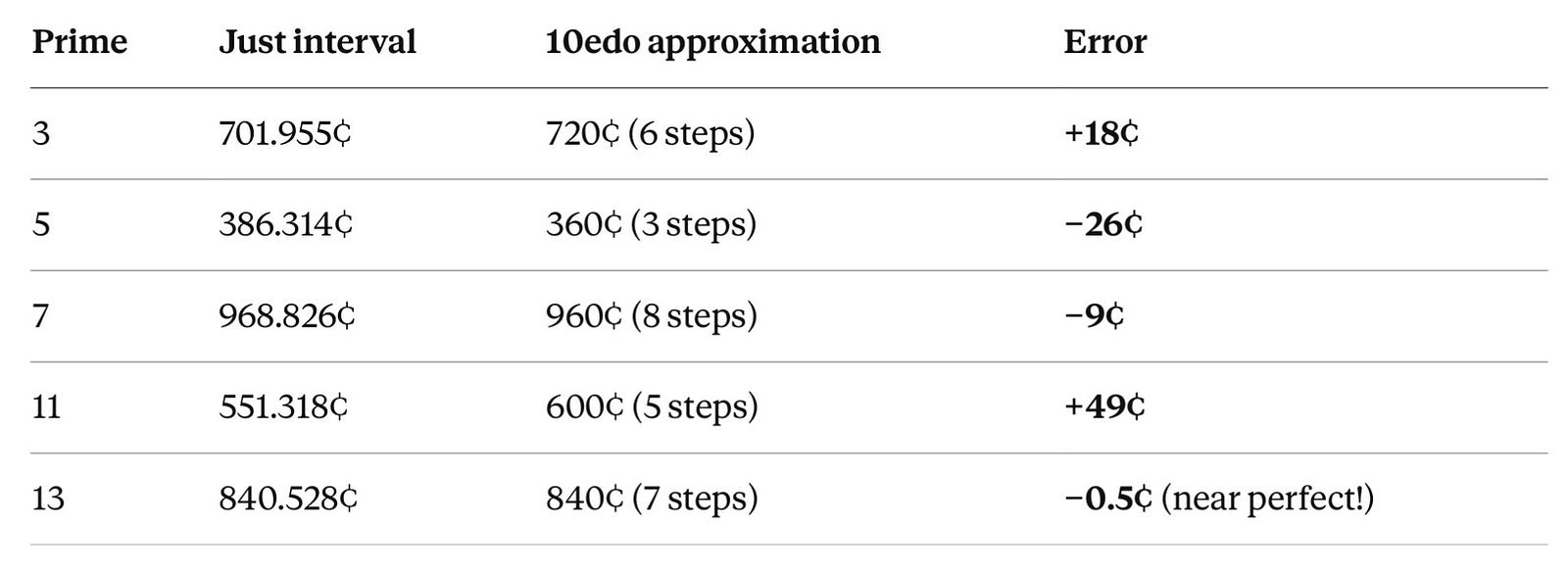
10edo’s profile is striking. Its fifth (+18¢) is noticeably wide, and its major third is 26 cents flat — both worse than 12edo, which is why 10edo can’t replace 12 for conventional harmony. The 11-limit approximation is also poor. But look at those last two rows.
The harmonic seventh (7/4) is only 9 cents flat in 10edo — genuinely usable, and much better than 12edo’s 31-cent error. And the 13th harmonic (13/8) is approximated to within half a cent — essentially just intonation. This is extraordinary for such a small system.
10edo is classified as a zeta peak EDO — a mathematical distinction indicating it punches above its weight in overall harmonic approximation. A useful way to think about 10edo: it lives in two separate worlds. The odd-numbered steps form a 5edo pentatonic scale (the whole-tone scale — familiar from Debussy). The even-numbered steps form another 5edo. You can bounce between them.
Who should explore it: Musicians interested in septimal (“7-limit”) harmonic colors. Blues and jazz musicians, take note — the near-pure harmonic seventh in 10edo gives a flavor of just barbershop harmony or blues “blue notes” that 12edo can’t match. A good entry point for people who want something different but not completely incomprehensible.
11edo: The Xenharmonic Oddity
11edo offers 109.1-cent steps — steps that are just barely larger than a 12edo semitone, giving the whole scale a curiously compressed quality.
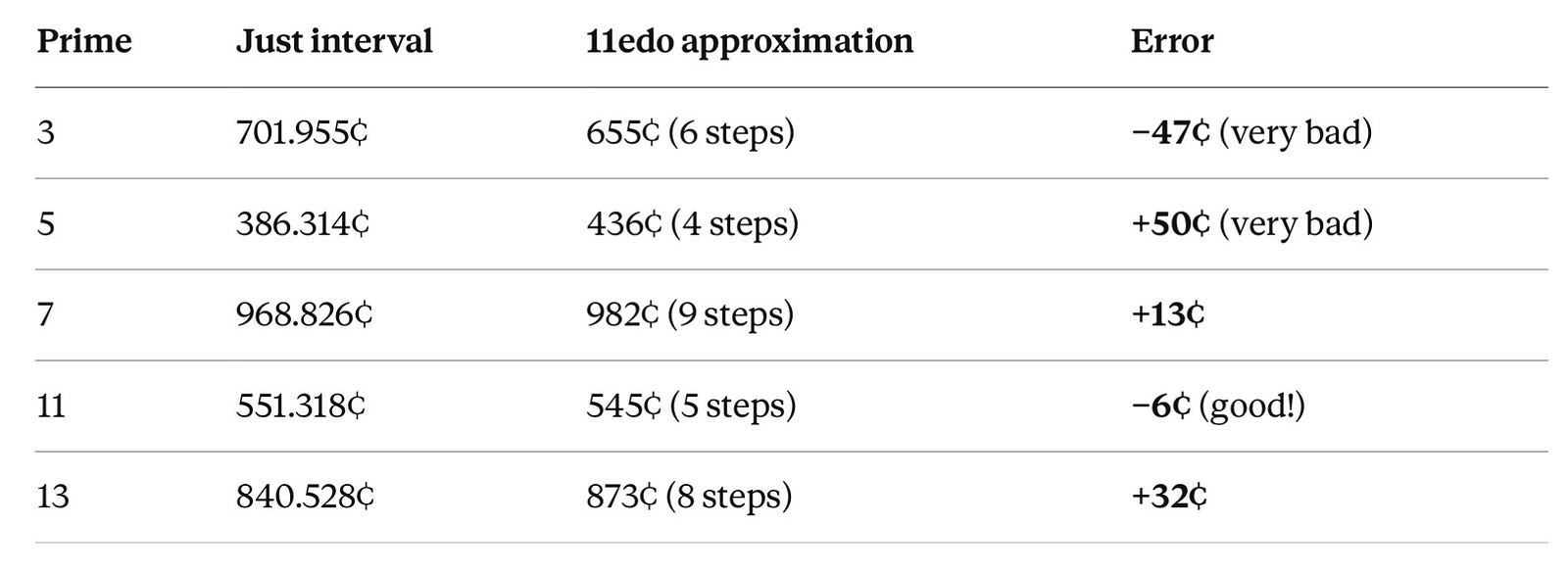
11edo is approximates primes 3 and 5 brutally poorly. The “fifth” is 47 cents flat — closer to a neutral sixth than a perfect fifth — and the “major third” is 50 cents sharp. Building conventional triads in 11edo sounds deliberately wrong, like music that’s been pushed through a funhouse mirror.
But prime 7 is usable (+13¢), and prime 11 — the 11th harmonic — is approximated to within just 6 cents, one of the better approximations available in any small EDO. This makes 11edo a genuinely interesting system for music that leans into the 11-limit, with its characteristic “neutral” intervals that sit exactly between major and minor.
Because 11 is a prime number, 11edo generates a richer variety of MOS (Moment of Symmetry) scales than 12edo. It has its own harmonic approach built on stacking 9/7 supermajor thirds. The community has produced an 11edo zine — apparently the first xenharmonic tuning to get its own zine. Clearly, it has its devotees.
Who should explore it: Experimental composers drawn to ambiguous, hovering harmonies. 11edo resists conventional tonal gravity almost completely — it’s for music that deliberately avoids the feeling of “home.”
13edo: A Parallel Universe
13edo gives 92.3-cent steps — slightly smaller than a semitone.
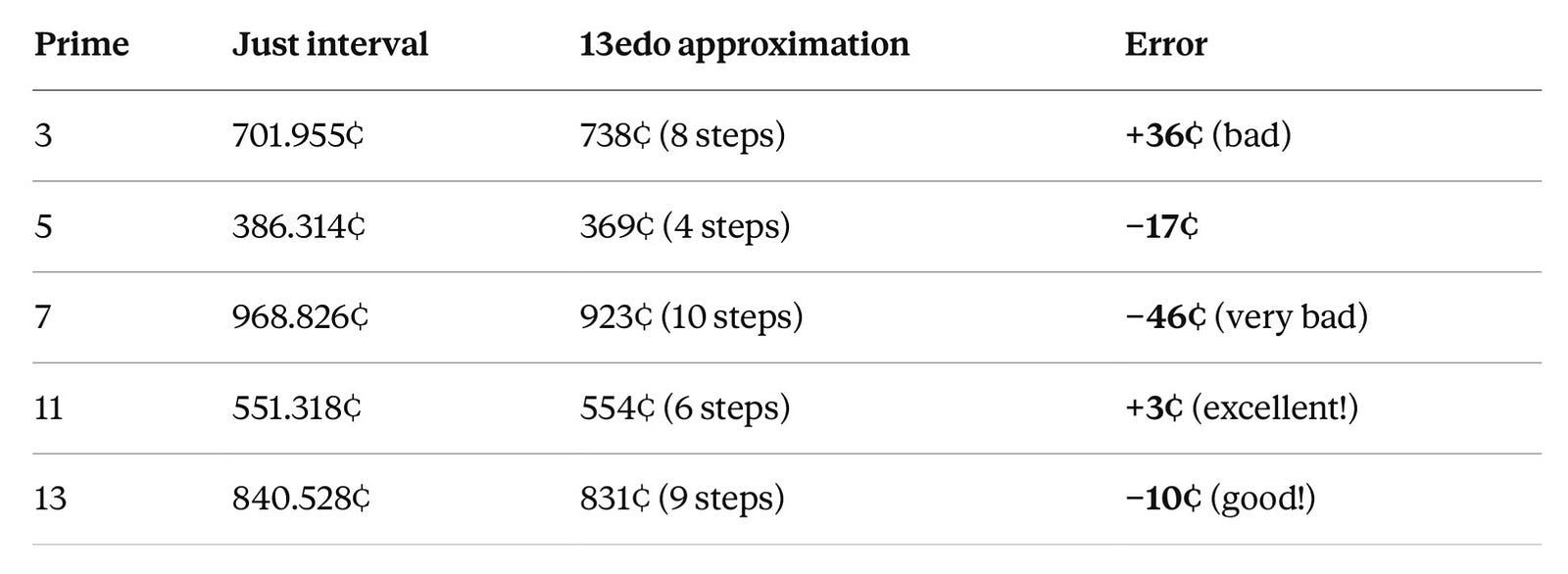
The fifth in 13edo is 36 cents sharp — completely unrecognisable as a perfect fifth — and the 7th harmonic is nearly 46 cents off. In terms of conventional harmony, 13edo is essentially unusable. It doesn’t have a perfect fifth or a perfect fourth in any recognisable sense.
But here’s what 13edo does have: an excellent approximation of prime 11 (only 3 cents off!) and a good approximation of prime 13 (about 10 cents off). Combined with a passable prime 5 (~17 cents), 13edo works beautifully as a 2.5.11.13 subgroup tuning — meaning chords built from those harmonics can sound genuinely consonant.
The Xen Wiki notes that 13edo also has exceptional approximations of the 17th, 19th, and 21st harmonics — colours that 12edo doesn’t touch at all.
One practical note that makes 13edo beginner-accessible: any familiar 12edo scale can be converted into a 13edo scale by adding one extra semitone or by widening one existing semitone to a whole tone. This means melodic lines in 13edo can sound tantalisingly familiar before drifting into something subtly alien.
Some composers describe 13edo as “the tuning from a parallel universe” — a world where the building blocks of harmony are irreversibly different from ours. The music is strange but internally consistent. That’s the appeal.
Who should explore it: Adventurous composers who want to start from scratch with harmony, building up from a new set of consonances. 13edo demands you unlearn familiar harmonic expectations and replace them with something new. It’s not for the faint-hearted, but its unique palette is genuinely unlike anything else in music.
14edo: Three Shades of Everything
14edo has 85.7-cent steps — noticeably smaller than a semitone, giving the scale a finer resolution.
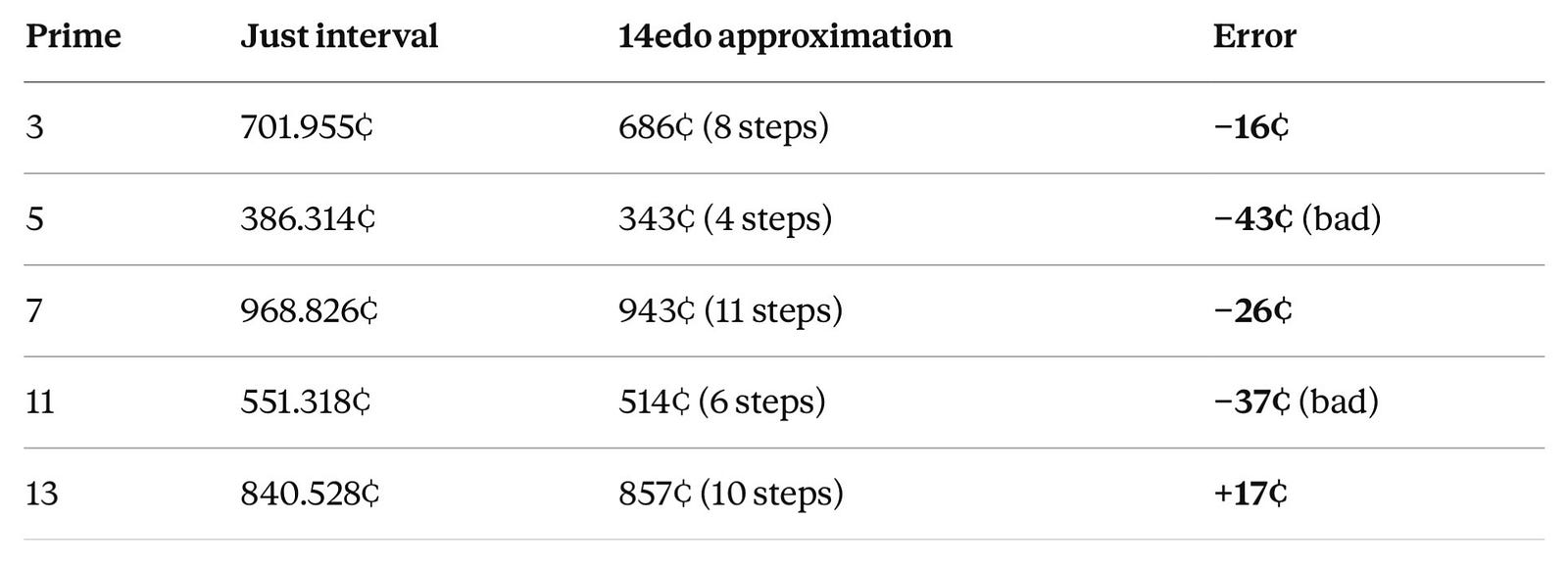
At first glance, 14edo looks uniformly mediocre — every prime is off by at least 16 cents, and primes 5 and 11 are quite badly approximated. If you’re chasing clean harmonic consonance, 14edo isn’t it.
But here’s what makes 14edo interesting: it has three sizes of third, three sizes of sixth, a recognisable fourth, and a recognisable fifth. In 12edo, you get two kinds of third (major and minor). In 14edo you get a whole spectrum — subminor, minor, and major — and likewise for sixths. The Xen Wiki notes that 14edo is actually quite useful for those wishing to “explore alternative triadic harmonies without adding significantly more notes” — you don’t need 31 or 41 notes to get harmonic colour variation; 14 will do.
14edo also contains 7edo as a subset (every other note), which is interesting because 7edo is one of the few EDOs used in historical world music contexts. So 14edo can be thought of as a refined 7edo.
There’s also a mathematical footnote: 14edo supports beep temperament, a quirky system where the interval 21/20 (the chromatic semitone in septimal harmony) is tempered out, creating unusual equivalences between intervals. It’s a “low-complexity, high-damage” temperament — meaning it does something harmonically interesting, but at the cost of accuracy.
Who should explore it: Musicians who want familiar structural landmarks (fourths, fifths, thirds) but want more tonal colours between them. 14edo is a good stepping stone for people who feel 12edo is too limited but aren’t ready to abandon tonal conventions entirely.
Side by Side: The Numbers Tell the Story
Here’s a consolidated summary of how all six EDOs approximate each prime harmonic, with errors in cents. Entries in bold are usable (under ~15¢); entries with ✗ are problematic (over ~25¢).
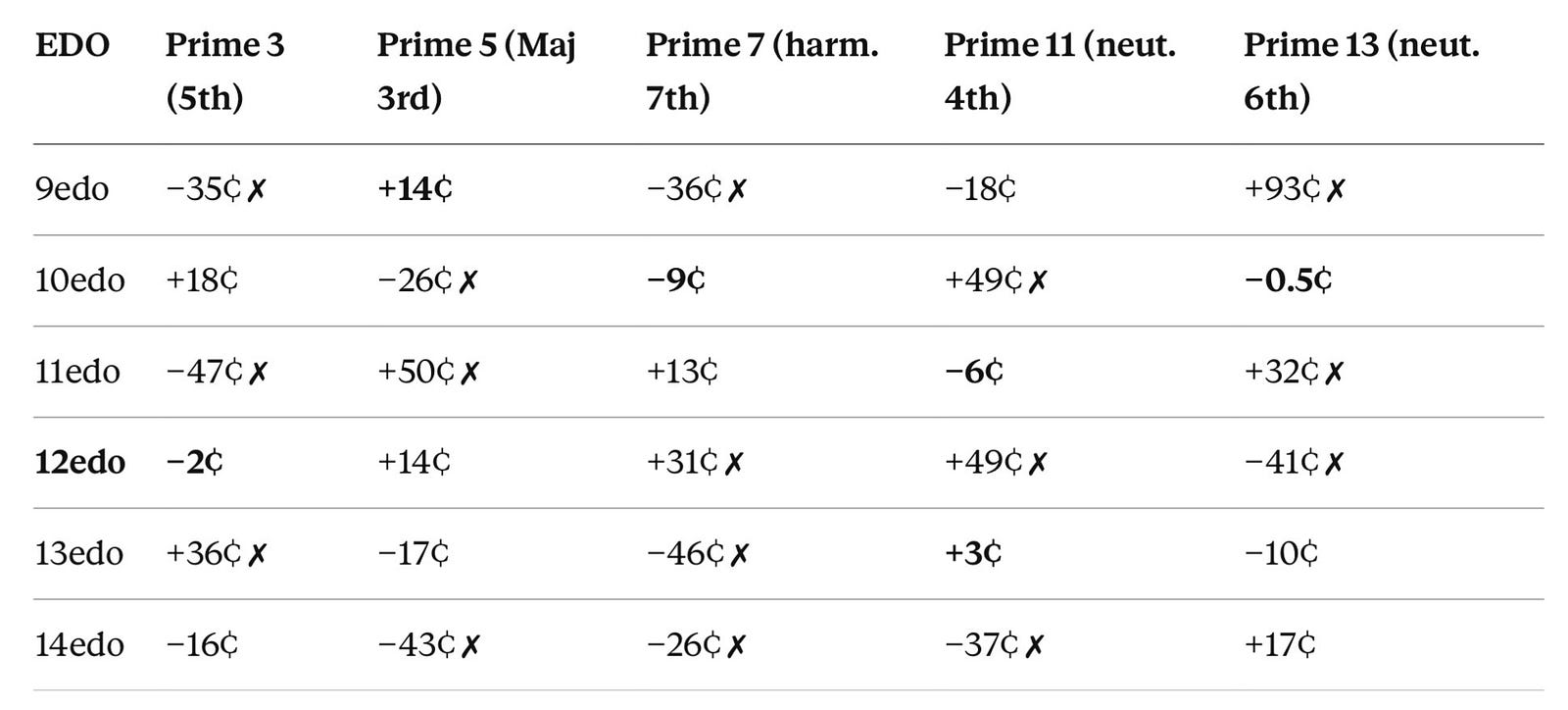
The pattern is striking. 12edo is the only one of these six that approximates prime 3 (the fifth) well — and a good fifth is the bedrock of everything we call “tonal music.” That’s the core reason why 12 sits at the centre of Western music history and not any of its neighbours.
But look at the colours the other EDOs do access. Prime 13 in 10edo. Prime 11 in 13edo. Prime 7 in 10edo. These are genuinely beautiful, consonant intervals that 12edo simply cannot approximate. The world of music doesn’t stop at the 5-limit.
Why 12 Won, Historically
It’s worth stating plainly: 12 didn’t win because of mathematical inevitability. It won because it was the smallest EDO that gave composers what they needed in the 18th–19th centuries — namely, good thirds and near-perfect fifths, combined with the ability to modulate freely through all keys without retuning.
Before 12edo was standardised, Western keyboards used unequal temperaments (like meantone or various well temperaments), where some keys sounded better than others. The move to 12edo was a compromise — accepting a slightly sharp major third in exchange for equal transposability to all 12 keys.
So 12edo is optimal for the harmonic goals of 18th–19th century Western music. For music that values prime 7 (blues, barbershop), prime 11 (Arabic maqam-like music, certain jazz extensions), primes 13 and above (avant-garde), or stretched primes (gamelan-influenced music), 12edo may actually be the wrong tool.
So Should You Try These Tunings?
The short answer is: yes, if you’re curious. And it’s easier than ever to experiment.
Software instruments like Surge XT, Vital, and LMMS support Scala (.scl) tuning files, which let you instantly retune them to any EDO. Notation software like Mus2 and Lumatone hardware isomorphic keyboards are designed with microtonal use in mind. Xen-calc is a free browser tool that lets you explore interval relationships in any tuning.
The Xenharmonic Wiki is the single best reference for all of this — a vast, community-built encyclopedia of tuning theory, scale design, and compositional approaches.
A suggested entry path:
- Start with 10edo — its 7th harmonic is beautiful, it contains a familiar pentatonic, and 10 notes isn’t overwhelming.
- Move to 9edo — simple enough to grasp quickly, sonically distinctive, and great for melodic composing.
- Try 14edo — if you want something with a fifth and triads, just subtly different from 12edo.
- Then 13edo or 11edo — once you’re comfortable abandoning the perfect fifth as a structural anchor.
None of these tunings replaces 12edo for most musical contexts. But each of them does something 12edo genuinely cannot. There are colours in the harmonic series that human music has barely touched — and they’re waiting just one or two divisions of the octave away.
Further Reading
- Xenharmonic Wiki: 12edo
- Xenharmonic Wiki: EDO (overview)
- Xenharmonic Wiki: Just Intonation
- Xenharmonic Wiki: Prime limit
- Xenharmonic Wiki: Harmonic series
- Xenharmonic Wiki: MOS scales
- Kyle Gann’s Just Intonation Primer — excellent introduction to the harmonic series and why it matters
Comments
Post a Comment