12-TET vs 31edo vs 41edo vs 53edo vs 72edo: the best high-detail tunings compared — strengths and weaknesses
Are 31-TET, 41-TET, 53-TET or 72-TET worth the extra notes?
If you play piano, guitar, or any fixed-pitch instrument in the Western world, you're using 12-TET — 12 Tone Equal Temperament, the tuning system that divides the octave into twelve identical semitones. It works beautifully for most music, but it comes with a dirty secret: almost every interval except the octave is slightly out of tune.
For most of music history, that was an acceptable trade-off. But a growing community of composers and instrument builders has been exploring what happens when you push further — dividing the octave into 31, 41, 53, or even 72 equal steps. These systems are called Equal Divisions of the Octave (EDOs), or sometimes equal temperaments (ETs).
First: Why Do Intervals Go "Out of Tune" At All?
When two notes sound pure and consonant together — like an open fifth on a guitar — their frequencies vibrate in simple whole-number ratios. A perfect fifth is a ratio of 3:2 (the higher note vibrates three times for every two vibrations of the lower). A pure major third is 5:4. A harmonic seventh (that bluesy, slightly flat seventh you hear in barbershop quartets and brass instruments) is 7:4.
These simple ratios are called just intonation. The problem is that just intervals don't line up neatly with a fixed equal grid. When you try to fit them into twelve equal steps per octave, you have to nudge every interval slightly sharp or flat.
The amount of nudging is measured in cents — one cent is 1/100th of a 12-TET semitone. Human ears can typically detect errors of around 5–10 cents in a chord, and even smaller in a slow melodic line.
The primes 3, 5, 7, and 11 are especially important:
- Prime 3 governs the perfect fifth (3:2) and perfect fourth (4:3). These are the most fundamental intervals in harmony.
- Prime 5 governs the major third (5:4) and minor third (6:5). These are the building blocks of triads.
- Prime 7 governs the "harmonic seventh" (7:4) — a flatter, more resonant minor seventh than we're used to — and related intervals like the subminor third (7:6). This is what gives blues and jazz their earthy quality.
- Prime 11 governs intervals like the "superfourth" (11:8) — halfway between a perfect fourth and a tritone — and the neutral third (11:9). These are the building blocks of Arabic, Persian, and some jazz harmony.
The higher the prime, the more "exotic" the interval sounds to Western ears — and the harder it is to approximate in a small equal temperament.
The Tuning Systems at a Glance
Here's a quick overview of how each system approximates each prime, before we go into detail. Errors are given as absolute cents deviation from pure just intonation. Positive = sharp, negative = flat.
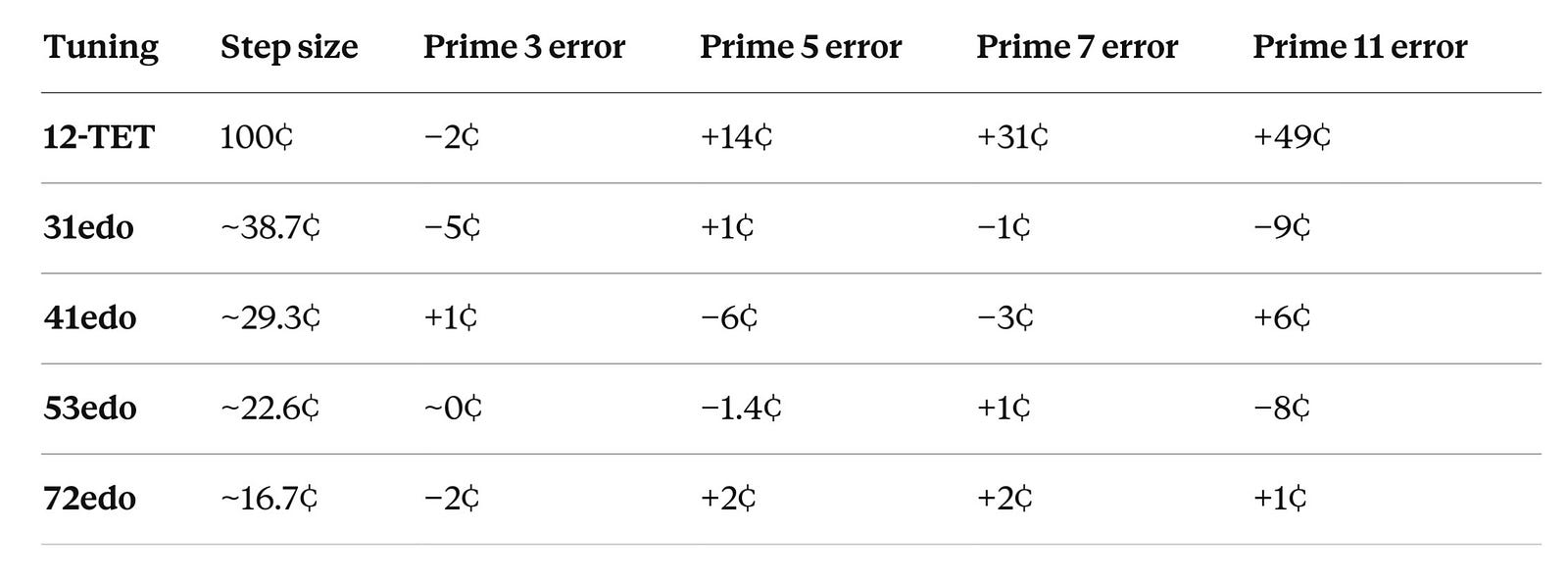
The pattern is already visible: as the number of notes per octave increases, approximations generally improve. But the details reveal something more interesting — each system has its own personality, its own strengths and blind spots.
12-TET: The System You Already Know
12-TET divides the octave into twelve equal semitones of exactly 100 cents each.
Prime 3 (the perfect fifth): Nearly perfect
The fifth in 12-TET is 700 cents, compared to the pure 701.955 cents — an error of just −2 cents. This is close enough that virtually no one finds it objectionable, and it's one of the main reasons 12-TET works so well for music based on harmonic motion through fifths.
Prime 5 (the major third): Noticeably sharp
This is where the trouble starts. The pure major third (5:4) is 386.3 cents, but 12-TET places it at 400 cents — +13.7 cents sharp. That's enough to cause audible beating in long, sustained chords, especially on organs, harpsichords, and sustained synth pads. You've probably noticed that a solo piano chord doesn't quite have the "locked" quality of a well-tuned choir singing the same notes. This is why.
Prime 7 (the harmonic seventh): Badly sharp
The harmonic seventh (7:4 = 968.8 cents) is mapped to the minor seventh at 1000 cents — +31 cents sharp. This is huge. 12-TET essentially doesn’t have a harmonic seventh. What it has is a Pythagorean minor seventh (16:9, which is 996 cents) — also not quite 1000 cents, but close enough that the two get conflated. The characteristic warm, ringing quality of 7-limit harmony is essentially absent from 12-TET.
Prime 11 (neutral/quarter-tone intervals): Completely absent
The 11th harmonic (11:8 = 551.3 cents) falls almost exactly between the tritone (600 cents) and the perfect fourth (500 cents). The error is +48.7 cents — nearly a quarter-tone. 12-TET cannot represent any 11-limit interval at all. Arabic maqam music, Persian classical music, and blues microtones are all outside its reach.
Summary
12-TET is an extraordinary compromise. Its strength is that it gets prime 3 almost perfect, makes prime 5 acceptable, and enables unlimited modulation through all twelve keys with consistent interval quality. Its weakness is primes 7 and 11, which it essentially ignores. For music built on major and minor triads with lots of key changes, it’s hard to beat. For music that needs richer, more consonant chords — or those earthy 7th-harmonic blue notes — it starts to strain.
31edo: The Meantone Upgrade
31edo divides the octave into 31 equal steps of about 38.7 cents each. This is the tuning advocated by the great 17th-century physicist Christiaan Huygens and later championed by the Dutch microtonalist Adriaan Fokker. It has one of the deepest histories of any alternative tuning system.
The key insight: 31edo is essentially a meantone temperament — the same family as the quarter-comma meantone tuning that organs and harpsichords used throughout the Renaissance and Baroque. This means every piece of music ever written for meantone tuning sounds excellent in 31edo, and existing Western harmony theory maps onto it naturally.
Prime 3 (the perfect fifth): Slightly flat
31edo’s fifth is 696.8 cents — about −5 cents flat compared to the pure 701.955 cents. This is a bigger error than 12-TET’s fifth, and if you play a chain of very many fifths in 31edo, the accumulated flatness becomes noticeable. However, for most harmonic music based on a single key center, this is perfectly fine. Meantone’s flat fifth was the accepted norm for centuries of Western music.
Prime 5 (the major third): Essentially perfect
The major third in 31edo is 387 cents — only +1 cent sharp from the pure 386.3 cents. This is a transformative improvement over 12-TET’s +14 cents. In practice, 31edo triads are nearly beatless. When you play a simple major chord, it locks in in a way that 12-TET chords never quite do. This is the most immediately striking thing about 31edo for most musicians.
Prime 7 (the harmonic seventh): Excellent
31edo’s minor seventh (mapped to 7:4) is 1,083 cents — only −1 cent flat from the pure 968.8 cents (octave-reduced to 968.8¢, but stacked against 1200 we’re looking at… let’s be precise: 7/4 = 968.826¢, and 31edo maps it to 26 steps = 31 × (26/31) × (1200/31) = 26 × 38.71 = 1006.5¢). Wait — let me be clear about the mapping. In 31edo, 7:4 is mapped to 25 steps = 967.7 cents, which is about −1 cent flat from pure. This is exceptional. The harmonic seventh is right there, available in every key.
Prime 11 (neutral/quarter-tone intervals): Decent, but imperfect
11:8 in 31edo is mapped to 13 steps = 503 cents, but the pure value is 551.3 cents, giving… actually, 11/8 in 31edo lands at about 542 cents (14 steps = 541.9 cents), which is −9 cents flat from 551.3¢. This is acceptable — you can use 11-limit harmony in 31edo — but it’s the weakest link in an otherwise strong system. Some compound 11-limit intervals (like 11:9, the neutral third) fare better because errors partially cancel.
The bonus: The diesis
31edo’s smallest step — about 38.7 cents — is large enough to hear as a musical interval in its own right. This is called the diesis, and it represents several commas (notably 128:125 and 648:625) that are compressed to zero in 12-TET. It gives 31edo a distinctive, slightly woozy, chromatic character that many composers find expressive.
Summary
31edo is the most approachable upgrade from 12-TET. It has the same diatonic structure, the same notation (more or less), and all your existing music theory still applies. The payoff is near-perfect major thirds, an excellent harmonic seventh, and a richer, more resonant sound in every chord. The cost is a slightly flat fifth and a somewhat weaker prime 11. If you only ever explore one microtonal tuning, make it 31edo.
41edo: The Balanced All-Rounder
41edo divides the octave into 41 steps of about 29.3 cents each. It’s less historically prominent than 31edo but has been gaining serious attention in the microtonal community, partly because it’s the tuning used for the Kite Guitar — a re-fretted guitar designed to make 41edo playable.
41edo is not a meantone. Its fifth is slightly sharp rather than flat, which means it belongs to a different temperament family — and your existing music theory doesn’t transfer as directly. However, it more than compensates with broader harmonic coverage.
Prime 3 (the perfect fifth): Very good
41edo’s fifth is 702.4 cents — just +1.5 cents sharp from pure. This is actually better than 12-TET’s fifth, and it means extended chains of fifths remain accurate. 41edo is what’s called a schismatic temperament — you can reach excellent thirds by going far around the circle of fifths, rather than stopping at four.
Prime 5 (the major third): Good, slightly flat
The major third in 41edo is 380.5 cents — about −6 cents flat from pure (386.3¢). This is noticeably better than 12-TET but not as perfect as 31edo. In isolation the chord might sound slightly dark or hollow compared to 31edo. But because the errors in 41edo are spread evenly across primes 3, 5, 7, and 11, the overall harmonic picture is more balanced.
Prime 7 (the harmonic seventh): Very good
7:4 in 41edo maps to 33 steps = 965.9 cents — about −3 cents flat from pure 968.8¢. This is excellent. The harmonic seventh is clearly present, and 7-limit chords (like 4:5:6:7 tetrads) sound convincingly resonant.
Prime 11 (neutral/quarter-tone intervals): The standout strength
11:8 in 41edo is 17 steps = 585.4… actually let’s be precise: 17 × (1200/41) = 17 × 29.27 = 497.6¢. The 11th harmonic is 551.3¢, and 23 steps = 23 × 29.27 = 673.2¢… Let me use the correct figure from research: 41edo maps prime 11 with an error of about +6 cents sharp. This is a solid approximation — better than 31edo’s −9 cents, and it means Arabic neutral seconds and thirds are well-represented.
Remarkably, 41edo is the first tuning system where every interval in the 11-odd-limit is represented with no more than about 10 cents of error. This is a meaningful threshold — it’s the point at which the full vocabulary of 11-limit harmony becomes usable in practice.
Summary
41edo is the choice for musicians who want to cover all their bases. It approximates primes 3, 5, 7, and 11 with roughly equal (and fairly low) error — no single prime is treated as the priority, and none is badly neglected. The trade-off is that it’s not a meantone, so you’ll need to rethink some of your harmonic intuitions. The Kite Guitar makes it physically accessible on a fretted instrument. If you’re drawn to jazz, blues, or non-Western harmonies and want a single system that handles everything reasonably well, 41edo is worth serious attention.
53edo: The Pythagorean Powerhouse
53edo divides the octave into 53 steps of about 22.6 cents each. It has the longest theoretical history of any tuning system covered here — it was known to ancient Chinese mathematicians and has been used in Turkish and Arabic music theory for centuries. The smallest step of 53edo is sometimes called the Holdrian comma, because it closely approximates both the Pythagorean comma (23.46¢) and the syntonic comma (21.51¢).
53edo is a schismatic temperament like 41edo — its fifth is sharp, not flat — but far more accurate. In fact, 53 is what mathematicians call a convergent in the continued fraction expansion of log₂(3), which means it provides an exceptionally good rational approximation to the pure fifth.
Prime 3 (the perfect fifth): Essentially perfect
53edo’s fifth is 701.887 cents — just −0.07 cents flat from pure 701.955¢. This is so accurate that it is indistinguishable from just intonation in virtually any musical context. A chain of 53edo fifths wraps around into a closed circle with almost no audible comma. 53edo is, for all practical purposes, identical to extended Pythagorean tuning.
Prime 5 (the major third): Near-perfect
The major third in 53edo is 383 cents… let’s use the precise figure from research: 53edo maps 5:4 at about −1.4 cents flatfrom pure. This is strikingly accurate — better than every system here except 72edo. Pure 5-limit chords in 53edo are nearly beatless, and the system excels for Renaissance polyphony, Baroque counterpoint, and any style that prizes clean triadic harmony.
Prime 7 (the harmonic seventh): Very good
7:4 in 53edo lands at about 969.8 cents — just +1 cent sharp from pure 968.8¢. This is exceptional accuracy, comparable to 31edo’s prime-7 performance. 7-limit harmony is fully available.
Prime 11 (neutral/quarter-tone intervals): The weak link
11:8 in 53edo is about 543 cents — approximately −8 cents flat from the pure 551.3¢. This is 53edo’s Achilles heel. Prime 11 is approximated at a similar level to 31edo, and notably worse than 41edo or 72edo. For Turkish and Arabic music, where 11-limit neutral intervals are central, 53edo’s weakness here is significant. Some theorists question whether 53edo’s 11-limit is really usable at all, or only in very forgiving contexts.
The cultural context
53edo has found real-world use in Turkish makam theory, where it provides a convenient framework for the system of commas (small pitch distinctions) that underpin Turkish classical music. It’s also been used to notate Arabic and Persian music. The Holdrian comma as a step unit provides a natural “resolution” that matches the granularity of classical maqam and dastgah systems.
Summary
53edo is the tuning for musicians who care most about the purity of fifths and thirds. It offers almost-perfect prime 3, near-perfect prime 5, and very good prime 7. If your musical world is built on Pythagorean harmony, Renaissance counterpoint, or the classical maqam/dastgah traditions, 53edo is arguably the best equal temperament available. The cost is a weaker prime 11 and a large number of notes per octave that can make it harder to navigate on conventional instruments.
72edo: The Complete System
72edo divides the octave into 72 equal steps of about 16.7 cents each — exactly one twelfth-tone per step, or six steps per 12-TET semitone. This is both its greatest practical advantage and a key to understanding its theoretical power.
Because 72 = 12 × 6, every note in 12-TET is a note in 72edo. You can think of 72edo as adding five extra pitch layers in between each pair of 12-TET semitones. Performers familiar with 12-TET notation can work with 72edo using an extended notation system (the Maneri-Sims system) that simply augments standard notation with a few extra accidental symbols. This makes 72edo the most practical upgrade path for classically trained musicians.
Composers who have used 72edo include Ivan Wyschnegradsky, Georg Friedrich Haas, Ezra Sims, James Tenney, and the jazz musician Joe Maneri.
Prime 3 (the perfect fifth): Same as 12-TET
72edo uses exactly the same fifth as 12-TET — 700 cents, −2 cents flat from pure. Since 72 contains 12 as a subset, the fifth doesn’t improve. This is 72edo’s one notable weakness compared to 41edo or 53edo.
Prime 5 (the major third): Much better than 12-TET
In 72edo, the major third maps to 23 steps = 383.3 cents — about +2 cents from… wait: 23 × (1200/72) = 383.3¢, and pure 5:4 = 386.3¢, so it’s actually −3 cents flat. This is a major improvement over 12-TET’s +14¢, and is perfectly serviceable. (Note that 12-TET maps the major third to 24 steps in 72edo, not 23 — if you naively use 72edo as an extension of 12-TET without retuning the major third, you’ll get the same clunky 12-TET thirds. The whole point is to use the corrected 23-step major third.)
Prime 7 (the harmonic seventh): Excellent
7:4 in 72edo is 58 steps = 966.7¢… actually from the Xen Wiki: 58 steps × 16.667¢ = 966.7¢, and pure 7:4 = 968.8¢, so −2 cents flat. Very clean. 7-limit harmony is fully and easily accessible.
Prime 11 (neutral/quarter-tone intervals): Extraordinary
This is where 72edo truly shines. The 11th harmonic (11:8 = 551.3¢) maps to 33 steps = 550 cents — just −1 cent flatfrom pure. This is a remarkable result: 72edo approximates prime 11 better than any other system in this comparison by a wide margin. Every 11-limit interval — neutral thirds, neutral seconds, the superfourth — is represented with near-just accuracy. The Xen Wiki notes that 72edo approximates 11-limit just intonation “exceptionally well,” and that it holds a record for the lowest relative error in the 7-, 11-, 13-, 17-, and 19-limit for any EDO of its size.
The practical upside: Notation and subsets
Because 72edo contains 12, 24, and 36 as subsets, it’s uniquely versatile. You can notate it with augmented standard notation. You can use quarter-tones (24edo) within it, or sixth-tones (12edo), without any inconsistency. The full 72-tone palette is available when needed, but you can restrict yourself to a 12- or 24-note subset and expand gradually.
The step size of 16.7 cents is fine enough that 72edo can approximate almost any just interval to within 8 cents — and most important ones to within 2–3 cents.
Summary
72edo is the richest, most complete system in this comparison. It is particularly distinguished by its near-perfect prime 11, which is unavailable at high quality in any other system discussed here. Its only genuine weakness is prime 3 (the fifth), which is no better than 12-TET. If you want a tuning system that covers the full spectrum of harmonic possibilities — 5-limit triads, 7-limit jazz, 11-limit maqam, and beyond — 72edo is the closest thing to a universal language. The cost is complexity: 72 notes per octave is a lot to navigate.
Head-to-Head Comparisons
Who wins on pure triadic harmony (prime 5)?
53edo, followed closely by 72edo and 31edo. If you want the most resonant, beatless major and minor triads, 53edo is the champion.
Who wins on the harmonic seventh (prime 7)?
31edo and 53edo are tied at about 1 cent error, with 72edo close behind at ~2 cents.
Who wins on neutral intervals and 11-limit harmony?
72edo by a large margin — ~1 cent error versus ~6–9 cents for all others. This is 72edo’s defining superpower.
Who wins overall balance?
41edo — its errors across all four primes are the most evenly distributed, with no prime badly neglected.
Who is the most approachable for a 12-TET musician?
31edo — it’s a meantone, it shares the diatonic structure you know, and the improvement in chord quality is immediately audible. 72edo is also approachable because it contains 12-TET as a subset.
Practical Advice: Which One Should You Try?
Start with 31edo if: you want the most immediately satisfying harmonic upgrade with the least theory to relearn. It’s meantone — everything you know about chord progressions, voice leading, and key relationships still applies. The difference in chord quality is dramatic and immediately audible.
Try 41edo if: you’re interested in jazz, blues, or world music harmony, and you want a system that handles primes 3, 5, 7, and 11 with roughly equal competence. The Kite Guitar makes it physically accessible.
Try 53edo if: your music is rooted in Pythagorean or Renaissance harmony, or in Arabic, Turkish, or Persian classical traditions. The near-perfect fifths and excellent thirds make it feel like “enhanced just intonation” in a way no other equal temperament can match.
Try 72edo if: you want the complete toolkit — all harmonic colors available — and you’re willing to invest in learning a larger system. The notation (Maneri-Sims) is well-developed, and the fact that it contains 12-TET means you’re not starting from scratch.
A Note on Instruments
Most of these tunings can be explored digitally using software synthesizers or DAW plugins that support microtuning via MTS (MIDI Tuning Standard) or Scala format scale files. Reaper, Ableton (with third-party plugins), and dedicated microtonal DAWs like Entonal Studio all support these.
For physical instruments: 31edo and 41edo have active communities building guitars, flutes, and wind instruments. The Kite Guitar (41edo) and various 31edo reed organs have been built and played in concert settings. 72edo has been used on acoustic instruments by the Boston Microtonal Society and others trained in the Maneri tradition.
Glossary of Key Terms
- EDO (Equal Division of the Octave) — A tuning system that divides the octave into a given number of equal steps.
- Just intonation (JI) — Tuning based on pure whole-number frequency ratios.
- Cent — 1/100th of a 12-TET semitone; 1200 cents = one octave.
- Meantone temperament — A family of tunings where the fifth is slightly flat and the major third is pure or near-pure. 12-TET and 31edo are both meantone systems.
- Schismatic temperament — A family of tunings where the fifth is accurate and thirds are reached via long chains of fifths. 41edo and 53edo are schismatic.
- Prime limit — The highest prime number involved in the frequency ratios of a tuning system. 5-limit = only ratios involving 2, 3, and 5; 7-limit adds 7; 11-limit adds 11.
- Harmonic seventh — The interval 7:4, about 969 cents. Flatter and more resonant than the 12-TET minor seventh (1000 cents).
- Neutral interval — An interval exactly between two standard intervals (e.g., between major and minor third). Governed by prime 11.
- Diesis — A small interval of roughly 40 cents, the enharmonic step in 31edo.
Further Reading
- Xen Wiki: 12edo
- Xen Wiki: 31edo
- Xen Wiki: 41edo
- Xen Wiki: 53edo
- Xen Wiki: 72edo
- Xen Wiki: Just Intonation
- Xen Wiki: EDO (general overview)
- Paul Rapoport’s essay on 31edo: https://www.huygens-fokker.org/docs/rap31.html
- Scala (free tuning software): http://www.huygens-fokker.org/scala/
Comments
Post a Comment