12-TET vs 15edo vs 17edo vs 19edo vs 22edo: the best small-sized tunings compared — strengths and weaknesses
This article compares five small equal temperament tuning systems: 12-TET, 15-TET, 17-TET, 19-TET, and 22-TET. All of them use fewer than 25 notes per octave — manageable on a retuned instrument or DAW (using Entonal Studio) — and all of them have real musical strengths. We’ll look at what each one does well and where it falls short, with a focus on how well each approximates the harmonic series: specifically the 3rd, 5th, 7th, and 11th harmonics, which are the building blocks of the intervals you already know and love, plus a few you’ve probably never heard.
Quick Reference: Error Table
Here is a summary of each tuning’s approximation error in cents for the key just intervals. Errors under 7 cents are excellent (★★★), 7–14 cents are good (★★☆), 14–20 cents are fair (★☆☆), and over 20 cents are poor (✗).
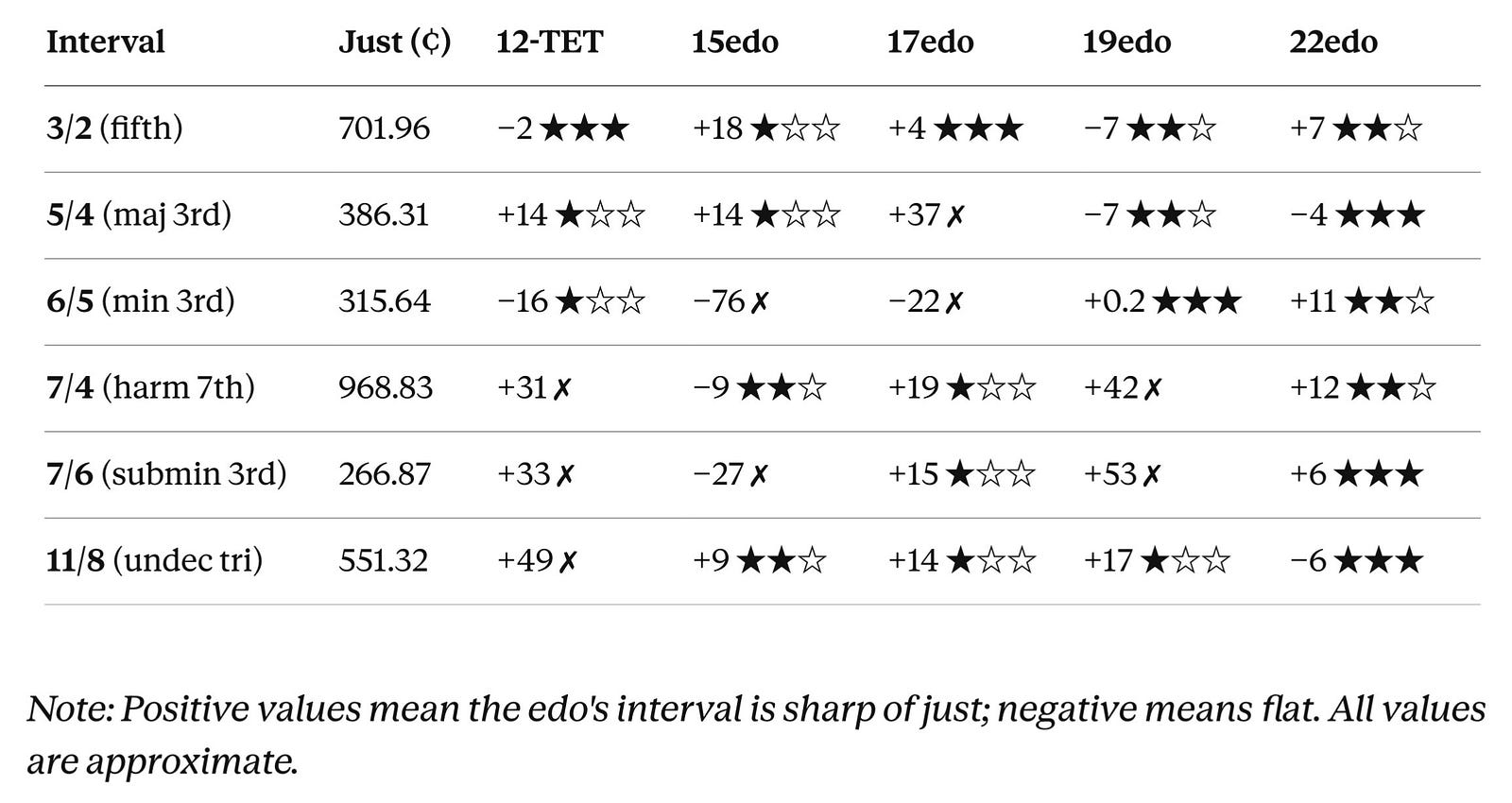
A Quick Primer: What Does “Approximating a Prime” Actually Mean?
When we talk about prime harmonics, we’re talking about the natural overtones that physical sound produces. When a string or pipe vibrates, it doesn’t just produce one note — it produces a whole series of frequencies stacked on top: the fundamental, then twice the frequency (the octave), three times (an octave + fifth), four times (two octaves), five times (two octaves + major third), seven times (two octaves + flat minor seventh), eleven times (three octaves + a very flat tritone), and so on.
These ratios — 3/2, 5/4, 7/4, 11/8 — are the intervals of just intonation. They sound pure and resonant because the overtones of the two notes line up. A tuning system earns points by placing its notes close to these pure ratios.
We measure closeness in cents — a unit where 100 cents = one semitone in 12-TET, and 1200 cents = one octave. An error of fewer than about 7 cents is generally very good. An error of around 14–20 cents is passable. Over 20 cents is significantly out of tune, though it can sometimes be used as a feature rather than a bug.
The four primes we’ll track:
- Prime 3 → the perfect fifth (3/2 = 701.96 cents) and its inversion, the perfect fourth
- Prime 5 → the major third (5/4 = 386.31 cents) and minor third (6/5 = 315.64 cents)
- Prime 7 → the harmonic seventh (7/4 = 968.83 cents), a flatter, smoother dominant seventh; also 7/6 (subminor third) and 7/5 (tritone)
- Prime 11 → the undecimal tritone (11/8 = 551.32 cents), a distinctively bright half-fourth; also 11/9 (neutral third) and 11/6
12-TET — The Devil You Know
Step size: 100 cents exactly | Notes per octave: 12
12-TET is the system built into every standard piano, guitar, and synthesizer. It became dominant in Western music by the 18th century and is now the de facto global tuning standard for most genres. Its defining feature is perfect enharmonic equivalence: C♯ and D♭ are the exact same pitch, which makes transposing to any key trivially easy.
Prime 3 (The Fifth)
12-TET’s perfect fifth is 700 cents — just 2 cents flat of pure. This is essentially inaudible. It’s the best thing 12-TET does. The circle of fifths closes perfectly after 12 steps, which is why key signatures and transposition are so clean.
Prime 5 (The Major Third)
Here’s where 12-TET starts to compromise. Its major third is 400 cents — 14 cents sharp of the just 386 cents. This is the audible “buzz” in sustained 12-TET major chords that early instrument builders and theorists spent centuries trying to minimize. Minor thirds (300 cents) are about 16 cents flat of just. Harmonic richness and true consonance come at a cost in this system.
Prime 7 (The Harmonic Seventh)
12-TET’s minor seventh is 1000 cents, which is 31 cents sharp of the harmonic seventh 7/4 (969 cents). This is a large error. The dominant seventh chord in 12-TET doesn’t actually approximate a pure 4:5:6:7 chord — it’s a meantone construct that was never intended to. As theorist Kyle Gann puts it, 7-related intervals “fall about a third of a half-step away from 12-pitch equal temperament.” The system essentially ignores prime 7.
Prime 11 (The Undecimal Tritone)
The tritone in 12-TET is 600 cents, while 11/8 is 551 cents. That’s 49 cents sharp — nearly a quarter-tone off. The 11th harmonic is completely absent from 12-TET’s vocabulary.
Overall Character
12-TET is an extraordinary all-rounder. It has a nearly perfect fifth, unlimited transposability, an enormous existing repertoire, and enormous practical infrastructure (every keyboard, every fret, every notation software). Its cost is in the purity of thirds and its total neglect of primes 7 and 11. For most music that lives harmonically in triads and seventh chords, this cost is accepted as the price of convenience. But you’ve been paying it every time you played a sustained major chord and heard it wobble slightly.
Best for: Western common-practice music, jazz, genres requiring frequent modulation, any situation where existing instruments and notation are paramount.
15edo — The Wild Card
Step size: 80 cents | Notes per octave: 15
15edo is the odd one out in this comparison. It’s not a meantone tuning (more on that later), and it doesn’t closely resemble 12-TET in feel. Yet it has a devoted following for its uniquely accessible approach to prime 7 and 11 harmony, and it’s small enough to be physically manageable.
Prime 3 (The Fifth)
This is 15edo’s biggest weakness. Its best fifth is 9 steps × 80 cents = 720 cents — 18 cents sharp of just. That’s a significant error, noticeably rough in sustained fifths. Practically, this means that traditional Pythagorean harmony (stacked fifths/fourths as the backbone of melody and counterpoint) doesn’t work cleanly in 15edo. Composers using 15edo generally need to avoid building music around fifths as primary structural pillars.
Prime 5 (The Major Third)
15edo’s major third is 5 steps × 80 cents = 400 cents — the same as 12-TET, 14 cents sharp of just. Its minor third is 3 steps × 80 cents = 240 cents, which is about 76 cents flat of just (315 cents). This means 15edo’s minor thirds sound distinctly “subminor” — closer to the 7/6 (267 cents) harmonic than the 6/5 consonance. 5-limit triads in 15edo are workable but not pure.
Prime 7 (The Harmonic Seventh)
This is where 15edo shines. The harmonic seventh (7/4 = 969 cents) falls very close to 12 steps × 80 cents = 960 cents — only 9 cents flat. Its subminor third (7/6 = 267 cents) is approximated by 3 steps at 240 cents — close enough to be recognizable. 15edo also handles the 7/5 tritone (583 cents) with only an 11-cent error. For a 15-note system, this is impressive 7-limit coverage.
Prime 11 (The Undecimal Tritone)
15edo is often cited as the smallest edo that meaningfully engages with prime 11. Its 7-step interval is 560 cents, only 9 cents sharp of 11/8 (551 cents). The neutral third 11/9 (347 cents) is approximated at 4 steps (320 cents) — rougher, but usable. As the Xen Wiki notes, “15edo is generally considered to be the first edo to work as an 11-limit system.”
Special Feature: Blackwood Temperament
Because 15 = 3 × 5, 15edo contains an embedded 5edo (every third note). This enables Blackwood temperament, a harmonic system where every note of a 10-note scale can serve as the root of both a major and minor chord. Named after composer Easley Blackwood Jr., it’s a genuinely novel harmonic universe that simply does not exist in 12-TET.
Overall Character
15edo is perhaps the most “alien” tuning in this comparison. Its rough fifths make it ill-suited for music that depends on clear Pythagorean harmony, but its strong 7- and 11-limit intervals open up a rich world of septimal and undecimal chords that 12-TET can’t touch. It’s particularly interesting for composers willing to treat the sharp fifth as a feature, and for exploring the porcupine and Valentine temperament families.
Best for: Septimal and undecimal harmony, composers comfortable abandoning tonal conventions, guitar (whose open-string symmetry works well in 15edo).
17edo — The Pythagorean Futurist
Step size: ~70.6 cents | Notes per octave: 17
17edo is the natural conclusion of Pythagorean thinking taken one step further than 12. Its defining property is a sharp fifth (~706 cents, about 4 cents sharp of just), which produces a family of intervals that sounds deliberately tense and edgy — more medieval European than Renaissance, and more Middle Eastern than Western. It also happens to be excellent at prime 7, 11, and 13.
Prime 3 (The Fifth)
17edo’s fifth is 10 steps × 70.6 cents ≈ 706 cents — 4 cents sharp of just. This is very good. It’s sharper than 12-TET’s fifth but still quite usable. The extra sharpness gives it a distinctly bright, hard quality that emphasizes the Pythagorean character of the diatonic scale: wider whole steps, smaller semitones. As the Xen Wiki describes it, 17edo “emphasizes the hardness of Pythagorean tuning rather than mellowing it out.”
Prime 5 (The Major Third)
Here’s the big trade-off. 17edo’s major third is 6 steps × 70.6 cents ≈ 424 cents — over 37 cents sharp of just 5/4. This is a significant miss. The Xen Wiki states plainly that it “completely misses harmonic 5, with 5/4 and 6/5 both being about halfway between its steps.” Traditional major and minor triads in 17edo sound harsh and dissonant by 5-limit standards. If smooth thirds and triads are your priority, 17edo is wrong for you.
Prime 7 (The Harmonic Seventh)
This is one of 17edo’s great surprises. The harmonic seventh (969 cents) falls near 14 steps ≈ 988 cents — about 19 cents sharp, which is not amazing but is much better than 12-TET’s 31-cent error. More importantly, the subminor third 7/6 (267 cents) is closely approximated by 4 steps ≈ 282 cents (15 cents sharp), and the 7/6 interval plays a prominent musical role. The Xen Wiki notes that 17edo “tempers out 64/63, equating the harmonic seventh 7/4 with the Pythagorean minor seventh 16/9,” meaning the dominant seventh chord is actually interpreted as a near-7-limit consonance. Chord structures like 6:7:8:9 (a tight, bright cluster around the seventh harmonic) come naturally in 17edo.
Prime 11 (The Undecimal Tritone)
17edo handles prime 11 well. Its neutral second (~141 cents) falls close to 12/11 (151 cents) and 13/12 (139 cents). More directly, the 11-step interval ≈ 776 cents is a reasonable approximation of 14/9, and 8 steps ≈ 565 cents is close to 11/8 (551 cents) — about 14 cents sharp. The neutral scale built on stacked neutral thirds is one of 17edo’s most celebrated features, giving it an evocative maqam-like character ideal for Middle Eastern or modal music.
Overall Character
17edo is a superpythagorean tuning — it takes the bright, tense quality of Pythagorean thirds and pushes it further. It is essentially useless for music that relies on smooth 5-limit triads, but excellent for music that thrives on raw power, tension, and resolution. Think modal metal, Arabic maqam, or counterpoint-focused music where fifths and fourths dominate. The Mercury Tree, a progressive rock band, has explored 17edo extensively.
Best for: Modal and Pythagorean-based music, Middle Eastern-inflected scales, composers willing to abandon 5-limit triads entirely, melody-first composition.
19edo — The Meantone Upgrade
Step size: ~63.2 cents | Notes per octave: 19
19edo is the most “12-TET-compatible” tuning in this comparison. It sounds familiar enough to feel safe, yet delivers significantly purer thirds, more nuanced enharmonic spelling, and a richer modal landscape. Mathematician Wesley Woolhouse proposed it as a practical alternative to other meantone tunings as early as 1835. It is the meantone temperament most closely related to historical 1/3-comma meantone — the tuning system that dominated European keyboard music before equal temperament.
Prime 3 (The Fifth)
19edo’s fifth is 11 steps × 63.2 cents ≈ 694.7 cents — about 7 cents flat of just. This is acceptable but noticeably flatter than 12-TET’s fifth. The flatness is the deliberate trade-off meantone makes: by flattening the fifth slightly, stacking four of them gives you a beautifully pure major third. This is the defining bargain of the entire meantone tradition.
Prime 5 (The Major Third)
19edo’s major third is 6 steps × 63.2 cents ≈ 378.9 cents — about 7 cents flat of just 386 cents. This is excellent. It’s considerably purer than 12-TET’s 400-cent major third, and it gives major triads a warm, blooming consonance. The minor third is 5 steps ≈ 315.8 cents — nearly perfect (just = 315.6 cents). As one analysis notes, all the main 5-limit intervals (6/5, 5/4, 4/3, 3/2, 8/5, 5/3, 9/5) are within about 8.5 cents of just. 19edo is, harmonically, 12-TET with the thirds fixed.
Prime 7 (The Harmonic Seventh)
19edo’s treatment of prime 7 is a mixed picture. It’s better than 12-TET — its minor seventh (1010 cents) is about 42 cents sharp of 7/4, which is ironically worse than 12-TET on that specific interval, but the overall 7-limit situation is nuanced. The subminor third (7/6 = 267 cents) maps to 3 steps ≈ 189 cents or 4 steps ≈ 253 cents — neither is great. The Xen Wiki notes that 19edo “conflates the septimal subminor third (7/6) with the septimal whole tone (8/7),” which is a real limitation. That said, 19edo has temperaments like Keemun and Negri that squeeze useful 7-limit tetrads out of the available notes.
Prime 11 (The Undecimal Tritone)
19edo is not a strong 11-limit system. Its tritone is 9 steps ≈ 568 cents, which is 17 cents sharp of 11/8 — usable but not precise. The neutral third 11/9 (347 cents) falls between steps, making consistent 11-limit harmony awkward. This is a known limitation.
Special Feature: Enharmonic Richness
Unlike 12-TET, where C♯ and D♭ are identical, 19edo distinguishes them — in fact, its chromatic semitone (63 cents) is smaller than its diatonic semitone (126 cents), the opposite of what’s conventional in Western notation but actually closer to Renaissance practice. This gives composers access to a much richer palette of expressive microtonal inflections within a still-familiar harmonic framework.
Overall Character
19edo is the easiest on-ramp into the microtonal world for a classically trained musician. Its diatonic scale sounds strikingly like “meantone in tune” — richer and more resonant than 12-TET. You can play existing repertoire in 19edo and it will sound recognizable but noticeably sweeter. The expansion beyond 12 notes gives you enharmonic nuance that Renaissance and Baroque musicians would have recognized. Many 19edo instruments have been built (guitars, keyboards, wind instruments), making it one of the most practically accessible alternative tunings.
Best for: Anyone coming from a Western classical background, meantone-based harmony, expressive music with rich triadic textures, beginners to microtonality who want to stay close to home.
22edo — The Best of Both Worlds
Step size: ~54.5 cents | Notes per octave: 22
22edo is arguably the most harmonically powerful tuning in this comparison. Music theorist Paul Erlich described it as capable of supporting a new kind of tonality analogous to but distinct from meantone, and microtonalists frequently rank it as the best “small” system for approaching true just intonation across multiple prime limits. The idea dates back to 19th-century theorist R. H. M. Bosanquet, and it was rediscovered and championed throughout the 20th century.
Prime 3 (The Fifth)
22edo’s fifth is 13 steps × 54.5 cents ≈ 709 cents — about 7 cents sharp of just. Like 17edo, it’s a superpythagorean tuning with a sharp fifth. This is a significant departure from 12-TET’s feel and means that traditional meantone-based harmony doesn’t apply. However, the error is still within acceptable range, and many 22edo compositions use the sharp-fifth diatonic scale effectively.
Prime 5 (The Major Third)
22edo’s major third is 7 steps × 54.5 cents ≈ 381.8 cents — just 4.5 cents flat of just 386 cents. This is remarkably good for such a small system. The minor third is 6 steps ≈ 327 cents — about 11 cents sharp of just. The Xen Wiki confirms that 22edo is one of only three edos under 30 that approximates the 5-limit to within a Tenney–Euclidean error of 4 cents (the others being 12 and 19). In other words, 22edo has excellent major thirds despite not being a meantone.
A crucial consequence: because 22edo doesn’t temper out the syntonic comma (81/80), it distinguishes the two different whole tones of just intonation — 9/8 (the larger tone) and 10/9 (the smaller one). Composers have to be mindful of this, since the same chord in different keys will have slightly different spacings. This is more demanding to work with, but it’s also more harmonically expressive — and closer to how string players and singers naturally intonate.
Prime 7 (The Harmonic Seventh)
This is 22edo’s crown jewel. Its harmonic seventh approximation is 7/4 ≈ 14 steps ≈ 763 cents… wait — let’s be precise:7/4 = 969 cents, and 18 steps × 54.5 ≈ 981 cents — only 12 cents sharp of just. But more critically, the subminor third7/6 (267 cents) falls near 5 steps ≈ 273 cents — just 6 cents sharp. And 7/5 (583 cents) is approximated at 11 steps ≈ 600 cents — the exact semioctave. The Xen Wiki states that unlike 12 or 19, 22edo “is able to approximate the 7- and 11-limit to within 3 cents of error.” That’s an extraordinary claim for a system with only 22 notes. 22edo is the smallest edo that represents the 11-odd-limit consistently.
This 7-limit strength enables pajara, a system of harmony built on two interlocking chains of fifths, and superpyth, which equates Pythagorean minor sevenths with the harmonic seventh — exactly as in 17edo, but with far better 5-limit thirds as well.
Prime 11 (The Undecimal Tritone)
22edo is the smallest equal division to represent the 11-odd-limit consistently. Its approximation of 11/8 (551 cents) falls at 10 steps ≈ 545 cents — just 6 cents flat. The neutral third 11/9 (347 cents) sits at 6 steps ≈ 327 cents (20 cents flat), which is on the edge of acceptability — but other 11-limit intervals are precise enough to make 22edo a genuine undecimal system.
One particularly elegant property: the small whole-tone step (164 cents, 3 steps) simultaneously approximates three different 11-limit intervals — 10/9 (182 cents), 11/10 (165 cents), and 12/11 (151 cents). This ambiguous, flexible interval is one of 22edo’s most musically interesting features.
Special Feature: Porcupine and Pajara
22edo supports two landmark temperaments. Porcupine generates 7- and 8-note scales using a generator of about 164 cents — yielding a melodic language completely unlike the diatonic scale but internally consistent. Pajara uses a period of a half-octave (600 cents) and generates the “decatonic scales” that Paul Erlich identified as a potential 7-limit analogue to the diatonic scale. Both offer fully-formed harmonic systems that simply don’t exist in 12-TET.
Overall Character
22edo is demanding but rewarding. Its sharp fifth means that playing familiar diatonic music requires adjusting expectations. Simple translations of 5-limit music into 22edo can sound different from 12-TET in character — the harmonic quality is richer and more complex. But for composers willing to engage with it on its own terms, 22edo offers unparalleled harmonic resources for a system this small: excellent 5-limit thirds, strong 7-limit septimal intervals, and consistent 11-limit harmony all in one package. Paul Erlich’s paper Tuning, Tonality, and Twenty-Two-Tone Temperament(freely available as a PDF) remains essential reading for anyone who wants to go deep.
Best for: Composers who want maximum harmonic range in a compact system, septimal and undecimal harmony, explorers of entirely new harmonic languages, anyone who has outgrown 19edo.
Summary: Which Tuning Is Right for You?
Choose 12-TET if you’re working with 12-tone instruments, existing repertoire, or any context where standard notation is non-negotiable. You already live here.
Choose 15edo if you want to explore 7- and 11-limit harmony in a small system and you’re willing to accept rough fifths and a genuinely alien sound world. Good for guitarists and experimental composers.
Choose 17edo if you love bright, tense Pythagorean harmony and want to extend it with 7- and 11-limit colors. Good for Middle Eastern-influenced music, modal metal, and melody-first composition. Expect to abandon smooth triads.
Choose 19edo if you want the easiest transition from 12-TET. You get better thirds, more expressive enharmonics, and a warm, meantone richness — all within a system that still sounds familiar. The best entry point for classically trained musicians.
Choose 22edo if you want the most harmonic power per note in a small system. It’s the most demanding of the alternatives, but it offers excellent 5-, 7-, and 11-limit harmony simultaneously — a combination that no larger system under ~31 notes can match.
Where to Go From Here
The field of exploring alternative tunings is called xenharmonics or microtonality. The best starting resources are:
- Xenharmonic Wiki — the comprehensive reference for everything in this article and far beyond
- Sevish — a composer and producer making genuinely accessible microtonal music, with tutorials and tools
- Paul Erlich’s “Tuning, Tonality, and Twenty-Two-Tone Temperament” — the seminal paper on 22edo and a great introduction to thinking about tonality systematically
- Scala and Surge XT synthesizer — free software tools for experimenting with any tuning
The best thing you can do is listen. Retune a synthesizer to 19edo or 22edo and play some chords. Theory only takes you so far — at some point, your ears have to decide what’s interesting.
Comments
Post a Comment