Just intonation, equal temperaments, regular temperaments, combination product sets & others…
What Is Microtonality?
If you’ve ever played a piano or guitar, you’ve been working within a system called twelve-tone equal temperament, or 12-TET for short. This is the dominant tuning system in Western music, and it works by dividing the octave into exactly twelve equal steps, called semitones.
Each of those twelve steps is precisely the same size as every other, which makes it very convenient. A piano tuned this way sounds equally in-tune (or equally slightly out-of-tune, depending on your perspective) in every musical key. It’s a brilliant compromise that has powered centuries of Western classical, jazz, pop, and rock music.
But here’s the thing — it is a compromise.
The intervals in 12-TET are somewhat close to, but not exactly, the pure mathematical ratios that occur naturally in the physics of sound. And the twelve notes don’t come anywhere near covering all the pitches the human voice or ear is capable of perceiving.
Microtonality is the broad term for any musical system that steps outside this twelve-note framework — using smaller intervals, different divisions of the octave, or entirely different mathematical approaches to pitch altogether. The world of microtonal tuning is vast, ancient, mathematically deep, and musically fascinating.
Just Intonation
Just intonation is perhaps the oldest and most mathematically fundamental approach to tuning. Rather than dividing the octave into equal steps, just intonation derives every interval from simple whole-number ratios — the same ratios that appear naturally in the sequence of overtones that rings out whenever a physical object vibrates (the harmonic series).
A perfect fifth, for instance, is expressed as the ratio 3:2, meaning one note vibrates exactly one and a half times as fast as the other. A major third is 5:4. These intervals are called “pure” or “just” because the sound waves of the two notes lock together with a kind of physical precision that produces a smooth, resonant sound, free of the subtle beating or wavering that equal-tempered intervals produce.
Just intonation can be extended in many directions. Five-limit just intonation uses only ratios built from the prime numbers 2, 3, and 5, which gives you a rich palette of consonant major and minor intervals. Seven-limit just intonationintroduces the prime number 7, unlocking a new class of intervals — like the 7:4 harmonic seventh — that sound bluesy, warm, and distinctly different from anything in 12-TET. Eleven-limit and thirteen-limit systems go further still, introducing increasingly exotic and unfamiliar interval colors. The composer Harry Partch, one of the great pioneers of microtonal music, built his entire compositional world around 43-tone just intonation based on ratios up to the 11-limit, even constructing his own custom instruments to play it.
The practical challenge of just intonation is that it doesn’t transpose cleanly. A scale perfectly tuned in the key of C will have slightly wrong intervals when you try to play in the key of G, because the pure ratios shift in ways that don’t align with a fixed set of pitches. This is why equal temperament was invented — but composers and theorists have developed many clever systems to work around just intonation’s limitations, including adaptive just intonation, where pitches shift slightly in real time to keep harmonies pure as the music moves through different keys.
Equal Temperament Divisions Other Than 12
One of the most natural ways to explore microtonality is simply to divide the octave into a number of equal steps other than twelve. These systems are called N-TET or N-EDO (equal divisions of the octave), and the possibilities are essentially endless, each with its own distinct harmonic personality.
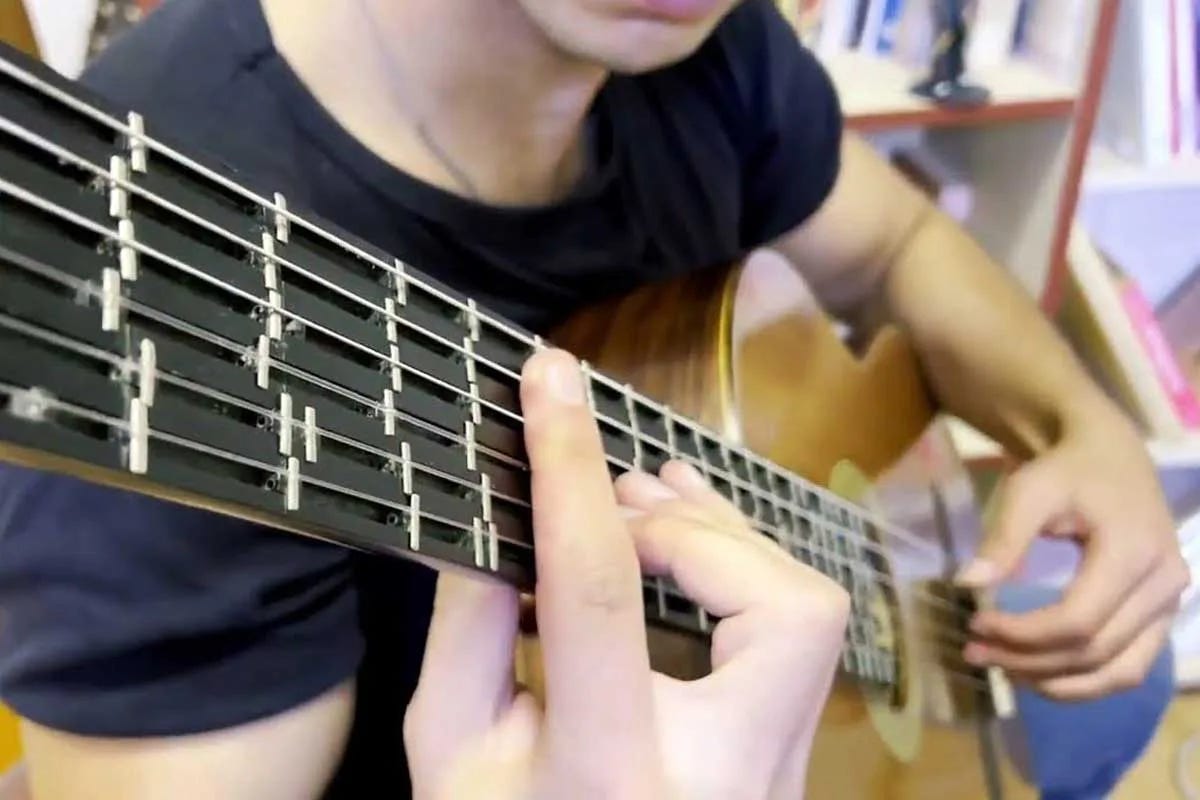
19-TET divides the octave into nineteen equal steps, making each step slightly smaller than a semitone. It was proposed as early as the sixteenth century and has a warm, slightly exotic quality. Its major thirds are actually closer to pure just intervals than those of 12-TET, and it preserves a familiar sense of tonality while opening up new melodic colors. Many guitarists have experimented with 19-TET fretboards.
22-TET is beloved in microtonal circles for its rich harmonic structure. It contains intervals that approximate the harmonic seventh and other seven-limit ratios quite well, giving it a bluesy, soulful expressiveness. Indian classical music theorist Vishnu Narayan Bhatkhande described 22 pitches in an octave called shrutis, and while the 22-TET system doesn’t map perfectly onto that tradition, it shares a certain conceptual kinship with it.
31-TET has a long and distinguished history, championed by Renaissance theorist Nicola Vicentino and later by Dutch physicist Adriaan Fokker. It approximates five-limit just intonation beautifully — its major thirds are almost indistinguishable from pure 5:4 ratios — and it also handles seven-limit harmony with grace. Many scholars consider 31-TET the best equal temperament for extending Western harmonic practice.
41-TET and 53-TET are systems that achieve very high accuracy in approximating just intervals. 53-TET in particular is remarkable: the Chinese theorist Jing Fang described it in the first century BCE, and it was independently rediscovered multiple times across cultures. Its perfect fifths are extraordinarily close to pure 3:2, making it essentially indistinguishable from Pythagorean tuning across a huge range of keys.
72-TET divides the octave into seventy-two equal steps, each one-sixth of a standard semitone. It approximates 11-limit just intonation with remarkable accuracy and has been used in contemporary classical composition, particularly by composers like Joe Maneri and in certain traditions of Byzantine chant theory.
At the more extreme end, systems like 96-TET, 118-TET, and beyond exist, and composers have written for them, though they require either electronic instruments or exceptionally skilled performers. On the other side of the spectrum, 5-TET and 7-TET — dividing the octave into just five or seven equal parts — produce scales that sound genuinely alien to Western ears, with no recognizable major or minor thirds at all, offering a kind of tonal blank slate for composers who want to start from scratch.
Meantone Temperaments
Meantone temperament is a family of historical tuning systems that predate equal temperament and represent one of the first systematic attempts to tame the inconsistencies of just intonation. The basic idea is to slightly flatten the perfect fifth from its pure 3:2 ratio so that, after a chain of those fifths, the major thirds come out purer and sweeter than they would in the older Pythagorean tuning (3-limit just intonation).
The term “meantone” comes from the fact that the whole tone in these systems is the geometric mean between a major and a minor tone.
Quarter-comma meantone, the most famous variety, flattens each fifth by a quarter of the syntonic comma — a tiny interval that represents the discrepancy between Pythagorean and just major thirds. The result is that major thirds are virtually pure, giving Renaissance and early Baroque music played in this tuning a luminous, lush quality that 12-TET can’t quite replicate.
The downside is the infamous “wolf interval” — one particularly dissonant fifth that appears when you close the circle of fifths, howling like its namesake animal. Composers writing in meantone carefully avoided certain key combinations, and the emotional character of each key was distinct and expressive.
Fifth-comma and sixth-comma meantone are other variants that make different tradeoffs, moving slightly closer to equal temperament and redistributing the wolf interval’s pain differently.
Extended meantone systems attempt to add extra notes — split keys on harpsichords and organs were one solution, allowing a single instrument to access both, say, G# and Ab as distinct pitches.
Well Temperaments
Well temperament is the family of tuning systems that Bach’s Well-Tempered Clavier is often associated with (exactly which well temperament Bach intended remains debated).
Unlike equal temperament, well temperaments are not perfectly equal — each key has a subtly different character, some smoother and more consonant, others brighter or slightly more tense. But unlike strict meantone, there is no wolf interval, and all twenty-four major and minor keys are usable.
Well temperaments represent a middle path.
The variety of key colors well temperaments produce was considered by many composers to be a feature, not a bug. C major might sound serene and pure, while F# major might have a bright, edgy quality. Andreas Werckmeister, Johann Philipp Kirnberger, and Francesco Antonio Vallotti all devised distinct well temperaments, each with their own distribution of purity and tension across the keys.
Non-Octave Systems
Most tuning systems treat the octave — the 2:1 frequency ratio — as the fundamental repeating unit of musical structure. But some microtonal systems challenge even this assumption.
Bohlen-Pierce tuning is the most famous non-octave tuning system: instead of the octave, it uses the tritave — the 3:1 ratio, an interval of a twelfth — as its period of equivalence, and divides it into thirteen equal steps. The resulting scale has no octaves at all and is built around ratios involving the prime numbers 3, 5, and 7, giving it an eerie, otherworldly sound. It has been championed by composers like Georg Hajdu and explored in electronic music contexts where the lack of conventional harmonic relationships creates a genuinely alien sonic world.
The Wendy Carlos alpha, beta, and gamma scales are another set of non-octave systems, designed by the pioneering synthesist who first brought microtonal music to wide public attention. Carlos constructed these scales by finding equal divisions of a non-octave interval that best approximate certain just intervals, arriving at scales with steps of roughly 78, 63.8, and 35.1 cents respectively. They produce music that is recognizably harmonic — consonances and dissonances exist and function — but that drifts away from the octave in uncanny ways over larger ranges.
Spectral Tuning
Rather than deriving pitches from mathematical abstractions, spectral tuning grounds itself in the physics of real sound. When a string, pipe, or voice produces a note, it simultaneously generates a whole series of overtones — the second harmonic at twice the frequency, the third at three times, the fourth at four times, and so on into the upper reaches of hearing.
Spectral composers like Gérard Grisey and Tristan Murail built entire pieces around these natural harmonic relationships, tuning their orchestras and ensembles to approximate the overtone series of specific fundamental pitches.
The resulting harmonies are deeply resonant and physically grounded — they feel like an expansion of a single sound into a chord — but they don’t line up neatly with 12-TET and require microtonal notation and performance.
Spectral tuning blurs the line between timbre and harmony, treating them as two aspects of the same acoustic phenomenon.
The related timbral tuning is a similar concept, except for instruments with inharmonic overtone spectra. There are many different kinds of timbral tuning.
Rank-2 and Regular Temperaments
Modern microtonal theory has developed a sophisticated mathematical framework for describing and classifying tuning systems called regular temperament theory.
A rank-2 temperament is any system generated by exactly two independent interval generators — typically a period (often the octave) and a generator (often a fifth or some other interval).
Meantone is a rank-2 temperament, generated by the octave and a tempered fifth. But the framework generalizes this idea enormously.
Miracle temperament, for instance, uses a small generator of about 116.7 cents — slightly larger than a whole tone — to generate scales that approximate 11-limit just intonation with remarkable efficiency.
Pajara temperament divides the octave into two equal halves, with a generator near a tempered fifth, producing scales with ten or twelve notes that handle seven-limit harmony very well.
Mavila temperament, based on the traditional music of the Chopi people of Mozambique, reverses the usual relationship between major and minor, producing a scale that shares the same structural logic as the Western diatonic scale but in which the intervals are inverted.
Orwell, Würschmidt, Hanson, Negri — the catalog of named temperaments runs into the hundreds, each representing a distinct way of mapping just intonation onto a manageable set of pitches.
Combination Product Sets
Combination product sets (CPS), are a family of just intonation scales discovered by the American composer and theorist Erv Wilson in the latter half of the twentieth century. They represent one of the most mathematically beautiful structures in tuning theory, offering a fundamentally different way of thinking about how a just intonation scale can be constructed.
The basic idea begins with a set of odd-number factors — say, the numbers 1, 3, 5, and 7 — and generates pitches by taking every possible product of a chosen number of those factors taken at a time. If you have four factors and you take them two at a time, you get six possible products: 1×3, 1×5, 1×7, 3×5, 3×7, and 5×7, giving you 3, 5, 7, 15, 21, and 35. These products are then normalized — divided or multiplied by powers of two until they all fall within a single octave — and arranged into a scale. The result is a set of pitches that is not anchored to any single tonal center but instead distributes its harmonic relationships with a remarkable evenness and symmetry. This particular example, taking two factors at a time from a set of four, is called the 1.3.5.7 hexany, and it is perhaps the most celebrated CPS structure of all.
The hexany is just the beginning of a whole family of CPS structures. By varying the number of starting factors and the number taken at a time, you generate a taxonomy of scales. Taking three factors at a time from a set of six gives you an eikosany, a twenty-note scale of considerable complexity built from six factors such as 1, 3, 5, 7, 9, and 11. Smaller structures include a tetrany — four pitches from three factors taken two at a time — and larger ones extend outward into scales of thirty or more notes.
Each structure in the family shares that same quality of combinatorial evenness, and each can be embedded within the next larger structure, so that hexanies nest inside eikosanies the way triangles nest inside larger geometric solids.
One of the most musically compelling aspects of CPS scales is that, despite having no fixed tonic, they contain within them many recognizable just intonation chords — major triads, minor triads, dominant seventh chords, and their higher prime-limit equivalents — distributed throughout the structure in a kaleidoscopic array of transpositions.
The American composer Marc Sabat and the instrument builder and theorist Kraig Grady have both explored CPS structures extensively, and Grady in particular has built physical instruments and composed large bodies of work based on Wilson’s discoveries.
Maqam, Shruti, and Gamelan
Microtonality isn’t solely a Western experimental pursuit — many of the world’s oldest and richest musical traditions use tuning systems that fall entirely outside the 12-TET framework.
Arabic and Turkish maqam music divides the octave into 24 quarter-tones as a rough theoretical framework, but in practice the tuning is much more fluid, with each maqam — a melodic mode with specific emotional and cultural associations — having its own characteristic pitch inflections that may not align precisely with any fixed grid.
Persian dastgah music similarly employs subtle pitch variations that carry enormous expressive weight. Iranian musicians will tell you that the difference of a few cents in a particular note changes the entire emotional meaning of a phrase.
Indian classical music operates with the concept of shruti, traditionally 22 micro-intervals within the octave, though the precise tuning of these has been interpreted differently across centuries of scholarship. Each raga has its own characteristic way of approaching, dwelling on, and ornamenting specific pitches, and a skilled performer’s slight sharpening or flattening of a note is a central expressive tool, not an imprecision. The Ottoman makam tradition similarly assigns precise theoretical pitch values to each note in each mode, with some makams using intervals of roughly three-quarters of a tone that have no equivalent in Western music.
Indonesian gamelan music presents yet another approach: the tuning of each individual gamelan ensemble is unique, handcrafted by its maker, and while there are general pitch areas associated with the slendro (roughly equal five-note) and pelog (highly unequal seven-note) scales, no two gamelans are tuned exactly alike. The slight beating between paired instruments tuned slightly apart from one another is not an error but a deliberate aesthetic choice, creating a shimmering, living quality to the sound.
Cents and the Mathematics of Microtonal Measurement
A practical note on how all of these systems are discussed and measured: the standard unit for microtonal intervals is the cent, where 100 cents equals one equal-tempered semitone and 1200 cents equals one octave. This logarithmic scale makes it easy to compare intervals across different systems.
A pure 3:2 fifth is approximately 701.96 cents — compared to the 700-cent tempered fifth of 12-TET, a difference of less than two cents, nearly imperceptible to most listeners.
A pure 5:4 major third is 386.31 cents, compared to 400 cents in 12-TET — a difference of nearly 14 cents, which is audible and accounts for that slightly bright, buzzy quality of equal-tempered thirds compared to just ones.
Understanding cents gives you a universal measuring tape that can be laid across every tuning system in the world, from ancient Greek scales to the latest algorithmic temperament generated by a computer search.
Comments
Post a Comment