History of the Hadean
4,600–4,000 Ma
Quick Facts
- Average surface temperature: ~200–500°C (early), cooling to ~70°C by end
- Length of day: ~6–10 hours
- Moon size in sky: ~200–300% of today's apparent size
- Atmospheric oxygen: ~0% of today's level
- Dissolved ocean oxygen: ~0% of today's level
- Ice coverage: 0% (surface largely molten or hot)
- Supercontinent: None (no stable crust)
The World's Appearance
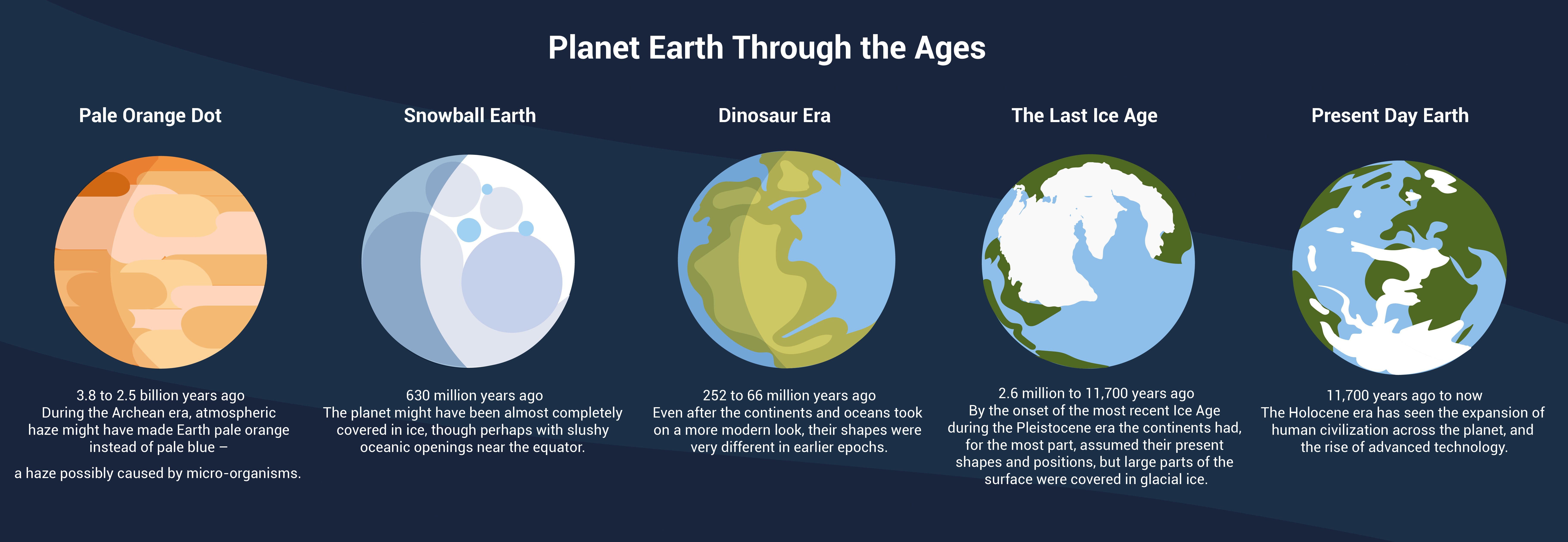
The Hadean Earth was an utterly alien world, barely recognizable as the planet we inhabit today. In its earliest moments, Earth was a roiling ball of molten rock — a magma ocean stretching across the entire globe, glowing orange and red beneath a thick, suffocating atmosphere of hydrogen, helium, water vapor, carbon dioxide, methane, and ammonia. The sky would have appeared a hazy orange-brown, occasionally lit by the streaks of infalling meteorites. There were no continents, no oceans, and no land in any familiar sense. As the planet slowly cooled over tens of millions of years, a thin basaltic crust began to form only to be constantly shattered and recycled by the relentless heat from below and the barrage of impacting debris from space. Later in the Hadean, after around 4,400 million years ago, liquid water began to pool into shallow seas on the cooling crust, revealed by ancient zircon crystals that record the presence of water. These proto-oceans would have been hot, acidic, and utterly devoid of any life, their surfaces perpetually disturbed by volcanic activity and meteorite bombardment. No multicellular organisms, no microbes, no chemistry remotely resembling life existed here — the Hadean was Earth's fiery, sterile infancy.
Key Events
The Hadean opens with the accretion of Earth itself, forming roughly 4,567 million years ago from the solar nebula — the disk of gas and dust surrounding the young Sun. Within the first few tens of millions of years, a Mars-sized body called Theia collided with the proto-Earth in the Giant Impact, an event so cataclysmic it melted the entire planet and ejected a vast cloud of debris that coalesced into the Moon. Because the Moon formed so much closer to Earth than it is today, it appeared enormous in the sky and drove powerful tidal forces that churned the early oceans and land. Earth's iron and nickel sank to form the core in a process called the iron catastrophe, releasing enormous heat and driving a global magma ocean. The Late Heavy Bombardment (LHB), peaking around 4,100–3,800 Ma, saw a renewed spike in asteroid and comet impacts that scarred the Moon (producing its visible craters) and delivered enormous quantities of water and organic compounds to Earth. Volcanic outgassing built the earliest atmosphere, while the first stable patches of continental crust began to appear by around 4,400–4,200 Ma as zircon minerals record. By the very end of the Hadean, conditions had cooled sufficiently that liquid water oceans existed, and the stage was being set for the emergence of life.
History of the Eoarchean
4,000–3,600 Ma
Quick Facts
- Average surface temperature: ~60–80°C
- Length of day: ~14–16 hours
- Moon size in sky: ~150–180% of today's apparent size
- Atmospheric oxygen: ~0% of today's level
- Dissolved ocean oxygen: ~0% of today's level
- Ice coverage: <1% (possibly none)
- Supercontinent: None
The World's Appearance
The Eoarchean Earth was still profoundly inhospitable by modern standards, but it was a world in which the first tentative steps toward habitability were being taken. The planet's surface had cooled enough that a stable — if thin and fragmented — basaltic crust covered much of the globe, and true liquid-water oceans had become a permanent fixture. These oceans were warm and acidic, tinted greenish or brownish by dissolved iron compounds, and they lacked any of the dissolved oxygen that characterizes the modern seas. The sky was a hazy, orange-tinged murk dominated by carbon dioxide and nitrogen, with no ozone layer to block lethal ultraviolet radiation from the young Sun. The landscape above the waterline, where any existed, was bare volcanic rock, dark and jagged, sculpted by constant eruptions and battered by occasional large impactors. The young Sun was also about 25–30% dimmer than today, yet Earth was kept warm by an intense greenhouse effect driven by high concentrations of CO₂ and methane. If life existed during the Eoarchean — and this is debated — it would have been microbial, chemosynthetic, and restricted to sheltered niches such as deep-sea hydrothermal vents, far from the ultraviolet-drenched surface.
Key Events
The Eoarchean records the tail end of the Late Heavy Bombardment and the gradual transition to a more stable geological regime. The oldest known rocks on Earth — the Acasta Gneisses of Canada, dated to approximately 4,031 Ma — originate from this era, providing our first solid window into ancient Earth's geology. Cratonization began in earnest, as small stable patches of continental crust (protocontinents or cratons) were assembled and survived recycling. Plate tectonics may have commenced during this time, though whether it operated in a modern sense or as a more sluggish, episodic alternative remains debated. Hydrothermal systems were active along mid-ocean ridges and volcanic seamounts, providing the chemical gradients and mineral surfaces that many scientists believe hosted the origin of life. The very earliest chemical signatures potentially consistent with life appear in some Eoarchean carbon-isotope records, though these remain highly contested. The heavy meteorite bombardment continued to decline during this eon, and the Moon, still much closer than today, was tidally slowing Earth's rotation and experiencing its own volcanic activity.
History of the Paleoarchean
3,600–3,200 Ma
Quick Facts
- Average surface temperature: ~55–70°C
- Length of day: ~16–18 hours
- Moon size in sky: ~130–150% of today's apparent size
- Atmospheric oxygen: ~0% of today's level
- Dissolved ocean oxygen: ~0% of today's level
- Ice coverage: <1%
- Supercontinent: None (scattered cratons)
The World's Appearance
The Paleoarchean world would still have appeared deeply strange to human eyes, but it was undeniably alive — or becoming so. The surface was dominated by a vast, mostly shallow global ocean, punctuated by volcanic islands and small, scattered protocontinents of greenish-gray granite and dark basalt. The ocean was warm, sulfurous in places, iron-rich, and entirely anoxic — a peculiar greenish sea with no oxygen either in the water or the air above it. The sky remained a reddish-orange haze with virtually no free oxygen, and the ultraviolet environment at the surface was intense. Yet in the shallow coastal waters and at hydrothermal vents on the seafloor, microbial life was taking hold. Stromatolites — layered, dome-shaped mounds built by communities of cyanobacteria-like microbes — were beginning to appear in the fossil record, most famously preserved in the Pilbara region of Western Australia. These living microbial mats would have given the shallow seas a slimy, textured appearance, and were among the only signs of life visible in an otherwise barren volcanic world. The Paleoarchean Earth smelled of sulfur and volcanic gases and was bathed in a red twilight from the dimmer young Sun.
Key Events
The Paleoarchean preserves Earth's most ancient definitive evidence of life. Stromatolites found in the Pilbara Craton of Australia, dating to ~3,480–3,430 Ma, represent the oldest confirmed macroscopic biosignatures on Earth. Microfossils of microbial cells have been reported from cherts of similar age, though some remain disputed. The Isua Greenstone Belt of Greenland, older still, contains graphite isotope signatures widely interpreted as biological carbon. Cratonization continued vigorously: the Kaapvaal Craton (southern Africa) and the Pilbara Craton (Australia) were forming during this time and would become two of the oldest surviving pieces of continental crust on the planet. The geological record shows abundant komatiite lavas — ultra-high-temperature volcanic rocks produced by a much hotter mantle than today — which indicate that the interior of the Earth was significantly hotter during this period. The oceans recorded banded iron formations (BIFs): alternating layers of iron oxides and silica deposited on the seafloor as microbes occasionally oxidized dissolved iron. The Moon continued its gradual recession from Earth, and tidal forces remained stronger than modern levels.
History of the Mesoarchean
3,200–2,800 Ma
Quick Facts
- Average surface temperature: ~50–65°C
- Length of day: ~18–20 hours
- Moon size in sky: ~120–135% of today's apparent size
- Atmospheric oxygen: ~0% of today's level
- Dissolved ocean oxygen: ~0% of today's level
- Ice coverage: <1%
- Supercontinent: Possibly Vaalbara (debated)
The World's Appearance
By the Mesoarchean, Earth had settled into a more recognizable — though still profoundly alien — geological rhythm. The global ocean remained dominant, warm, and anoxic, its surface broken by chains of volcanic islands and small cratons that were slowly aggregating into larger landmasses. The shallow marine shelves would have appeared greenish or brownish, while deeper waters were a dark, iron-rich sea. Stromatolite reefs were increasingly conspicuous features of the coastal environments, building up layered domes and columns that could reach considerable heights in warm, sunlit shallows. The atmosphere remained a thick, oxygen-free mixture of nitrogen, CO₂, and methane, giving the sky a perpetual haze. Microbial mats likely colonized not just marine environments but also some freshwater systems and perhaps even moist surfaces on land, protected by their own chemistry from the harsh UV radiation. The continents that did exist were low-lying and entirely barren of any macroscopic life, their dark volcanic surfaces scraped bare by wind and rain with no soil to speak of — just thin chemical weathering rinds on exposed rock.
Key Events
The Mesoarchean is characterized by the continued growth and stabilization of cratons and the possible formation of the first true supercontinent-like assemblages of crust. Some researchers have proposed that a protocontinent called Vaalbara — combining the Kaapvaal Craton and Pilbara Craton — existed during this time, making it potentially the earliest supercontinent. The geological record shows widespread greenstone belts: ancient sequences of volcanic and sedimentary rock that record the intense igneous activity and sedimentation of this era. Komatiite lavas, while still present, were becoming less common as the mantle slowly cooled. Banded iron formations continued to accumulate on the seafloor, building up some of the world's largest iron ore deposits that are mined today. Evidence from this period suggests the growing role of plate-tectonic processes, including subduction and arc volcanism, though debate continues over the exact mode of tectonics. The genetic evidence within living organisms suggests that major evolutionary divergences among primitive microbial lineages — including the emergence of key metabolic pathways — may have occurred around this time.
History of the Neoarchean
2,800–2,500 Ma
Quick Facts
- Average surface temperature: ~40–60°C
- Length of day: ~20–21 hours
- Moon size in sky: ~115–125% of today's apparent size
- Atmospheric oxygen: ~0.001–0.01% of today's level
- Dissolved ocean oxygen: ~0% of today's level
- Ice coverage: ~1–2% (brief glaciations)
- Supercontinent: Kenorland (forming)
The World's Appearance
The Neoarchean Earth was a world on the cusp of a transformation that would redefine the planet forever. The surface still looked largely alien: vast warm oceans covered most of the globe, punctuated by growing landmasses of granite and gneiss that were beginning to resemble small continents. Stromatolite reefs flourished in the shallow seas in extraordinary abundance, forming extensive bioherms that could stretch for many kilometers along tropical coastlines. These microbial mats were now producing oxygen in increasing quantities through photosynthesis, but the oxygen was being rapidly consumed by the abundant dissolved iron in the ocean and by chemical reactions with volcanic gases, so atmospheric oxygen remained vanishingly low. The sky was still reddish-orange and the ocean greenish-brown in iron-rich zones. Komatiite lavas had become rare, and the types of volcanic rocks being produced were increasingly similar to those of modern island arcs and continental margins. On land, the bare rock surfaces of early continents were being weathered into the planet's first primitive soils — thin, reddish, iron-rich crusts with no plant life but perhaps microbial films in sheltered, wet locations.
Key Events
The Neoarchean witnessed a dramatic pulse of continental growth, with some estimates suggesting that as much as 60–70% of Earth's total continental crust may have formed during this eon and the early Paleoproterozoic. The supercontinent Kenorland — or its precursor — appears to have assembled near the end of the Neoarchean, combining several major cratons including the Superior, Slave, Wyoming, and Kaapvaal cratons. Critically, the Neoarchean saw the rise of oxygenic photosynthesis in cyanobacteria, which would ultimately transform the entire planet. The first reliable evidence for cyanobacteria-produced oxygen appears in geological proxies such as oxidized chromium isotopes and the nature of banded iron formations during this period. The Neoarchean also records the first evidence of glaciation: the Pongola glaciation around 2,900 Ma represents one of the earliest known ice ages, suggesting that Earth's surface temperatures briefly dropped enough for ice sheets to form despite the greenhouse atmosphere. The geological record from this era also preserves spectacular examples of preserved ancient continental crust, including the Superior Province in Canada — the world's largest Archean craton.
History of the Siderian
2,500–2,300 Ma
Quick Facts
- Average surface temperature: Plummeting from
40°C to near-snowball conditions (-20°C at glacial maximum) - Length of day: ~21–22 hours
- Moon size in sky: ~113–118% of today's apparent size
- Atmospheric oxygen: Rising from ~0.01% to ~1–2% of today's level
- Dissolved ocean oxygen: ~0–5% of today's level
- Ice coverage: Up to 30–50% (Huronian Glaciation beginning)
- Supercontinent: Kenorland (breaking apart)
The World's Appearance
The Siderian opened with Earth still largely in its Archean configuration — vast, warm, anoxic oceans and low-lying continents — but it was the period in which the most dramatic chemical transformation in Earth's history unfolded. The shallow seas were still rich in stromatolites, whose cyanobacterial inhabitants had been pumping oxygen into the water and air for tens of millions of years, but now the capacity of the ocean and atmosphere to absorb this oxygen was becoming overwhelmed. As the oxygen began to accumulate in the atmosphere, it reacted with methane (a powerful greenhouse gas) to produce CO₂ and water, triggering a catastrophic collapse of the greenhouse effect. The sky was transitioning from its reddish-orange haze to a clearer, bluish appearance as methane was scrubbed away. The oceans, as iron was progressively oxidized and precipitated out as rust-colored banded iron formations, were shifting from greenish to clearer. The continents were bare rock, still utterly devoid of macroscopic life, and the climate was careening toward one of the most extreme glaciations in Earth's history.
Key Events
The defining event of the Siderian is the Great Oxidation Event (GOE), which occurred approximately 2,400 Ma. After billions of years of near-zero atmospheric oxygen, cyanobacterial photosynthesis finally overwhelmed the planet's oxygen sinks and oxygen began accumulating in the atmosphere — rising from less than 0.001% to perhaps 1–3% of today's levels. This had cascading consequences: the destruction of atmospheric methane caused global temperatures to plummet, triggering the Huronian Glaciation (approximately 2,400–2,100 Ma), one of the most severe ice ages in Earth's history — possibly a global "Snowball Earth" event in which ice sheets reached the equator. The rise of oxygen also poisoned the existing anaerobic microbial ecosystems, representing potentially the largest mass extinction in the history of life. At the same time, it created new opportunities for aerobic life forms. The supercontinent Kenorland began to break apart during the Siderian, and banded iron formations — the largest deposits of which date to this period — were laid down in abundance as dissolved iron reacted with rising oxygen and precipitated to the seafloor.
History of the Rhyacian
2,300–2,050 Ma
Quick Facts
- Average surface temperature: ~10–30°C (recovering from glaciation)
- Length of day: ~22 hours
- Moon size in sky: ~111–114% of today's apparent size
- Atmospheric oxygen: ~1–5% of today's level
- Dissolved ocean oxygen: ~5–15% of today's level
- Ice coverage: Declining from glacial maximum, ~5–20%
- Supercontinent: None (fragments assembling)
The World's Appearance
The Rhyacian was a period of intense geological activity, climate upheaval, and biological innovation. Earth was emerging from or recovering through the extreme Huronian glaciations, and the planet's surface was being remade by both tectonic activity and the consequences of the newly oxygenated atmosphere. Where ice sheets had retreated, the landscape was bare, abraded rock — polished and striated by glacial action. The oceans, now in the process of being oxygenated from above, were changing profoundly in their chemistry, with the great iron-rich banded formations beginning to taper off as dissolved iron was exhausted. The sky was clearing of methane haze and oxygen was slowly building up, allowing the first tenuous ozone shield to develop, which would begin to reduce surface UV radiation. Stromatolites persisted in the warming seas, and microbial life — now increasingly including aerobic organisms that could take advantage of oxygen — was adapting to the new chemical reality. The continents were geologically active, with intense mountain-building, magmatic intrusions, and the stitching together of new continental blocks.
Key Events
The Rhyacian is named for its abundant dyke swarms — great sheets of igneous rock intruded into existing crust — and it was a period of extraordinary magmatic activity globally. The Lomagundi-Jatuli carbon isotope excursion, one of the largest in Earth's history, occurred during the Rhyacian (~2,220–2,060 Ma), recording a dramatic increase in the burial of organic carbon that may reflect a massive bloom of photosynthetic life following oxygenation. The Huronian glaciations appear to have wound down during this period, and global temperatures recovered. A critical biological innovation occurred around 2,100–2,000 Ma: the earliest evidence for eukaryotic cells — cells with a true nucleus — appears in the fossil record. The Francevillian Biota of Gabon (approximately 2,100 Ma) preserves possible colonial eukaryote-like organisms, though their nature remains debated. Plate tectonic activity was vigorous, and new continental crust was being added and assembled into evolving configurations. Large igneous provinces — vast outpourings of flood basalt — were emplaced across multiple cratons.
History of the Orosirian
2,050–1,800 Ma
Quick Facts
- Average surface temperature: ~20–35°C
- Length of day: ~22–23 hours
- Moon size in sky: ~108–112% of today's apparent size
- Atmospheric oxygen: ~5–15% of today's level
- Dissolved ocean oxygen (surface): ~20–40% of today's level
- Ice coverage: ~1–3%
- Supercontinent: Nuna/Columbia (assembling)
The World's Appearance
The Orosirian was a time of dramatic mountain-building on a global scale — its very name derives from the Greek word for mountain range — and Earth's surface was being remodeled by the collision and suturing of ancient continental fragments into a new, vast supercontinent. The newly assembled landmass of Nuna (also called Columbia) was taking shape, creating the world's first truly extensive mountain ranges: roots and remnants of these Orosirian belts are preserved today in the cores of continents from North America to Scandinavia to India. The oceans between the colliding blocks were closing, turning vast marine basins into sedimentary archives now folded and metamorphosed in the roots of these ancient ranges. Shallow seas on the margins of the assembling supercontinent hosted dense communities of stromatolites, while the open ocean was home to increasingly diverse communities of eukaryotic phytoplankton. This was the last age before the great Cryogenian glaciations, and it appears to have been warm, stable, and biologically static at the macroscopic scale — though the microscopic innovations of eukaryotic life that would enable the Ediacaran explosion were quietly accumulating.
Key Events
Two extraordinary impact events punctuated the Orosirian. The Vredefort impact in what is now South Africa (2,023 Ma) and the Sudbury impact in what is now Canada (1,850 Ma) were among the largest meteorite strikes in Earth's history, each creating craters hundreds of kilometers in diameter and releasing energy equivalent to billions of nuclear bombs. Despite these catastrophes, life persisted and continued to evolve. The assembly of the supercontinent Nuna — involving collisions between the North American, Baltic, Amazonian, Australian, and other cratons — produced global orogenic belts that fundamentally reorganized Earth's geography. The Trans-Hudson Orogeny in North America, the Svecofennian Orogeny in Scandinavia, and the Capricorn Orogeny in Australia all occurred during this period. Eukaryotic life was continuing to develop in the oceans, with red algae appearing by around 1,900–1,800 Ma according to some molecular clock estimates and fossil evidence. The deep ocean likely remained anoxic, but surface waters were increasingly oxic, and the global carbon cycle was shifting toward a more modern configuration.
History of the Statherian
1,800–1,600 Ma
Quick Facts
- Average surface temperature: ~25–35°C
- Length of day: ~23 hours
- Moon size in sky: ~106–109% of today's apparent size
- Atmospheric oxygen: ~10–20% of today's level
- Dissolved ocean oxygen (surface): ~30–50% of today's level
- Ice coverage: ~1–2%
- Supercontinent: Nuna/Columbia
The World's Appearance
The Statherian Earth was dominated by the fully assembled supercontinent Nuna (Columbia), which would have presented a vast, red-brown expanse of ancient highland terrain, eroded mountain ranges, and broad river-lain plains stretching across much of the tropics and subtropics. The interior of Nuna would have been arid — far from the moderating influence of the surrounding ocean — and its bare rocky and sandy surface baked under the somewhat dimmer but still powerful sun. The oceans surrounding Nuna were warm, stratified, and chemically complex: the surface waters were increasingly oxygenated, but below the thermocline the deep ocean may have become euxinic (rich in sulfide rather than iron), a condition sometimes called the "Canfield Ocean." This chemical stratification limited the spread of oxygen into deeper waters and may have constrained the evolution of complex life. In the shallows and coastal zones, microbial mats and stromatolites remained the dominant visible life forms, their layered domes still building up in sunlit tropical waters. Early eukaryotes — more complex cells with nuclei — were present in the oceans, invisible to the naked eye but chemically significant.
Key Events
The Statherian records the culmination of Nuna's assembly and the beginning of its long stability. The supercontinent remained largely intact for hundreds of millions of years and represented a stable platform on which erosion, sedimentation, and chemical weathering proceeded quietly for a geological age. The biological record is dominated by microfossils: acritarchs (organic-walled microfossils of uncertain biological affinity, likely eukaryotic algae) and simple filamentous and colonial organisms appear in abundance. The oldest confirmed fossils of red algae (Bangiomorpha pubescens) date to around 1,050 Ma, but molecular clock analyses push eukaryotic diversification back further into this period. The Statherian also saw the emplacement of large igneous provinces and the deposition of widespread continental sediments — sandstones and carbonates — across the stable Nuna platform. The deep ocean's euxinic chemistry may have created conditions that would slow eukaryotic evolution, keeping life in a "boring billion" holding pattern that would persist for hundreds of millions of years.
History of the Calymmian
1,600–1,400 Ma
Quick Facts
- Average surface temperature: ~25–35°C
- Length of day: ~23 hours
- Moon size in sky: ~104–107% of today's apparent size
- Atmospheric oxygen: ~15–25% of today's level
- Dissolved ocean oxygen (surface): ~30–50% of today's level
- Ice coverage: ~0–1%
- Supercontinent: Nuna/Columbia (stable)
The World's Appearance
The Calymmian — meaning "covering" in Greek, for the thick sedimentary sequences laid down during this time — was a period of relative geological tranquility over the broad stable platforms of the Nuna supercontinent. The world's surface was largely organized around this single great landmass, whose interior was dry and red, while the surrounding ocean was warm and stratified. The equatorial regions of Nuna were hot and tectonically quiet, accumulating thick blankets of carbonate and clastic sediment in shallow seas that repeatedly inundated the continental margins. These sedimentary platforms — preserved today in the ancient rocks of many continents — record a warm, chemically stable world. Microbial life continued to dominate the visible biosphere: stromatolites decorated the shallow shelves and tidal flats, while the open ocean was populated by unseen microscopic algae and bacteria. Life had not yet made a major evolutionary leap, and the Calymmian belongs to what geologists sometimes call the "Boring Billion" — a long interval of apparent evolutionary and geological stasis. Nevertheless, the eukaryotic cell was continuing to develop in sophistication, and sexual reproduction may have evolved during or around this period.
Key Events
The Calymmian was a time of relative geological quietude — no major ice ages, no supercontinent breakup, no dramatic shifts in ocean chemistry. Nuna remained mostly intact through this period, though some rifting and extension along its margins was beginning to prefigure its eventual breakup. The biological record preserves an array of acritarchs and microfossils of eukaryotic affinity, but no dramatic evolutionary radiations. Some scientists identify this entire interval (Calymmian through Stenian) as one of evolutionary and ecological stagnation, potentially enforced by the euxinic deep ocean that may have limited the availability of molybdenum and other trace metals essential for nitrogen fixation, thus capping biological productivity. Large igneous provinces continued to punctuate the geological record, emplacing enormous volumes of basaltic magma into the crust. The slow weathering of Nuna's interior was contributing to a globally humid carbon cycle dominated by carbonate and organic carbon burial in the shelf seas.
History of the Ectasian
1,400–1,200 Ma
Quick Facts
- Average surface temperature: ~25–35°C
- Length of day: ~23 hours
- Moon size in sky: ~103–106% of today's apparent size
- Atmospheric oxygen: ~20–40% of today's level
- Dissolved ocean oxygen (surface): ~35–55% of today's level
- Ice coverage: ~0–1%
- Supercontinent: Nuna/Columbia (fragmenting)
The World's Appearance
The Ectasian — named for the "extension" of existing platform covers — continued the long Mesoproterozoic era of relative stability, but by its latter half, the supercontinent Nuna was beginning to rift apart, sending fractures across its ancient surface. The world remained warm and largely ice-free, with broad, shallow seas lapping over the margins of the slowly fragmenting landmass and depositing thick carbonate platforms and reef-like structures built by stromatolites. The atmosphere was now meaningfully oxygenated — perhaps 20–50% of modern levels in the upper atmosphere — and the ocean surface was increasingly hospitable to aerobic microbial life. The deep oceans, however, remained largely anoxic or euxinic. The most striking visible organisms of this world would still have been the microbial mats and stromatolites of the shallow seas, though by this time more complex eukaryotic cells — including possible early green algae — were present in the water column. No animals, no plants, no fungi existed in any macroscopic form. The Ectasian world, observed from above, would have appeared as an unrelieved brown-and-tan continent surrounded by greenish-blue seas dotted with the lumpy mounds of stromatolite reefs.
Key Events
The Ectasian period records the gradual breakup of Nuna and the early stages of the assembly of the next supercontinent, Rodinia. As Nuna fragmented, ocean basins opened between the separating cratons and new subduction zones were initiated, beginning the Wilson Cycle that would ultimately produce Rodinia. Major orogenic events associated with Rodinia's assembly — including the Grenville Orogeny along the eastern margin of proto-North America — began near the end of the Ectasian and accelerated into the Stenian. The oldest confirmed fossils of eukaryotic organisms with clear cell differentiation and possible sexual reproduction (Bangiomorpha pubescens, a red alga) come from rocks now dated to around 1,050–1,200 Ma, within or near the Ectasian-Stenian boundary. The trace element record suggests that ocean chemistry may have remained fundamentally unusual — with the deep ocean euxinic and the surface ocean relatively low in sulfate — conditions that could have limited biological innovation. Large stromatolite reef complexes are well-preserved from this time in formations such as the Belt Supergroup of North America and equivalent sequences in China, Russia, and Australia.
History of the Stenian
1,200–1,000 Ma
Quick Facts
- Average surface temperature: ~20–30°C
- Length of day: ~23–23.5 hours
- Moon size in sky: ~102–104% of today's apparent size
- Atmospheric oxygen: ~30–50% of today's level
- Dissolved ocean oxygen (surface): ~40–60% of today's level
- Ice coverage: ~0–1%
- Supercontinent: Rodinia (assembling)
The World's Appearance
The Stenian — meaning "narrow" for the orogenic belts being squeezed up around colliding continents — was a geologically intense period in which the great mountain chains associated with the assembly of Rodinia were being built. Where the ancient Nuna fragments were colliding, towering mountain ranges rivaling the modern Himalayas were rising, their roots of hot deformed rock visible in the deeply eroded core complexes preserved today in the Grenville Province of eastern North America and equivalent terranes on other continents. The oceans between the colliding blocks were closing, turning vast marine basins into sedimentary archives now folded and metamorphosed in the roots of these ancient ranges. Shallow seas on the margins of the assembling supercontinent hosted dense communities of stromatolites, while the open ocean was home to increasingly diverse communities of eukaryotic phytoplankton. This was the last age before the great Cryogenian glaciations, and it appears to have been warm, stable, and biologically static at the macroscopic scale — though the microscopic innovations of eukaryotic life that would enable the Ediacaran explosion were quietly accumulating.
Key Events
The defining geological event of the Stenian is the Grenville Orogeny, a global-scale mountain-building episode triggered by the final collisions that assembled the supercontinent Rodinia by approximately 1,100–1,000 Ma. Rodinia was positioned largely in tropical latitudes, with most major cratons sutured together into a single vast landmass. This configuration had profound consequences for Earth's climate and geochemistry: the weathering of Rodinia's vast mountain ranges drew down CO₂ from the atmosphere, and its positioning in the tropics — where chemical weathering rates are highest — may have gradually cooled the planet. The biological record shows the confirmed presence of multicellular eukaryotes by this time: Bangiomorpha, possibly the oldest known sexually reproducing organism, has been securely dated to around 1,050 Ma. Molecular clock analyses suggest that the major eukaryotic supergroups — animals, fungi, plants, and their relatives — were beginning to diverge during the Stenian, though none yet displayed macroscopic complexity. The ocean chemistry record suggests a possible increase in ocean oxygenation during this period, which may have contributed to eukaryotic diversification.
History of the Tonian
1,000–720 Ma
Quick Facts
- Average surface temperature: ~15–25°C (cooling through period)
- Length of day: ~23.5 hours
- Moon size in sky: ~101–103% of today's apparent size
- Atmospheric oxygen: ~50–70% of today's level
- Dissolved ocean oxygen: ~50–70% of today's level
- Ice coverage: ~1–5% (increasing toward end)
- Supercontinent: Rodinia (intact then breaking up)
- Most intelligent species: Microscopic sponge-like animals — no centralised nervous system, EQ effectively ~0.0; comparable to a modern sea sponge or jellyfish
The World's Appearance
The Tonian opened with the world organized under the supercontinent Rodinia, a vast equatorial landmass that dominated Earth's geography. Its interior was arid and red-brown, surrounded by warm, shallow epicontinental seas on its margins where stromatolites still built their reefs. The atmosphere was moderately oxygenated, the sky a familiar blue, and the climate was warm — though progressively cooling as Rodinia's weathering rocks consumed atmospheric CO₂. The ocean was undergoing important chemical changes: a second, minor oxygenation event (sometimes called the Neoproterozoic Oxidation Event) was beginning to bring oxygen to deeper water masses. In the seas, eukaryotic life was diversifying at the microscopic scale, with an increasing variety of single-celled algae and protists, some of them producing distinctive, ornamented organic-walled cysts (acritarchs) that are widely preserved in the fossil record. By the later Tonian, the first animals — or at least the first animal-related organisms — were beginning to diverge from their protistan ancestors, though they remained tiny and soft-bodied and invisible in the fossil record. The breakup of Rodinia was producing new ocean basins and diversifying habitats.
Key Events
The Tonian records the gradual breakup of Rodinia, which commenced around 800–750 Ma with the rifting apart of its constituent cratons. New ocean basins opened — including the proto-Pacific — as continents separated. This breakup had enormous consequences: the exposure of fresh, unweathered rock to tropical rainfall dramatically accelerated chemical weathering, consuming atmospheric CO₂ and ultimately driving the planet toward the extreme Cryogenian glaciations that followed. The Tonian also records a diversification of eukaryotic microfossils, including the appearance of new acritarch assemblages and the earliest possible animal fossils — microscopic fossils from around 800 Ma in South Australia that may represent early sponge-grade animals. Molecular clocks consistently place the origin of the animal kingdom in the Tonian, with the common ancestor of all animals living approximately 800–900 Ma. Major igneous provinces associated with Rodinia's breakup — including the voluminous Franklin LIP in northern Canada around 717 Ma — represent some of the geological events that may have triggered Snowball Earth conditions.
History of the Cryogenian
720–635 Ma
Quick Facts
- Average surface temperature: ~-50°C during glacial maxima, rising to +30–40°C in rapid deglaciation
- Length of day: ~23.5 hours
- Moon size in sky: ~101–102% of today's apparent size
- Atmospheric oxygen: ~40–80% of today's level
- Dissolved ocean oxygen: ~variable, ~20–60% in refugia
- Ice coverage: Up to 80–100% during Snowball events
- Supercontinent: None (Rodinia fully fragmented)
- Most intelligent species: Microscopic sponge-like animals — no centralised nervous system, EQ effectively ~0.0; comparable to a modern sea sponge or jellyfish
The World's Appearance
The Cryogenian presents one of the most extreme climatic scenarios in Earth's history: two episodes of near-total global glaciation, commonly called "Snowball Earth," in which ice sheets may have reached the equator and the entire ocean surface could have been frozen to depths of hundreds of meters. During these glaciations, the Earth would have appeared from space as a gleaming white sphere, almost completely covered in ice and snow. Temperatures at the equator would have been comparable to modern Antarctica. The ice was not uniform — beneath the sea ice, liquid water persisted and life clung on in refugia: hot springs, hydrothermal vents, pockets of geothermally-heated meltwater, and possibly unfrozen equatorial seas in some models. Between and after the glaciations, during the brief warm interglacial periods, the ice retreated and the ocean rebounded with bursts of productivity. Any surviving life would have been small, microbial, and huddled in these scattered refugia. The sky during deglaciation events would have been dramatically colored by volcanic CO₂ buildup and subsequent wild climate oscillations.
Key Events
The Cryogenian records two major glaciations. The Sturtian glaciation (720–660 Ma) was the longer and possibly more severe, with strong evidence that ice sheets reached tropical latitudes on multiple continents. The Marinoan glaciation (650–635 Ma) was the later event, equally severe, ending in an abrupt and dramatic deglaciation driven by volcanic CO₂ that had built up under the ice. Both glaciations ended with cap carbonates — distinctive layers of carbonate rock deposited globally in the immediate aftermath of deglaciation, recording the rapid ocean chemistry changes as the ice melted. The causes of Snowball Earth remain debated but likely involved the combination of Rodinia's breakup exposing vast amounts of silicate rock to tropical weathering (consuming CO₂), reduced solar luminosity, and possible biological feedbacks. The biological consequences were profound: only organisms that survived in refugia made it through, and the post-glacial world saw rapid evolutionary diversification as surviving lineages expanded into newly available environments. The first complex multicellular organisms — including the ancestors of animals — were evolving during and after the Cryogenian glaciations.
History of the Ediacaran
635–539 Ma
Quick Facts
- Average surface temperature: ~15–25°C
- Length of day: ~22.4 hours
- Moon size in sky: ~100.5–101% of today's apparent size
- Atmospheric oxygen: ~60–80% of today's level
- Dissolved ocean oxygen: ~40–70% of today's level
- Ice coverage: ~1–5% (brief Gaskiers glaciation ~580 Ma)
- Supercontinent: Gondwana (forming in south)
- Most intelligent species: Simple Ediacaran organisms (e.g. Dickinsonia) — no centralised nervous system, EQ effectively ~0.0; comparable to a modern sea sponge or jellyfish
The World's Appearance
The Ediacaran was a world reborn after the extreme glaciations of the Cryogenian, and it was a world in which life, for the first time, began to leave macroscopic traces on the seafloor and in the rock record. The post-glacial ocean was warm, nutrient-rich, and increasingly oxygenated, its surfaces tinted by blooms of eukaryotic phytoplankton. The shallow seafloors were blanketed by microbial mats — thick, rubbery, purple-green sheets of bacteria that covered sediment surfaces and formed a stable substrate unlike anything in modern marine environments. On and within these mats lived the Ediacaran biota: bizarre, soft-bodied organisms of uncertain affinity, ranging from frond-like Charnia and quilted mattress-like Dickinsonia to disc-shaped Aspidella and tube-shaped Cloudina. These creatures had no hard parts, no eyes, no guts — at least in their early forms — and most lacked any obvious symmetry or body plan recognizable in modern animals. By the late Ediacaran, organisms with bilateral symmetry, trace fossils (burrows), and even possible mineralized shells were appearing, signaling the impending Cambrian explosion. The continents were scattered, the climate warm, and the world was on the threshold of the animal revolution.
Key Events
The Ediacaran records three major evolutionary assemblages of the Ediacaran biota — the Avalon assemblage (575–560 Ma), the White Sea assemblage (558–550 Ma), and the Nama assemblage (549–539 Ma) — each showing different communities that suggest ecological succession. The small shelly fossils appearing at the very end of the Ediacaran (after 550 Ma) represent the first mineralizing animals, heralding the biomineralization revolution of the Cambrian. The Ediacaran also records the second Neoproterozoic Oxidation Event: a stepwise increase in deep-ocean oxygenation around 580–560 Ma that is thought to have enabled the evolution of larger, more active animals requiring higher oxygen levels. The Gaskiers glaciation (580 Ma) was a relatively brief but significant glaciation event that punctuated the Ediacaran. Geologically, the Ediacaran saw the assembly of the supercontinent Gondwana in the Southern Hemisphere, as African, South American, Antarctic, Australian, and other blocks sutured together in the Pan-African Orogeny — building mountain ranges whose roots are preserved across Africa, Brazil, and beyond.
History of the Cambrian
539–485 Ma
Quick Facts
- Average surface temperature: ~21–25°C
- Length of day: ~22.1 hours
- Moon size in sky: ~100.3–100.5% of today's apparent size
- Atmospheric oxygen: ~70–80% of today's level
- Dissolved ocean oxygen: ~60–80% of today's level
- Ice coverage: ~0–2%
- Supercontinent: None (Gondwana plus scattered continents)
- Most intelligent species: Anomalocaris or early chordates such as Pikaia — estimated EQ ~0.01–0.02 (comparable to a modern simple invertebrate such as a sea snail)
The World's Appearance
The Cambrian world was one of the most dramatic turning points in the history of life, and its oceans would have been visually spectacular by any previous standard. The seas were warm, shallow, and bathed in sunlight over vast tropical continental shelves — the continents had dispersed following Gondwana's assembly and were mostly clustered in equatorial and low-latitude positions, with broad, warm, carbonate-producing shelf seas surrounding them. These seas were filled with an extraordinary profusion of animal life that appeared with seemingly geological suddenness. Among the large herbivores — or more precisely, large filter-feeders and grazers — the most conspicuous were the radiodont Anomalocaris and its relatives, which actually served as apex predators rather than herbivores; true large herbivores were largely absent, as plant material on land did not yet exist and marine algae were consumed by smaller invertebrates. The dominant large carnivores were the radiodonts: Anomalocaris canadensis could reach over 60 centimetres and was equipped with a pair of spiny frontal appendages for seizing prey, while Hurdia and Peytoia were other formidable predators. Trilobites scurried across the seafloor by the millions, their segmented bodies and compound eyes representing the first complex visual predators in Earth's history. The famous Burgess Shale and Chengjiang fossil beds preserve the full richness of Cambrian marine life, including bizarre forms like the five-eyed Opabinia. There were no large plants anywhere: on land, only microbial films existed, and marine "plants" were microscopic algae in the water column and on the seafloor. The ocean was the world of life.
Key Events
The Cambrian Explosion — the rapid appearance of most major animal body plans in the fossil record between approximately 539 and 520 Ma — is the defining event of this period, though its causes remain debated. The leading explanations include rising atmospheric oxygen (enabling larger, more active bodies), the evolution of predation (creating evolutionary arms races), ecological opportunity in newly emptied post-glacial oceans, and changes in ocean chemistry (particularly calcium availability enabling mineralized skeletons). The Cambrian also records the first chordates — the phylum that would eventually give rise to vertebrates — in fossils such as Pikaia from the Burgess Shale and Haikouichthys from Chengjiang, China. Several significant extinction events punctuated the Cambrian, including the Botomian and Toyonian mass extinctions that reset marine communities. Tectonically, Gondwana was drifting southward, and the margins of Laurentia (proto-North America) were being flooded by warm, shallow seas that deposited the great carbonate platforms visible today in the limestone cliffs of the Rocky Mountains and Appalachians.
History of the Ordovician
485–444 Ma
Quick Facts
- Average surface temperature: ~16–45°C depending on latitude (warm globally, then cooling at end)
- Length of day: ~21.9 hours
- Moon size in sky: ~100.2–100.3% of today's apparent size
- Atmospheric oxygen: ~68–70% of today's level
- Dissolved ocean oxygen: ~60–75% of today's level
- Ice coverage: ~0% early, rising to ~20–30% at glacial maximum (Late Ordovician)
- Supercontinent: None (Gondwana dominant)
- Most intelligent species: Large nautiloid cephalopods such as Cameroceras — estimated EQ ~0.02–0.05 (comparable to a modern crab or simple mollusc)
The World's Appearance
The Ordovician was a time of extraordinary marine biodiversity, a warm and largely ice-free world in which the seas teemed with a richness of animal life that rivalled or even exceeded modern oceans in terms of ecological diversity. The shallow, clear, tropical seas that covered much of Gondwana's northern margins and the scattered smaller continents of Laurentia, Baltica, and Avalonia were colonised by reef-building bryozoans and stromatoporoids, dense beds of brachiopods, crinoids waving their feathery arms from the seafloor, and trilobites in bewildering variety. The dominant large herbivores of the Ordovician seas were the filter-feeding crinoids and brachiopods, which covered the seafloor in dense meadows, as well as large sea urchin-like echinoderms that grazed algal films from hard substrates. The large carnivores were the nautiloid cephalopods — some, like Cameroceras, reached extraordinary sizes of up to 6 metres in length, their straight or coiled shells cutting through the water as they seized trilobites and fish with their tentacles. The first true vertebrates — primitive jawless fish called ostracoderms — were beginning to diversify in the Ordovician seas; small and armoured, they were not yet dominant but represented the earliest chapter in the vertebrate story. On land, the very first primitive plants — liverwort-like bryophytes — were taking their first steps onto damp rock surfaces, but no macroscopic vegetation yet covered the bare, brown continents.
Key Events
Early in the Ordovician, the GOBE (Great Ordovician Biodiversification Event) saw marine animal diversity skyrocket, possibly driven by an increased flux of meteoritic material (the Ordovician Meteorite Event) or tectonic restructuring of ocean circulation. The Taconic Orogeny was building mountains along the eastern margin of Laurentia as oceanic terranes collided with proto-North America. The Ordovician ended with one of the five largest mass extinctions in Earth's history — the Late Ordovician Mass Extinction (~444 Ma), which eliminated approximately 85% of marine species. This extinction appears to have been triggered by the glaciation of Gondwana: as Gondwana drifted over the South Pole, massive ice sheets built up over what is now the Sahara Desert, locking up vast quantities of water, lowering sea levels, and cooling the global ocean. The glaciation also drew down CO₂ through silicate weathering, further cooling the climate. The extinction occurred in two pulses — one associated with the onset of glaciation and cooling, and one with the rapid warming and sea-level rise that followed the melting of the ice.
History of the Silurian
444–419 Ma
Quick Facts
- Average surface temperature: ~17–25°C
- Length of day: ~21.8 hours
- Moon size in sky: ~100.15–100.2% of today's apparent size
- Atmospheric oxygen: ~70–80% of today's level
- Dissolved ocean oxygen: ~70–80% of today's level
- Ice coverage: ~0–2%
- Supercontinent: None (Laurussia forming)
- Most intelligent species: Eurypterids or early jawed fish (acanthodians) — estimated EQ ~0.02–0.05 (comparable to a modern fish such as a goldfish)
The World's Appearance
The Silurian world rose from the ashes of the Late Ordovician extinction, rebuilding its marine communities on a warmer, ice-free globe. The great Gondwana ice sheets had melted, sea levels rose dramatically, and warm, shallow epicontinental seas flooded the low-lying continental interiors. The marine communities that recolonised these seas were somewhat different from those that had perished: coral reefs — true colonial coral reefs, the first in Earth's history — became a dominant feature of tropical marine environments, building extensive carbonate structures in the warm, clear seas. Among the large herbivores of the Silurian ocean, the most conspicuous grazers were large sea urchins and the chiton-like molluscs that rasped algae from reef surfaces, while enormous placoderm-like agnathans browsed on seabed detritus. The dominant large carnivores were the eurypterids — giant sea scorpions — with Pterygotus reaching up to 1.7 metres and bearing powerful chelicerae capable of crushing prey; alongside them, large nautiloid cephalopods continued their predatory reign. On land, the Silurian witnessed the first vascular plants — including Cooksonia, a tiny leafless photosynthetic tube only a few centimetres tall — beginning to colonise the bare rock surfaces near water, the first tentative green staining of what had been a brown and grey continental world. The first land-capable arthropods, including early myriapods and arachnids, were venturing onto the shore alongside these pioneer plants.
Key Events
The Silurian is best known for the colonisation of land by vascular plants and terrestrial arthropods, representing the first permanent ecosystems on dry land. Cooksonia and other early vascular plants evolved lignin-reinforced stems, cuticles, and stomata that allowed them to survive the desiccating terrestrial environment. The appearance of the first land scorpions and myriapods shows that animals were following plants onto land, possibly initially to feed on decaying plant material or on each other. In the ocean, the first jawed fish evolved during the Silurian — a momentous innovation, as jaws dramatically expanded the ecological roles available to vertebrates and set the stage for the vertebrate takeover of both marine and later terrestrial environments. Acanthodians (spiny sharks) and early placoderms were among these first jawed vertebrates. The Silurian also saw the continuing closure of the Iapetus Ocean between Laurentia and Baltica, building the Caledonian mountain ranges in what would become Scotland and Scandinavia — evidence for a collision event whose worn-down roots are still visible today.
History of the Devonian
419–359 Ma
Quick Facts
- Average surface temperature: ~20–30°C (cooling at end)
- Length of day: ~21.6–21.8 hours
- Moon size in sky: ~100.1–100.15% of today's apparent size
- Atmospheric oxygen: ~70–100% of today's level
- Dissolved ocean oxygen: ~50–75% of today's level (widespread anoxia events)
- Ice coverage: ~2–10% (cooling at end)
- Supercontinent: None (Gondwana + Laurussia converging)
- Most intelligent species: Large lobe-finned fish such as Eusthenopteron or early tetrapods such as Ichthyostega — estimated EQ ~0.05–0.1 (comparable to a modern amphibian such as a frog)
The World's Appearance
The Devonian was a world undergoing a profound biological revolution on land and in the sea simultaneously, earning its popular title as the "Age of Fishes." The shallow, warm seas of the Devonian were dominated by armoured placoderms, with the apex predator Dunkleosteus terrelli growing up to 6 metres in length and possessing self-sharpening bony jaw plates capable of delivering one of the most powerful bites in Earth's history. Alongside Dunkleosteus, large lobe-finned fish such as Eusthenopteron and Hynerpeton-ancestors prowled coastal waters, while early sharks including Cladoselache patrolled the open ocean as fast, agile carnivores. The dominant large herbivores of the Devonian seas were large filter-feeding placoderms and the vast shoals of antiarch placoderms like Bothriolepis that scooped organic material from seafloor sediments. On land, the transformation was even more dramatic: the Devonian saw the rise of the first genuine forests. Archaeopteris grew to heights of 10 metres or more on stout woody trunks, its ferny fronds shading a forest floor carpeted in mosses, club mosses, and horsetail relatives. Protolepidodendron and Pseudosporochnus added to the diversity of early forest vegetation. The first tetrapods — four-limbed vertebrates like Ichthyostega and Acanthostega — were crawling through Devonian swamps, their stumpy limbs pushing them through the mud of estuaries where land and sea blurred into one another.
Key Events
The Devonian records multiple mass extinctions, most severely the Late Devonian extinction event (~372–359 Ma), actually a prolonged interval of elevated extinction called the Kellwasser and Hangenberg events, which eliminated approximately 75% of all species and hit reef communities especially hard — destroying the great Devonian reef systems and leaving the ocean floors covered in black, anoxic shales. The causes of the Late Devonian extinctions are still debated but likely involved ocean anoxia, cooling, sea-level changes, and possibly the biotic crisis triggered by forests: plant roots releasing acids, weathering phosphorus from rocks, and fuelling massive algal blooms that stripped oxygen from shallow seas. The colonisation of land was the great biological narrative of the Devonian: the Romer's Gap leading into the Carboniferous saw the first fully terrestrial vertebrates. Tectonically, the Acadian Orogeny was building the ancestral Appalachian Mountains as Gondwana and Laurussia began to converge, presaging the ultimate assembly of Pangaea.
History of the Carboniferous
359–299 Ma
Quick Facts
- Average surface temperature: ~14–20°C (cooling through period)
- Length of day: ~21.5 hours
- Moon size in sky: ~100.05–100.1% of today's apparent size
- Atmospheric oxygen: ~130–170% of today's level (reaching ~35%)
- Dissolved ocean oxygen: ~70–80% of today's level
- Ice coverage: ~10–30% (Gondwana glaciation in south)
- Supercontinent: Pangaea (assembling)
- Most intelligent species: Large early synapsid predators such as Sphenacodon or Haptodus — estimated EQ ~0.1–0.2 (comparable to a modern monitor lizard)
The World's Appearance
The Carboniferous was perhaps the most visually spectacular terrestrial environment in Earth's history: a world dominated by vast coal swamp forests stretching across equatorial Pangaea in an unbroken green canopy. Enormous club mosses — Lepidodendron and Sigillaria — towered 30–40 metres, their trunks covered in diamond-patterned bark, while giant horsetails (Calamites, reaching 20 metres) lined the waterways and tree ferns (Psaronius) spread their giant fronds above a dense understory. Among the largest herbivores, the massive edaphosaurid synapsids — including Edaphosaurus, which could reach 3 metres and bore a spectacular sail on its back — browsed on the lush vegetation of the swamp margins, while giant millipedes like Arthropleura (up to 2.5 metres long) consumed decaying plant material on the forest floor. The large carnivores were equally impressive: the sphenacodontid pelycosaur Haptodus and larger relatives such as Sphenacodon (forerunners of Dimetrodon) were the top terrestrial predators, while giant temnospondyl amphibians such as Proterogyrinus and the enormous Crassigyrinus (up to 2 metres long) lurked in the swamps and waterways. In the sea, the shark Edestus — with its enormous serrated teeth that grew beyond the jaw tips — and other eugenodont sharks were dominant marine predators alongside cladoselachian sharks. This high-oxygen atmosphere, reaching perhaps 35% oxygen, also enabled insects to grow to extraordinary sizes: Meganeura, a dragonfly relative, had a wingspan of 70 centimetres, while Pulmonoscorpius was a scorpion over 70 centimetres long.
Key Events
The Carboniferous is defined by the formation of vast coal deposits as organic material from the great swamp forests was buried faster than it could decay — possibly because wood-rotting fungi had not yet evolved to efficiently digest lignin. The atmospheric oxygen spike to 35% had profound biological consequences, enabling gigantism in terrestrial arthropods and increasing the frequency and intensity of wildfires (charcoal is common in Carboniferous deposits). The amniotic egg evolved during this period, freeing reptiles from dependence on water for reproduction and opening up the dry interior of the continent to vertebrate life. Synapsids (the lineage leading to mammals) and sauropsids (the lineage leading to reptiles and birds) diverged during the Carboniferous. Tectonically, this was the time of Pangaea's final assembly: the collision of Gondwana with Laurussia built the Hercynian/Variscan mountain ranges across Europe and the southern Appalachians in North America. The Carboniferous also includes the Carboniferous Rainforest Collapse (307 Ma), a drying event that fragmented the equatorial forests and may have driven rapid evolution in terrestrial animals.
History of the Permian
299–252 Ma
Quick Facts
- Average surface temperature: ~16–22°C (spiking at end to ~28–30°C)
- Length of day: ~21.4 hours
- Moon size in sky: ~100.02–100.05% of today's apparent size
- Atmospheric oxygen: ~80–115% of today's level
- Dissolved ocean oxygen: ~60–80% of today's level (crashing at end)
- Ice coverage: ~5–20% (declining through period, ~0% at end)
- Supercontinent: Pangaea (fully assembled)
- Most intelligent species: Advanced cynodont therapsids such as Cynognathus — estimated EQ ~0.2–0.4 (comparable to a modern crocodile or small lizard)
The World's Appearance
The Permian world was dominated by the fully assembled supercontinent of Pangaea, the largest and most complete supercontinent since Rodinia. This vast landmass stretched from pole to pole and was surrounded by a single global ocean called Panthalassa. The interior of Pangaea was a vast, harsh desert — dry, hot, and swept by fierce continental winds — while the equatorial belt was dominated by red sandy deserts and salt flats. The polar regions of Gondwana in the south hosted ice sheets and cool forests of Glossopteris, a distinctive seed fern with tongue-shaped leaves that grew in dense stands and was the dominant large herbivore food source of the cold south. The dominant large herbivores of the Early Permian were the pelycosaur synapsids — barrel-bodied animals like the sail-backed Edaphosaurus and the heavy-set Diadectes — which cropped the low-growing vegetation of the subtropical floodplains; by the Middle and Late Permian the dicynodont therapsids had taken over: barrel-bodied, beaked creatures like Lystrosaurus and the ox-sized Moschops and Tapinocephalus which cropped the seed ferns and cycad-like plants of the subtropical plains. The apex large carnivores of the Early Permian were the sail-backed sphenacodontids, principally Dimetrodon (up to 4 metres long), whose elongated neural-spine sail almost certainly served in thermoregulation, making it the supreme terrestrial predator of the Early Permian floodplains; by the Late Permian, gorgonopsid therapsids — wolf-to-bear-sized hunters like Inostrancevia (up to 3.5 metres long) — had taken over the apex predator role, possessing enormous saber-like canine teeth for taking down large dicynodonts. Giant amphibians such as Eryops (up to 2 metres long) lurked in the rivers and swamps of the Early Permian, ambushing fish and smaller tetrapods. Conifers dominated the wetter regions of the continent, while seed ferns covered vast areas of the subtropical and temperate zones. Marine life featured magnificent reef systems dominated by sponges and fusulinid foraminifera; in the open ocean the bizarre eugenodont fish Helicoprion — possessing a spiral tooth-whorl set in its lower jaw — was among the largest and most distinctive marine predators of the Early to Middle Permian seas.
Key Events
In the mid Permian (~260 Ma), the major Capitanian Extinction event occurred, likely associated with the Emeishan Traps volcanism in China. The Late Permian records the evolution of the earliest true mammals' forerunners: the cynodont therapsids had evolved complex teeth, possible endothermy (warm-bloodedness), and other mammalian characteristics, representing one of the most dramatic evolutionary transitions in vertebrate history. The Permian ends with the most catastrophic mass extinction in Earth's history: the Permian-Triassic Extinction Event, approximately 252 Ma, which eliminated an estimated 96% of marine species and 70% of terrestrial vertebrate species. The primary cause was a series of enormous volcanic eruptions in what is now Siberia — the Siberian Traps — which released vast quantities of CO₂, methane, and sulfur dioxide over a geologically brief interval, triggering runaway greenhouse warming, ocean acidification, stratospheric ozone destruction, and widespread ocean anoxia. Global temperatures may have risen by 10–15°C in a geologically instantaneous pulse.
History of the Triassic
252–201 Ma
Quick Facts
- Average surface temperature: ~20–30°C
- Length of day: ~22.9 hours
- Moon size in sky: ~100.01–100.02% of today's apparent size
- Atmospheric oxygen: ~80–90% of today's level
- Dissolved ocean oxygen: ~50–70% of today's level
- Ice coverage: ~0–1%
- Supercontinent: Pangaea (beginning to rift)
- Most intelligent species: Advanced cynodonts and early mammals such as Morganucodon — estimated EQ ~0.3–0.6 (comparable to a modern small reptile or primitive mammal)
The World's Appearance
The world that emerged from the Permian-Triassic extinction was a scarred, depleted Earth in the process of slow recovery. The Early Triassic was a barren, hostile world: for several million years after the extinction, life struggled to reestablish itself, with desert conditions, hypersaline oceans, and recurrent anoxic events. Pangaea remained intact, and its interior was dominated by vast red deserts. By the Middle and Late Triassic, life had recovered and diversified dramatically. Among the large herbivores, the dicynodont Lisowicia was a massive, rhinoceros-sized plant-eater up to 4.5 metres long, while smaller rhynchosaurs and aetosaurs grazed the fern meadows and conifer woodland undergrowth; prosauropod dinosaurs like Plateosaurus (6–10 metres) were also emerging as large herbivores late in the period, browsing on cycads, conifers, and seed ferns that formed the dominant large vegetation of the Triassic world. The apex carnivores on land were the rauisuchians — large, erect-postured crocodile relatives like Saurosuchus that could reach 7–10 metres — as well as theropod dinosaurs like Herrerasaurus and Coelophysis emerging by the Late Triassic. In the ocean, ichthyosaurs like Shonisaurus reached 15 metres, making them among the largest animals yet to appear on Earth, while nothosaurs and placodonts filled other marine predator roles. The first pterosaurs soared overhead, and the first small, shrew-like mammals were scurrying through the undergrowth.
Key Events
The Triassic opens with the "dead zones" of the Early Triassic recovery phase and closes with another major mass extinction: the End-Triassic Extinction (~201 Ma), caused by the opening of the Central Atlantic Magmatic Province (CAMP) — vast eruptions associated with the beginning of Pangaea's breakup as the North Atlantic opened. The End-Triassic extinction eliminated approximately 76% of species, including many non-dinosaurian archosaurs and large amphibians, opening the ecological door for dinosaurs to rise to global dominance in the Jurassic. The Triassic is thus bookended by two of the Big Five mass extinctions. The first true mammals evolved during the Triassic from cynodont therapsid ancestors, representing the culmination of the synapsid-to-mammal transition. The first pterosaurs — flying reptiles — appear in the fossil record from about 230 Ma. Conodonts, a group of jawless vertebrates that had persisted since the Cambrian, finally went extinct at the end of the Triassic after an extraordinary 300-million-year run.
History of the Jurassic
201–145 Ma
Quick Facts
- Average surface temperature: ~16–25°C
- Length of day: ~22.8 hours
- Moon size in sky: ~100.005–100.01% of today's apparent size
- Atmospheric oxygen: ~80–100% of today's level
- Dissolved ocean oxygen: ~70–85% of today's level
- Ice coverage: ~0–1%
- Supercontinent: Pangaea breaking apart (Laurasia + Gondwana)
- Most intelligent species: Small early mammals such as Juramaia or Hadrocodium — estimated EQ ~0.5–0.9 (comparable to a modern hedgehog or small marsupial)
The World's Appearance
The Jurassic was the age in which the dinosaurs became the undisputed rulers of the Earth — large, medium, and small, as carnivores, herbivores, and omnivores, they filled every terrestrial ecological niche from forests to floodplains. The world was warm, humid, and lush: Pangaea was breaking apart, allowing moist oceanic air to penetrate into continental interiors, and vast fern prairies, conifer forests of araucaria and cypress, and cycad thickets spread across much of the land. The dominant large herbivores were the sauropods: Brachiosaurus reached 25 metres in length and browsed high conifer canopies, Diplodocus (up to 27 metres) swept its long neck through low fern meadows, and Apatosaurus used its massive bulk to access mid-level vegetation. The armoured Stegosaurus, with its iconic back plates and spiked tail, was a medium-large herbivore of the North American Morrison Formation, while ornithopod dinosaurs like Camptosaurus browsed lower vegetation. The apex large carnivores were Allosaurus (up to 12 metres, a powerful ambush predator), Torvosaurus (also up to 10–11 metres), and the smaller but pack-hunting Ceratosaurus. In the shallow seas, plesiosaurs like Liopleurodon (up to 10 metres) and the dolphin-like ichthyosaurs patrolled the warm Jurassic oceans, while enormous marine crocodilians like Machimosaurus were also present. The sky was shared by diverse pterosaurs and, in the Late Jurassic, the first birds — Archaeopterix and its kin.
Key Events
The Jurassic is defined geologically by the progressive breakup of Pangaea. The North Atlantic Ocean opened as North America separated from Africa and Europe, while the Tethys Sea expanded. The opening of new ocean basins changed ocean circulation, bringing warmth to previously cold polar regions and generally making the Jurassic climate warm and equable worldwide. The evolution of birds from theropod dinosaurs — one of the most significant evolutionary transitions in vertebrate history — occurred in the Late Jurassic, documented by Archaeopteryx and a growing suite of feathered dinosaur fossils from China. Mammals diversified during the Jurassic into numerous lineages including the earliest relatives of modern monotremes, marsupials, and placentals, though they remained small. The Morrison Formation of western North America, one of the world's great fossil deposits, preserves the extraordinary dinosaur-dominated ecosystem of the Late Jurassic with remarkable detail. Marine environments experienced diversification in reef-building organisms (corals and sponges), and the ocean was warm and carbonate-rich.
History of the Cretaceous
145–66 Ma
Quick Facts
- Average surface temperature: ~17–28°C
- Length of day: ~23.2–23.4 hours
- Moon size in sky: ~100.001–100.005% of today's apparent size
- Atmospheric oxygen: ~90–115% of today's level
- Dissolved ocean oxygen: ~60–80% of today's level
- Ice coverage: ~0% (no polar ice caps for most of period)
- Supercontinent: None (Laurasia and Gondwana fully fragmented)
- Most intelligent species: Troodon or other small theropods, and early placental mammals — estimated EQ ~0.5–1.0 for theropods; ~1.0–2.0 for early mammals (comparable to a modern chicken or small rodent)
The World's Appearance
The Cretaceous was a warm, lush, greenhouse world — one of the warmest periods in the last 500 million years — in which tropical forests stretched to polar latitudes and the oceans were warm enough to bathe the continents in shallow, chalk-depositing seas. The Western Interior Seaway bisected North America from the Arctic to the Gulf of Mexico. The dominant large herbivores included the massive ceratopsians — Triceratops (up to 9 metres, 12 tonnes) with its spectacular bony frill and three horns, and Torosaurus — alongside the hadrosaurs (duck-billed dinosaurs): Edmontosaurus reached 13 metres and roamed in vast herds across the floodplains of North America like Cretaceous bison. Ankylosaurs such as Ankylosaurus (up to 10 metres, armoured like a tank) and the long-necked titanosaur sauropods — Argentinosaurus potentially reaching 30–35 metres and perhaps 70 tonnes — rounded out the roster of truly enormous plant-eaters. The apex carnivores were dominated by the tyrannosaurs: Tyrannosaurus rex (up to 13 metres and 9 tonnes) was the supreme predator of Late Cretaceous North America, while Spinosaurus (up to 14–18 metres) was the largest known carnivorous dinosaur, a semi-aquatic fish-hunter of North Africa, and Giganotosaurus rivalled T. rex in South America. Carcharodontosaurus and Carnotaurus were other formidable large predators. In the air, Quetzalcoatlus had a 10-metre wingspan, the largest flying animal in Earth's history. The revolution in plant life was equally spectacular: flowering plants, having first appeared in the Early Cretaceous, spread explosively and by the Late Cretaceous dominated the landscape from ground cover to forest canopy, with magnolias, fig trees, palms, and early deciduous trees all present.
Key Events
Throughout the Cretaceous, the continued breakup of Gondwana produced the South Atlantic Ocean (opening as South America split from Africa), isolated India as a northward-drifting island, and began separating Australia and Antarctica. The first flowering plants evolved early in the Cretaceous, and marine plankton called coccolithophores proliferated in the warm seas, depositing the vast chalk beds that give the period its name. The Cretaceous ends with the most famous of all mass extinctions: the Chicxulub impact event, 66 million years ago, in which an asteroid approximately 10–15 km in diameter struck the shallow Yucatan coast of Mexico with the energy of a billion nuclear bombs. The impact triggered global wildfires, a "nuclear winter" of dust and soot that blocked sunlight for months to years, acid rain, and then prolonged cooling. The non-avian dinosaurs went extinct, along with ammonites, mosasaurs, plesiosaurs, pterosaurs, and approximately 75% of all species. Earlier, the Deccan Traps — a massive flood basalt province in India — had been erupting for hundreds of thousands of years, releasing CO₂ and sulfur dioxide and stressing ecosystems even before the asteroid struck.
History of the Paleogene
66–23 Ma
Quick Facts
- Average surface temperature: ~18–28°C (very warm mid-period, cooling at end)
- Length of day: ~23.5 hours
- Moon size in sky: ~100% of today (essentially identical)
- Atmospheric oxygen: ~95–105% of today's level
- Dissolved ocean oxygen: ~80–95% of today's level
- Ice coverage: ~0–10% (Antarctic ice sheet forming at end)
- Supercontinent: None (modern continental configuration forming)
- Most intelligent species: Early primates such as Plesiadapis or Notharctus — estimated EQ ~1.0–2.5 (comparable to a modern rabbit or small monkey)
The World's Appearance
The Paleogene opened in the devastation of the end-Cretaceous extinction and watched as life slowly rebuilt a complex, warm world from the ground up. The earliest Paleocene was an era of survivors: small mammals, birds, lizards, and crocodilians dominated a world from which the non-avian dinosaurs had been erased. The great conifer forests and emerging angiosperm vegetation gradually recolonised the land, and over millions of years the mammals underwent a spectacular adaptive radiation. By the Eocene, the world had become extraordinarily warm and lush. Among the large herbivores, the uintatheres — tank-sized, rhinoceros-like mammals with bony knobs on their skulls, such as Uintatherium (up to 4 metres) — were among the most impressive early Paleogene plant-eaters, alongside Brontothere (also called titanotheres), which by the Late Eocene had grown to the size of large rhinos. Paraceratherium (formerly Indricotherium), the largest land mammal ever to walk the Earth, appeared in the late Eocene–Oligocene, standing 4.8 metres at the shoulder and browsing on tall trees like a giraffe of enormous proportions. Giant flightless birds such as Gastornis (nearly 2 metres tall, with an enormous crushing beak) were among the largest herbivores in some Paleocene and Eocene ecosystems, likely cracking hard seeds and tough plant material rather than hunting prey. The large carnivores of the Paleogene included the creodonts — Hyaenodon and Sarkastodon could reach the size of modern bears — and the mesonychids. Later, the phorusrhacids (true "terror birds") emerged as apex predators in South America. Dense angiosperm forests, including the magnificent Metasequoia groves of the Arctic, dominated the warm Eocene landscape.
Key Events
The Paleocene-Eocene Thermal Maximum (PETM), approximately 56 Ma, was a sudden and intense warming event in which global temperatures rose by 5–8°C over about 20,000 years, caused by a massive release of carbon into the atmosphere. It serves as a geological analogue for modern climate change and drove rapid evolution in mammals and other groups. The Eocene-Oligocene Transition (~34 Ma) was a dramatic cooling event: the opening of the Drake Passage between Antarctica and South America allowed the Antarctic Circumpolar Current to establish, thermally isolating Antarctica and triggering the formation of the Antarctic ice sheet. India collided with Asia during the Paleogene, beginning the uplift of the Himalayas and Tibetan Plateau. Australia separated from Antarctica and began its northward drift, taking with it its unique marsupial fauna.
History of the Neogene
23–2.6 Ma
Quick Facts
- Average surface temperature: ~12–16°C (cooling through period)
- Length of day: ~23.8–23.9 hours
- Moon size in sky: ~100% of today
- Atmospheric oxygen: ~98–102% of today's level
- Dissolved ocean oxygen: ~90–100% of today's level
- Ice coverage: ~10–20% (Antarctic fully glaciated, Arctic beginning)
- Supercontinent: None (modern configuration)
- Most intelligent species: Late Miocene great apes such as Sivapithecus or early Homo (by end of period) — estimated EQ ~2.5–4.0 for late Miocene apes; rising to ~3.5–5.0 for early Homo habilis by ~2.6 Ma (comparable to a modern chimpanzee)
The World's Appearance
The Neogene world would have looked increasingly familiar to modern eyes. The continents had largely reached their current positions, and grasslands spread across vast interior plains of North America, Eurasia, and Africa as the climate cooled and dried from its Eocene peak. These open savannas and prairies drove the evolution of the modern grazing mammal communities: Paraceratherium had given way to the true rhinos, and the horse lineage produced Merychippus and Dinohippus — increasingly large, single-toed runners well adapted to open grasslands. The large herbivores of the Neogene were spectacularly diverse: Sivatherium, a giraffe relative with broad, moose-like antlers, browsed the African woodlands; giant ground sloths like Megatherium (up to 6 metres, 4 tonnes) were evolving in South America; Deinotherium, a proboscidean with massive downward-curving tusks, reached 4 metres at the shoulder in Africa and Eurasia; and Stegodon was a widespread, large elephant relative across Asia. The large carnivores included Smilodon's precursors and related machairodont "saber-toothed" cats, the massive lion-like Dinofelis, and the giant short-faced hyena Pachycrocuta. In Africa, the combination of forest, woodland, and grassland was fostering the diversification of the hominids. Kelp forests and modern coral reefs were flourishing in the cooling seas.
Key Events
The Neogene is defined by a progressive cooling trend toward the Quaternary Ice Ages. The closure of the Tethys Sea and the establishment of the modern Atlantic circulation patterns (particularly after the closure of the Central American Seaway by the rise of the Isthmus of Panama 3 Ma) reorganised global ocean circulation and contributed to Northern Hemisphere glaciation. The Messinian Salinity Crisis (5.96–5.33 Ma) saw the Mediterranean Sea nearly completely evaporate. Hominid evolution was accelerating: Ardipithecus (4.4 Ma), Australopithecus (4–2 Ma), and the first members of genus Homo (~2.8 Ma) were all Neogene inhabitants of Africa. The Great American Biotic Interchange, enabled by the closure of the Isthmus of Panama around 3 Ma, allowed mammals to exchange between North and South America with dramatic evolutionary consequences. The Himalayas continued their rise, fundamentally altering Asian climate and monsoon patterns.
History of the Quaternary
2.6 Ma–present
Quick Facts
- Average surface temperature: ~8–14°C (varying between glacials and interglacials; current ~14.9°C)
- Length of day: ~24 hours (modern value)
- Moon size in sky: ~100% of today
- Atmospheric oxygen: ~100% of today's level (20.95%)
- Dissolved ocean oxygen: ~100% of today's level
- Ice coverage:
5–30% depending on glacial phase (10% today) - Supercontinent: None (modern continental configuration)
- Most intelligent species: Homo sapiens (modern humans) — EQ ~7.4–7.8; no modern animal comparison needed, as humans are the benchmark. For context, our nearest relative (chimpanzee) has an EQ of ~2.2–2.5.
The World's Appearance
The Quaternary is the age in which we live — and it is, in geological terms, an ice age. The dominant theme of the Quaternary landscape is the repeated advance and retreat of vast continental ice sheets across North America, northern Europe, and Asia. During glacial maxima, ice sheets kilometres thick covered Canada, Scandinavia, and northern Britain, and sea levels dropped by 120 metres. The Quaternary megafauna was spectacular: woolly mammoths (up to 4 metres at the shoulder) and woolly rhinoceroses in the north; the giant short-faced bear Arctodus (the largest terrestrial mammalian carnivore of the Quaternary in North America) and Smilodon fatalis (saber-toothed cat, up to 280 kg) as apex predators; the enormous cave bear Ursus spelaeus roaming Eurasia; and the Irish elk Megaloceros with its 3.7-metre antler span. In South America, the giant ground sloth Megatherium (6 metres long) was a spectacular large herbivore, alongside glyptodonts — armadillo relatives the size of a small car — and Macrauchenia, a bizarre camel-like ungulate. Giant wombat-like Diprotodon (3 metres long, 2.7 tonnes) dominated the Australian Pleistocene alongside giant kangaroos. Carnivores included Thylacoleo, the "marsupial lion" of Australia, and the giant short-faced hyena Pachycrocuta (up to 110 kg) in Eurasia and Africa. Modern humans — Homo sapiens — evolved in Africa around 300,000 years ago and spread across the globe, ultimately becoming the most transformative species in Earth's history.
Key Events
The Quaternary is dominated by approximately 50 glacial-interglacial cycles, with the last glacial maximum peaking around 20,000 years ago when ice sheets reached their greatest extent. The late Quaternary megafaunal extinctions — beginning about 50,000 years ago and accelerating after 12,000 years ago — eliminated a large fraction of the world's large animals, closely correlated in timing with the spread of Homo sapiens to each new continent. The Holocene — the current interglacial, beginning 11,700 years ago — has been an interval of extraordinary human activity: the agricultural revolution (~10,000 years ago), the rise of civilisations, industrialisation, and now the profound planetary-scale impacts of human activity on climate, biodiversity, and geochemistry. Earth may be in the early stages of another mass extinction event, similar in scale to the Cretaceous, but this time caused by human activity.
Comments
Post a Comment