If you like 31edo but something about it is just slightly off, the solution might be 43edo (1/5-comma meantone)
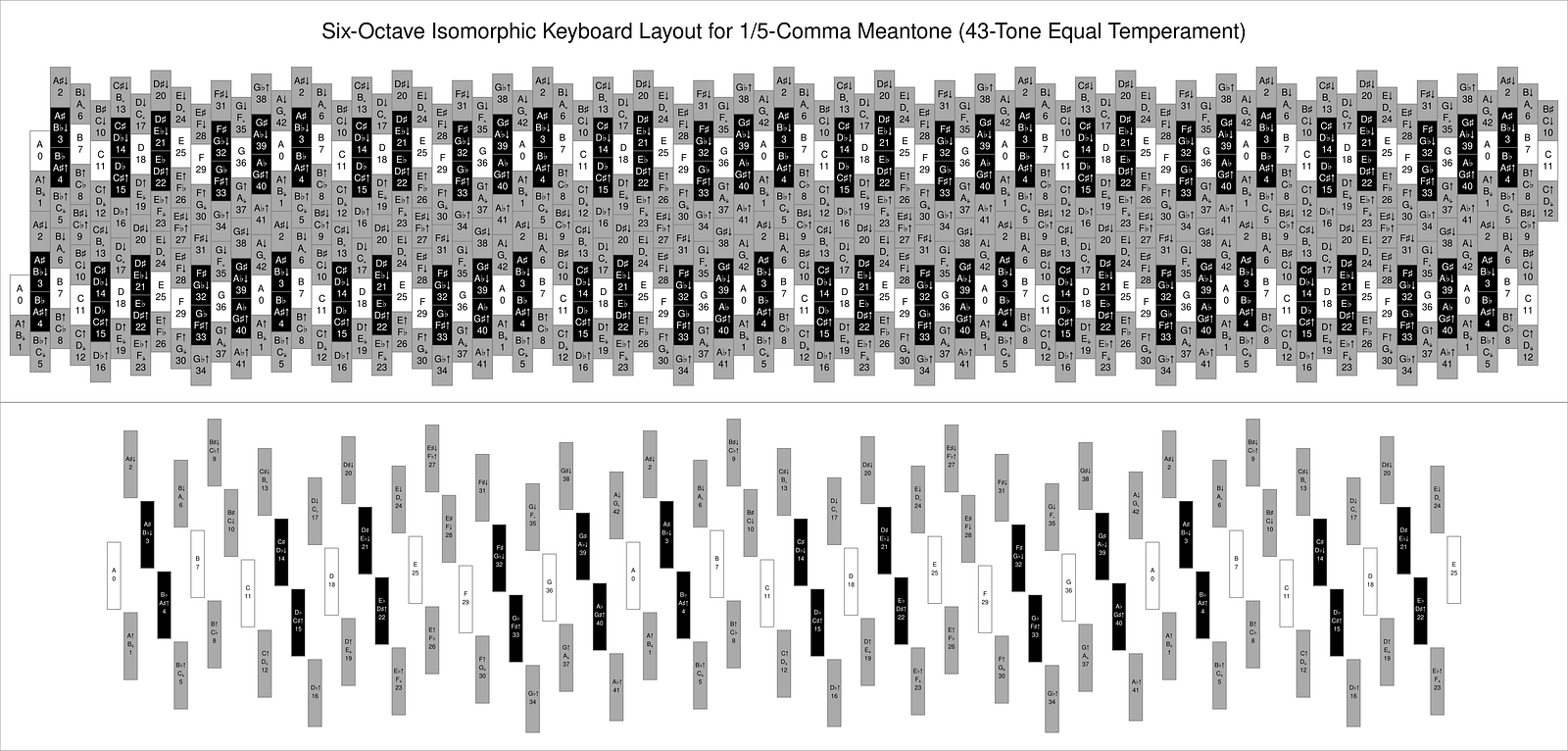
If you’ve spent any time poking around the world of alternative tuning systems, you’ve probably heard of 31edo — the 31-note equal temperament beloved by xenharmonic composers for its gorgeous, pure-sounding thirds and its ability to approximate the 7th harmonic. You may also have heard of 1/4-comma meantone, the historical tuning beloved by early music performers for its warm, lush major thirds. Both are wonderful. Both also have a quirk that puts some musicians off: their perfect fifths are noticeably flat.
That’s where 43edo comes in.
43edo (43 equal divisions of the octave, also called 43-tone equal temperament or 43et) is a tuning system that divides the octave into 43 equal steps of about 27.9 cents each. It is, for all practical purposes, identical to 1/5-comma meantone — a historical temperament first described by the French acoustician Joseph Sauveur in the early 1700s, who called each step a méride. It sits in a particularly interesting position on the meantone spectrum: its fifths are flatter than 12edo but noticeably less flat than 31edo’s, and its major thirds are sweeter than 12edo’s while not quite as pure as 31edo. In other words, it makes meaningful compromises in both directions without sacrificing too much in either.
A Quick Refresher: What Is Meantone?
Before we go further, let’s briefly recap what meantone means, since this is the foundation of everything that follows.
In standard 12-tone equal temperament (12edo, or just “12ET” — the tuning your piano uses), the perfect fifth is very slightly narrowed from its pure acoustic value so that 12 fifths stack up to exactly 7 octaves. This closes the circle of fifths and lets every key sound equally in tune. The cost is that every single major third is about 14 cents sharp of the pure ratio 5:4 — noticeably buzzy if you listen carefully.
Meantone temperament is the family of tuning systems that takes a different trade-off: instead of barely narrowing the fifth so that the circle closes perfectly, it narrows the fifth more aggressively, so that four stacked fifths produce a much more pleasant major third. The name comes from the “mean tone” whole step — the major second that sits exactly halfway between the large 9:8 whole tone and the smaller 10:9 whole tone of just intonation. Different meantone variants differ in how much they flatten the fifth, and consequently how pure or impure their major thirds are.
The most famous examples along this spectrum:
- 1/4-comma meantone / 31edo: fifth flattened by 1/4 of a syntonic comma (~5.4 cents). Major thirds are nearly pure — only about 0.7 cents sharp. Fifths are about 5.2 cents flat.
- 1/5-comma meantone / 43edo: fifth flattened by 1/5 of a syntonic comma (~4.3 cents). The error is shared equally between the fifth and the major third — each is about 4.3 cents away from pure. Fifths are 4.3 cents flat, major thirds are 4.3 cents sharp.
- 12edo: fifth flattened by only about 2 cents. Major thirds are ~14 cents sharp. Fifths are almost pure.
The syntonic comma, by the way, is the tiny interval of about 21.5 cents that separates a pure 9:8 major second from a pure 10:9 major second. It’s the fundamental “error” that meantone temperament distributes across the scale.
The Interval That Makes or Breaks Everything: The Perfect Fifth
If you’ve ever played 31edo or 1/4-comma meantone and thought “this sounds beautiful, but something feels slightly sluggish or heavy in the harmony” — you were probably sensing the flat fifth. At about 696.6 cents (compared to a pure fifth of 701.9 cents), 31edo’s fifth is a full 5.3 cents narrow. That’s past the threshold where many ears, especially those trained on string ensemble playing or choral music, start to feel uneasy.
43edo’s fifth sits at 697.7 cents — only 4.2 cents flat. That may sound like a minor difference, but tuning perception is nonlinear. The difference between a fifth at 696.6 cents and 697.7 cents is musically significant, especially in sustained harmonic contexts. The 1/5-comma fifth is generally described as close enough to just that it feels stable and grounded, while still being narrow enough to produce significantly purer thirds than 12edo.
The concertina players in the forum thread included in the uploaded PDF bear this out nicely. One player of an Anglo concertina tuned in 1/5-comma meantone noted that the major thirds were “noticeably sweeter” than equal temperament while the fifths were not flat enough to feel uncomfortable — even when playing Irish traditional music alongside pipes and fiddles, which themselves don’t use equal temperament. Another noted that playing in a jazz context, in Eb major and C minor, presented no issues of clashing with other instruments.
So How Does 43edo Compare to 31edo?
Let’s be concrete about what you gain and what you give up.
What 43edo has that 31edo doesn’t:
- A subtly different harmonic character — slightly smoother and gentler
- Slightly better fourths & fifths (3rd harmonic)
- Slightly better 11th harmonic
- Moderately better 13th harmonic
What 31edo has that 43edo doesn’t:
- A subtly different harmonic character — slightly more vivid and crystalline
- Moderately better thirds & sixths (5th harmonic)
- Moderately better 7th harmonic
- Moderately better approximation of just xenharmony overall
…Both make available a full range of new xenharmonic consonances not available in 12edo, which lacks harmonics 7, 11 and 13 entirely.
On the xenharmonic side,
31edo’s near-pure 7:4 is one of its most celebrated features. The septimal seventh — that buzzy, bluesy interval that appears in the 4:5:6:7 harmonic seventh chord — is dramatically more in tune in 31edo. If you’re attracted to septimal meantone for its expressive dominant seventh chords and augmented sixth chords that collapse onto pure 7:4, then 43edo is less ideal, since its 7:4 approximation is rougher.
That said, it’s worth keeping 43edo’s 7.9-cent error on the 7th harmonic in perspective. 12edo’s approximation of 7:4 is more than 30 cents off — so wildly inaccurate that the harmonic seventh doesn’t really function as a recognizable interval at all in standard equal temperament. 43edo’s 7.9-cent deviation is still close enough that the septimal color comes through clearly, and listeners familiar with 12edo will find it strikingly expressive even if it can’t match 31edo’s near-perfection.
The picture gets more interesting when you look beyond the 7th harmonic. 43edo actually beats 31edo on the 11th harmonic (11:8, the “natural” tritone) and the 13th harmonic (13:8). 43edo approximates the 11th harmonic to within about 7 cents and the 13th to within about 3 cents, whereas 31edo is roughly 9 cents off on the 11th and 11 cents off on the 13th. These are the harmonics that give music a distinctly otherworldly, floating quality when used as consonances, and 43edo handles them with more precision. So while 31edo wins decisively on harmonics 5 and 7 — which are the backbone of most tonal and septimal harmony — 43edo has a quiet edge in the higher reaches of the harmonic series.
The overall picture: 31edo’s extremely accurate 5th and 7th harmonics make it the closer approximation to just intonationacross most of the xenharmonic intervals you’re most likely to use (11/5, 7/6 and so on). But 43edo is no slouch — it is a fully viable xenharmonic system in its own right.
One useful way to frame the comparison: 31edo is xenharmonic-first, familiarity second. 43edo is familiarity-first, xenharmonic second.
43edo vs 1/4-Comma Meantone: For the Historical Tuning Crowd
Now let’s talk about the other comparison the title promises: 43edo as an alternative to 1/4-comma meantone for players of early music.
1/4-comma meantone was the dominant keyboard tuning across much of Renaissance and early Baroque Europe, used by composers like Gesualdo, Frescobaldi, and likely Monteverdi. Its defining feature is pure 5:4 major thirds — strikingly beautiful, organ-like, deeply resonant. The cost is the most heavily flattened fifths of any common meantone variant, at about 696.6 cents (in practice essentially the same as 31edo’s fifth).
For string players and singers who use meantone-adjacent intonation intuitively — placing leading tones high and thirds low — 1/4-comma’s flat fifths can feel instinctively right. But for keyboard players whose ears are partly anchored to equal temperament, or for composers writing music that moves through many different chord roots, those flat fifths can create a kind of low-level unease or muddiness, especially in bass motion.
1/5-comma meantone / 43edo splits the error differently: rather than dedicating all the tuning effort to purifying the thirds (and paying in flat fifths), it spreads the 4.3-cent impurity evenly across both the fifth and the major third. The result is that neither interval is pure, but neither is uncomfortably out of tune. The thirds are noticeably warmer and more resonant than 12edo’s harsh thirds, but they have a slight glow to them rather than the organ-stop purity of 1/4-comma.
The 1/5-comma meantone page on the Xenharmonic Wiki states this elegantly: “The major third and the fifth are equally off from JI by 1/5 syntonic comma (c. 4.3 cents), with the major third sharp and the fifth flat.” This symmetric distribution of error is actually rather elegant from a musical standpoint — it means there’s no interval that really stands out as problematic.
For playing Baroque repertoire — Bach, Handel, Telemann — in a meantone tuning, 43edo is entirely plausible. Xen Wiki’s 43edo page includes modern renderings of Bach’s Prelude in C minor BWV 999, the “Ricercar a 3” from the Musical Offering, and movements from the Art of Fugue, all in 43edo, by organist Claudi Meneghin. There are also renderings of Chopin preludes and études in 43edo, suggesting the tuning is attractive even for early Romantic repertoire.
The concertina player Little John put it well after thirty years of using 1/5-comma: the tuning sounds “sweet enough,” and the practical difference from 12edo in an ensemble context is minimal enough that no other player ever commented on it being out of tune — while the thirds are genuinely nicer.
The Meantone Scale in 43edo: What You Actually Get
In any meantone system, the diatonic major scale — your standard C D E F G A B C — works beautifully. The fifths are only slightly narrowed and the thirds are sweeter. What changes from 12edo is that sharps and flats are no longer the same pitch. F# and Gb are different notes, separated by what’s called the diesis in 31edo or a méride in 43edo. In 43edo, this gap is one step — 27.9 cents.
This means that in a standard 7-note diatonic key, everything feels perfectly familiar. But the moment you start adding accidentals, you have more pitch options than in 12edo. Bb and A# are different. C# and Db are different. This is both the opportunity and the constraint of meantone tuning.
Like all meantone systems, 43edo has a wolf fifth — one very wide, dissonant fifth that appears when you try to use the enharmonic equivalents of 12edo (like G# as Ab). This limits you to roughly six comfortable major keys and six minor keys in any given 12-note instrument layout. For most folk, early, and chamber music this is no real constraint at all.
What’s unique to 43edo compared to simpler meantones like 19edo is the high note density. With 43 notes per octave, a fully-fretted or fully-keyed 43edo instrument gives you tremendous chromatic flexibility, accessing all 43 pitches within an octave and enabling a wide range of exotic scales and harmonics beyond the standard diatonic. The Xenharmonic Wiki lists a remarkable variety of scales available in 43edo, from familiar meantone diatonic scales and their modes to blues scales, double harmonic scales, and gamelan-inspired scales like Budjarn Lambeth’s ‘fossa pentatonic’.
Who Should Consider 43edo?
You might love 43edo if:
- You play an instrument that can be retuned (fretted instruments, concertinas, organs, synths, software instruments) and want a meantone that feels only a small step away from equal temperament
- You play early music or Renaissance polyphony and want warmer thirds without the very flat fifths of 1/4-comma or 31edo
- You’re a composer or producer who wants to explore xenharmony but finds 31edo’s 7.9-cent flat fifths a bit too far from what your ears are used to
- You want a tuning that plays well with non-keyboard instruments (strings, winds, voice) that naturally favor pure intervals, without jarring them
You might prefer 31edo instead if:
- The near-pure major third (only 0.7 cents sharp) is your primary goal
- You specifically want the warm, slightly bluesy sound of the near-just 7:4 harmonic seventh chord
- You’re deeply interested in septimal harmony and want the best overall approximation of 7- or 11-limit just intonation within a meantone framework
- You want access to 31edo’s other impressive MOS scales beyond meantone (eg orwell, miracle, valentine, myna)
A Note on History: Joseph Sauveur’s Mérides
The tuning system underlying 43edo has a fascinating history. It was devised by the French acoustician Joseph Sauveur(1653–1716), a figure of remarkable determination: he was hearing and speech impaired from birth, yet dedicated his life to the science of sound and is generally credited with coining the word acoustique. He called each step of his 43-division octave a méride, and the 1/7th subdivision of that a heptaméride (later known as a savart).
Sauveur chose 43 because the intervals are well represented in it, particularly the small intervals that mattered to him as a theorist. His temperament was essentially 1/5-comma meantone, and modern calculations confirm that 43edo and 1/5-comma meantone are nearly identical — the fifth of 43 is only 0.02 cents sharper than the exact 1/5-comma fifth. For all musical purposes, they are the same tuning.
How to Try It
The easiest way to experiment with 43edo is in a DAW using a software instrument that supports custom tuning, or a plugin like the free Surge XT synthesizer which supports SCL/KBM tuning files. You can find 43edo tuning files at the Scala Scale Archive and in various xenharmonic community repositories.
For real instruments, concertinas, organs, and fretted instruments are the most practical candidates for retuning to 1/5-comma meantone. The forum thread included in the uploaded document gives practical figures for tuning a concertina to 1/5-comma meantone relative to equal temperament, with the tuning centered on A=440:
C: +6¢ | C#: −8¢ | D: +2¢ | D#: −12¢ | Eb: +12¢ | E: −2¢ | F: +8¢ | F#: −6¢ | G: +4¢ | G#: −10¢ | Ab: +14¢ | A: 0¢ | Bb: +10¢ | B: −4¢
(Figures courtesy of concertina tuner Geoff Wooff, via the concertina.net forum.)
These offsets can be entered into most chromatic tuner apps as custom temperament settings, making it straightforward to retune any instrument reed by reed or string by string.
Further Listening
The Xenharmonic Wiki’s 43edo page lists a growing body of music composed and recorded in this tuning. Particularly accessible entry points include:
- Claudi Meneghin’s organ renderings of Bach (including Art of Fugue movements) and Chopin
- Bryan Deister’s improvisations, including a 43edo cover of “Being for the Benefit of Mr. Kite!” by the Beatles
- Sevish’s Mystify (2025), an electronic track in 43edo
- Budjarn Lambeth’s “Gamelan-Inspired Improvisation in 43edo, Fossa Scale”
43edo won’t give you the crystalline, choir-of-angels thirds of 1/4-comma meantone or the septimal richness of 31edo. What it gives you is something arguably more useful as a starting point: a meantone world that feels grounded and natural, where the fifths are confident and stable, the thirds are genuinely warmer than 12edo’s, and the exotic intervals of the wider xenharmonic universe are within reach whenever you want them. It’s the tuning that, as the concertina forum put it, “makes going back to equal temperament painful”.
Comments
Post a Comment