Welcome to 16edo — where major and minor swap places, the fifth is delightfully wrong, and a whole new harmonic universe opens up
What Is 16edo?
16edo stands for “16 equal divisions of the octave.” You might also see it called 16-TET (16-tone equal temperament) or 16et. The idea is simple: instead of dividing the octave into 12 equal semitones as we do in standard Western tuning, we divide it into 16 equal steps. Each step is exactly 75 cents — three-quarters of a standard semitone.
That 75-cent unit even has its own name: the eka, coined by composer Luca Attanasio from the Sanskrit word for “one” or “unit.” You’ll see it used throughout the Armodue theory system, the main compositional framework developed for this tuning.
For context: in 12edo, the octave contains 1200 cents total, divided into 12 steps of 100 cents each. In 16edo, those same 1200 cents are divided into 16 steps of 75 cents each. The octave itself stays the same — it’s just sliced differently.
Why Would Anyone Do This?
This is the right question to ask, and the answer is genuinely interesting.
Standard 12-tone equal temperament makes certain compromises. It tunes the perfect fifth (the interval from C to G) to 700 cents, which is only 2 cents away from the “pure” version found in nature (702 cents). But it tunes the seventh harmonic — the interval that gives dominant seventh chords their tension — rather inaccurately, at 1000 cents instead of the natural 969 cents. That’s a 31-cent error, which is significant.
16edo takes a completely different trade-off. Its fifth is quite flat at 675 cents — a full 27 cents flat of pure. That’s audibly out of tune by any standard. But its approximation of the 7th harmonic (the interval we’d call a minor seventh) is only 6 cents sharp. And its major third, at 375 cents, is only 11 cents flat of the pure 5/4 ratio (386 cents) — considerably closer than 12edo’s major third, which is 14 cents sharp.
As the Xenharmonic Wiki puts it, 16edo’s 3, 5, and 7 are “backwards from 12edo’s” — where 12edo has a great fifth but a poor seventh, 16edo has a poor fifth but a nearly perfect seventh. It’s a tuning built for different harmonic priorities.
The Upside-Down Scale: Mavila Temperament
Here’s where things get genuinely mind-bending for musicians trained in standard theory.
In 12edo, stacking four perfect fifths (going C → G → D → A → E, and adjusting for octaves) gives you something close to a major third — the 5/4 ratio. This is the basis of meantone temperament and most Western harmony. Major thirds are bright, minor thirds are darker.
In 16edo, the fifth is so flat that stacking four of them takes you in the opposite direction. Instead of landing near a major third, you land near a minor third. This property defines Mavila temperament, and 16edo is its most common tuning.
The practical consequence is remarkable: the major and minor sounds are swapped.
What you notate as a major chord (C–E–G in standard notation) sounds like what we’d call a minor triad — dark, introspective. What you notate as a minor chord (C–E♭–G) sounds bright and resolved, like a major triad. The entire emotional vocabulary of Western tonal music is inverted. Composers writing in 16edo have described it as looking in a mirror and seeing a world where everything is familiar but fundamentally different — some describe mavila as having a “face swap, expectation and surprise” quality.
This isn’t a bug — it’s one of 16edo’s most expressive features. The Mavila scale (which functions like the diatonic scale within this system) is sometimes called the “antidiatonic” scale because its step pattern is essentially the reverse of a standard major scale: where diatonic goes Large–Large–small–Large–Large–Large–small, Mavila goes small–small–Large–small–small–small–Large.
The Interval Map: What You’re Actually Working With
Let’s walk through the 16 steps and what they sound like. Instead of 12 notes in the octave, you have 16, each 75 cents apart:
- 0 cents (step 0): Unison — same as always.
- 75 cents (step 1): The eka. Smaller than a semitone, but surprisingly musical — close to the chromatic semitone theorized by the Renaissance theorist Zarlino (70 cents). Armodue harmonyconsiders it a “harsh dissonance,” to be used carefully, like a leading tone on steroids.
- 150 cents (step 2): A “neutral second” — halfway between a semitone and a whole tone. Unfamiliar, slightly dissonant.
- 225 cents (step 3): Close to a whole tone, approximating the 8/7 ratio (the “septimal whole tone”). The Armodue system calls 3 ekas the “wholetone of Armodue,” noting it’s actually closer to the natural interval between the 7th and 8th harmonics than the standard whole tone of 12edo.
- 300 cents (step 4): A minor third — same as in 12edo. This is one of 16edo’s anchor points in familiar territory, approximating the 6/5 ratio reasonably well. It also approximates 19/16 (the 19th harmonic), giving it a slightly different quality.
- 375 cents (step 5): The closest thing to a major third (5/4), only 11 cents flat. Warmer and “purer” than 12edo’s major third, which overshoots the natural ratio in the other direction.
- 450 cents (step 6): A “neutral fourth” — exactly between a major third and a perfect fourth. Exotic, ambiguous, striking.
- 525 cents (step 7): The “wide fourth” — the Armodue “perfect fourth.” It’s sharper than a standard fourth but functions as one within the system. In Armodue terms this is 7 ekas, the equivalent of the diatessaron in Greek modal theory.
- 600 cents (step 8): The tritone — same as 12edo. Divides the octave exactly in half. Still restless and unstable, still wonderful for tension.
- 675 cents (step 9): The “narrow fifth” — 27 cents flat of a pure 3/2. This is the mavila fifth, the generator of the antidiatonic scale. It’s recognizable as a fifth but clearly out of tune, lending a distinctive buzzy quality.
- 750 cents (step 10): A “neutral sixth” — between a perfect fifth and a minor sixth. Exotic and colorful.
- 825 cents (step 11): Close to a minor sixth (8/5), approximating it reasonably well.
- 900 cents (step 12): A major sixth — same as 12edo’s major sixth.
- 975 cents (step 13): The most important interval in Armodue. This is a near-perfect approximation of the 7th harmonic (7/4), only 6 cents sharp. This is the interval that defines the metallic harmonyapproach (more on this below). Standard 12edo’s minor seventh misses the 7th harmonic by 31 cents; 16edo’s is almost exact.
- 1050 cents (step 14): A “neutral seventh” — between a minor and major seventh. Available as a strong consonance when paired with the 975-cent interval.
- 1125 cents (step 15): Close to a major seventh, slightly wide.
- 1200 cents (step 16): The octave — home, as always.
Armodue: A Complete Theory System for 16edo
One of the most developed frameworks for composing in 16edo is Armodue theory, developed by Italian composer Pierpaolo Beretta and theorist Luca Attanasio and documented on their website armodue.com. (The name Armodue comes from Italian: “armo” as in harmony, “due” meaning two — referencing the 16 = ²⁴ structure of the system.)
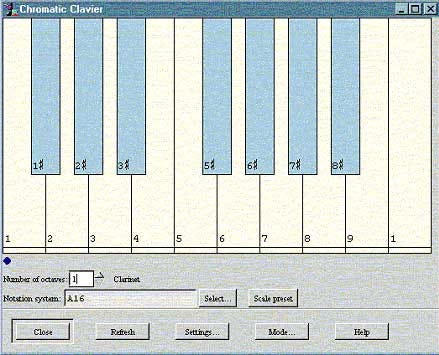
Armodue renames the notes using numbers 1 through 9 (with sharps: 1, 1#, 2, 2#, 3, 3#, 4, 5, 5#, 6, 6#, 7, 7#, 8, 8#, 9), sidestepping the confusing major/minor reversal of conventional letter names. It uses a 4-line staff, and treats the octave as a “tenth” (decima), since it’s the tenth note of the 9-note Mavila scale.
The philosophical foundation of Armodue rests on a key observation: the 12-tone system prioritizes the 3rd harmonic (the perfect fifth), while 16edo prioritizes the 5th and 7th harmonics. The major third at 5 ekas (375 cents) closely approximates the 5th harmonic ratio 5/4, and the interval at 13 ekas (975 cents) closely approximates the 7th harmonic ratio 7/4. Armodue replaces the traditional “cycle of fifths” with a “cycle of 5 ekas” and a “cycle of 13 ekas.”
Attanasio’s harmony guide (translated and preserved on the Xenharmonic Wiki) classifies intervals by consonance in a way that feels both familiar and refreshingly different:
- Harsh dissonances: 1 eka, 15 ekas (the chromatic step and its complement)
- Neutral dissonances: 2 ekas, 14 ekas (the “big semitone”)
- Sweet dissonances: 3 ekas, 13 ekas (the wholetone and natural minor seventh) — these are “dissonances” in the system, but they’re quite consonant-sounding, especially the 13-eka near-pure seventh
- Sweet consonances: 4, 5, 11, 12 ekas (minor/major thirds and sixths)
- Neutral consonances: 6, 10 ekas (the neutral fourth and sixth)
- Open consonances: 7, 9 ekas (the wide fourth and narrow fifth)
- Unstable dissonance: 8 ekas (the tritone)
The recommended progression of tension in chord sequences goes from open consonances through to harsh dissonances — a tension ladder not unlike functional harmony’s tonic–subdominant–dominant arc, but with different rungs.
Armodue also has a rich approach to scale construction. Rather than starting from the cycle of fifths, it builds scales from tetrachords and pentachords within a span of 7 ekas (the “Armodue fourth”), then combining two of these spans with a 2-eka gap between them. This is analogous to how ancient Greek modal theory worked — but adapted for the new system. By mixing and matching the 13 possible tetrachord patterns and 10 pentachord patterns, Armodue theoretically yields over 8,000 distinct scales.
Chord Names: The Notation Problem
Here is where notation gets complicated, and understanding it is key to working practically with 16edo.
Because of the major/minor reversal described above, if you use standard chord names and spellings, you get the opposite of what you expect. A chord spelled C–E–G (a “major chord” by letter names) sounds like a minor triad (10:12:15). A chord spelled C–E♭–G (a “minor chord”) sounds like a bright, resolved major triad (4:5:6).
There are two solutions. The first, called harmonic notation, just accepts the reversal and uses standard letter names — useful if you’re importing music from 12edo or using tools that only support chain-of-fifths notation, but the chord names don’t match the sounds. The second, called antidiatonic notation, renames things so that what sounds like a major chord is called a major chord — but this requires learning that, in 16edo, adding two minor seconds gives you a minor third (not two major seconds giving a major third as in 12edo). Essentially, all the quality names are swapped: major becomes minor and vice versa, augmented becomes diminished, sharp becomes flat.
In practice, many composers working in 16edo use the Armodue number system, which sidesteps the whole issue.
Metallic Harmony: A New Kind of Triad
Metallic harmony is one of the most exciting things you can do with 16edo that has no real equivalent in 12edo. Instead of building chords by stacking thirds, metallic harmony builds chords by stacking sevenths.
The key interval is the 975-cent near-pure seventh (the 7/4 ratio). Stack two of these (with an octave in between), and you get a triad built entirely from large intervals: for example, 0–975–2025 cents. Every dyad in this chord is consonant. There’s no scratchy third, no wolf interval — just a open, resonant, slightly metallic shimmer.
Composer William Lynch, a major proponent of this approach, distinguishes two basic metallic triads:
- Hard triad: The 7/4 interval (975 cents) is on the bottom. It has a more grounded, resonant quality.
- Soft triad: The 7/4 interval is on the top (with an 11/6-approximation below it). It sounds smoother but paradoxically more dissonant.
There are also symmetrical versions analogous to diminished and augmented chords. The characteristic sound of all of these — buzzy, open, slightly otherworldly — gives the style its name. As the Xenharmonic Wiki notes, these chords work best within the Mavila[7] scale, where the Mavila heptatonic provides context and a sense of harmonic function.
What Does It Actually Sound Like?
Composer Easley Blackwood Jr., who systematically explored many equal temperaments, described 16edo this way: it is best thought of as four interleaved diminished seventh chords (since 16 = 4 × 4). Triads are recognizable but too discordant to serve as final cadence points. Keys can still be established through subdominant and dominant progressions, but the fundamental consonant harmony is a minor triad with an added minor seventh.
In practice, 16edo music tends to have a distinctive quality: tonal but alien, settled but restless, with a warmth in its thirds and an intriguing buzz in its fifths. Some describe it as gamelan-adjacent — and this isn’t accidental. The Mavila antidiatonic scale is similar to Pelog, the scale used in Indonesian gamelan music, and indeed mavila may have originally been discovered by Erv Wilson after studying the tuning of the timbila music of the Chopi people in Mozambique.
The best way to get a feel for the range of what 16edo can do is to listen to actual pieces. Here are some concrete examples spanning very different styles:
Aeterna — Tribute to Armodue (2008). This is the landmark album for Armodue theory in practice — 13 tracks composed by Pierpaolo Beretta and Luca Attanasio, the two creators of the system, and released on the Cronos label. All tracks are in an Armodue tuning (16edo or a related 16-tone temperament). The album ranges from reflective piano pieces (“Bright River,” which appears in both piano and guitar versions) to more atmospheric works like “Red Moon Eclipse” and “Beatrice’s Dream.” It’s the foundational listening document for anyone wanting to understand what a fully worked-out 16edo harmonic language sounds like from the inside. Available on Spotify, Apple Music, and Amazon.
Aaron Andrew Hunt — Enantiodromia (2013). Hunt is one of the most prolific 16edo composers, and this album (along with the EP Maniacal Meditations) represents a more rigorously contrapuntal approach to the tuning — dense, serious, and not trying to sound “exotic.” His earlier piece “Fuga a3 in 16ET” is a good introduction: it applies baroque fugal technique directly to 16edo, and the results are alien but structurally coherent in a way that rewards close listening.
Claudi Meneghin — Mavila Fugue (2020/2026) and baroque consort works. Meneghin has consistently explored what traditional Western forms sound like when transplanted into 16edo. His “Canon on Twinkle Twinkle Little Star” is a deceptively simple entry point — a melody everyone knows, rendered in a tuning where it sounds like it has been translated into a dream. His later “MICROPIECE IN 16-EDO FOR BAROQUE CONSORT” and “CANON in 16 edo — 3-in-1 on a GROUND” push this further into full ensemble writing for period instruments.
William Lynch — Mavila Jazz Groove and Cold, Dark Night for a Dance. Lynch’s pieces are the best showcase for metallic harmony in action. “Mavila Jazz Groove” in particular demonstrates how the near-pure 7/4 interval can anchor chord progressions in a way that feels simultaneously jazz-influenced and completely unlike anything in 12edo. The harmonic language here isn’t trying to approximate Western jazz — it’s using jazz’s rhythmic and textural sensibility to explore something genuinely new.
Xotla — “Robotic Dialogue” (2017) and “Cognitive Climate” (2022). These tracks, from the albums Microtones & Garden Gnomes and Science Fraction respectively, take 16edo into more electronic and experimental territory. “Robotic Dialogue” in particular earns its name — the tuning contributes an uncanny, mechanical quality that no amount of pitch-shifting in 12edo could replicate.
Budjarn Lambeth — Waking with a fever before sunrise (2026). A recent addition to the 16edo catalogue and a striking one — ambient and introspective, using the tuning’s characteristic warmth in the thirds and buzz in the fifths to create an unsettled, dawn-light atmosphere.
Across all of these, a common thread emerges: 16edo rewards composers who commit to its logic rather than fighting it. The pieces that work best are not ones that try to sound like 12edo with wrong notes — they’re the ones that accept the inverted harmonic hierarchy and build something coherent from the inside out.
Practical Starting Points
If you want to experiment with 16edo, here are the practical basics:
Software. The free tool Scala has supported 16edo since its early days and can retune a MIDI keyboard to any temperament. Scale Workshop (free, browser-based) makes it easy to generate and export 16edo tuning files for use with most software synthesizers that support MTS (MIDI Tuning Standard) or .scl/.tun files. Most modern soft synths can be retuned this way.
Which scale to start with. The Mavila[7] antidiatonic scale (step pattern 2–2–3–2–2–2–3 in 16edo steps) is the most natural starting point — it functions like a diatonic scale within the system. Once you’re comfortable with the sound, try expanding to Mavila[9] (pattern 2–2–2–1–2–2–2–2–1), which adds two more notes and opens up more harmonic possibilities.
Timbre matters more than you’d think. Most Western acoustic instruments — strings, brass, woodwinds — produce overtones that are close to exact integer multiples of the fundamental (1×, 2×, 3×, 4×…). The 3× overtone (a perfect twelfth) is a strong presence in their sound, and when you play 16edo’s flat fifth against it, the clash can make chords sound muddier than they really are. Synthesizers or instruments with suppressed or absent harmonics at multiples of 3 will work noticeably better — FM and additive synthesis give you fine control over this. On the acoustic side, stiff metal bar instruments like those used in Indonesian gamelan (metallophones, saron, gender) actually have a naturally stretched harmonic series due to the physics of bar vibration, which means their overtones align better with 16edo’s sharp upper intervals. This is part of why 16edo has that gamelan-adjacent quality even on non-gamelan instruments — and why actual metallophones can be a surprisingly natural fit for the tuning.
What to listen for. The first thing most musicians notice is that resolved-sounding chords feel “backwards.” Lean into this. The tension-release narrative you’ve spent years internalizing is still there — it just runs in a different direction. The 975-cent interval (13 steps) will quickly become a favourite: it has a warmth that 12edo’s minor seventh can’t quite match.
Notation. For casual work, the Armodue number system (1 through 9 with sharps) is probably the clearest. For working with other musicians, the antidiatonic notation described on the Xen Wiki lets you use standard note names with the understanding that quality terms are reversed.
Further reading. Luca Attanasio’s harmony manual (in English translation) is archived on the Xenharmonic Wiki and is worth reading carefully — it’s a systematic and thoughtful approach. The original Italian material (including keyboard diagrams, frequency tables, and compositions) is at armodue.com. For guitar players specifically, Ron Sword’s book series Hexadecaphonic Scales for Guitarprovides practical scale and theory material for 16edo on a stringed instrument.
The Bigger Picture
16edo is a reminder that 12-tone equal temperament, for all its power and familiarity, is just one solution to the problem of dividing musical space. It’s a solution optimized for one set of harmonic priorities — primarily, good fifths and reasonable thirds — but other priorities are possible. 16edo optimizes for the 7th harmonic, accepts a flat fifth as the cost, and in doing so opens up a complete harmonic world with its own logic, its own tension and release, and its own emotional palette.
Major sounds minor. Minor sounds major. The fifth is off-kilter. And somehow, it all hangs together into music that is surprising, coherent, and genuinely beautiful on its own terms.
That’s the invitation of 16edo: not to replace what you know, but to discover that the world of music is much larger than any single tuning system can contain.
Tags: microtonal, 16edo, tuning theory, mavila, armodue, xenharmonic, equal temperament, music theory
Comments
Post a Comment