What you can achieve with 20-equal temperament (20edo)
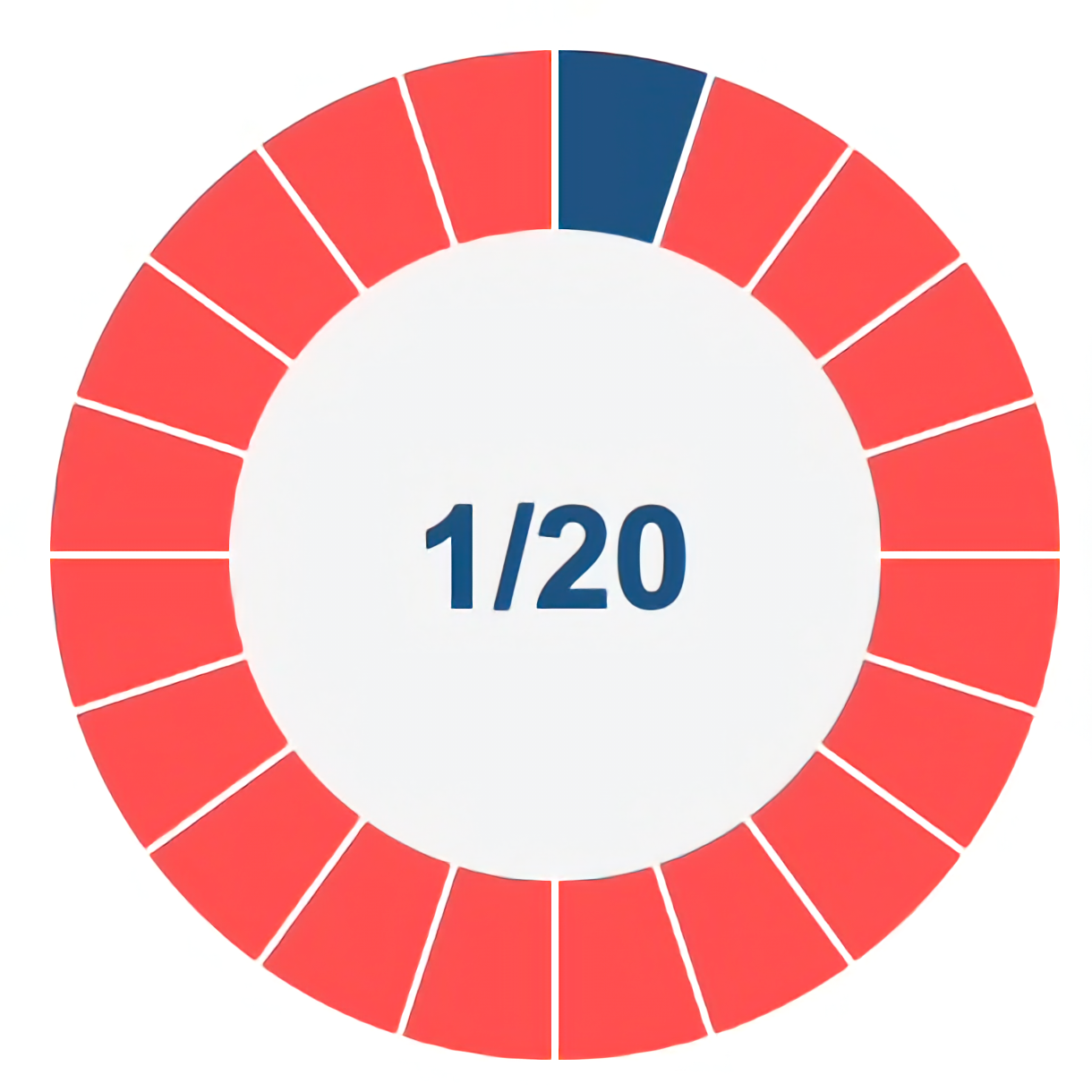
The notes we use — the familiar 12 semitones of the piano keyboard — aren’t the only way to divide up an octave. They’re just the system Western music settled on. But what if you used 20 notes instead? What would that sound like, and could it still make music in a way that feels satisfying rather than just “wrong”?
That’s exactly what 20 equal divisions of the octave — or 20edo for short — is all about. And it’s a surprisingly approachable system, one with real structural logic that any musician with a solid grounding in theory can start to appreciate.
First, What Even Is an EDO?
Before we get into 20 specifically, a quick framing note. The tuning system you already know is called 12edo — 12 equal divisions of the octave. Each of those 12 divisions is exactly 100 cents wide (a cent being 1/100th of a semitone). Your piano, your guitar, your DAW — they all default to this.
An equal division of the octave (EDO) just means you’re slicing the octave into n equal pieces instead of 12. Each step in 20edo is exactly 60 cents wide — smaller than a semitone (100¢), but bigger than a quarter-tone (50¢). You get 20 distinct pitches before you reach the octave, none of which line up with the familiar 12 except at a few specific points.
This family of tuning systems is sometimes called xenharmonic music — music that sounds genuinely foreign to Western ears, not because it’s playing wrong notes, but because it’s playing different notes with their own internal logic.
Why 20? What Makes It Special?
Here’s where it gets interesting for anyone who thinks in terms of harmony and chord function.
20edo is part of the 5n-edo family. It contains 5edo (every 4th step), 10edo (every 2nd step), and 4edo (every 5th step) as subsets. This gives it a kind of modular harmonic architecture. Some intervals it inherits from those smaller systems, and some are unique to 20.
One important characteristic: 20edo’s perfect fifth sits at 720 cents (12 steps), which is noticeably wide compared to the just fifth at 702¢. This means traditional diatonic harmony — the kind built around stacked fifths — doesn’t work well here. Trying to force 20edo into a standard major/minor framework is fighting the system.
What 20edo does do well is approximate the 7th harmonic (the natural “barbershop” seventh sitting around 969¢) with impressive accuracy, along with harmonics 11, 13, and 15. In practical terms, this means it’s very good at chords built on intervals of a seventh rather than a third. More on that shortly.
Forget Major/Minor. Meet the Blackwood Scale.
The most natural and musically rewarding way to work in 20edo isn’t to look for major scales — it’s to use a structure called the Blackwood decatonic scale, named after composer and theorist Easley Blackwood Jr.
The Blackwood scale uses 10 of the 20 available notes, arranged in a highly symmetrical pattern: alternating steps of 3 and 1 (major version: 3–1–3–1–3–1–3–1–3–1). Because the scale divides perfectly into 5 equal “mini-octaves” of 240 cents each, every note in the scale is the root of either a recognizable major or minor triad. You can freely modulate to any of these five harmonic centers without leaving the scale — something that’s genuinely difficult to achieve in 12edo without chromatic alterations.
What do those triads sound like? The major third in Blackwood’s major scale is 4 steps wide, which comes out to 240 cents — considerably wider than the 200¢ major second but nowhere near a standard major third (400¢). The triads are heavily tempered compared to what you’re used to, with a characteristic brightness that many listeners describe as “glassy” or “shimmery.” They don’t resolve the way 12edo triads do, but within the internal logic of the scale, they have their own gravitational pull.
There’s also a Blackwood minor decatonic scale (pattern: 1–3–1–3–1–3–1–3–1–3), and extended versions reaching 15 notes that pack even more chromatic color into the system.
Metallic Harmony: Sevenths as the New Triads
One of 20edo’s most distinctive harmonic possibilities is something called metallic harmony. The idea is simple but radical: instead of building chords by stacking thirds the way Western harmony does, you build them by stacking sevenths.
Specifically, metallic harmony treats the ratio 7/4 — the natural seventh harmonic, sitting around 969 cents — as the most fundamental consonant interval after the octave. In 20edo, this ratio is approximated at step 16 (960 cents), with only about 9 cents of error. That’s a close enough match to sound genuinely consonant.
A basic metallic triad is formed by combining a 7/4 seventh with another large interval like 13/7 above the root. The resulting chord — spanning roughly the same register as a dominant seventh chord but with a completely different flavor — has a cold, metallic, resonant quality that gives the approach its name. There are “soft” triads (7/4 on top) and “hard” triads (7/4 on the bottom), each with a different character. Hard triads have a rougher, more earthbound sound; soft triads are smoother but carry more harmonic tension.
20edo is noted as an ideal system for metallic harmony precisely because its approximation of the 7th harmonic is so clean.
Playing It: Guitars and Other Instruments
One of the practical appeals of 20edo for instrumentalists — especially guitarists — is that it maps onto fretted string instruments in a particularly elegant way.
In 12edo, you can tune a guitar in perfect fourths (each string 500 cents apart), but the span across all six strings doesn’t add up to a clean number of octaves. In 20edo, the “fourth” sits at 480 cents (8 steps), and five of these flat fourths span exactly two octaves (480×5 = 2400¢). This means a 20edo guitar can be tuned uniformly in fourths across all strings, and the same chord and scale shapes work the same way regardless of where you are on the neck — more consistently than standard guitar tuning allows.
For keyboard players, there are Lumatone mappings designed for 20edo, as well as various software solutions for working in non-standard tunings within a DAW environment.
What Does It Sound Like? A Listen-First Example
If you want an entry point that doesn’t require any prior experience with microtonal music, one of the most accessible examples of 20edo in practice is “T w e n t y / T w e n t y” (2019) by the experimental electronic artist E8 Heterotic. It’s listed on the Xenharmonic Wiki as a piece of synthwave made using the Blackwood[10] scale in 20edo tuning.
What makes this a good starting point is the genre. Synthwave is already a familiar framework — pulsing rhythms, wide pads, melodic leads — and E8 Heterotic uses it as a vehicle to demonstrate what a 20edo harmonic language actually feels like in a pop-adjacent context. The symmetrical structure of Blackwood[10] lends itself naturally to the kind of cyclic, hypnotic chord movement that synthwave loves, and the “glassy” character of 20edo’s thirds adds an otherworldly sheen without sounding atonal or chaotic.
Listening to it alongside something like Sevish’s more jazz-influenced microtonal work or the austere academic explorations of earlier pioneers, E8 Heterotic’s approach is explicitly designed to be listenable first — the tuning is the medium, not the message.
A Note on Notation
For musicians who want to actually read and write 20edo music, notation is an interesting challenge. The standard approach uses ups and downs notation — a system that extends standard Western staff notation with arrow symbols to indicate the microtonal alterations. In 20edo, every note has many names: D is also C# and Eb, because the system doesn’t have enough granularity to distinguish them. This many-to-one relationship takes some getting used to, but it means 20edo can be written and read on ordinary sheet music with modest additions to the symbol set.
There’s also Sagittal notation, a more elaborate system designed from the ground up for microtonal music, which handles 20edo cleanly and is increasingly used in xenharmonic composition circles.
Is 20edo “Musical”?
This is always the implicit question underneath any discussion of non-12 tuning systems. The answer, predictably, is yes — but it requires abandoning the assumption that the familiar sounds of major/minor harmony are a universal standard rather than one particular set of conventions.
20edo is not trying to approximate 12edo poorly. It’s doing something structurally different: optimizing for a different set of harmonic relationships (particularly the 7th harmonic and its combinations with 11 and 13), and generating scales — like Blackwood[10] — with their own kinds of symmetry, modulation, and resolution. The music it produces can be tense or relaxed, dark or bright, simple or complex. It just sounds like itself rather than like a slightly detuned version of something you already know.
For musicians with a strong theory background, 20edo is actually a viable on-ramp into xenharmonic thinking. Its connections to familiar smaller systems (it contains 5edo, 4edo, and 10edo), its clean guitar tuning geometry, and the structural clarity of the Blackwood scale all give you solid conceptual footing before you venture into the stranger corners of the system.
Start with “T w e n t y / T w e n t y,” let the harmonics settle, and then dive into the Xen Wiki’s 20edo article to see how deep the rabbit hole goes.
Comments
Post a Comment