If you’ve ever heard Middle Eastern music and noticed those notes that seem to land between the keys of a piano — that slightly “bent” quality that feels simultaneously alien and deeply expressive — you’ve already encountered the sound world of 24-tone equal temperament.
Also called 24edo (24 equal divisions of the octave) or quarter-tone tuning, this is the most accessible entry point into microtonal music for anyone already fluent in standard Western theory. It keeps everything you know and simply doubles it.
This article will walk you through what 24edo is, why it sounds the way it does, what new harmonic territory it opens up, and how you can actually start using it — even with tools you already own.
The Basic Idea: Splitting the Semitone in Two
In standard 12-tone equal temperament (12edo), the octave is divided into 12 equal semitones of 100 cents each. 24edosimply divides each of those semitones in half, producing 24 equal steps of exactly 50 cents each. That 50-cent step — the new smallest interval — is the quarter tone.
The crucial thing to understand is that 24edo contains all of 12edo. Every note you already know is still there. The even-numbered steps of 24edo (0, 2, 4, 6, 8… cents × 50) are exactly your familiar 12-note chromatic scale. The odd-numbered steps (1, 3, 5, 7, 9…) are the new quarter-tone pitches sitting halfway between each pair of adjacent semitones. Think of it as adding a second, parallel chromatic scale that floats exactly a quarter tone above the one you know.
This is what makes 24edo such a welcoming first step into microtonality: you don’t have to abandon your existing harmonic vocabulary. You’re expanding it.
A Quick History: This Isn’t a New Idea
Quarter-tone thinking has roots stretching back centuries in Persian, Arabic, and Turkish musical traditions, where intervals between the familiar semitones were recognized as important melodic building blocks long before Western music theory caught up.
In the Western tradition, the first formal proposal of an equally-tempered 24-note scale came from theorists Heinrich Richter (1823) and Mikhail Mishaqa (around 1840). Then, in the early 20th century, a wave of avant-garde composers began seriously exploring it. Charles Ives, Alois Hába, Ivan Wyschnegradsky, and others were writing quarter-tone music for specially built instruments — Hába even had a quarter-tone piano and clarinet commissioned for the purpose. Even Schoenberg, Webern, and Berg experimented with quarter tones during this period.
The arguably first mainstream Western orchestral piece to use quarter tones was Fromental Halévy’s Prométhée enchaînéin 1849. In the later 20th century, composers like Pierre Boulez, Krzysztof Penderecki, Karlheinz Stockhausen, and Iannis Xenakis all incorporated quarter tones into their work.
More recently, the Australian band King Gizzard and the Lizard Wizardbrought quarter-tone tuning to a rock audience with their albums Flying Microtonal Banana (2017), K.G. (2020), and L.W. (2021), using custom-built guitars in 24edo tuning.
How Does It Sound? The Character of the Quarter Tone
The 50-cent quarter tone itself is a striking interval. Psychoacoustic research (via harmonic entropy models) consistently identifies it as one of the most dissonant intervals possible — it sits at the peak of harmonic ambiguity, too large to fuse with a unison but too small to clearly imply any simple frequency ratio. The result is a tense, beating, slightly “detuned” sound that many listeners describe as washy or shimmering.
Melodically, though, quarter tones create a bending, sliding quality — a sense of notes dissolving into one another. This is why they function so beautifully as grace notes or passing tones in Arabic and Persian music, smoothing the transition between more distant pitches. In tonal Western music, moving a chord up or down by a quarter tone creates an uncanny, dreamlike effect — familiar harmony suddenly made strange.
The most important new melodic intervals in 24edo are not the quarter tone itself, but the neutral intervals that open up once you have it.
The New Intervals: A Tour of Unfamiliar Territory
Here’s how 24edo’s interval vocabulary expands the five categories familiar from 12edo. For seconds, thirds, sixths, and sevenths, there are now five sizes instead of two or three:
Seconds: Infra Second (50¢) — Minor Second (100¢) — Neutral Second (150¢) — Major Second (200¢) — Ultra Second (250¢)
Thirds: Infra Third (250¢) — Minor Third (300¢) — Neutral Third (350¢) — Major Third (400¢) — Ultra Third (450¢)
Fourths: Diminished Fourth (400¢) — Narrow Fourth (450¢) — Perfect Fourth (500¢) — Wide Fourth (550¢) — Augmented Fourth (600¢)
Fifths: Diminished Fifth (600¢) — Narrow Fifth (650¢) — Perfect Fifth (700¢) — Wide Fifth (750¢) — Augmented Fifth (800¢)
Sixths: Infra Sixth (750¢) — Minor Sixth (800¢) — Neutral Sixth (850¢) — Major Sixth (900¢) — Ultra Sixth (950¢)
Sevenths: Infra Seventh (950¢) — Minor Seventh (1000¢) — Neutral Seventh (1050¢) — Major Seventh (1100¢) — Ultra Seventh (1150¢)
The italicized intervals are the genuinely new ones — the ones that don’t exist in 12edo. A few are worth singling out:
The neutral second (150¢) is the classic “Middle Eastern” sound. It’s that step between a semitone and a whole tone that gives maqam and dastgah music so much of its characteristic color. It splits a minor third (300¢) exactly in half — two neutral seconds make a minor third.
The neutral third (350¢) sits exactly between a minor and major third. It doesn’t clearly sound like either — it has a floating, ambiguous quality that can function as both. In harmonic terms, it’s a remarkably close approximation of the ratio 11/9, one of the cleaner intervals of the 11-limit overtone series.
The wide fourth (550¢) is a great approximation of the 11th harmonic (11/8), only about 1.3 cents flat of just. This is one of 24edo’s genuine strengths as a tuning system — the 11th harmonic is represented with exceptional accuracy.
The narrow/wide fifth pair (650¢ and 750¢) have a tense, unusual character. The narrow fifth in particular has a rough, “wolf” quality that can be used to create expressive harmonic tension.
Harmony in 24edo: Five Triads Instead of Two
In 12edo, every triad is built from one of two third types: major (400¢) or minor (300¢). In 24edo, you have five distinct third sizes, giving rise to five basic triads:
- Inframinor triad (0–250–700¢): Built with an infra (ultra) third. Dark, ambiguous, close in sound to a subminor chord.
- Minor triad (0–300–700¢): Your familiar minor chord. Unchanged.
- Neutral triad (0–350–700¢): The most characteristic new chord. Neither major nor minor — floating and modal in quality.
- Major triad (0–400–700¢): Your familiar major chord. Unchanged.
- Ultramajor triad (0–450–700¢): Built with an ultra (or wide) third. Bright, tense, and unusual.
These triads “tend to lack the forcefulness to sound like resolved, tonal sonorities” when used on their own (to quote the Xenharmonic Wiki), but adding a seventh or using tetrads gives them much more harmonic weight. The neutral tetrad — 0–350–700–1050¢ — is a beautiful chord: a neutral triad with a neutral seventh added. It has an open, somewhat ancient quality, and can form the basis of entirely new harmonic progressions.
One especially interesting option is the “11-limit neutral tetrad”: 0–700–1050–1750¢ (which wraps around the octave). This is considered by some theorists to be the most purely consonant tetrad involving neutral intervals available in 24edo.
Another powerful new option is the harmonic seventh chord variant: a standard major triad with an “infra seventh” (950¢) on top instead of the usual minor seventh (1000¢). This approximates the just ratio 7/4 — the natural seventh of the overtone series — more closely than 12edo does.
New Scales and Modes
24edo also opens up a wealth of new scales, many of which have real-world connections to non-Western musical traditions.
The most theoretically important new scale family is the Mohajira (also called the neutral diatonic scale), which uses a step pattern of large and neutral seconds — for example, 3–4–3–4–3–4–3 in 24edo steps. This produces a heptatonic scale close to several Arabic scales, and gives access to a kind of “neutral tonality” where neutral thirds function as the stable harmonic intervals instead of major and minor thirds. The modes of this scale have names like Maqam Rast, Maqam Hussaini, and Dastgah-e Sehgah, reflecting their roots in Arabic and Persian music.
The Semaphore pentatonic (5 5 4 5 5 in 24edo steps) and its 9-note expansion are also distinctive — close to equipentatonic and resembling certain Indonesian slendro scales.
More exotically, 24edo can play enharmonic scales from ancient Greek theory — scales that use tiny intervals (just 1 or 2 steps = 50–100¢) followed by large leaps. For example, the Enharmonic Dorian: 1–1–8–4–1–1–8. These archaic-sounding scales (which are actually what Greek writers like Aristoxenus described, and which are nearly impossible to render in 12edo) become straightforwardly playable.
A Note on Harmony and Intonation
It’s worth being honest about where 24edo is strong and where it’s weaker as an approximation of the just intonationovertone series.
Strong points: The 11th harmonic (and its related intervals: 11/8, 11/9, 11/6, 11/10) is approximated with exceptional accuracy — the 550¢ wide fourth is only 1.3 cents from just 11/8. The 13th and 17th harmonics are also represented reasonably well. Since it contains 12edo, all the 5-limit harmony (major and minor thirds and fifths) is present with exactly the same accuracy as standard equal temperament.
Weaker points: The 7th harmonic (the “blue note” seventh, ratio 7/4 = 969¢) is poorly approximated. 24edo maps it to 950¢, which is about 19 cents flat of just — worse than the 12edo mapping of 1000¢ (which is 31 cents sharp). If you specifically want good 7-limit harmony alongside the 12edo notes, tunings like 31edo or 72edo are more accurate.
The practical upshot: 24edo is not ideal for reproducing the warm, natural quality of pure just-intonation seventh chords. But it is excellent for a harmonic world based around 11-limit intervals and neutral tonality — a genuinely different harmonic palette, not a lesser version of something else.
Notation: Writing Quarter Tones Down
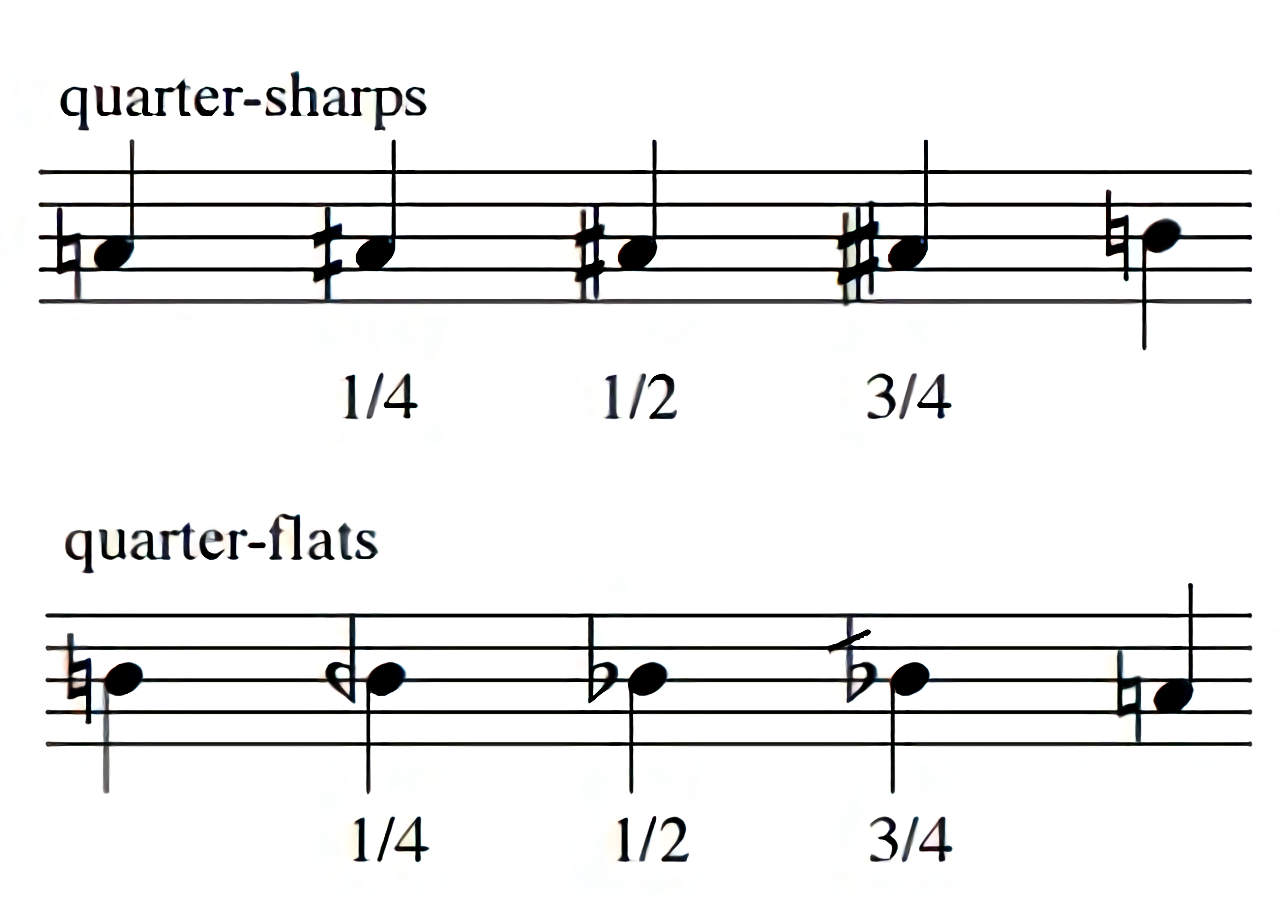
Several notation systems exist for 24edo. The most commonly encountered in scores is the Stein–Zimmermann system, which adds two new accidentals to the standard sharp and flat:
- A half-sharp (semisharp): raises a note by 50¢
- A half-flat (semiflat): lowers a note by 50¢
- A sharp-and-a-half (sesquisharp): raises by 150¢
- A flat-and-a-half (sesquiflat): lowers by 150¢
In Persian music, the traditional accidentals koron (quarter-tone flat) and sori (quarter-tone sharp) are used instead — intuitive to read but harder to type.
There is also the more comprehensive Sagittal notation system, which uses a unified set of arrow-like symbols designed to work across many different tuning systems. Its “Revo” flavor is particularly clean and well-suited to 24edo scores, though it requires some learning for musicians used to traditional notation.
For analytical purposes, ups and downs notation is popular in the xenharmonic community: a caret (^) means “raised by a quarter tone” and a lowercase v means “lowered by a quarter tone,” so E-half-sharp would be written ^E.
How to Actually Play It
One of 24edo’s great practical advantages is how easy it is to access with standard instruments. The classic approach: take two of the same instrument and tune one a quarter tone higher than the other. Two pianos, two harps, two violins in the same ensemble — suddenly you have access to all 24 notes. This is how most of the existing orchestral and chamber literature was realized, from Wyschnegradsky’s piano studies to Charles Ives’s Three Quarter-Tone Pieces for Two Pianos.
For guitarists, the “Sazocaster” approach popularized by King Gizzard adds extra frets between approximately half the regular fret positions, giving access to quarter tones across the neck while keeping standard chord shapes reachable. Custom luthiers like Ron Sword’s Metatonal Music can re-fret standard guitars for 24 frets per octave.
For trombonists and other slide brass players, 24edo requires nothing special — just increased precision. Fixed-pitch brass players can use instruments with an extra valve (Courtois and Van Laar both make quarter-tone trumpets).
For electronic musicians, this is arguably the easiest tuning to work with: most modern DAWs and soft synths support microtuning via MTS-ESP or scala tuning files, and 24edo is one of the most straightforward tunings to implement since it maps cleanly onto a standard MIDI keyboard (two keyboards, one tuned 50 cents up, or a single keyboard with re-mapped tuning).
The Lumatone isomorphic keyboard also provides an ergonomic layout for 24edo with better physical design than stacked piano keyboards.
Where to Start Listening
If you want to hear what 24edo actually sounds like across a variety of styles, here are some starting points:
- Alois Hába — String Quartet №3 in Quarter-Tone System, Op. 12(1922). A landmark of the Western quarter-tone tradition, using neutral intervals in a chromatic-but-tonal framework.
- King Gizzard and the Lizard Wizard — Flying Microtonal Banana(2017). Psychedelic rock that makes the quarter-tone guitar sound completely natural.
- Ivan Wyschnegradsky — any of his quarter-tone piano works. Dense, post-romantic harmony filtered through a microtonal lens.
- Traditional Arabic maqam music (any genre) — the neutral seconds and thirds of 24edo approximate the intonation of instruments like the oud and the riq in this tradition more closely than 12edo ever can.
- The 24edo music page on the Xenharmonic Wiki collects a large range of contemporary pieces in the tuning, from orchestral to electronic to experimental rock.
The Bottom Line
24edo is the natural first step beyond 12 for any musician who wants to explore microtonality without abandoning everything they know. It preserves all of standard harmony, adds a coherent set of new intervals built around neutral thirds and 11-limit sonorities, connects deeply with non-Western musical traditions, and is practically accessible with minimal investment in new instruments or software.
The neutral third and neutral seventh are not “out of tune” versions of anything — they are their own intervals, with their own character and logic. Once you start hearing them as such, a whole new dimension of melody and harmony opens up. And because 24edo keeps the familiar landmarks of 12edo in place, you always have something to orient yourself with as you explore.
The best summary might be this: 24edo doesn’t replace the music theory you already know. It gives it a second floor.
Further Reading
- 24edo — Xenharmonic Wiki (the primary technical reference)
- 24edo Music — Xenharmonic Wiki (pieces and recordings)
- Quartertone — Xenharmonic Wiki
- Mohajira — Xenharmonic Wiki (the main neutral-third scale)
- 24edo Scales — Xenharmonic Wiki (extensive scale list)
- Don Ellis, Quarter Tones: A Text with Musical Examples, Exercises and Etudes (1975) — a practical guide from a jazz perspective
Comments
Post a Comment