Succeeding at 9edo means leaving familiar scales and chords at the door
If you’ve spent any time around the microtonal music community, you’ve probably encountered the abbreviation “EDO” — Equal Divisions of the Octave. Our familiar Western tuning system is 12-EDO: twelve equally spaced notes per octave. But what if you used nine instead?
That’s 9-EDO (also written 9edo, or sometimes 9-TET for 9-tone equal temperament). It’s a tuning system where the octave is sliced into nine equal pieces, each one roughly 133 cents wide. For comparison, our standard semitone is 100 cents and a whole tone is 200 cents — so each step in 9-EDO falls right between those two, in the territory of a neutral second. These are macrotones, not microtones.
This article is a practical introduction to 9-EDO for musicians who already understand scales, intervals, chords, and basic harmony. We’re going to look at what makes 9-EDO tick, what harmonic resources it offers, where it shows up in real-world music, and how you might start exploring it yourself.
Wait, is this micro- or macrotonal?
This is a common point of confusion worth clearing up at the start. “Microtonal” technically means any tuning that departs from 12-EDO, but colloquially it implies notes smaller than a semitone — quarter-tones and the like. 9-EDO goes the other direction entirely: its smallest step is about 133 cents, sitting between a semitone and a whole tone — what’s called a neutral second.
A more specific term for this is macrotonal. You’re not splitting hairs between nearly-identical pitches; you’re working with a palette that has fewer, more widely-spaced notes. Think of it as painting with a broader brush.
The Basic Structure: Three Augmented Triads
The single most important thing to understand about 9-EDO is this: the octave divides evenly into three equal parts, each of 400 cents (three steps of 133¢ each).
If you’ve spent time with 12-EDO harmony, you already know this interval. 400 cents is very close to a just major third (5/4 = 386¢), and three of them stacked together make an augmented triad. In 12-EDO we have four such augmented triads interlocking to form the chromatic scale. In 9-EDO, we have three.
Music theorist Rich Cochrane captures this beautifully: think of 9-EDO as three interlocking augmented triads, evenly spaced a single step apart:
- Triad A: notes 0, 3, 6
- Triad B: notes 1, 4, 7
- Triad C: notes 2, 5, 8
Every note in the system belongs to exactly one of these three groups. This gives 9-EDO an unusually clean, symmetrical architecture — something that is immediately apparent when you visualize it as three equilateral triangles inscribed in a circle of nine points.
This symmetry also explains one of 9-EDO’s more striking properties: since 9 and 12 share a common factor of 3, these three augmented triads are identical to those found in standard 12-EDO. If you play the augmented chord C–E–G# on a regular piano, all three of those pitches exist verbatim in 9-EDO. It’s the six remaining notes of the chromatic scale that disappear, and nine new (macrotonal) notes that take their place.
The Intervals: What You’ve Got to Work With
With nine notes per octave, the interval palette looks quite different from what you’re used to. Here are the nine intervals available (from unison to octave), named approximately:
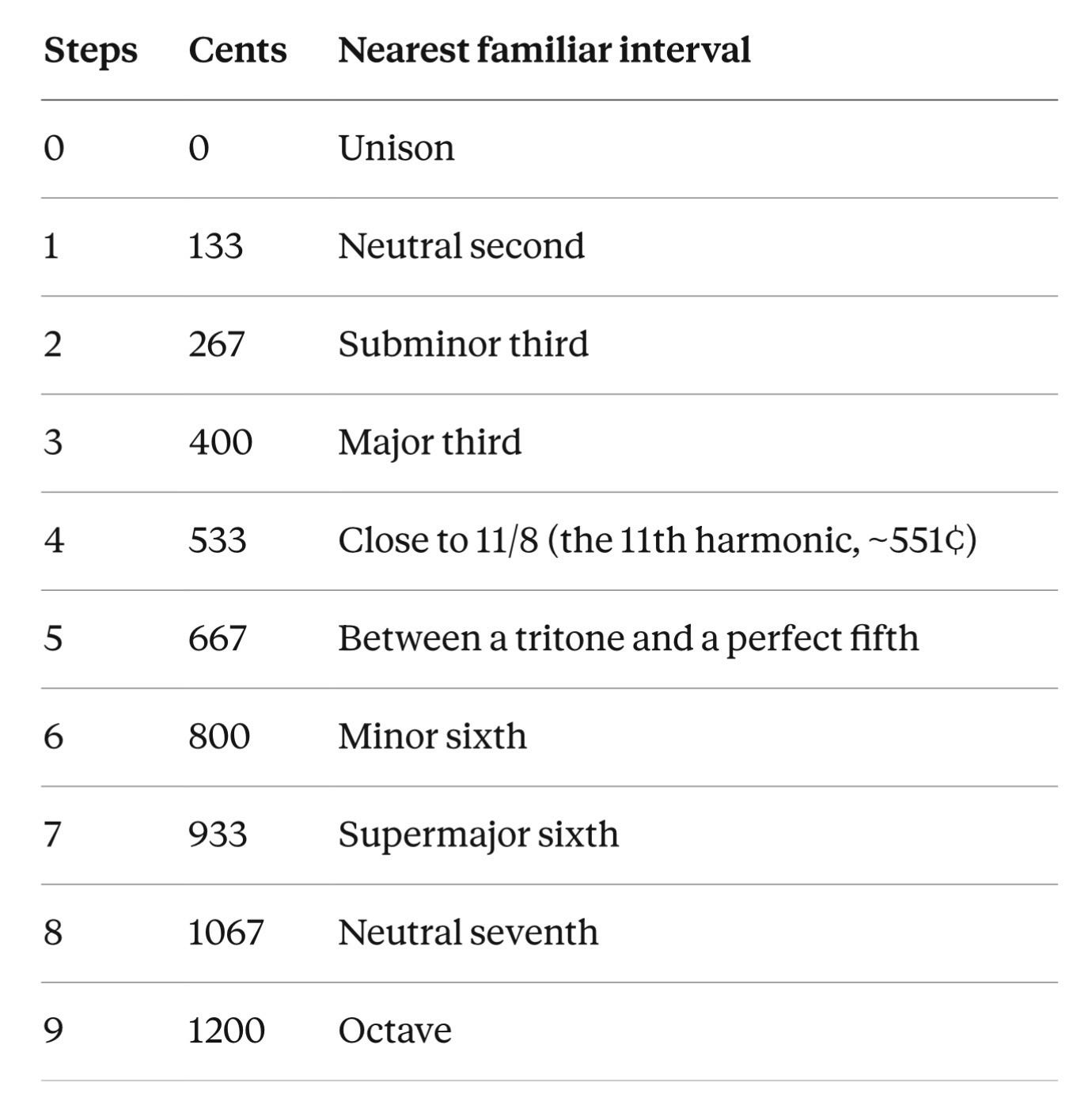
The first thing musicians notice is how sparse this is. There’s no interval that sounds quite like a perfect fifth (3/2 = 702¢). The closest we get is step 5 at 667 cents, which is about 35 cents flat — noticeably out of tune as a “fifth,” enough to feel more like a widened tritone than a pure fifth. If you’re a harmony-focused musician used to building triads from stacked thirds and fifths, this is the biggest adjustment 9-EDO demands.
On the other hand, the major third (step 3, 400¢) is reasonably good — it’s about 14 cents sharp from pure, similar to what you hear in equal-tempered 12-EDO every day. The subminor third (step 2, 267¢) is a pretty solid approximation at only about 0.2 cents off from the just 7/6 ratio — a sweetly in-tune septimal interval that 12-EDO can’t touch. Step 4 at 533¢ is in the neighbourhood of the 11th harmonic (11/8 ≈ 551¢), giving 9-EDO a usable — if approximate — undecimal tritone. And the neutral seventh (step 8, 1067¢) sits close to 11/6 (≈ 1049¢), an important 11-limit consonance that gives 9-EDO chords an exotic, open quality quite unlike the leading-tone tension of a major seventh. So 9-EDO actually has decent subminor thirds, great augmented triads, a usable undecimal fourth, and troubled fifths. It rewards a different approach to harmony than what classical or popular music has trained us to expect.
Harmony: Embracing Dissonance (and Symmetry)
Because all three “root” augmented triads are structurally identical, the most natural harmonic approach in 9-EDO is something called planing — a technique borrowed from Impressionist composers like Debussy and Ravel, where you move chord shapes in parallel without changing their quality. In 9-EDO, you’re planing augmented triads, creating a consistent sonic texture where every chord sounds like every other chord.
That gets boring quickly, which is where the real creativity begins. Cochrane identifies nine basic triad types available in 9-EDO, created by mixing notes from different augmented triads. Three of these come from taking one note from each of the three augmented groups — these tend to be the most dissonant. Six more come from taking two notes from one group and one from another — these sound somewhat less jarring.
For four-note chords, there are thirteen distinct possibilities, most of them dense and richly dissonant. One of the most characteristic chord types for the system is built on the close approximation of septimal (7-limit) intervals that 9-EDO happens to contain. The chord 1/1–7/6–49/36–12/7 (a kind of septimal seventh chord) fits naturally in 9-EDO because the septimal subminor third (7/6 ≈ 267¢) and the septimal supermajor sixth (12/7 ≈ 933¢) are both tuned with near-zero error. The system doesn’t handle the dominant seventh chord (4:5:6:7) very well as a whole, but it finds these specific septimal intervals with surprising accuracy.
The impure fifths, far from being a defect, become a characteristic sound. At 667 cents, the “fifth” in 9-EDO is close to a tritone and creates a restless, unresolved quality in chords. If you’re drawn to music that lives in ambiguity — post-tonal, ambient, or experimental styles — this is a feature, not a bug.
Scales: The Antidiatonic World
This is where 9-EDO gets genuinely strange and wonderful.
In standard 12-EDO, our most familiar seven-note scale — the major scale — has a specific pattern of steps: L L s L L L s (where L = whole tone and s = semitone). This generates what theorists call a diatonic scale, with its characteristic asymmetry of two small steps and five large ones.
9-EDO’s native seven-note scale (called the antidiatonic scale, or sometimes the mavila scale after the temperament family it belongs to) is the mirror image of this: s s L s s s L. Two large steps and five small ones. The large and small are flipped everywhere.
This has a profound effect on harmony. In the antidiatonic scale:
- Major and minor are swapped. What’s notated as a major chord sounds minor, and vice versa.
- Fourths and fifths are also swapped in a sense: the interval you’d call a “fourth” (4 steps, 533¢) lies between a fourth and a tritone, and the “fifth” (5 steps, 667¢) lies between a tritone and a fifth.
- Normal interval arithmetic breaks down. A major second plus a major second does not equal a major third in this system. You have to learn new rules.
If this sounds disorienting, that’s because it is — at first. But the antidiatonic scale has its own internal logic, and musicians who spend time with it often find that it unlocks a genuinely different emotional vocabulary. It’s been described as the “sister scale” to the diatonic, containing all the same structural relationships but with the polarities reversed.
Interestingly, 9-EDO also contains a five-note subset (2L 3s) that sits between the familiar pentatonic and something more exotic — useful as an entry point for improvisation before you tackle the full nine-note system.
Musical Examples
Reading about an unfamiliar tuning system only gets you so far — at some point you need to just listen. Here is a selection of pieces written in 9-EDO, spanning several decades and a range of styles, to give you a sense of what composers have actually done with this system.
Ivor Darreg — “9 Tones Per Octave — Strings” (1994, from Detwelvulate!) Darreg was one of the founding figures of the xenharmonic movement and the person who coined the term “xenharmonic.” This track, preserved on what was for a long time the only commercially available CD of his work, is an early and historically significant exploration of 9-EDO on string timbres — fitting, given what we said above about inharmonic or bowed sounds suiting the system. Available on Bandcamp.
Aaron Andrew Hunt — “Prelude in 9ET” and “Fugue a3 in 9ET” (from The Equal-Tempered Keyboard, 1999–2022) Hunt approaches 9-EDO from a keyboard and classical perspective, demonstrating that the system can sustain contrapuntal writing. The fugue in particular is a fascinating document of what voice-leading looks and sounds like when your interval palette is this stripped back. Available on Bandcamp.
Stephen Weigel — “Tenacious Chorale” (Movement 1) (2016) and “Gamelan, Origin, Creation” (2017) Weigel is a prolific xenharmonic composer and the co-host of the Now and Xen podcast. “Tenacious Chorale” is a guitar piece in 9-EDO (with a second movement in 8-EDO) that was performed at a new music festival, demonstrating that 9-EDO can support recognisably harmonic, choral-style writing. “Gamelan, Origin, Creation” is a string duet using the mavila/antidiatonic scale, and is a perfect companion to the Gamelan section below — same system, very different aesthetic approach. Both on SoundCloud.
Claudi Meneghin — “Passacaille for Recorder, Oboe, English Horn, Cello” (2020) A genuinely accomplished piece of chamber music in 9-EDO, showing the system’s capacity for sustained melodic and contrapuntal writing across acoustic instruments. The passacaille form — a repeating bass figure with variations above — is an interesting structural choice that lets the ear settle into the tuning gradually. On YouTube.
Nick, The NRG — “Microtonal Satie Kalimba Cover — Gnossienne #1” (2023) Perhaps the most approachable entry point on this list: a cover of Erik Satie’s Gnossienne №1 performed on kalimba retuned to 9-EDO. Satie’s original already has a modal, ambiguous quality that translates surprisingly well into the system, and the kalimba timbre (inharmonic metal tines) is an ideal fit. A good first listen for someone who wants a familiar melodic anchor before diving into fully original 9-EDO music. On YouTube.
Francium — “9edo chill” (from Melancholie, 2023) A contemporary electronic/ambient track that demonstrates 9-EDO in a modern production context, and one of the more widely available pieces on streaming platforms. On Spotify, Bandcamp, and YouTube.
Phanomium — “Enneagon” (2024) The title (“enneagon” = nine-sided polygon) signals the composer’s intent: this is 9-EDO treated as a distinct geometric world, not just a retuned version of something familiar. A good example of newer-generation xenharmonic composers who approach these systems with fluency from the ground up. On YouTube.
For a much longer list covering many more styles and composers, see the Music in 9edo page on the Xenharmonic Wiki.
Real-World Connections
Indonesian Gamelan
The connection between 9-EDO and traditional Indonesian pelog scales is one of the most fascinating threads in xenharmonic theory. Pelog is one of the two main tuning systems used in Javanese and Balinese gamelan music, and it uses a seven-note scale with very unequal steps — some quite wide, some narrow.
Theorists have observed that Indonesian gamelan music often uses five-tone subsets of a seven-tone pelog superset in a way that closely mirrors how the 5-tone and 7-tone mavila/antidiatonic scales work in 9-EDO. Some researchers have even suggested that certain gamelan traditions may stem from a 9-EDO tradition. The match isn’t perfect — real pelog scales vary from gamelan to gamelan and are never truly equal-tempered — but the structural similarity is striking enough to give 9-EDO a tangible cultural anchor.
The gamelan connection is also a useful hint about timbre. Gamelan instruments — metallophones, gongs, and bells — produce inharmonic partials that don’t clash with the system’s impure fifths the way a violin or a piano string would. Western instruments with strongly harmonic overtone series tend to fight with 9-EDO, because those overtones imply 3/2 fifths and 5/4 thirds that the tuning only approximates. If you’re composing in 9-EDO, you may find that bell-like synth tones, mallet instruments, bowed metal, or heavily processed timbres sit far more comfortably in the system than a straightforward guitar or piano patch.
Klingon Music Theory (No, Really)
This one deserves a mention because it’s delightful and surprisingly rigorous. Linguist Marc Okrand, who invented the Klingon language for Star Trek, wrote in his book Klingon for the Galactic Traveler that older Klingon music is based on a nine-note scale — not an octatonic scale within 12-EDO, but an entire tuning system of nine notes. Okrand didn’t specify whether this was an equal or unequal division of the octave. It was music theorist and YouTuber Levi McClainwho interpreted this to mean 9-tone equal temperament — and while that’s his reading rather than Okrand’s explicit intent, it’s a poetic one for reasons we’ll get to in a moment.
An equal system turns out to be poetic because of the Klingon number system. Klingons originally used a base-3 counting system, and 9 = ³² maps beautifully onto their cultural motifs of threes — the three blades of the empire’s crest, the three trials of Kahless, the Klingon trinity of honor, duty, and loyalty. A nine-note equal scale built from three interlocking augmented triads reflects that numerological symmetry in a way a lopsided nine-note scale never could.
A real-world Klingon opera, ‘u’ (premiered in 2010), explored a related system based on just intonation rather than equal temperament, with the unusual feature that different characters sing in different tuning systems simultaneously — a kind of poly-microtonality intended to express the musical ideal of embraced dissonance.
What Does It Sound Like?
Descriptions of 9-EDO tend toward words like “bells,” “chimes,” “otherworldly,” and “unsettled.” The wide step sizes mean melodies move in large leaps by our standards, giving music an open, spacious quality. The impure fifths mean triads never fully “lock in” with the satisfying consonance of 12-EDO chords — there’s always a slight buzz or beating.
One experienced microtonal composer described 9-EDO as having a bells-and-chimes quality — clean and ringing, but harmonically restless. The augmented triad symmetry makes it easy to write music that feels geometrically balanced even while sounding harmonically ambiguous.
At the same time, that spare palette means you’re constantly aware of what the system doesn’t have. There’s no dominant seventh that wants to resolve. There’s no leading tone half-step away from the tonic. The familiar gravitational pulls of tonal harmony mostly evaporate, which either feels liberating or terrifying depending on your relationship to functional harmony.
How to Start Exploring
If you want to experiment with 9-EDO, here are some practical starting points:
Software: Most DAWs with microtonal support can load Scala tuning files. A 9-EDO Scala file is trivially simple to create — nine equal steps. Tools like MTS-ESP by Oddsound let you retune software instruments in real time. Pianoteq, Surge XT, and various other synths support microtuning natively.
Hardware: The Lumatone isomorphic keyboard has community-maintained layouts specifically for 9-EDO. It’s also been played on a retuned ukulele (using heavier fishing line to compensate for the different fret positions) and on fretless stringed instruments.
Mental framework: Rather than trying to map 9-EDO onto 12-EDO thinking, try starting from the three augmented triads as your foundation. Number the notes 0 through 8. Explore what happens when you move a single note from one triad to an adjacent one. Build slowly outward from the augmented structure rather than looking for familiar chord shapes.
Listen first: Before playing, spend time just listening to 9-EDO music. Your ear needs time to adjust to the step sizes before your hands can do anything meaningful. The xenharmonic community has produced a fair amount of 9-EDO material, much of it available on YouTube and Bandcamp.
A Final Note
9-EDO is unusual in the microtonal landscape because it’s genuinely a macrotonal system — fewer, bigger steps, not more tiny ones. It’s simple enough structurally (only nine notes, built from three augmented triads) that you can hold the whole thing in your head, yet musically rich enough to support real compositions with genuine harmonic depth.
It won’t give you the smooth voice-leading of meantone or the lush overtone richness of just intonation. What it gives you instead is symmetry, strangeness, and a harmonic world where dissonance is the native language and consonance is something you have to build your own definition of from scratch.
That’s either a challenge or an invitation, depending on your disposition. For a certain kind of musician, it’s both.
Further reading and listening:
- 9edo on the Xenharmonic Wiki
- Antidiatonic scale (2L 5s)
- Mavila temperament
- EDO (Equal Divisions of the Octave)
- Macrotonal EDOs
- Rich Cochrane, “9-EDO: Three Augmented Triads in Perfect Symmetry” at cochranemusic.com
Comments
Post a Comment