What if it’s the tuning that changes to fit the instrument? An introduction to William Sethares' "Tuning, Timbre, Spectrum, Scale"
Timbre and scales are not two separate concepts — they’re deeply intertwined and symbiotic
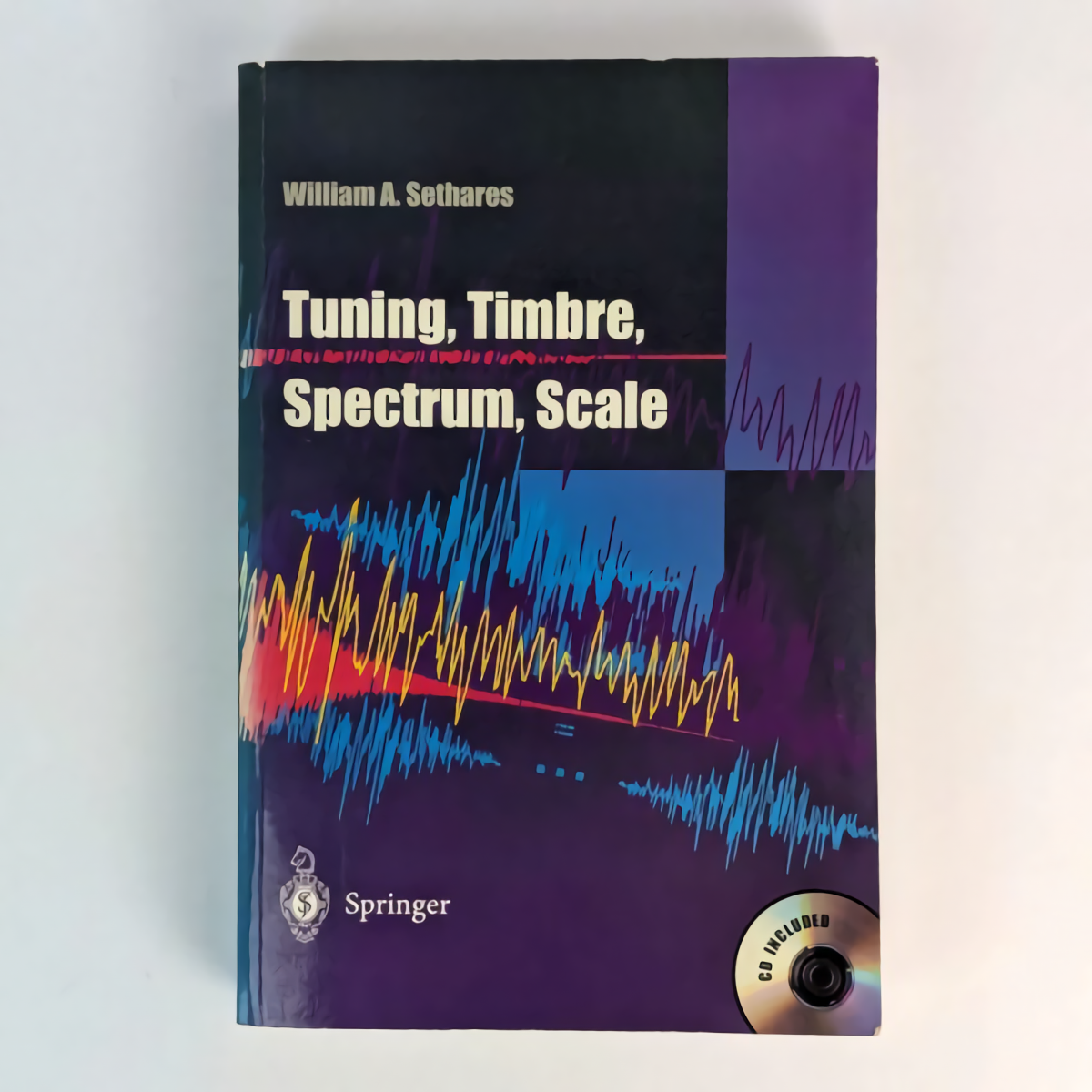
William Sethares' book Tuning, Timbre, Spectrum, Scale (published by Springer, second edition 2004) tells us something strange and more profound. The central claim of the book is this: the consonance of a musical interval is not a fixed property of the interval itself. It depends on the timbre of the instrument playing it.
That single idea rewrites a lot of what we take for granted about music theory.
The Shocking Opening: A Dissonant Octave
The book opens with a provocation. Sethares asks you to listen to a sound example where a note is played together with the note an octave above it — a 2:1 frequency ratio, the most universally consonant interval in Western music — and it sounds harsh, grinding, and dissonant. Then he plays the same note together with a note at a ratio of roughly 2.1:1, which in 12-tone equal temperament would fall somewhere between the octave and the minor 9th, a frankly weird microtonal interval, and it sounds smooth and restful.
The trick is the timbre. The sound was specifically engineered so that its overtones line up with the 2.1:1 ratio rather than the 2:1 ratio. The "octave" clashes because the upper partials of each note are beating against each other. The "pseudo-octave" at 2.1 sounds consonant because the partials align.
This is not a trick or a gimmick. It is the entire thesis of the book, demonstrated in the first three pages.
First, Some Vocabulary
Before going further, it helps to get the key terms clear.
Spectrum and Partials
When you play a note on, say, a violin, the string doesn't just vibrate at one frequency. It vibrates at a fundamental frequency (which determines the pitch you hear) and simultaneously at a series of higher frequencies called partials or overtones. The complete set of all these frequency components, and how loud each one is, is called the spectrum of the sound.
For most Western instruments — strings, winds, the voice — these partials fall at exact integer multiples of the fundamental. A note with a fundamental of 100 Hz will have partials at 200 Hz, 300 Hz, 400 Hz, and so on. This is called a harmonic spectrum, and these overtones are called harmonics. This kind of spectrum is what you get from vibrating strings and air columns, which is why violins, flutes, trumpets, and most orchestral instruments all share this property.
Some instruments, however, do not produce harmonic spectra. Bells, chimes, marimbas, metallophones, and many percussion instruments produce overtones that do NOT fall at integer multiples of the fundamental. These are called inharmonic spectra, and the partials are inharmonic partials.
Timbre
Timbre is the perceptual quality that lets you tell a flute from a clarinet even when they're playing the same pitch at the same volume. It is closely related to the spectrum of the sound, though technically the two are not the same thing: the spectrum is the physical measurement, and timbre is how we perceive it. For the purposes of this article, you can treat them as near-synonyms.
Sensory Consonance and Dissonance
This is where Sethares' argument really begins. He draws on psychoacoustics research (especially the work of Plomp and Levelt from the 1960s) to make a distinction between sensory consonance and other kinds of consonance. Sensory consonance is the immediate, physical sensation of smoothness or roughness when two tones are played together. It is different from:
- Music-theoretic consonance, where a minor seventh is "dissonant" because of how it functions in a chord progression
- Cultural consonance, where what sounds restful or tense varies between traditions and eras
Sensory consonance is more basic than either of those. It arises from whether the partials of two notes are beating against each other or sitting quietly side by side.
Beats, the Critical Band, and Why Dissonance Happens
To understand sensory consonance, you need to understand beats.
When two pure sine waves (tones with no overtones at all) are played at nearly the same frequency, they interfere with each other. The result is a pulsing or wavering sound — beats. You hear this whenever two instruments are slightly out of tune with each other. The rate of the beating equals the frequency difference between the two tones: two tones at 440 Hz and 441 Hz will beat at 1 Hz, once per second.
As the frequency difference increases, the beating gets faster. At a certain point — around 15–20 beats per second in the mid-range — the beating turns into roughness. The two tones start to feel unpleasant and harsh. This roughness is sensory dissonance at its most basic level.
Now there is an important psychoacoustic concept here called the critical band. The human auditory system processes sound within frequency channels of a certain width. Two tones within the same critical band will interact and produce roughness if they are close but not identical in frequency. Once the tones are far enough apart to fall in different critical bands, the roughness disappears, and the sensation becomes smooth — even if the interval between them might be "dissonant" in a theory textbook.
This is why a minor second (like C and C#, played near the middle of the piano) sounds harsh and rough, while the same interval played extremely high up or extremely low down sounds less uncomfortable — at the extremes of the keyboard, the absolute frequency difference changes relative to the critical band width.
Harmonic Sounds and the Western Scale
Here is where it gets interesting.
A harmonic sound, as described above, has partials at 1f, 2f, 3f, 4f, 5f, 6f, and so on. When you play two harmonic notes together, each note brings this whole stack of partials with it. The consonance of the interval depends on how well those two stacks of partials avoid beating against each other.
It turns out that the intervals where the partials line up most cleanly — where the fewest pairs of partials fall uncomfortably close together — are exactly the intervals of small integer ratios: 2:1 (octave), 3:2 (fifth), 4:3 (fourth), 5:4 (major third), and so on. These are the intervals that just intonation is built around, and they are the intervals that Western scales, through centuries of refinement, have organised themselves around.
Sethares introduces the concept of the dissonance curve to visualise this. For a given spectrum, you can plot the level of sensory dissonance across all possible intervals from unison up to (and beyond) the octave. For a harmonic spectrum, the dissonance curve has local minima — dips of low dissonance — right at the points corresponding to those small integer ratios. The Western scale is essentially a collection of the consonance sweet spots for harmonic instruments.
This is not just a coincidence. Sethares argues it is a genuine causal relationship: Western instruments have harmonic spectra, and Western scales evolved to take advantage of the consonance minima created by those harmonic spectra.
The Big Idea: Related Spectra and Scales
Once you accept this argument for Western music, the next step is obvious. If the consonance of intervals depends on the spectrum of the sound, then different spectra will produce different sets of consonance sweet spots, and therefore suggest different scales.
Sethares calls spectra and scales that share this alignment related spectra and scales. For any given spectrum, you can draw its dissonance curve and read off the most consonant intervals. Those intervals define a scale that is "natural" for that spectrum in exactly the same way that the Western scale is natural for harmonic instruments.
Going the other direction, if you start with a desired scale — say, 10-tone equal temperament — you can work backwards and find a spectrum whose dissonance curve has minima at the steps of that scale. Then music played in that scale, using instruments with that spectrum, will have the same potential for contrast between consonance and dissonance that tonal Western music has with its harmonic instruments and diatonic scales.
This is genuinely new. Most approaches to microtonal music either try to preserve just intonation relationships in the new scale, or accept that the music will sound uniformly dissonant and treat that as an aesthetic choice. Sethares offers a third path: design the timbre to match the scale, and you recover the full expressive palette of consonance and dissonance, even in a tuning that has no obvious relationship to the harmonic series.
Why Some Microtonal Tunings Are Easy and Others Are Hard
This explains something that puzzled Sethares when he first started experimenting with alternative tunings. He found that 19-tone equal temperament (19-TET) was easy to work with — almost any ordinary synth sound sounded fine in it. But 10-tone equal temperament (10-TET) was a nightmare. Nothing sounded right.
The reason: 19-TET contains very good approximations to the small integer ratios (particularly 3:2, 6:5, and 5:4). So when you play harmonic instruments in 19-TET, many of the notes still happen to land near the consonance minima of the harmonic dissonance curve. The timbre and the scale are not perfectly matched, but they are close enough to work.
10-TET, on the other hand, has no good approximations to 3:2 or 5:4. The harmonic dissonance curve has minima at places where 10-TET has no notes, and 10-TET has notes at places where the harmonic dissonance curve has peaks. It is a fundamental mismatch. Harmonic instruments will always sound slightly out of tune in 10-TET, no matter how precise your tuning, because the instrument's own overtones are fighting the scale.
The solution is not to give up on 10-TET. The solution is to find a spectrum whose dissonance curve does have minima at the 10-TET step sizes, and use that spectrum to make your instruments.
The Gamelan: Nature's Proof of the Theory
One of the most compelling sections of the book is the extended analysis of the Indonesian gamelan. The gamelan is an orchestra of metallophones — tuned metal bars and gongs — whose instruments produce strongly inharmonic spectra. Their partials do not fall at integer multiples of the fundamental.
Gamelan ensembles are tuned to five- and seven-note scales (called pelog and slendro) that are wildly different from any Western scale, and moreover, each gamelan has its own unique tuning — the intervals in one gamelan ensemble from Java will not match those from another ensemble even in the same village. From a Western standpoint this seems chaotic.
Sethares went to Indonesia, recorded multiple gamelan ensembles, measured the spectra of their instruments, and drew dissonance curves for those spectra. The result: the dissonance curve minima of the inharmonic metallophone spectra line up closely with the actual tuning intervals used in each individual gamelan. Different gamelans are tuned differently because different ensembles have instruments cast from different metal with slightly different shapes, producing slightly different inharmonic spectra — and the tuning of each ensemble evolved to match its own instruments' timbre.
This is the same pattern as Western music, but realised independently in an entirely different musical tradition, with entirely different instruments and entirely different scales. The gamelan is not a primitive approximation of something Western that went wrong. It is a coherent, internally logical musical system where the spectrum and the scale are related, exactly as Sethares' theory predicts.
The same analysis extends to classical Thai music, which uses a 7-tone equal temperament and xylophone-like instruments (the ranat) whose spectra produce dissonance curve minima that closely match the 7-TET step size.
Dissonance Curves and Practical Composition
For composers, the dissonance curve is not just a theoretical tool. It is a practical map.
Sethares walks through several concrete compositional examples. In one, he analyses the spectrum of a Tibetan tingsha bell — a small, high-pitched bell used in meditation practice — and draws its dissonance curve. The minima of that curve fall at intervals that do not correspond to any standard Western scale. He then composed a piece using those intervals, with timbres derived from the bell's own spectrum, and the result is music that has genuine tonal movement — some intervals sound consonant, others dissonant, tensions resolve — but in a sonic world completely unlike anything in Western or gamelan music.
He does the same with sounds derived from striking a rock from Chaco Canyon, New Mexico, and from computer-modelled crystal sounds. Each "found sound" implies a scale, and each scale implies a musical language.
The chapter titled "A Music Theory for 10-TET" is particularly striking for anyone with a standard theory background. Sethares takes 10-TET, finds the spectrum related to it, and then proceeds to work out that scale's "music theory": which intervals function as the most stable consonances, what kinds of chord structures are available, how progressions can be built around motion between consonance and dissonance. It reads like a music theory textbook for a parallel universe — and it is no more or less arbitrary than the music theory textbook for ours.
Adaptive Tuning: The Scale That Changes While You Play
One of the more technically ambitious parts of the book concerns what Sethares calls adaptive tuning. The idea is to build a system that continuously monitors the intervals being played and the timbres of the instruments, calculates the current dissonance, and micro-adjusts the tuning of each note in real time to minimise that dissonance.
This is not the same as just-intonation adaptive tuning systems like Hermode tuning (which adjust pitches to lock onto pure harmonic ratios). Sethares' system is timbre-aware — it takes the actual spectrum of the sounds into account, so it will produce different results for a piano patch versus a bell patch, even if they are playing the same MIDI notes.
The system can also be run in reverse, to maximise dissonance rather than minimise it, giving composers a direct, continuously variable control over the perceptual roughness of the music.
A Philosophical Conclusion: The Co-evolution of Instruments and Scales
Near the end of the book, Sethares draws a broader conclusion that is worth sitting with. He suggests that musical scales and musical instruments co-evolved together. The Western harmonic scale was not discovered as a mathematical truth about the universe and then instruments were built to match it. Rather, instruments were built from strings and air columns (which naturally produce harmonic spectra), and scales gradually settled into the consonance minima created by those spectra. Each reinforced the other over centuries.
The implication is that the Western major scale is not the "correct" or "natural" scale. It is the scale that fits harmonic instruments. There is no universal musical grammar. There are only locally coherent combinations of timbre and tuning, and an infinite space of such combinations waiting to be explored.
This is not a relativist or nihilist conclusion — Sethares is not saying that all scales are equally valid for all purposes. He is saying that scale and timbre are inseparable, that you cannot evaluate one without the other, and that the choice of timbre is effectively a choice of musical universe.
Who Should Read This Book?
Tuning, Timbre, Spectrum, Scale is not a light read. The first several chapters are accessible to any musician with a basic grasp of what overtones are. The later chapters move into signal processing, optimization algorithms, and spectral analysis, and you may find yourself skipping over the maths to focus on the concepts and examples — Sethares explicitly encourages this.
But the core ideas, once grasped, are genuinely transformative. If you have ever wondered why microtonal music often sounds "just out of tune" rather than interestingly different, this book explains exactly why that happens and how to fix it. If you have ever wondered why the gamelan sounds the way it does, this book answers that question from first principles. If you are interested in electronic music, synthesis, or sound design, this book reframes the relationship between the sounds you design and the harmonic language you can use with them.
The book is available through Springer, and the author's website at https://sethares.engr.wisc.edu hosts supporting materials including sound examples that are essential to understanding the argument — hearing a dissonant octave or a consonant tritone, produced by the right timbre, does more in ten seconds than several paragraphs of description.
Comments
Post a Comment