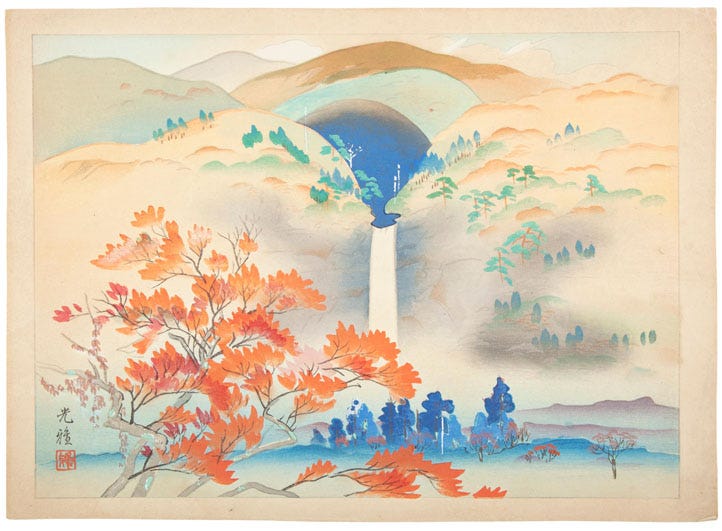
If you’ve spent a while in the corners of YouTube where music gets genuinely strange, you may have stumbled across a channel called Hideya A. The banner reads “Amano Hideya — Xenharmonic music. Mountains seen from Tokyo, etc.” The videos have modest view counts, the thumbnails are plain text on black backgrounds, and yet something about the music stops you in your tracks. It doesn’t sound broken or academic or like a physics experiment. It sounds like weather. Like memory. Like a walk you once took but can’t quite place.
Amano Hideya is a Japanese composer who has been releasing microtonal music since 2019. According to the Xenharmonic Wiki, they work almost exclusively in equal divisions of the octave — a framework that, once you understand it, opens up a universe of sound that most musicians never touch. This article is your entry point into that universe.
First: What Is an EDO?
You already know one. 12-EDO — twelve equal divisions of the octave — is the tuning system underneath virtually all Western music. It divides the octave into twelve equal steps of 100 cents each, giving you the familiar chromatic scale. The “equal” part is crucial: each step is exactly the same size, which is why you can transpose freely and why a piano sounds in tune in every key.
Now imagine doing the same thing, but dividing the octave into a different number of equal steps. That’s all an EDO is. The abbreviation stands for Equal Division of the Octave (you’ll also see the equivalent term TET — Tone Equal Temperament — used interchangeably, which is why Hideya labels their videos “7 TET 7 EDO”). Each number of divisions creates a completely different palette of intervals, a different set of harmonic relationships, a different emotional colour.
The step size of any EDO is simple to calculate: divide 1200 cents by the number of divisions. So:
- 7-EDO: each step is ~171 cents — much wider than a whole tone (200 cents) in 12-EDO
- 19-EDO: each step is ~63 cents — closer to a semitone, giving a dense, chromatic-adjacent palette
- 53-EDO: each step is ~22.6 cents — extraordinarily fine-grained, approximating just intonation with remarkable accuracy
- 1200-EDO: each step is exactly 1 cent — so fine it essentially is just intonation for practical purposes
The intervals you can build from any given EDO are entirely determined by its step size. Some EDOs happen to approximate the pure harmonic ratios (perfect fifths, major thirds, etc.) found in just intonation very closely. Others diverge from those ratios dramatically, producing harmonies that have no familiar analogue in Western music theory.
Hideya’s Approach: Systematic and Poetic
What makes Hideya distinctive isn’t just the tunings they use — it’s the range of them, and the attitude they bring to each one.
According to their YouTube channel description, Hideya composes in tunings built by dividing the octave into 1, 2, 3, 4, 5, 6, 7, 8, 9, 10, 11, 13, and 15 equal parts — a systematic survey of the smaller, stranger EDOs that most composers wouldn’t touch. On top of that, they’ve ventured into larger systems: 17, 19, 24, 34, 48, 53, 144, and even 1200 divisions. Their catalogue of 36 videos (and counting) reads like a methodical yet emotionally driven field guide to the harmonic cosmos.
Hideya uses DAW software (Cubase Pro), sample libraries (Kontakt), and processing plugins (Waves Platinum) — tools any professional producer would recognise — on, as they put it, “a cheap used laptop.” There’s something refreshing about that: this is not ivory-tower academic music requiring specialist instruments. It’s made with widely available gear, by someone who simply decided to tune things differently.
The Tunings, One by One
Let’s walk through the EDOs Hideya has explored, from the simplest to the most elaborate, with the musical intuitions that each one suggests.
The Very Small EDOs (5, 7, 8, 9, 10, 11)
These are sometimes called macrotonal tunings — their steps are larger than a semitone, giving them a wide, open, sometimes stark quality.
5-EDO divides the octave into five equal steps of 240 cents each. You can think of it as a pentatonic scale where all the gaps are the same size — but those gaps are enormous compared to what we’re used to. There’s no half-step to provide tension; melody becomes something else entirely, more like a series of gestures than a directed line. Hideya has returned to 5-EDO repeatedly, with pieces called Like a Pleasant Breeze, Like a Quiet Wave, Like a calm river flow, and Like Japanese Curry. The titles aren’t arbitrary. Something about 5-EDO’s floating, ambiguous quality genuinely does evoke those things — undirected, pleasant, a little vertiginous.
7-EDO is one of the most theoretically interesting of the small EDOs. Its seven steps map loosely onto the seven notes of a diatonic scale, except every interval — “second,” “third,” “fourth” — comes in only one size. There’s no distinction between major and minor; there’s just the third, which lands at 514 cents, roughly halfway between a perfect fourth (500 cents) and a major third (400 cents). Chords feel neither resolved nor tense in any familiar way. They simply are. Hideya has used 7-EDO for Like a Midnight Run, Like KoB, Like it’s snowing, and Like Chikuzan — that last one a reference to Takahashi Chikuzan, a blind Japanese shamisen master whose music has its own quality of unhurried sorrow.
8-EDO has no recognizable fourths or fifths. Its steps are 150 cents — between a semitone and a whole tone. It’s one of the more disorienting small EDOs because it offers no harmonic anchor points. Hideya’s Like Yamashiro and Like Ensor’s paintings (a reference to the Belgian Expressionist painter James Ensor) suggest they hear something unsettling and dreamlike in this system.
9-EDO produces steps of 133 cents — a little narrower than a whole tone. It contains a close approximation of the 7/6 ratio (a small minor third from the harmonic series), giving it an unusual warm-dark quality. Hideya’s titles here — Like Satchmo, Like the sea of Chiba — suggest something bittersweet, late-night, with salt in the air.
10-EDO can be thought of as two interleaved 5-EDO scales, which gives it a bit more melodic variety while retaining that pentatonic floatiness. Hideya has been particularly prolific here: Like a morning walk, Like Summer Creatures, Like spring sea, Like Yagi-bushi, Like spring flowers. The references to folk music (Yagi-bushi is a Japanese folk song style) are telling — 10-EDO’s simplicity lends itself to something that feels traditional even as it sounds alien.
11-EDO is a prime number EDO, meaning none of its intervals repeat or subdivide into smaller familiar ones. It has an approximation of the 11th harmonic — an interval that doesn’t appear in standard Western tuning at all. Like 40s musicand Like Parker 3 (presumably a Charlie Parker reference) suggest Hideya hears something jazzy or bluesy in 11-EDO’s particular brand of harmonic ambiguity.
The Middle Ground (13, 14, 15, 17, 19)
These EDOs start to resemble 12-EDO in structure while diverging sharply in character.
13-EDO is famously “xenharmonic” — its steps are about 92 cents, giving it a compressed, unsettled quality. It’s notoriously hard to make sound pleasant, which perhaps explains why Hideya’s titles here are Like autumn weather and Like alien conversation. Overcast. Strange. Communicating something, but in a language just beyond comprehension.
14-EDO can be thought of as two interleaved 7-EDO scales. Like Heatwave is Hideya’s piece here — that shimmering, slightly nauseating quality of heat distortion seems exactly right for a tuning where the familiar and unfamiliar are tangled together.
15-EDO is one of the more approachable alternative tunings — it contains intervals close to a perfect fourth and fifth, and its step size (80 cents) allows for something resembling conventional melody. Both Like Bach’s Invention and Like Satielive here, and the comparison is apt: both Bach and Satie wrote music with a certain formal clarity and emotional restraint that 15-EDO seems to invite.
17-EDO has a fifth that’s slightly sharper than just (about 4 cents sharp), giving it a brighter, more tense quality than 12-EDO. It has good approximations of the 7th and 11th harmonics, which gives it some jazz-adjacent flavour. Hideya’s Like Riding on a Night Train captures that forward motion, that rhythmic inevitability.
19-EDO is one of the most beloved alternative tunings among microtonalists. Its fifth is about 7 cents flat, which produces a meantone-like quality — the major third is nearly pure, making chords sound unusually sweet. Often called “the stealth microtonal tuning” because it can pass for 12-EDO in some contexts, it has three pieces in Hideya’s catalogue: Like pulsar, Like rattling gear, and Like the movement of Saturn. That last title is striking — 19-EDO’s near-pure thirds do have a kind of celestial smoothness.
The Larger Systems (24, 34, 48, 53, 144, 1200)
24-EDO is quarter-tone music — each step is 50 cents, exactly half a semitone. It’s been used in Arabic classical music and by 20th-century composers like Charles Ives and Alois Hába. Hideya’s Like Stairs hints at its characteristic quality: each step is regular, disciplined, but the destination keeps shifting underfoot.
34-EDO has excellent approximations of the 5th and 7th harmonics, giving it a richly consonant harmonic palette. Like refracted light — light that bends, disperses into colour, shows its hidden structure — is exactly the kind of image that comes to mind.
48-EDO divides the octave into eighth-tones. Like the Milky Way is Hideya’s piece here. With 48 pitches per octave, melody can glide between notes in ways that blur the boundary between pitch and timbre.
53-EDO is a tuning with a long history — it was discussed by ancient Chinese and Greek theorists and later by Kepler and Newton. Its fifth is only 0.07 cents from pure, making it one of the most accurate approximations of just intonation available in an EDO. Hideya’s Like Uminari (a reference to the sound of the sea heard from a distance, a particular atmospheric phenomenon in Japan) suggests an interest in the near-perfect, the almost-identical-but-not-quite.
144-EDO is a multiple of 12, so it contains all of 12-EDO within it, plus a vast array of additional pitches. Like an endless uphill — yes. The sensation of climbing without ever arriving.
1200-EDO divides the octave into 1200 equal steps of 1 cent each. This is essentially the resolution limit of human pitch perception; at this granularity, the composer can place notes at any pitch they choose with essentially infinite precision. Like scattered blue light is one of Hideya’s most-viewed pieces. Blue light scatters more than other wavelengths — it’s what makes the sky blue, what makes distant mountains look hazy. Something fine-grained and diffuse and everywhere at once.
The Titles as a Body of Work
One of the most remarkable things about Hideya’s catalogue is the consistency and poetry of the naming system. Every piece begins with “Like” — a word that situates the music in the territory of resemblance, of approximation. Not amidnight run, but like a midnight run. Not the Milky Way, but like the Milky Way.
This is a profound artistic statement dressed up as a simple naming convention. Music in non-standard tunings is always “like” something familiar but not quite the same. The intervals almost resolve the way you expect. The chords are almost the ones you know. The emotional arc is almost recognisable. “Like” is the honest word for that experience.
There’s also something characteristically Japanese in the reference pool. Alongside the European names (Satie, Bach’s Invention, Ensor’s paintings, Satchmo) are deeply local images: Uminari (the roar of the sea), Yamashiro (an ancient mountain castle region), Yagi-bushi (a folk song), Chikuzan (a blind shamisen player), the sea of Chiba (a very specific, ordinary, local sea). Hideya seems uninterested in the grandiose. The cosmic and the mundane sit side by side: the Milky Way in one video, a curry in the next.
The one video that breaks the naming pattern is the earliest and most-viewed: 1 to 11 tone Equal temperament songs — a single piece (or suite) moving through each EDO from 1 to 11 in sequence. With 36,000 views, it remains by far the most-watched thing on the channel. It’s a remarkable piece of concept art: a guided tour through eleven different harmonic universes, each one a room with a different atmosphere, a different colour temperature, a different sense of time.
A Curious Outlier: The Marble Piece
One entry in the catalogue stands apart: Like Marble — Music that mixes 13 tone equal temperament (25%) with 12 tone equal temperament (75%). Rather than composing in a single EDO, Hideya here blends two systems, letting notes from 13-EDO appear within a mostly 12-EDO context. The analogy is perfect: marble is a material with veins of one substance running through another, the boundary between them blurred and organic. It’s the only piece in the catalogue that explicitly plays with the seam between the familiar and the alien.
How to Listen
If you’re coming from a background in standard music theory, here are a few things that might help orient your ears:
Don’t try to hear it as detuned 12-EDO. The instinct to hear microtonal music as “out of tune” is strong, but it’s the wrong frame. A 7-EDO third isn’t a mistuned major third — it’s a different interval entirely, with its own logic. Try to hear it on its own terms.
Notice what the music does instead of resolution. A lot of Western tonal music is about tension and release — dissonance moving to consonance, dominant chords resolving to tonic. Many EDOs don’t support this kind of functional harmony, so the music has to find other ways to move. Pay attention to how Hideya creates momentum and arrival without those familiar tools.
Let the titles guide you. This is not ironic advice. Like a Midnight Run really does capture something about the quality of 7-EDO’s night-coloured intervals. Like Heatwave really does evoke the shimmer of 14-EDO. The titles are not decorative — they’re perceptual instructions.
Start with the popular ones. The 1 to 11 EDO suite is the natural starting point — it’s a guided tour. After that, Like Japanese Curry (5-EDO) and Like KoB (7-EDO) are excellent entry points for the smaller tunings, and Like Uminari (53-EDO) or Like scattered blue light (1200-EDO) for the larger ones.
Why This Matters
Amano Hideya is not famous. Their channel has around 1,500 subscribers and just over 154,000 total views. By any metric of internet success, this is a small operation. But what they’re doing is significant.
Most microtonal music falls into one of two camps: highly academic, theoretically sophisticated music that’s difficult to access emotionally; or novelty-driven content that’s more about the concept than the listening experience. Hideya occupies an unusual third territory — music that is systematically rigorous in its choice of tuning systems but emotionally direct and accessible in its delivery. These are short pieces (most run two to four minutes), carefully produced, with titles that invite an emotional response rather than demanding theoretical knowledge.
In a genre that can sometimes feel like it’s talking to itself, Hideya is making music for the listener. For the person who’s curious. For the musician who suspects there’s more to pitch than twelve notes but doesn’t know where to look.
The mountains can be seen from Tokyo. You just have to know where to stand.
Amano Hideya’s music is available on YouTube. Their entry on the Xenharmonic Wiki can be found here. For deeper dives into the tuning systems mentioned in this article, the Xenharmonic Wiki is the best starting point: EDO overview, macrotonal EDOs, just intonation.
Comments
Post a Comment