Most people learn early on that musical sounds are built from the harmonic series — a fundamental frequency accompanied by overtones at exactly 2x, 3x, 4x, and so on… But for a surprisingly large number of instruments, it’s not true at all
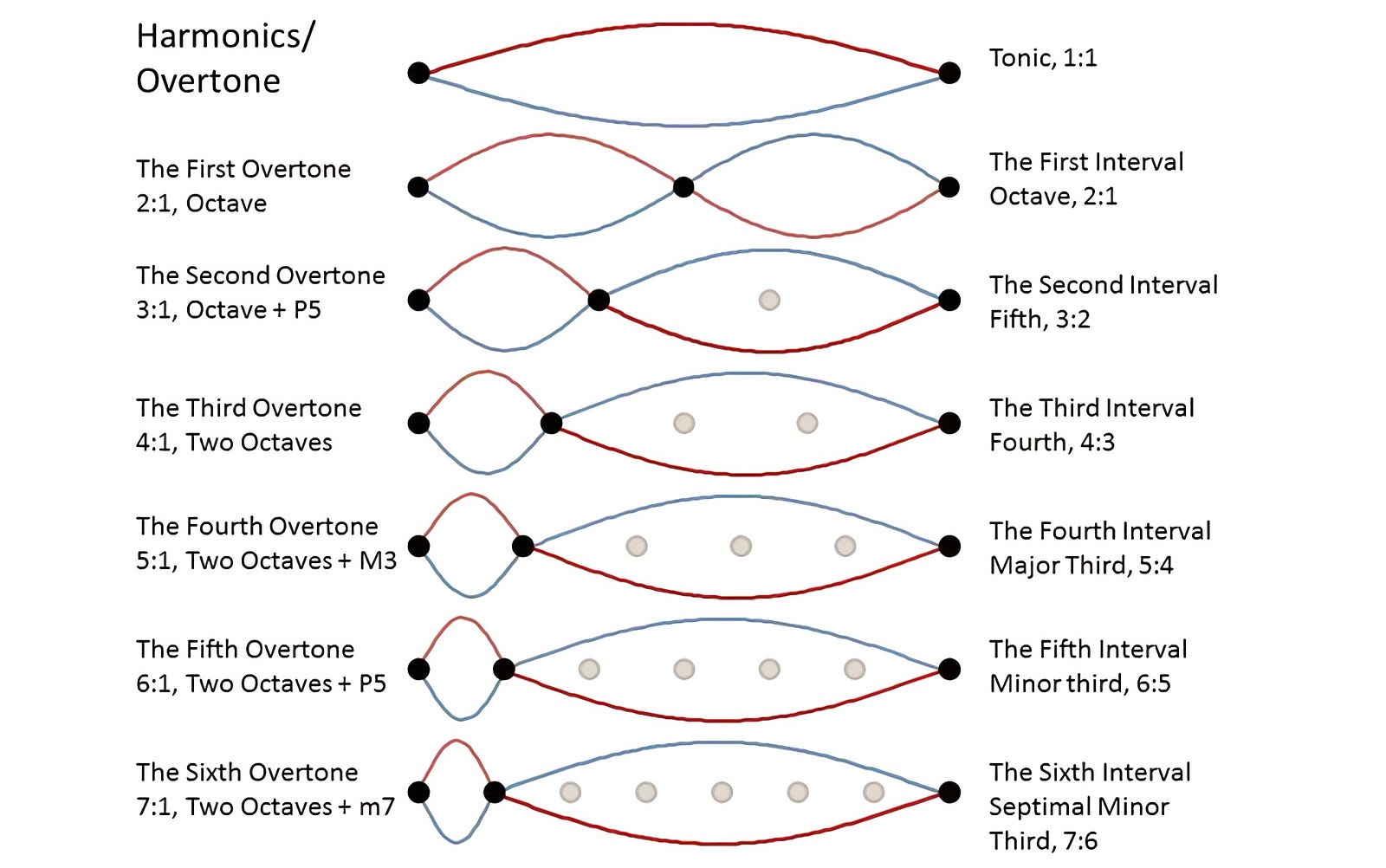
Most people learn early on that musical sounds are built from the harmonic series — a fundamental frequency accompanied by overtones at exactly 2x, 3x, 4x, and so on. It’s a tidy, satisfying picture. And for a handful of instruments, it’s roughly true.
But for a surprisingly large number of instruments, it’s not true at all.
Many instruments produce overtones that deviate systematically from the harmonic series. Some produce partials that are stretched — pushed further apart than the series predicts. Some produce partials that are compressed — squeezed closer together. And some produce overtone structures so fundamentally different from the harmonic series that terms like “stretched” or “compressed” barely even apply.
This is the world of inharmonic partials. And once you understand it, you start hearing music — and instrument design — in an entirely different way.
What Are Inharmonic Partials?
When a string or air column vibrates, it produces a stack of frequencies. In an ideal, perfectly flexible string or a perfectly cylindrical tube, these frequencies line up exactly at integer multiples of the fundamental: 1f, 2f, 3f, 4f… That’s the harmonic series. The overtones are, properly speaking, harmonics.
Real instruments are not ideal. Strings have stiffness. Bars and plates have complex three-dimensional vibration modes. Membranes vibrate according to entirely different mathematics. In all these cases, the overtones land somewhere other than exactly on integer multiples — and those overtones are called inharmonic partials.
The degree and character of this inharmonicity has profound consequences for timbre, tuning, and the emotional quality of an instrument’s sound.
Percussion: The Champions of Inharmonicity
Percussion instruments are where inharmonicity gets extreme.
Timpani sit at the relatively tame end of the spectrum. Their partials are slightly inharmonic — the lowest modes come close to a 1:2:3:4 relationship but not quite — and instrument makers exploit this by tuning the membrane tension to push the prominent modes toward approximate harmonicity. The result is a drum that has a definite, tuneable pitch, which is exactly what an orchestra needs. The inharmonicity is mild enough to be managed, and the type is compressed — partials land slightly below where the harmonic series would predict.
Snare drums, tom-toms, and bass drums are a completely different story. The vibration modes of a circular membrane are governed by Bessel functions — a family of mathematical curves that arise in cylindrical wave problems — and the ratios they produce are something like 1.00 : 1.59 : 2.14 : 2.30 : 2.65. These numbers bear no resemblance to the harmonic series. They are not stretched or compressed versions of 1:2:3:4; they are simply something else entirely. This is why drumming produces that characteristic thwack of indeterminate pitch: the overtones have no harmonic relationship to each other or to any recognizable fundamental.
Steelpans are a fascinating intermediate case. The instrument is made by hammering concave areas into the bottom of an oil drum, and skilled makers tune the metal by ear, using hammering and sometimes heat treatment to push the partials of each note toward something resembling harmonicity. The result is slightly compressed — partials land a little below harmonic positions — but it varies considerably by note and by maker. The steelpan is essentially an ongoing negotiation between metal physics and musical intention.
Xylophones, marimbas, and glockenspiels have strongly stretched partials. The bars are stiff, and stiffness causes higher modes to be pushed upward faster than the harmonic series would predict. The first few partial ratios for a typical rectangular bar are something like 1 : 3.9 : 9.6, wildly higher than the harmonic 1 : 2 : 3. Instrument makers compensate partly by undercutting the bars — cutting an arc from the underside — which lowers the pitch of specific modes. But the result still departs substantially from the harmonic series. The vibraphone undergoes more careful tuning of this kind, resulting in partials that are only mildly stretched, which helps it blend more smoothly with other instruments.
Cymbals, gongs, and tam-tams represent the far extreme. The vibration modes of a flat plate — especially a curved and shaped one — are mathematically chaotic in the sense that no clean pattern describes them. There is no meaningful “fundamental” in the usual sense, no harmonic relationship between modes, and describing the spectrum as stretched or compressed doesn’t really make sense. The partials simply inhabit a completely different mathematical universe. This is exactly what gives cymbals and gongs their characteristically shimmering, wash-like quality: a dense fog of inharmonic overtones, all decaying at different rates.
The Piano: Stretched by Design
The piano occupies a special place in discussions of inharmonicity because the effect is well-quantified and has real consequences for tuning practice.
Piano strings have stiffness — they are not ideal flexible threads — and stiffness causes the vibration modes to be pushed upward. The relationship follows a known formula involving an “inharmonicity coefficient” B, which is larger for shorter, thicker strings. The practical result is that every partial in a piano string is slightly sharper than the harmonic series predicts, and the deviation increases for higher partials. A note’s 8th partial might be noticeably sharper than 8 times the fundamental.
This has a famous consequence: piano tuners use stretched tuning. Rather than tuning the piano to a mathematically pure equal temperament, they stretch the octaves very slightly — tuning the treble sharp and the bass flat relative to theoretical values — so that the stretched partials of bass notes align with the fundamentals of treble notes. If you tuned a piano to “pure” equal temperament, it would sound flat and dead in the high register and muddy in the low. The stretch makes it come alive.
The amount of stretch varies by instrument. Concert grand pianos with long bass strings have relatively low inharmonicity. Small uprights with short, thick strings have much higher inharmonicity and require more aggressive stretch tuning. This is one of the reasons small pianos never sound quite as rich as large ones — the inharmonicity is harder to compensate for.
Strings: Almost Harmonic, But Not Quite
Bowed string instruments — violins, violas, cellos, and double basses — come remarkably close to the harmonic ideal. The strings are thin and flexible compared to piano wire, and the bowing mechanism drives the string in a way that strongly reinforces harmonic modes. The partials are very slightly stretched, but barely enough to matter in most musical contexts.
One nuance worth noting: higher strings on an instrument show more stretching than lower ones. The violin E string (the highest and thinnest) has more inharmonicity than the cello C string (the lowest and thickest relative to its length). This contributes subtly to the different timbral characters of different strings.
Plucked string instruments — guitars, harps, lutes, and their relatives — show a similar picture: mildly stretched, close to harmonic, but not exactly. The banjo is a notable exception within the family, because its membrane-covered resonator creates additional coupling between the string vibration and membrane vibration, increasing inharmonicity noticeably. Electric guitar pickups introduce another wrinkle: by sampling the string at a fixed point, they emphasize certain partials over others, which can make inharmonicity more audible to the listener even if the physical inharmonicity of the string itself is small.
Wind Instruments: Mostly Harmonic, With Interesting Exceptions
Woodwind and brass instruments are, as a family, among the most nearly harmonic of all instruments. An air column in a tube, driven by a vibrating reed or lips, tends strongly toward harmonic resonance because the resonance modes of the air column and the driving mechanism reinforce each other in a mutually locking relationship.
That said, there are interesting deviations.
Brass instruments — trumpet, trombone, tuba, French horn — are almost harmonic, but the bell flare introduces a slight asymmetry. Lower partials are slightly compressed (flat), while higher partials are slightly stretched (sharp). The net effect is a mixed picture, overall tending slightly toward stretched. Brass instrument makers and players manage this through bore geometry, bell shape, and playing technique.
Woodwinds are generally very close to harmonic. The flute is perhaps the most nearly harmonic of all common instruments. The clarinet is dominated by odd harmonics — a consequence of its cylindrical bore and single-reed mouthpiece, which makes it behave acoustically like a closed tube — with slight inharmonicity from the tone holes. Oboes and bassoons, with their conical bores, show tiny inharmonic deviations due to bore imperfections and the complex acoustics of the double reed.
The human voice is nearly harmonic at normal intensities, but introduces slight stretching at high intensities because of increased tension in the vocal folds. Certain specialized vocal techniques — Tuvan throat singing, for instance — can introduce genuinely non-harmonic components by selectively amplifying modes that do not fall on the harmonic series.
Summary: A Map of the Landscape
To pull it all together, here’s how the main instrument families relate to the harmonic series:
- Piano: Stretched (increasingly sharp at high partials; requires stretch tuning)
- Violin, viola, cello, bass: Almost harmonic; very slightly stretched
- Guitar, harp, lute: Almost harmonic; mildly stretched
- Brass: Mixed (lower partials slightly compressed, upper partials slightly stretched)
- Woodwinds: Nearly harmonic; tiny deviations both directions
- Timpani: Approximately harmonic; slightly compressed
- Xylophone, marimba, glockenspiel: Strongly stretched
- Vibraphone: Mildly stretched
- Cymbals, gongs, tam-tams: Completely non-harmonic (plate vibration modes)
- Snare drum, tom, bass drum: Completely non-harmonic (Bessel function membrane modes)
Gamelan: Inharmonicity as a Design Principle
If Western instrument design generally tries to minimize inharmonicity or compensate for it, gamelan instrument making treats inharmonicity as a creative resource. The instruments of the Javanese and Balinese gamelan traditions don’t aim for harmonic partials. They shape their inharmonic spectra deliberately, and then build tuning systems to match.
This is one of the most remarkable things about gamelan acoustics: the tuning systems — sléndro and pélog — are not theoretical scales imposed on the instruments from outside. They emerge from the instruments’ own acoustic properties. The scale is built to fit the timbre.
Metallophones — saron, gender, slenthem, demung, peking — are the backbone of the gamelan. They are stiff metal bars, and like all stiff bars, their partials are strongly stretched. A typical partial ratio for a metallophone bar looks something like 1 : 2.76 : 5.40 : 8.93 : 13.34. These numbers bear no resemblance to the harmonic series.
But here’s the ingenious part. The second partial — at roughly 2.76 times the fundamental — doesn’t fall on a harmonic of the fundamental pitch, but it does fall near a musically meaningful interval. 2.76/2 = 1.38 octaves above the fundamental, which is roughly 14 semitones — close to a major seventh in Western terms. In many gamelan tunings, a scale degree sits near this region. Instrument makers exploit this by filing and undercutting the bars to push partials toward specific scale tones.
The result: sléndro and pélog intervals are chosen partly to minimize perceptual roughness between the fundamentals of one note and the partials of another. This is precisely the kind of tuning–timbre matching that the acoustician William Sethares formalized in his research. The gamelan tradition arrived at the same insight through centuries of empirical craft.
Central Javanese gamelan metallophones are typically undercut more carefully to reduce the degree of inharmonicity, while still remaining far from harmonic. Balinese gamelan metallophones are intentionally tuned to be more stretched and irregular, because Balinese instruments come in male-female pairs tuned slightly apart to create ombak — the characteristic shimmering beating that is central to Balinese musical aesthetics.
Gamelan gongs — gong ageng, kempul, kenong, kethuk — are acoustically the most complex members of the family. Large Javanese gongs have partial ratios that include some near-harmonic low modes (something like 1 : 2 : 2.8 : 4 : 5.2) alongside some wildly inharmonic higher modes. The near-octave and near-fifth relationships in the low modes are what allow the gong ageng to serve as a pitch reference and tonal center — its lowest partials help establish the “home” pitch of the ensemble. Other instruments are tuned so that their fundamentals and partials avoid clashing with the gong’s strongest modes. This is why the gong ageng is the reference point from which an entire gamelan is tuned.
Balinese gongs have brighter, more complex spectra than Javanese ones. Their greater inharmonicity pushes the tuning toward more brilliant, beating-rich intervals — consistent with the overall aesthetic difference between Javanese and Balinese styles.
The bonang — a set of small bossed kettle gongs arranged in rows — has a particularly interesting role in shaping the tuning system. Bonang pots are highly inharmonic, with spectra strongly influenced by boss height and wall thickness. Makers often tune the bonang first, then tune the metallophones to match the bonang’s spectral landscape. Because the bonang articulates melodic patterns and outlines the scale, its inharmonic partials literally determine the contour of the tuning system. The scale is, in a very direct sense, built around the bonang’s inharmonicity.
The Balinese ombak system adds another layer of complexity. Because Balinese instruments come in paired male-female sets tuned slightly apart, beating occurs not just between the fundamentals of paired notes but between their partials. And because those partials are stretched, the beating rate increases at higher partials, producing the characteristic shimmer that intensifies in the upper register. Tuning a Balinese gamelan means carefully calibrating desired beating rates against the partial structure of every instrument in the set — a process that requires extraordinary skill and sensitivity.
The non-metallic parts of the gamelan — the rebab (bowed spike fiddle), the suling (bamboo flute), and the human voice — are all nearly harmonic, like their counterparts in Western music. Their role in the ensemble is partly to provide contrast: a stable, clear harmonic presence against the shimmering inharmonic wash of the metallophones and gongs. The interplay between the harmonic and inharmonic layers is part of what gives gamelan music its distinctive texture.
The Bigger Picture: Tuning and Timbre Are Not Separate
What the gamelan tradition makes explicit is something that’s actually true of all music: tuning systems and instrument timbres are not independent. They co-evolve.
Western equal temperament was developed in the context of instruments — strings, winds, voices — that are very close to harmonic. The octave relationship (2:1) and the fifth relationship (3:2) are reinforced by the partials of those instruments, which is precisely why those intervals sound “consonant.” The entire architecture of Western harmony rests on the harmonic series.
Gamelan music builds a different architecture, starting from a different acoustic foundation. The stretched, inharmonic partials of the metallophones and gongs make Western-style harmonic relationships less relevant, because those relationships are not reinforced in the instrument spectra. Different interval relationships minimize roughness and maximize blend. Different scales emerge.
This is a profound insight: the reason different musical cultures have developed different scales and harmonic systems is not arbitrary or purely cultural. It is grounded in physics — in the specific acoustic properties of the instruments those cultures happened to develop. The music is, in a very literal sense, an expression of the instruments’ inharmonicity.
A Note on Research
Gamelan acoustics is one of the most thoroughly studied areas of non-Western instrument acoustics. Key contributions have come from Neville Fletcher and Thomas Rossing (whose book The Physics of Musical Instruments contains detailed gong and bar measurements), William Sethares (who formalized the tuning–timbre relationship theoretically and empirically), and ethnomusicologists including Andrew McGraw and Michael Tenzer. The UCLA Gamelan Research Group and researchers at Indonesian universities including ISI Surakarta, ISI Yogyakarta, and Udayana University have published detailed spectral analyses of individual instruments.
For Western instruments, the physics of inharmonicity in piano strings is particularly well-documented, and the theory of stretch tuning has been quantitatively validated. The acoustics of bowed strings, brass instruments, and woodwinds are described in detail in Fletcher and Rossing and in the journals of the Acoustical Society of America.
If you want to go further down this rabbit hole, William Sethares’ book Tuning, Timbre, Spectrum, Scale is probably the single best entry point for understanding the relationship between inharmonic spectra and musical scale formation. It will permanently change the way you think about why music sounds the way it does.
Comments
Post a Comment