This guide will walk you through every practical way to start playing microtones, from free-to-try web app experiments all the way to purpose-built guitars
What exactly is a microtone?
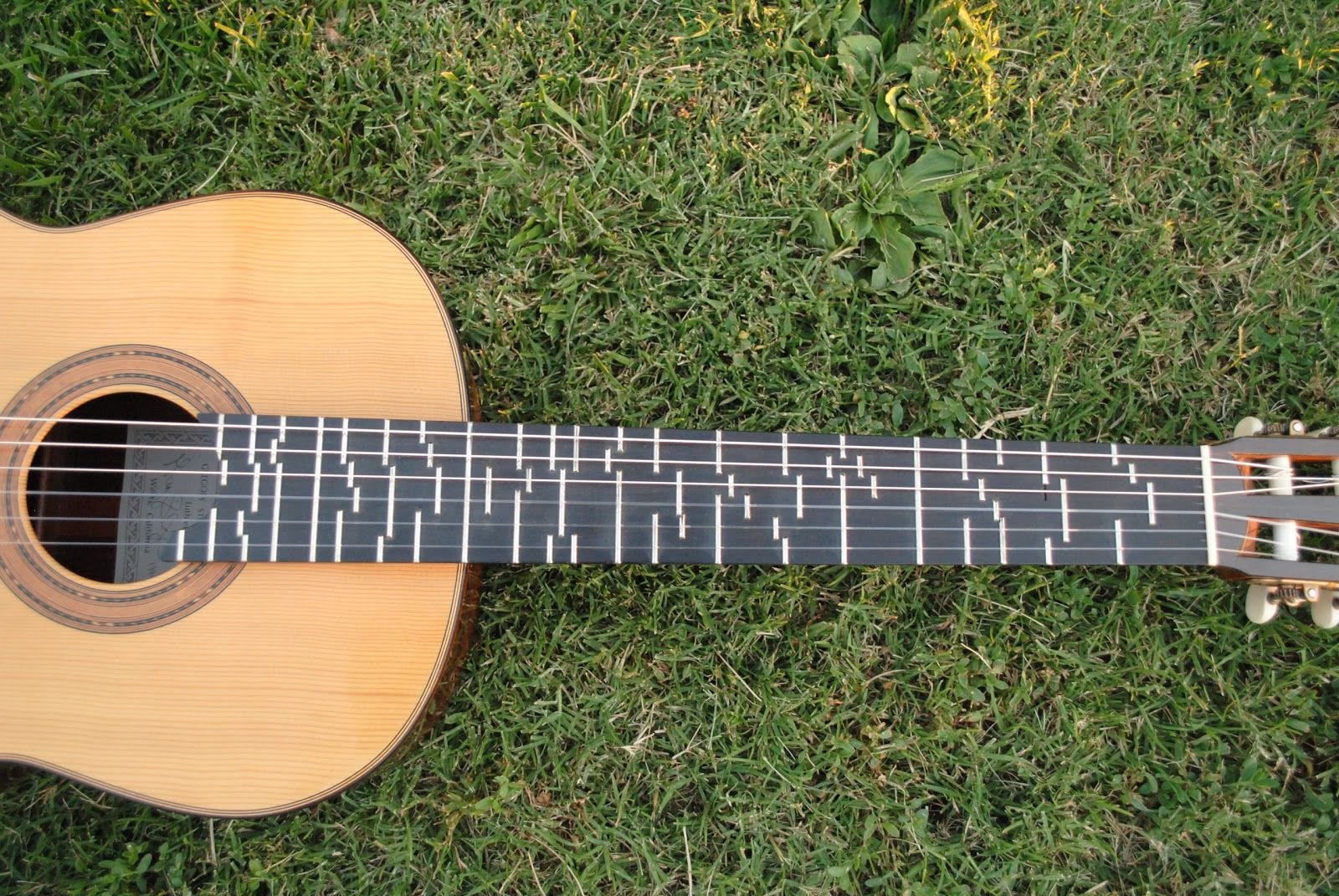
The guitar you own right now is built around 12-tone equal temperament (12-EDO) — the octave divided into 12 equal steps, one per fret. Every note you can play sits on one of those 12 steps. In Western music, the octave is divided into 12 equal parts, creating the familiar chromatic scale. A microtone is simply any pitch that falls between those 12 steps. Microtones are any notes that fall in between the current pitches of fixed-pitch instruments such as the piano. MoisesMicrotonal-guitar
That might sound abstract, but you’ve already heard microtones your whole life. Every time a blues singer bends a phrase between minor and major, every time a violinist plays in an orchestra and nudges a chord into pure resonance, every time you listen to Turkish, Persian, Indian, or Arabic music — you’re hearing microtones. Microtonality can sound very normal. You are probably quite used to hearing it in a cappella music, lead vocals, or Eastern music. Tuning notes by ear often comes out slightly differently to 12-EDO. SevenString
The Western 12-note system was largely standardised for keyboards — so that a piano could play in any key without retuning. Guitars inherited the same compromise. The fascinating thing about microtones is that they’re not some modern experimental gimmick. Traditional music from the Middle East, India, and Turkey has used microtonal intervals for centuries — their scales naturally include quarter tones and other divisions that don’t map to our Western keyboard. Chromelodeon
A few terms you’ll encounter
EDO (Equal Divisions of the Octave) — A tuning system where the octave is chopped into a fixed number of equal steps. Standard guitar uses 12-EDO. Add more steps and you get microtonality: 24-EDO (quarter-tones), 19-EDO, 31-EDO, and so on. The higher the number, the more pitches available per octave.
Just Intonation (JI) — Rather than dividing the octave into equal steps, JI tunes intervals as pure mathematical ratios (like 3:2 for a perfect fifth). Just intonation is the tuning of musical intervals as whole number ratios (such as 3:2 or 4:3) of frequencies. Chords in JI tend to sound unusually smooth and resonant — “beatless” — because the overtones align naturally. Microtonal-guitar
Cent — The unit of pitch measurement used in microtonality. One semitone equals 100 cents. A quarter-tone is 50 cents.
Quarter-tone — The most approachable entry point into microtonality. Half a semitone, or 50 cents. The quarter-tone scale (24-EDO) is standard 12-tone tuning plus 12 additional pitches, each one added halfway between the standard tones. SevenString
Don’t worry if these feel unfamiliar — everything that follows is practical and hands-on, no theory degree required.
Method 1: Try it for free in a browser right now
Before you touch an instrument, spend twenty minutes with a browser-based synth. This is genuinely the fastest way to train your ears to what microtones sound like.
Scale Workshop by Sevish is free, runs in any browser, and lets you design your own tuning systems. You can enter a preset EDO, play it with your computer keyboard, and hear exactly what quarter-tones or 19-EDO sounds like before committing to anything. Scala Workshop is browser-based, polyphonic, and played with your QWERTY keyboard. Produce Like A Pro
This step costs nothing and gives your ears a head start. Spending even a few sessions with an unfamiliar tuning before you play it on a physical instrument dramatically shortens the learning curve.
Method 1.5: Play it on your iPad with GeoShred
If you own an iPad and want something that feels genuinely instrument-like rather than just a theory toy, GeoShred is one of the most remarkable microtonal tools available at any price.
Designed by Dream Theater keyboardist Jordan Rudess in collaboration with physical modeling researchers at Stanford’s CCRMA, it presents a horizontal touch surface that works like a fretless guitar neck: slide left and right to change pitch continuously, slide up and down to move between string-like rows. GeoShred is designed to be both pitch-fluid and able to help the performer precisely reach desired pitches in any temperament.
That last part is the key feature for microtonal beginners: an “intelligent pitch rounding” algorithm lets you slide freely between notes but snaps to the scale degrees of whatever tuning system you’ve chosen, so you can explore quarter-tones or Indian ragas without constantly landing on wrong pitches.
GeoShred supports world scales and temperaments including Indian ragas, Arabic scales, and Balinese scales, and recent updates have added dedicated quarter-tone keyboard layouts for 24-EDO specifically.
The full GeoShred Pro app includes a physically modeled guitar engine with effects built in, while the cheaper GeoShred Control version strips out the sounds and acts purely as an MPE controller you can route into any compatible softsynth on your iPad or Mac.
GeoShred has 300,000 artists in over 120 countries performing with it, with a strong global community that includes many musicians in India — which gives you a sense of how seriously it’s been adopted for non-Western microtonal styles. For a guitarist who already thinks in terms of string layouts and sliding technique, the learning curve is surprisingly gentle. MWM + 2
Method 2: Retuning a standard guitar (the sneaky, free approach)
This is the cleverest beginner trick, and almost nobody talks about it. You don’t need extra frets, a new neck, or any money at all.
If you tune your guitar’s strings so that adjacent strings are slightly out of 12-EDO standard tuning with respect to each other, your existing frets give you access to pitches that aren’t normally available — because each string is now on a different “grid.” By retuning a conventional guitar so that adjacent strings are tuned a quarter-tone apart, you can play quarter-tone scales on a conventionally fretted guitar. This is ‘stealth microtonality’ — no one would know by looking at your guitar that it is microtonal. SevenString
For example, tune your top three strings down 50 cents (a quarter-tone) relative to your bottom three. Now one hand can access normal pitches, the other accesses pitches a quarter-tone shifted, and you can combine them in a single line. All you need is a chromatic tuner that reads in cents. This approach is completely reversible and costs nothing.
Method 3: Defret your guitar
This is the boldest free option, and it opens up complete pitch freedom — every pitch in existence becomes available because your finger becomes the fret.
A fretless guitar works exactly like a fretless bass or a bowed string instrument: you place your finger precisely where the pitch lives, guided by your ear. With a fretless instrument, your finger is the fret. I recommend you first try playing your fretless guitar in 12-TET, playing along with a song you know, and get to where you can play in tune. Then make a microtonal backing track with a VST and a MIDI keyboard and play with that. Produce Like A Pro
You can defret a cheap guitar yourself with a soldering iron to loosen the frets, a fret puller, and some wood filler to fill the slots. I recommend doing this first on a cheap guitar. Fenders or Fender types are best. You can also just buy a Fender-type neck and bolt it on to an existing guitar to try this out. Binding on higher-end guitars makes this harder, so do it on a budget instrument. The result isn’t perfect for beginners — staying in tune requires constant ear attention — but it’s free and teaches you intonation faster than almost anything else. Xenharmonic Wiki
If you want a purpose-built fretless, FreeNote Music makes professionally finished fretless guitars with specially treated fingerboards that don’t wear out the way bare wood does.
The main challenge with fretless microtonal playing is sustain: it’s harder to get sustain on a fretless guitar because with frets, you have the string firmly terminated at both ends by hard metal, whereas fretless, you have metal at the bridge but flesh at the other end. Thicker strings and lower action help. Xenharmonic Wiki
Method 4: Buy a purpose-built microtonal neck or guitar
If you’re ready to commit to a specific tuning system — one particular EDO or JI fretting — a re-fretted or microtonal neck is the cleanest physical solution. You bolt the neck onto a standard guitar body, and every fret is exactly where it should be.
FreeNote Music (founded by guitarist Jon Catler) offers Fender-compatible bolt-on necks in several tunings. Their 19-EDO neck provides a popular entry point: the 19-tone system provides more consonant major thirds and beautifully in-tune minor thirds/major sixths, as well as intriguing new melodic and harmonic options. As it is an equal temperament, all 19 keys are the same, so modulation to 19 different major or minor keys is possible. They also offer 31-EDO necks — 31-tone features 3rds and harmonic 7ths that are very close to pure harmonic series pitches, as well as new neutral 3rds, 6ths, and 7ths — and a “12-Tone Ultra Plus” neck that keeps all 12 standard frets and adds 12 harmonic-series frets on top, making it the most approachable step up from standard playing. FreenotemusicFreenotemusic
Microtonal Guitar Music Technologies (founded by Prof. Tolgahan Çoğulu of Istanbul Technical University) takes a completely different approach with their adjustable fretboard. On the Adjustable Microtonal Guitar’s fretboard, all the frets are movable in channels under each string. Any number of frets can also be inserted into or removed from the fretboard. This means one guitar can play maqam, Renaissance, just intonation, 24-EDO, or any other tuning you choose, simply by sliding the frets. The company produces adjustable microtonal fretboards and necks for classical, acoustic, electric, bass guitars, ukuleles, bouzoukis, baglamas and various custom instruments. It is the most versatile option if you don’t want to lock yourself into a single tuning. Microtonal GuitarsMicrotonal Guitars
The Kite Guitar uses a clever skip-fretting approach based on 41-EDO. A guitar with 41 frets per octave is physically challenging to play. Kite-fretting cleverly omits every other fret, so while the frets are closer together than a standard guitar, the Kite guitar is still quite playable — about as playable as a 19-EDO or 22-EDO guitar. The payoff is exceptional harmonic accuracy: 41-EDO approximates 7-limit just intonation to within 3–6 cents, and chords sound gorgeous. Kite Guitar sells converted guitars and pre-slotted fretboards, and even rents instruments for $10/week from their Portland, Oregon base if you want to try before committing. The Kite GuitarKiteguitar
FreeNote Music also sells and rents full guitars with their various frettings, in addition to standalone necks.
Method 5: Quarter-tone guitars and the King Gizzard approach
The most culturally visible microtonal guitar movement of recent years came from an unlikely source: an Australian psych-rock band giving everyone a $200 budget and a mandate to make their instruments microtonal.
King Gizzard & the Lizard Wizard started experimenting with a custom microtonal guitar their friend Zak made for lead singer and guitarist Stu Mackenzie. The guitar was modified to play in 24-TET tuning and could only be played with other microtonal instruments. They ended up giving everyone a budget of $200 to buy instruments and turn them microtonal. The result was their 2017 album Flying Microtonal Banana — a genuinely accessible rock record that introduced millions of listeners to quarter-tones without any theory lectures. Amazon
According to Microtonal Guitar Music Technologies, professional microtonal fretboard installation typically costs $300–600 depending on the density of frets. That’s a reasonable price to have a local luthier add quarter-tone frets to a guitar you already own, giving you a 24-EDO instrument that plays every note King Gizzard used across their microtonal trilogy. Chromelodeon
The quarter-tone (24-EDO) system is widely considered the most beginner-friendly microtonal tuning for guitarists coming from Western music, for a few reasons. It contains all 12 standard notes, so existing chords and riffs still work. The additional 12 notes sit exactly halfway between the standard ones, making them relatively easy to conceptualise. And there’s a wealth of Middle Eastern, Turkish, and Arabic music to learn from, since the 24-TET tuning is identifiable as an Arabic tone system based on dividing an octave into 24 equal divisions rather than the Western 12, giving it quarter tones instead of half steps. Eleven PDX
Method 6: Use microtonal plugins in your DAW
If you make music in a DAW (Ableton, Reaper, Logic, FL Studio, etc.), you can start exploring microtonality through software without touching a physical guitar at all. Connect a MIDI keyboard, retune your softsynths, and play. This is arguably the most powerful and flexible approach.
ODDSound MTS-ESP has become the industry standard for microtuning inside a DAW. The MTS-ESP Suite provides the computer musician with an intuitive toolset for rapidly composing and finessing microtonal pieces. Existing MIDI compositions can be easily converted to a different tuning system and given an entirely different emotional context. A free version called MTS-ESP Mini loads scale files and retunes all connected plugins from one central place. The MTS-ESP Mini plug-in loads .scl, .kbm or .tun files and retunes all connected MTS-ESP client plugins. Best of all, it’s completely free. OddsoundOddsound
For the paid suite, ODDSound offers a 30-day fully functional demo. It works with hundreds of MTS-ESP compatible plugins, and you can import tuning files from the community or design your own.
TAQS.IM MicroToner is another option particularly suited to Middle Eastern and world music scales. It uses MIDI pitch bend data to retune virtual instruments in real time, and ships with a large library of global scales ready to go.
If you already have a guitar audio signal you want to pitch-shift into microtonal territory, pitch-correction plugins can bend individual notes. For the cleanest results, though, MIDI-based approaches are simpler and more stable.
Where to go next
The best next step depends on how you want to play:
If you just want to hear and feel microtones: Start with Scale Workshop in your browser or (GeoShred on your iPad) and spend a few sessions with 24-EDO and 19-EDO. Train your ears first.
If you produce music in a DAW: Download the free MTS-ESP Mini, grab some MTS-ESP compatible free synths, and start composing in any tuning you like. No instrument modification required.
If you want to play guitar with unlimited pitch freedom: Defret a cheap Stratocaster-type guitar. It costs almost nothing and teaches you intonation at a deep level.
If you want a specific tuning locked in: Order a FreeNote neck in 19-EDO or 31-EDO, or have a luthier add quarter-tone frets to your current guitar for the King Gizzard experience.
If you want maximum flexibility: Look into the Tolgahan Çoğulu adjustable fretboard from Microtonal Guitar Music Technologies — one instrument, every tuning.
The theory rabbit hole goes very deep, and the Xenharmonic Wiki is the most comprehensive resource on the internet for exploring it. But none of that theory is required to start playing. The oldest microtonal tradition is simply: listen carefully, trust your ear, and play what sounds good to you. Singers and violinists have been doing it for thousands of years.
Further reading and resources: Xenharmonic Wiki guitar page · Scale Workshop (free browser tuning tool) · ODDSound MTS-ESP Mini (free DAW plugin) · Microtonal Guitar Music Technologies · FreeNote Music · Kite Guitar
Comments
Post a Comment