And what instruments can actually play them?
If you’ve ever noticed that a perfectly tuned string quartet sounds richer and more resonant than a piano playing the same chord, you’ve already heard just intonation at work — you just didn’t know what to call it.
Just intonation (JI) is the practice of tuning intervals to pure whole-number frequency ratios: a perfect fifth is exactly 3:2, a major third is exactly 5:4, and so on. When two notes are sounded together, the resulting interval is perceived as more consonant when their overtones are in accordance — clashing overtones produce acoustic beats, and just intonation eliminates those beats entirely. Wikipedia The result is something that most musicians can hear immediately: a kind of locking-in, a crystalline stillness that equal temperament never quite achieves.
But “just intonation” isn’t a single system. It’s a family of systems, organized by something called the prime limit — and once you understand what that means, a whole universe of tuning opens up.
First: What Is a Prime Limit?
Every interval in just intonation is expressed as a ratio of whole numbers. That major third? 5:4. A perfect fifth? 3:2. A minor seventh that sounds like a blues note? 7:4. The prime limit of a JI system is simply the largest prime number that appears in any of those ratios.
The term “limit” was devised by Harry Partch. By increasing the limit, more complex chords can be created. In medieval music, only chords made of octaves and perfect fifths (involving relationships among the first three harmonics) were considered consonant. Triadic harmony arose around the time of the Renaissance, and triads quickly became the fundamental building blocks of Western music — invoking relationships among the first five harmonics. Wikipedia
So the history of Western harmony is, in a sense, the history of the gradual acceptance of higher prime limits:
- Medieval = 3-limit (Pythagorean)
- Renaissance/Common Practice = 5-limit
- Blues, barbershop, experimental = 7-limit
- Spectral music, Middle Eastern harmonics = 11-limit and 13-limit
Each time a new prime enters, you don’t just get a few new notes. You get a whole new dimension of harmonic space with its own distinct emotional character.
7-limit tuning is called septimal, 11-limit is called undecimal, and 13-limit is called tridecimal. Wikipedia You’ll see these terms on the Xen Wiki and in academic scores using extended JI notation.
5-Limit JI: The Sound of Western Harmony at Its Purest
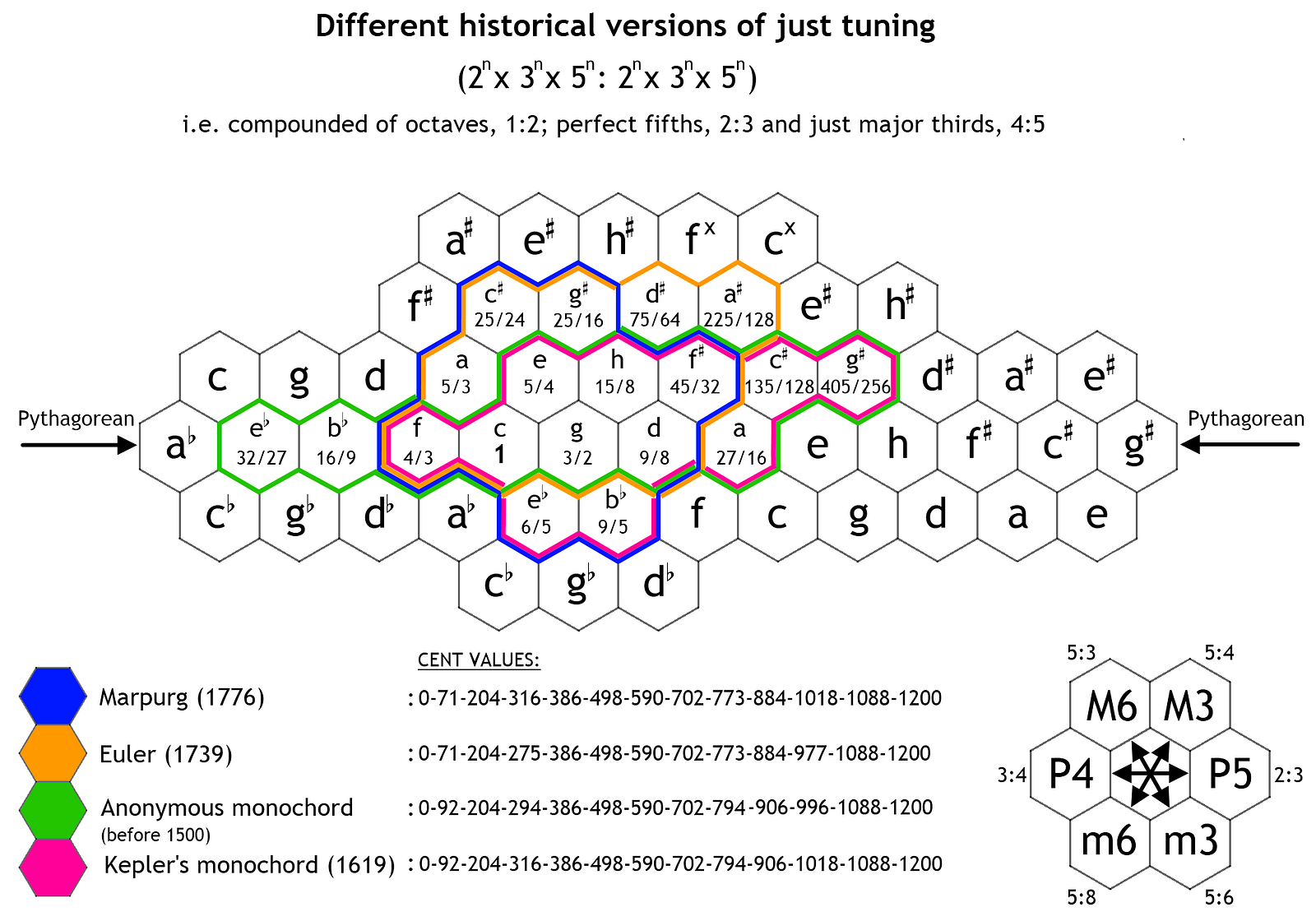
Five-limit tuning is any system that obtains the frequency of each note by multiplying the frequency of a given reference note by products of integer powers of 2, 3, or 5. Powers of 2 represent octaves, powers of 3 represent movements by perfect fifths, and powers of 5 represent intervals of major thirds. Thus, 5-limit tunings are constructed entirely from stacking three basic purely-tuned intervals: octaves, thirds, and fifths. Wikipedia
In practical terms, 5-limit JI gives you:
- A pure major third (5:4) — about 14 cents flatter than equal temperament
- A pure minor third (6:5)
- A pure major seventh (15:8)
- All the intervals your ears have learned to associate with “in tune” Western harmony
The 5-limit system is the theoretical basis of much Western art music (although in practice things rarely achieve this ideal). Both 3-limit and 5-limit JI give acceptable diatonic and chromatic scales, but 5-limit gives nicer, smoother harmonies in thirds and sixths. Patmissin
Who is it for? Composers writing for choir, strings, or any ensemble where the performers can tune by ear. If you want to write music that sounds like the platonic ideal of Western tonal music — Palestrina but perfect, or string quartet writing where the harmonics actually lock — 5-limit is your starting point.
The catch: The number of potential intervals, pitch classes, pitches, key centers, chords, and modulations available to 5-limit tunings is unlimited in theory, but most tuning systems designed for acoustic instruments restrict the total number of pitches for practical reasons. A twelve-tone scale in 5-limit JI requires navigating some inconsistencies — for instance, different versions of the same note depending on harmonic context. Wikipedia You can’t just take a 5-limit C major scale and freely modulate to distant keys without encountering “wolf intervals” — ugly clashes where the pure ratios don’t line up anymore.
7-Limit JI: The Blues Dimension
Add the prime 7 and something remarkable happens. If you take a major chord in the ratio 4:5:6 and add a note to make it 4:5:6:7, you get a pure seventh chord — the same as you would find on a traditionally just-intonated harmonica. The 7-limit G in an A dominant seventh chord is actually more than 12 Hz flatter than the 3-limit G (two perfect fourths above the A). The 7-limit introduces notes that are often about a third of a semitone away from familiar pitches. Patmissin
The key 7-limit intervals and their flavors:
- 7:4 — the harmonic (or “natural”) seventh. About 31 cents flatter than equal temperament’s minor seventh. This is the interval that gives barbershop quartets their distinctive “ring,” and the note that a brass player accidentally lands on when they play a seventh harmonic in an open tube.
- 7:6 — the subminor third. Narrow, tense, bluesy.
- 9:7 — the supermajor third. Wide, bright, slightly disorienting.
Compositions with septimal tunings include La Monte Young’s The Well-Tuned Piano, Ben Johnston’s String Quartet №4, Lou Harrison’s Incidental Music for Corneille’s Cinna, and Michael Harrison’s Revelation: Music in Pure Intonation. Even the Great Highland bagpipe can be described as a seven-tone 7-limit scale. Wikipedia
Who is it for? If you’re interested in the sonic world between jazz and contemporary classical — rich dominant seventh chords that actually resolve with gravitational force, bluesy inflections that aren’t just “bent” notes but acoustically correctones, or the eerie resonance of music rooted in harmonic series from low in the overtone spectrum — 7-limit is your territory. It’s also the limit where most microtonal exploration begins for composers who grew up with pop and jazz.
Instruments that support continuous intonation — like fretless strings, trombones, and trained voices — work well in 7-limit JI. Microtonaltheory For a stunning entry point, listen to Ben Johnston’s String Quartet №4 (Amazing Grace), performed by the Kepler Quartet.
11-Limit JI: Neutral Intervals and Quarter-Tone Territory
The 11th harmonic introduces something genuinely strange to Western ears: neutral intervals — intervals that sit exactly between familiar categories. Not major, not minor. Not consonant in the traditional sense, but not dissonant either. Just… other.
The “undecimal” neutral third of 11:9 sits in-between major and minor, at about 347 cents. The 11-related intervals are very close to quarter-tones — a quarter-tone scale allows for close approximations of many 11-related intervals. La Monte Young’s
The key 11-limit color is the 11:8, sometimes called the “superfourth” or “undecimal tritone” — it sits exactly halfway between a perfect fourth and a tritone, about 551 cents. This interval sounds gorgeous and perfectly in tune once your ear adjusts to it. Pro Audio Files You can hear something close to it in certain Middle Eastern maqam scales and in the natural harmonic series of brass instruments playing overtones.
Harry Partch, one of the great pioneers of microtonal music, built his entire compositional world around 43-tone just intonation based on ratios up to the 11-limit, even constructing his own custom instruments to play it. Medium
Who is it for? Composers drawn to spectral music, Middle Eastern or Turkish modal flavors, or music that wants to unsettle without resorting to pure noise. The 11-limit is also interesting for OST composers: neutral thirds and seconds create a sense of ambiguity that can be deeply effective in scoring tension, mystery, or the uncanny. Think of it less as “microtonal weirdness” and more as having access to emotional colors that simply don’t exist in 12-tone equal temperament.
72-tone equal temperament approximates 11-limit just intonation with remarkable accuracy and has been used in contemporary classical composition, particularly by composers like Joe Maneri. Medium If writing for live performers in 11-limit JI feels too demanding, 72-EDO is a practical gateway.
13-Limit JI: Tridecimal Colors and the Edge of Recognition
The 13-limit consists of just intonation intervals such that the highest prime factor in all ratios is 13. The 13-limit is a rank-6 system, and can be modeled in a 5-dimensional lattice, with the primes 3, 5, 7, 11, and 13 represented by each dimension. Xenharmonic Wiki
The signature 13-limit interval is the 13:8, a neutral sixth — roughly a third of the way between a minor sixth and a major sixth. The 13-limit is perhaps the most difficult to accurately learn by ear. It is characterized by the neutral sixth 13/8, which may be found approximately 1/3 of the way between a minor sixth and a major sixth. This relation is more easily heard in wide position (13/4). Plainsound
13-limit JI is genuinely foreign territory, even for trained microtonal musicians. The intervals don’t map cleanly onto anything in the standard repertoire. They’re not “out of tune” versions of familiar intervals — they’re new intervals altogether, with their own acoustic identity.
Who is it for? Composers working in electroacoustic or spectralist traditions who want to push harmonic language into territory that still has internal logic and acoustic purity, but sounds like nothing in the existing repertoire. The 13-limit is also intriguing for drone-based music, where sustained tones give listeners time to adjust their perception and begin to hear these intervals as stable rather than wrong.
Equal divisions of the octave that represent 13-limit intervals well include 31, 41, 46, 53, 72, and 87-EDO. Xenharmonic Wiki Of these, 31-EDO is particularly accessible (it has a long historical pedigree and several existing instruments), and 72-EDO covers most of the 13-limit alongside 11-limit with high accuracy.
A Quick Comparison
LimitPrime AddedNew ColorCharacteristic IntervalSounds Like55Smooth thirds5:4 major thirdPure Western harmony77Blue sevenths7:4 harmonic seventhBarbershop, blues, warm1111Neutral intervals11:8 superfourthQuarter-tone territory, maqam1313Tridecimal neutrals13:8 neutral sixthExotic, drone-friendly
What Instruments Can Actually Play These?
This is where things get practical — and where many composers either get excited or quietly give up. The honest answer is that the higher the limit, the smaller the pool of acoustic instruments that can reliably execute it.
The freebies: instruments that are naturally continuous-pitch
Continuous pitch instruments give access to a wider range of pitches, but often require more skill to be played accurately and reliably. The human voice falls in this category, along with other standard instruments such as bowed strings and trombones. Xenharmonic Wiki
- Trained voices — A skilled choir can sing any limit, in principle. Barbershop quartets already sing 7-limit naturally. For 11-limit and above, your performers need to be specifically rehearsed on the target intervals, ideally with reference recordings or drones.
- Bowed strings (violin, viola, cello, double bass) — The most versatile JI instruments in the orchestral world. Instruments with continuous pitch — voice, violin, trombone, fretless bass — can accommodate JI just fine, and performers may gravitate towards just tunings instinctively without even being aware they’re doing it. BootlegetherWith a skilled string quartet and good rehearsal time, 7-limit and even 11-limit is achievable (see Ben Johnston’s string quartets as proof).
- Trombone — The slide makes any ratio accessible. Brass players already navigate 7-limit territory when playing open horn harmonics.
- Fretless bass and guitar — Highly flexible but require great ear training and physical precision.
Fixed-pitch acoustic instruments: the hard cases
Pianos, harps, marimbas, and similar instruments can only play the notes they’re tuned to. For 5-limit JI, a piano can be retuned to a specific key (La Monte Young’s The Well-Tuned Piano is the canonical example). But for 7-limit and above, you either need custom instruments (like Partch’s Cloud Chamber Bowls and Chromelodeon), or you accept significant compromise.
Woodwinds occupy a middle ground — skilled players can adjust intonation substantially with embouchure and alternate fingerings, making 5-limit and cautious 7-limit writing feasible, but 11-limit and above is very challenging.
The practical answer for most composers: software and electronics
A recent development in music technology is MIDI polyphonic expression (MPE). Instruments that support MPE can apply pitch-bend on a per-note basis, and some plugins can intercept MIDI note data and systematically apply the correct per-note pitch-bend — making microtonal music with MPE-compatible instruments a viable approach. Xenharmonic Wiki
For DAW-based composition:
- Scala (free) — the grandfather of all microtonal tuning tools. Load any JI scale as a .scl file into a compatible soft synth.
- Surge XT (free) — open-source synth with excellent built-in microtuning support.
- Alt-Tuner — a plugin that can retune any MPE-compatible instrument in real time to JI intervals relative to a root note. Good for adaptive JI in live or DAW contexts.
- Most modern soft synths (including those in Native Instruments Kontakt, with scripting) support custom tuning tables.
See the Xen Wiki list of microtonal software plugins for a comprehensive rundown.
A Note on Notation
If you want to write JI music for live performers, you’ll need a notation system. There are two main camps:
Helmholtz-Ellis JI Pitch Notation (HEJI) — Xen Wiki — developed by Marc Sabat and Wolfgang von Schweinitz. HEJI is a musical notation system for just intonation intervals up to the 47-limit. It consists of a set of accidentals defined by formal commas for each prime harmonic. Xenharmonic Wiki It’s the preferred system in European contemporary classical circles and works well in Sibelius/Finale with the appropriate fonts.
Ben Johnston’s notation — Xen Wiki — the preferred system for composers in the American JI tradition (Johnston himself, Kyle Gann, Toby Twining). Its great advantage is that the scores of Johnston’s remarkable body of music are written in it, as well as music by several other composers — making familiarity with it practically useful for that repertoire. La Monte Young’s
Both systems extend standard staff notation with additional accidentals for each prime. Neither is hard to learn at the 5- or 7-limit; things get genuinely complex above 11-limit.
So Which Limit Is Right for You?
Here’s a practical heuristic:
Start with 5-limit if your music is tonal or modally tonal, you want richer choral or string writing, you’re not interested in “microtonal” as an aesthetic statement, you just want things to be more in tune.
Move to 7-limit if you love blues, jazz harmony, barbershop, or the warm, slightly otherworldly quality of music that uses the natural seventh. The 7:4 and 7:6 intervals have a pungent sweetness that’s addictive once you hear it.
Explore 11-limit if you’re drawn to spectral music, Middle Eastern tonalities, or music that lives between categories — neither major nor minor, neither tonal nor atonal. Also excellent for OST composers who want unsettling, ambiguous, or otherworldly textures that don’t rely on clichéd dissonance.
Venture into 13-limit if you’re composing electroacoustic or drone music where listeners have time to calibrate to unusual intervals, you’re working primarily in software or with specialist performers, and you want to go somewhere genuinely uncharted.
Remember: in its own terms, each system is a complete whole supporting music of great expressive power and beauty. Medieval You don’t need to climb the prime-limit ladder to be doing something meaningful. Some of the most profound JI music ever written — Arvo Pärt’s tonal language, the Kepler Quartet recordings of Ben Johnston — lives almost entirely within 5- and 7-limit territory.
The limits aren’t rungs on a ladder of sophistication. They’re different countries, each with its own language.
Going Further
- Kyle Gann’s Just Intonation Explained — the best single-page introduction on the internet
- The Xenharmonic Wiki — deep reference for every concept mentioned in this article
- Harry Partch, Genesis of a Music — the foundational text for 11-limit JI thinking
- Ben Johnston String Quartets, performed by the Kepler Quartet (New World Records) — the best argument for just intonation in contemporary classical music
Comments
Post a Comment