How one man and 43 notes built the modern xenharmonic movement
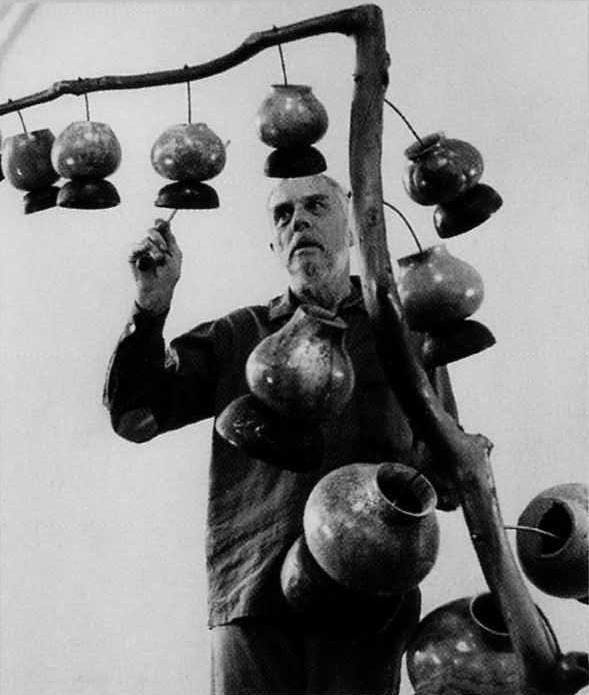
If you've spent any time around composers who tune their own instruments or write music in unusual intervals, you've almost certainly heard the name Harry Partch. He's cited everywhere in microtonal music, treated like a founding father — and for good reasons that go far beyond simply "he used more than 12 notes." Partch didn't just expand the palette of Western music. He rebuilt it from the ground up, starting from first principles, and the theoretical framework he invented is still the foundation of a huge amount of cutting-edge work in tuning theory today.
This article is aimed at musicians who know their way around standard theory — you understand intervals, chord construction, harmonic series, maybe some counterpoint — but who haven't dipped into the world of microtonality yet. We'll look at what Partch actually did, why he did it, how his famous 43-tone scale is built, and what later theorists made of his ideas.
Who Was Harry Partch?
Harry Partch (1901–1974) was an American composer, theorist, and instrument builder. He grew up in the American Southwest, largely educated himself in music theory through public libraries, and in 1930 made one of the most dramatic gestures in musical history: he burned all his previous compositions in a rejection of the European concert tradition. He was 28 years old.
What drove him to that? In 1923, browsing the Sacramento Public Library, he encountered a book on the physics of sound and musical theory — almost certainly Hermann von Helmholtz's On the Sensations of Tone. That encounter convinced him that the tuning system underpinning all Western music since Bach — twelve-tone equal temperament — was a historical compromise, not a natural law. He spent the next decade developing an alternative.
The resulting system was documented in his 1949 book Genesis of a Music, which is equal parts music theory, instrument-building manual, polemical history of Western music, and autobiography. It's a strange and difficult read, but enormously influential. Composers including Lou Harrison, Ben Johnston, and James Tenney all cite it as a major influence.
Partch also built an entire orchestra of custom instruments to play his music — the Chromelodeon (a retuned reed organ), the Quadrangularis Reversum, the Cloud Chamber Bowls, the Diamond Marimba, and many others — because no existing instruments could play his scales. His debut performance at Carnegie Hall in the mid-1940s was the first time microtonal music from an entire composed ensemble had been heard in a major American concert venue.
The Problem With Equal Temperament
To understand what Partch was doing, you need to understand what he was reacting against.
The twelve-tone equal temperament (12-TET) you're used to divides the octave into 12 equal semitones. This is enormously practical: every key sounds the same, any chord can be transposed anywhere, and you can build instruments like pianos that play in every key without retuning. The trade-off is that almost every interval except the octave is slightly out of tune relative to the natural harmonic series.
Here's what that means in practice. When a string or a pipe vibrates, it doesn't just produce one pitch — it produces a whole series of frequencies called the harmonic series (or overtone series). If the fundamental is C2, the series above it goes: C3 (octave), G3 (perfect fifth), C4 (octave), E4 (major third), G4 (perfect fifth), Bb4 (a seventh that doesn't exist in our scale), C5, D5, E5, F#5 (an augmented fourth that doesn't exist in our scale), G5, A5, Bb5, B5, C6...
The ratios between these harmonics are simple whole numbers: 2:1 for an octave, 3:2 for a perfect fifth, 4:3 for a perfect fourth, 5:4 for a major third, 6:5 for a minor third. Tuning intervals to these exact whole-number ratios is called just intonation (Xen Wiki: Just intonation). When you sing in a barbershop quartet or a well-trained a cappella ensemble and the chord "locks in" with that ringing, shimmering quality, that's just intonation at work.
In 12-TET, the perfect fifth is 700 cents (100 cents per semitone × 7 semitones). The just perfect fifth is 701.96 cents. That's barely 2 cents off — nearly inaudible. The major third is more dramatic: in 12-TET it's 400 cents, but the just major third is 386.3 cents — about 14 cents flat of what 12-TET gives you. That's why a major chord on a synthesizer with a pure sawtooth wave can sound slightly harsh compared to a well-tuned choir singing the same chord.
This mismatch gets worse the further you go up the harmonic series. The 7th harmonic produces a minor seventh at about 969 cents — 31 cents flatter than the 12-TET minor seventh. The 11th harmonic produces an augmented fourth at about 551 cents — right in the crack between F and F# in 12-TET, belonging to neither. These intervals don't exist in our system at all.
Partch's fundamental argument was that limiting yourself to 12-TET meant cutting yourself off from an enormous range of musical color that the human ear is perfectly capable of appreciating. He wanted access to all of it.
The Concept of Limit
Before we can understand Partch's scale, we need the concept of prime limit(Xen Wiki: Odd limit). This is the single most important idea in just intonation theory.
Every interval in just intonation is expressed as a ratio of whole numbers: 3:2 for a perfect fifth, 5:4 for a major third, 7:4 for the harmonic seventh. The "limit" of a just intonation system refers to the largest odd number used in any of its ratios. (We say "odd" because powers of 2 just move you up and down octaves — they don't change the pitch class.)
Standard Western tonal harmony, when tuned in just intonation, is essentially a 5-limit system (Xen Wiki: 5-limit). The major triad is 4:5:6. The minor triad is 10:12:15. The dominant seventh chord is 4:5:6:7 — except that last ratio pushes into the 7-limit (Xen Wiki: 7-limit), which 12-TET approximates badly. Go further and you reach the 11-limit (Xen Wiki: 11-limit), where the 11th harmonic — that augmented fourth that falls between F and F# — is genuinely foreign to Western ears.
Partch chose the 11-limit as the basis of his system for a specific reason. The 7th harmonic, though unfamiliar in classical music, appears in ancient Greek scales and is well approximated by meantone temperament; it shows up in the "sweet" seventh chords of barbershop harmony. The 9th harmonic is just two stacked perfect fifths (3×3=9) and exists in Pythagorean tuning. But the 11th harmonic at 551 cents sits exactly halfway between two pitches of 12-TET — it has genuinely no equivalent in our system. Partch saw this as the natural boundary: the first harmonic that was completely outside anything Western ears already knew. As he wrote, "if the ear does not realize an implication, it does not exist."
The Tonality Diamond
Now here's where Partch's real theoretical innovation comes in — the concept that B. McLaren, writing in the source documents for this article, calls his most important contribution to music theory.
Before Partch, just intonation theorists had always built their scales by subdividing a string: you divide by 2 to get an octave, by 3 to get a fifth, by 5 to get a third, and so on. The problem is there's no principled stopping point. Why stop at the 7th harmonic? Why not the 13th? Why not the 97th? Every theorist made a different arbitrary choice, and the arguments were endless.
Partch solved this by inventing a new method of scale construction he called the Tonality Diamond (Xen Wiki: Tonality diamond).
Here's the idea. Take the odd numbers from 1 to 11: that's 1, 3, 5, 7, 9, 11. These are your identities. Now build a matrix: multiply each number by each other number (divided by the appropriate power of 2 to keep everything within one octave). Then do the same thing with the inverses of those numbers — i.e., divide instead of multiply. The overtone-based ratios Partch called Otonalities (Xen Wiki: Otonality and Utonality) (from "overtone tonality"); the undertone-based inversions he called Utonalities.
In plain terms: an Otonality built on C is a chord whose notes are in the relationship 4:5:6:7:9:11 above C. It's a natural chord derived from the harmonic series, containing a major third, perfect fifth, harmonic seventh, major ninth, and that alien 11th harmonic. A Utonality built on C is the mirror image — its notes form the same ratios below C. The Utonality chord sounds vaguely minor, and it has no physical analog in acoustic resonance (it's not produced naturally by a vibrating string), but Partch argued it was theoretically necessary as the mirror image of the Otonality.
When you lay out all the Otonality and Utonality chords for each of your six identities and collect all the resulting pitch classes, you get exactly 29 distinct pitches. Partch called this the 11-limit tonality diamond — and crucially, it's a closed system. You don't have to make any arbitrary choices. The 29 pitches follow necessarily from the decision to use 11 as your limit. For the first time in just intonation history, there was a principled reason to stop where you stopped.
This, according to McLaren in the source material, was a genuine breakthrough: "Partch introduced an entirely new functional method of generating just intonation scales. Subsequent theorists were no longer limited to conceiving of just scales as string subdivision; instead, they could now view just intonation scales as cyclic groups generated by mathematical functions operating on sets of integers."
The 43-Tone Scale
The 29 pitches of the diamond are the core of Partch's system, but they're not quite enough on their own. Two problems arise.
First, the diamond only gives you complete Otonality and Utonality chords rooted on one tonic. Second, there are large gaps in the scale — particularly near 1/1 (the tonic) and 2/1 (the octave), where the pitches are spread far apart. This makes melodic movement awkward and limits compositional flexibility.
Partch's solution was to add 14 additional secondary ratios — pitches derived by multiplying or dividing the primary diamond tones by small integers, effectively filling in the gaps. These aren't part of the diamond itself; they're melodic helper tones. With these 14 fillers added to the 29 diamond pitches, you arrive at the famous 43-tone scale (Xen Wiki: Harry Partch's 43-tone scale), also known as the Genesis scale or Partch's pure scale.
The complete scale spans the octave in 43 unequal steps. Here's a sense of the density: the smallest interval in the scale is 21.5 cents (81/80, a comma), and the largest gap is around 38 cents. Compare this to 12-TET where every step is exactly 100 cents. The pitches are clustered unevenly, with more density in the middle of the octave (around the perfect fourth and fifth) and more space near the extremes.
It's worth listing the first few pitches just to give you a sense of what the scale actually looks like:
1/1 (0¢) — 81/80 (21.5¢) — 33/32 (53.3¢) — 21/20 (84.5¢) — 16/15 (111.7¢) — 12/11 (150.6¢) — 11/10 (165.0¢) — 10/9 (182.4¢) — 9/8 (203.9¢) — 8/7 (231.2¢) — 7/6 (266.9¢) — 32/27 (294.1¢) — 6/5 (315.6¢) ...
Notice those first four pitches above the tonic: 81/80 is only 21.5 cents away from 1/1 — barely a fifth of a semitone. Then 33/32 at 53 cents, then 21/20 at 84 cents, then 16/15 at 111 cents (roughly a semitone). You have four distinct pitches in the space of one 12-TET semitone.
The scale was not arrived at all at once. It evolved over more than a decade. Partch started with 12 just pitches in 1923, expanded to 29 in 1928, went as high as 55 at some point, and worked back down through 41 and 43 before settling on the final 43-tone version published in Genesis of a Music. The detailed forensic history of this evolution — involving black-light examination of whited-out ratios on manuscript pages — is documented in B. McLaren's "The Evolution of Harry Partch's Tuning System," included in the source material for this article.
Otonality, Utonality, and Harmonic Thinking
The 43-tone scale isn't just a list of pitches — it comes with a whole harmonic grammar. Because every pitch in the diamond belongs to one or more Otonalities and Utonalities, Partch could think in terms of chord progressions within his system, moving from one tonal center to another through shared pitches.
An Otonality on 1/1 contains, among other pitches: 1/1, 5/4, 3/2, 7/4, 9/8, 11/8. Stack those up and you have something like an extended major chord with a harmonic seventh and that alien 11th. An Utonality on 1/1 contains: 1/1, 8/5, 4/3, 8/7, 16/9, 16/11 — a chord with a "minor" quality but colored by those same upper harmonics.
The tonality diamond gives you ten complete primary Otonalities and ten Utonalities — one for each of the six identities (1, 3, 5, 7, 9, 11) plus the inversions. Each chord shares at least some pitches with others, allowing smooth voice-leading and harmonic motion through what Partch called his "tonal flux."
One of Partch's major theoretical contributions, noted in the source material, was his argument that modulation was unnecessary in just intonation. The standard criticism of just intonation had always been that you can't modulate through different keys without the pitches shifting in ways that create harmonic inconsistencies. Partch countered that the enormous variety of harmonic color within a single key center in 11-limit just intonation could produce all the drama and surprise that modulation through equal-tempered keys offered. Walking along the levee of the Mississippi in New Orleans in the early 1930s, he had a realization — as he described it himself — of "the great potential of just that one tone."
Notation: Ratios as Pitch Names
One practical consequence of Partch's system that working musicians find either liberating or alarming: he abandoned standard Western notation entirely for his own scores, writing pitches as numerical ratios rather than note names.
He had good reason. Standard notation — with its staff, clefs, accidentals, and letter names — is built around the diatonic scale, which is a 5-limit just intonation structure. When you get to the 11-limit, pitches like 11/8 (551 cents) genuinely don't correspond to any note in the system. It's not an F and it's not an F# — it's something in between that has its own distinct identity. Trying to notate it with a dagger or an apostrophe attached to a conventional note name just obscures its true nature.
By notating everything as ratios, Partch made the harmonic relationships immediately visible in the score. When you see 11/8 and 4/3 in the same bar, you instantly know their relationship (11/8 ÷ 4/3 = 33/32 — a tiny interval of 53 cents). This habit has been enormously influential: most just intonation composers today think and notate at least partially in ratios.
Scales by Others Based on Partch's Work
Partch's theoretical framework spawned a whole family of related scales and tuning systems. Here are the most significant ones, moving roughly from closest to the original to most distant.
Genesis Minus (41 notes)
By removing just two pitches from Partch's 43-tone scale — 11/10 and its mirror image 20/11 — you get a 41-note scale called Genesis Minus (Xen Wiki: Genesis Minus). These two pitches are the ones that cause the most trouble in equal temperament approximations (they're tempered together in 41-EDO), and their removal produces a scale with a mathematically elegant property: it becomes a constant structure under 41-equal-divisions-of-the-octave (41-EDO). Erv Wilson — who worked closely with Partch and drew the original diagrams in Genesis of a Music — pointed out that even the full 43-tone scale nearly achieves this constant structure property, with just those two pitches as exceptions.
Genesis Minus also turns out to be close to a Fokker block — a type of scale that tiles frequency space in a mathematically regular way — and it tempers to a Moment of Symmetry (MOS) scale in several temperament systems, including cassandra, magic, and rodan temperaments.
Ben Johnston's Extended Just Intonation
Composer Ben Johnston (1926–2019) was one of Partch's most devoted students and the person who pushed his framework the furthest. While Partch stopped at the 11-limit, Johnston went to 31-limit and higher in his later string quartets. His String Quartet No. 4 uses a scale based on Partch's ideas but extended, and his String Quartet No. 9 explores ratios up to prime 31.
Johnston developed his own notation system — still based on standard staves but with a set of accidentals for each prime limit — which has since become widely used among just intonation composers. Where Partch abandoned standard notation, Johnston tried to extend it.
Lou Harrison's Scales
Lou Harrison (1917–2003) was a close friend of Partch's and shared his interest in just intonation, though he came to it from a different direction — partly through Gamelan music and non-Western traditions. Harrison's tuning systems typically stayed within the 11-limit like Partch, but he often worked with just scales that weren't derived from the tonality diamond, instead building scales from stacked pure fifths and thirds in specific configurations. His scale for the piece Cinna, for instance, shares all but one pitch with Partch's 43-tone scale (it adds a 25/18 augmented fourth that Partch didn't use) and similarly features rich septimal intervals.
Erv Wilson's Combination Product Sets
Erv Wilson (1928–2016) was the theorist who perhaps did the most to develop the mathematical framework implicit in Partch's tonality diamond. The tonality diamond can be understood as a specific case of what Wilson called a Combination Product Set (CPS) (Xen Wiki: Combination product set): you take a set of integers (Partch used {1, 3, 5, 7, 9, 11}) and form all possible products of choosing pairs (or triples, or other subsets) of them.
The famous Hexany (Xen Wiki: Hexany) is the simplest CPS: take four integers, choose all possible pairs, and you get six pitches that can be arranged on the vertices of an octahedron. Every edge of the octahedron connects pitches that share three factors — meaning every edge represents a consonant interval within the system. The hexany is extraordinarily elegant: six pitches, three complete tetrads, all from the same four-integer generating set.
Wilson generalized this to produce a whole zoo of CPS structures — the Dekany, the Pentadekany, the Eikosany — each with beautiful geometric properties and rich harmonic relationships. All of them can be seen as offspring of the basic idea behind Partch's diamond.
James Tenney and Harmonic Space
James Tenney (1934–2006) was a composer and theorist deeply influenced by Partch who took the ratio-based thinking in a more abstract direction. His concept of harmonic space treats just intonation pitches as points in a multi-dimensional lattice, where each dimension corresponds to a prime factor. Two pitches are "close" in harmonic space if their ratio involves small numbers — i.e., if they're harmonically related. Tenney's work on harmonic distance and his piece Spectral CANON for CONLON Nancarrow are direct applications of this Partch-derived framework.
The Genesis Plus Family (58 notes and beyond)
Going in the other direction — adding rather than subtracting from Partch's scale — theorists have asked: what's the smallest epimorphic scale that contains all 43 pitches of the Genesis scale? An epimorphic scale is one where you can define a consistent mapping from scale steps to equal-tempered steps. The answer turns out to be 58 notes, called Genesis Plus(Xen Wiki: Genesisplus) — a scale that contains Partch's 43 tones plus 15 more to fill out its structure. Interestingly, 58 is also the smallest size of epimorphic scale that contains a complete 11-limit tonality diamond, making it a natural boundary in the theory.
How Well Does Equal Temperament Approximate Partch?
A practical question for musicians who want to play Partch-influenced music without building custom instruments: how closely can standard (or extended) equal temperament approximate the Genesis scale?
The answer depends on which equal temperament you use. Standard 12-TET does remarkably well for the 5-limit pitches in Partch's scale — the biggest error is only about 15.6 cents for the minor third — but it fails completely for the 7-limit and 11-limit intervals, which are its whole point.
41-EDO (Xen Wiki: 41edo) does an excellent job with almost all of Partch's scale. The only pairs it can't distinguish are 11/10 and 10/9 (which it tempers together), and their mirror images — which is exactly why removing those two tones produces Genesis Minus, a scale that 41-EDO can represent perfectly.
72-EDO (Xen Wiki: 72edo) does even better. It's distinctly consistent through the 11-limit — meaning it represents every 11-limit interval unambiguously and accurately — and fits the Genesis scale very well. Importantly, 72-EDO divides the standard 12-TET semitone into 6 equal parts of 16.67 cents each, meaning standard notation can be extended to 72-EDO using a small set of additional accidentals (±1/6, ±1/3, ±1/2 semitone). This makes it practical for acoustic musicians without custom instruments. The composer Joe Maneri developed a complete notation and pedagogical system for 72-EDO, and it's been used by many composers who want access to Partch's harmonic world without fully departing from standard notation.
For the very best approximation, theorists have found that 270-EDOapproximates Partch's scale better than 1200-EDO (the standard "cents" measurement), which is a remarkable claim — it means 270 equal divisions to the octave is a more efficient way to represent Partch's tuning than measuring everything in thousandths of a semitone.
Some Honest Caveats
Partch was a genius, but he wasn't infallible, and the microtonal community has been frank about the limitations of his work.
His psychoacoustic arguments — his claims about why the human ear "naturally" prefers just intonation intervals — were largely wrong, or at least far too simple. Modern psychoacoustics has shown repeatedly that the intervals musicians actually prefer are slightly stretched compared to just intonation: when asked to tune a "perfect octave" by ear, listeners consistently land around 1220 cents — roughly 20 cents wider than the mathematically pure 2:1 ratio — not exactly 1200 (Ward, 1954; Dobbins & Cuddy, 1982; and many replications since). Performers also consistently play thirds and fifths slightly sharp of just. The effect varies across individuals and registers, and some subjects show little or no stretch at all, but the average is robust enough to have been replicated across decades of research. The ear's preferences are context-dependent, timbre-dependent, and culturally conditioned in ways Partch didn't account for.
This doesn't make Partch's music sound bad — it still sounds extraordinary — but it does mean you shouldn't accept his theoretical justifications uncritically. Just intonation is a compelling compositional choice, but not because of universal acoustic laws hardwired into the human brain. It's interesting for the same reason any consistent interval system is interesting: it creates a specific palette of colors and relationships that reward close listening.
Partch also never fully resolved the notation problem. Writing everything as ratios is logically clean but practically difficult for performers, especially in ensemble contexts. Subsequent theorists (Johnston, Sims, Maneri) have developed notation systems that extend standard notation to handle just intonation more gracefully.
Where to Go From Here
If this article has sparked your interest, here are some next steps:
Listen first. Partch's recordings are widely available. Start with Delusion of the Fury (1966–69), his most fully realized music-theater work, or Barstow(1941), settings of hitchhiker inscriptions for voice and adapted guitar. The sound is unlike anything else — percussive, ritualistic, and deeply strange in the best possible way.
Read Genesis of a Music. Skip the polemical opening chapters (pages 3–67 in the 1974 second edition) unless you want to understand Partch's rage at the musical establishment. Pages 68–180 contain the actual theory, which is dense but rewarding. Pages 181–319 are essentially a handbook for building his instruments.
Explore the Xenharmonic Wiki. The Harry Partch page and the Harry Partch related scales page are good starting points, with links to detailed mathematical treatments of everything covered in this article.
Try composing in 11-limit just intonation. Software like Scala (free) lets you load the Genesis scale, tune a MIDI instrument to it, and hear what the intervals actually sound like. Even a few minutes with 7/4 and 11/8 as actual pitches rather than equal-tempered approximations is revelatory.
Harry Partch spent his life arguing that Western music had voluntarily impoverished itself by adopting equal temperament. Whether or not you accept that framing, the harmonic world he opened up — and that subsequent theorists have continued to explore — is vast, beautiful, and still largely unmapped. The Genesis scale isn't an endpoint. It's a door.
Comments
Post a Comment