12-TET vs 19edo vs 22edo vs 29edo vs 31edo: the best all-purpose tunings compared — strengths and weaknesses
First, Some Background: What Are We Actually Comparing?
Just Intonation and the Harmonic Series
When two notes sound pure and beatless together, their frequencies are in a simple whole-number ratio. A perfect fifth is 3:2. A major third is 5:4. These are called just intonation intervals, and they come from the harmonic series — the natural overtones that ring inside any sustained note.
The catch: if you build a scale entirely from pure just intervals, notes in different keys end up at slightly different pitches. A D tuned as a perfect fifth above G sounds different from a D tuned as a major third above B♭. That gap — around 22 cents (hundredths of a semitone) — is called the syntonic comma, and it’s the root of all tuning headaches.
Prime Limits
Tuning theorists talk about intervals in terms of which prime numbers appear in their frequency ratios:
- Prime 3 → perfect fifths and fourths (ratio 3:2)
- Prime 5 → major and minor thirds (5:4 and 6:5)
- Prime 7 → the “harmonic seventh,” a bluesy, flat minor seventh (7:4), plus subminor thirds (7:6) and supermajor thirds (9:7)
- Prime 11 → neutral intervals — intervals halfway between familiar ones, like a neutral third between major and minor (11:9)
A tuning’s prime limit tells you which harmonics it can reasonably access. The higher the prime limit a tuning handles well, the more flavors of consonance it can offer.
EDO: Equal Divisions of the Octave
An EDO simply means dividing the octave into some number of equal steps. 12-TET divides it into 12 steps of 100 cents each. 19edo divides it into 19 steps of about 63 cents each. The question for each one is: how closely do those equal steps approximate the pure just ratios?
We measure the error in cents. Anything under about 7 cents is generally considered excellent (most listeners can’t detect it), 7–15 cents is good, 15–20 cents is noticeable but usable, and above 20–25 cents starts to feel distinctly “wrong” compared to a pure interval, especially in sustained chords with clear timbres.
Meantone vs. Superpyth vs. Pythagorean
Three major families of tuning show up in this comparison:
- Meantone: fifths tuned slightly flat of pure (3:2) to make major thirds (5:4) more accurate. 12-TET, 19edo, and 31edo are all meantone systems.
- Superpyth: fifths tuned slightly sharp, which makes the 7-limit accessible more directly (7:6 and 9:7 thirds become available) at the cost of making the 5-limit thirds require more complex scales to reach. 22edo is the flagship example.
- Pythagorean/Para-Pythagorean: the fifth is close to pure, and the rest of the scale is built from that. 29edo falls into this category.
The Comparison at a Glance
Here’s a quick reference table for the error each tuning makes on the four key prime harmonics. Negative means flat of just; positive means sharp of just.
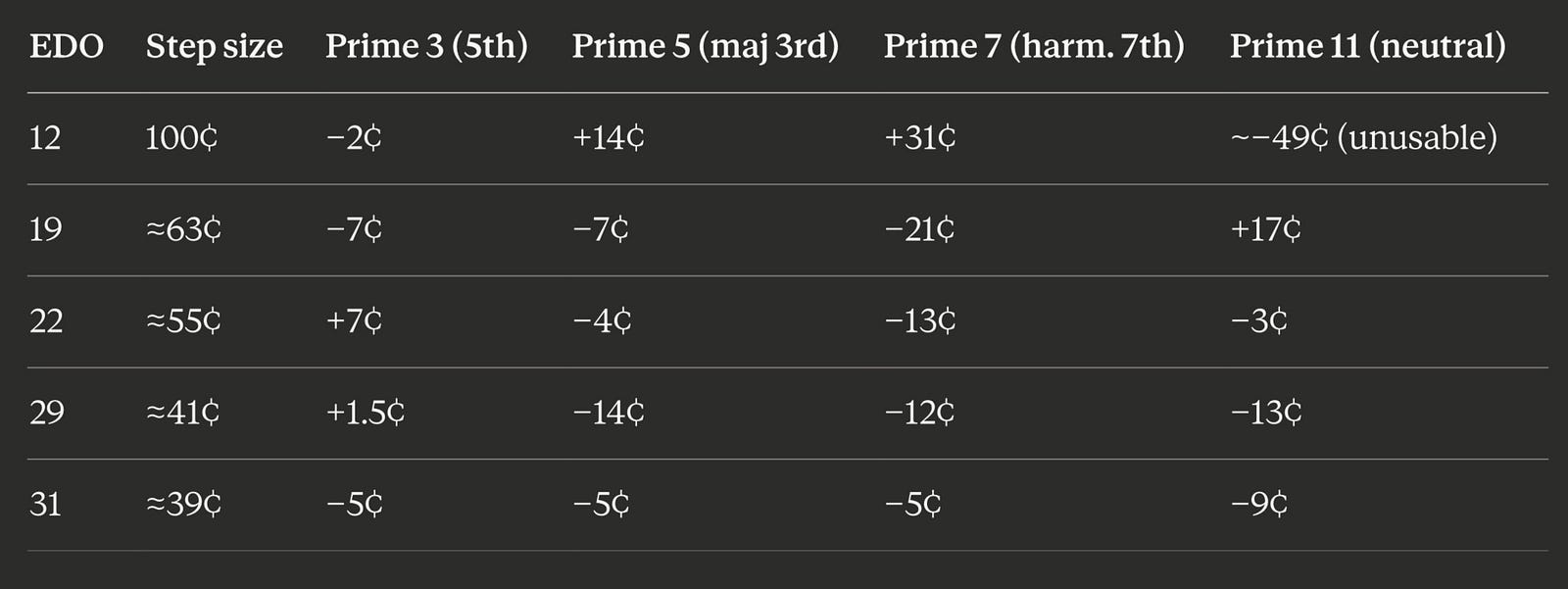
Now let’s go through each one in depth.
12-TET (12edo)
12 equal steps, 100 cents each
The Good
Excellent prime 3
12-TET is the tuning everyone knows, and it earns its position. Its perfect fifth is only 2 cents flat of pure — close enough that most listeners never notice. That means Pythagorean-style music (anything built primarily on fifths and fourths) sounds excellent in 12-TET. Medieval parallel organum, modern jazz voicings built on fourths and fifths, rock or metal power chords— all fine.
Passable prime 5
12-TET is the smallest EDO that can reasonably handle 5-limit harmony at all. Its major third is 14 cents sharp of just, which is noticeable in slow, sustained chords (especially on organ or strings) but workable in most contexts. Its circle of fifths closes perfectly, giving free modulation to all 12 keys — a massive practical advantage.
The Bad
Passable prime 5
The major third at +14¢ is 12-TET’s most famous weakness. Compared to a pure 5:4, it sounds bright and slightly tense. Centuries of acoustic music were performed in meantone temperaments precisely because musicians found 12-TET’s major thirds unacceptably harsh. Modern listeners are simply more accustomed to it.
Poor-to-nonexistent prime 7
Beyond 5-limit harmony, 12-TET struggles severely. The harmonic seventh (7:4) — the interval that gives blues and barbershop their characteristic sound — is 31 cents sharp of just in 12-TET. That’s almost a third of a semitone, and it’s why jazz musicians and blues singers instinctively bend notes down when approaching that interval. The tuning tempers out the septimal comma in a way that makes 7-limit intervals fuzzy at best.
Nonexistent prime 11
As for prime 11, 12-TET essentially doesn’t support it. The nearest approximation to the 11th harmonic is about 49 cents away from just — practically a quarter-tone off — making neutral intervals inaccessible without bending.
In short: 12-TET is a brilliant compromise for diatonic, modulation-heavy music in the European tradition. It is a poor fit for pure triadic harmony, 7-limit harmony, or anything involving neutral intervals.
19edo
19 equal steps, ≈63.2 cents each
19edo is the smallest EDO after 12-TET that can seriously handle 5-limit harmony. Interest in it dates back to the 1500s, when composer Guillaume Costeley used it. Joel Mandelbaum argued in his PhD thesis that it’s the only viable equal tuning between 12 and 22 divisions.
Prime 3 (Fifth): −7¢ — Passable
19edo’s perfect fifth is about 7 cents flat of just. That’s more than 12-TET’s 2-cent flat fifth, and in sustained contexts you can hear it — the fifth has a slightly “narrow” quality. It’s still entirely usable, and the circle of fifths closes after 19 steps, allowing full modulation. 19edo is a ⅓-comma meantone, meaning the fifth is deliberately narrowed to spread the error across the thirds.
Prime 5 (Major Third): −7¢ — Excellent
Here’s where 19edo shines. Its major third is only 7 cents flat of just — half the error of 12-TET, and in the opposite direction. Pure major thirds feel warm and stable; 19edo’s are noticeably closer to that quality than 12-TET’s. Minor thirds are also very close to just (the errors on primes 3 and 5 partially cancel out), making minor triads equally beautiful.
Easley Blackwood described 19edo as offering “a substantial enrichment of the tonal repertoire” for exactly this reason: traditional Western harmony, especially slow or resonant music, sounds more consonant and lush in 19edo than in 12-TET.
Prime 7 (Harmonic Seventh): −21¢ — Poor
19edo’s handling of prime 7 is its major weakness. The harmonic seventh (7:4) is about 21 cents flat of just — worse even than 12-TET’s +31¢ error in absolute terms, and in the flat direction. 19edo does distinguish 7-limit intervals from 5-limit ones (unlike 12-TET, which conflates them), but the approximation is rough enough that septimal harmony sounds distinctly unclean. Some composers use it anyway, exploiting the dark, subminor quality; others simply avoid 7-limit harmony in 19edo.
Prime 11 (Neutral Intervals): +17¢ — Passable
The 11th harmonic is about 17 cents sharp in 19edo. Not usable for clean neutral intervals, but somewhat better than 12-TET’s situation. The 19edo neutral second (between a tone and a semitone) approximates 11:10 with reasonable accuracy, but the core neutral third (11:9) is off enough to sound more like a tempered interval than a pure one.
What Makes 19edo Special
19edo is a meantone system, meaning it’s theoretically familiar to any musician trained in standard Western music. The same diatonic patterns, the same circle of fifths logic, the same chord functions — all apply directly. Enharmonic notes (C♯ vs D♭) are no longer identical, which is musically meaningful: they resolve differently. This gives 19edo a sense of directional richness that 12-TET lacks.
Because 19 is a prime number, cycling through any fixed interval will eventually visit all 19 pitches — analogous to how the circle of fifths cycles through all 12 notes in standard tuning.
Best for: Enriched diatonic harmony, lush triads, early music performance practice, composers who want familiar theory with a warmer, more resonant sound. 19edo is arguably the most accessible microtonal system for classically trained musicians.
Weaknesses: Poor 7-limit, mediocre 11-limit, somewhat flat fifths.
22edo
22 equal steps, ≈54.5 cents each
22edo is where things get genuinely different. It was championed by theorist Paul Erlich as a “next step” beyond 12-TET specifically because it opens harmonic territory that 12-TET and 19edo can’t reach. The 19th-century theorist R.H.M. Bosanquet was apparently the first to note its mathematical interest.
Prime 3 (Fifth): +7¢ — Passable
22edo’s fifth is about 7 cents sharp of just — the mirror image of 19edo’s flat fifth. This puts it in the superpyth family: the slightly sharp fifth generates a diatonic scale with more contrast between its large and small steps than meantone systems produce.
Prime 5 (Major Third): −4¢ — Excellent
Surprisingly, despite its sharp fifths, 22edo’s major third is only 4 cents flat of just. This is because the major third is reached by stacking four fifths (minus two octaves), and four slightly-sharp fifths overshoot enough to land close to 5:4. The result is genuinely good 5-limit harmony — 22edo is the third EDO (after 12 and 19) to approximate 5-limit harmony to within a Tenney–Euclidean error of 4 cents.
However, there’s a twist: because 22edo is not a meantone system, it does not temper out the syntonic comma. This means that the two just whole tones — 9:8 (204¢) and 10:9 (182¢) — remain distinct in 22edo, whereas meantone systems (including 12-TET) treat them as the same. This is a double-edged sword: more harmonic nuance, but also more complexity when navigating the diatonic scale.
The diatonic scale in 22edo comes from superpyth temperament, and as a result the major third in the diatonic scale sounds not like 5:4 but like 9:7 (the supermajor third), and the minor third sounds like 7:6 (the subminor third). If you want the pure 5-limit thirds, you have to use specific non-diatonic intervals. This makes 22edo’s diatonic scale sound unusual — more “open” and “bright” rather than the warm lushness of meantone.
Prime 7 (Harmonic Seventh): −13¢ — Good
This is 22edo’s most important advantage over 12-TET and 19edo. The harmonic seventh (7:4) is only 13 cents flat of just — roughly half the error of 19edo and less than half of 12-TET. Dominant seventh chords in 22edo can approximate the septimal (barbershop-style) quality much more convincingly. The supermajor third (9:7) is tuned almost perfectly just.
Prime 11 (Neutral Intervals): −3¢ — Excellent
22edo is the smallest EDO that consistently represents the 11-odd-limit. Its 11th harmonic is only about 3 cents flat of just, which is effectively indistinguishable in most musical contexts. This means neutral thirds, neutral seconds, and other quarter-tone-adjacent intervals can be genuinely consonant in 22edo — something no smaller EDO achieves.
As a side effect, 22 is divisible by 11, meaning a 22edo instrument can play any 11edo music as a subset.
What Makes 22edo Special
22edo is unique in accessing both the 7-limit and 11-limit to high accuracy while still handling the 5-limit well. It’s the smallest EDO where all four of our key prime harmonics are represented with meaningful accuracy. The trade-off is that the music it generates sounds noticeably different from 12-TET: the diatonic scale has a harder, more angular character, and to access its beautiful 5-limit triads you need to think beyond the standard diatonic framework.
Best for: Composers willing to break from meantone habits, music that emphasizes 7-limit and 11-limit harmony (septimal chords, neutral intervals, Arabic-influenced scales), and anyone curious about what genuine microtonal harmony sounds like on a relatively approachable number of pitches.
Weaknesses: The diatonic scale sounds “wrong” by meantone expectations; navigating 5-limit and 7-limit simultaneously requires new mental maps; 22 pitches per octave is larger than 19 and requires purpose-built or retuned instruments.
29edo
29 equal steps, ≈41.4 cents each
29edo is the odd one out in this comparison — less commonly discussed than its neighbors, but with some genuinely interesting properties. It sits between 22edo and 31edo, and its character is quite distinct from both.
Prime 3 (Fifth): +1.5¢ — Excellent
29edo’s strongest asset is its near-perfect fifth. At only about 1.5 cents sharp of just, it is actually more accurate than 12-TET’s fifth — and notably, 29 is the smallest EDO to better 12-TET’s approximation of 3:2. This gives 29edo a supremely Pythagorean character: chains of fifths feel extremely clean and stable.
Prime 5 (Major Third): −14¢ — Passable
With such a good fifth, you might expect the major third to suffer — and it does. Four stacked fifths in 29edo land about 14 cents flat of just for the major third. This is just outside the range of comfortable 5-limit harmony. Triads in 29edo have a noticeably impure quality, which makes it unsuitable as a drop-in replacement for standard tonal music. The Xenharmonic Wiki bluntly states that “3 is the only harmonic, of the intelligibly low ones anyway, that 29edo approximates very closely.”
Prime 7 (Harmonic Seventh): −12¢ — Passable
The harmonic seventh (7:4) is about 12 cents flat in 29edo — better than 12-TET’s +31¢ error and comparable to 22edo’s −13¢. All of the low prime harmonics (5, 7, 11, 13) are tuned flatly in 29edo, which means that while none of them are ideal, they are at least internally consistent: intervals built from combinations of these primes can cancel out some of the errors.
This is what leads to a surprising fact: 29 is the smallest EDO that consistently represents the 15-odd-limit. By having accurate prime 3 as an anchor and consistently flat errors on 5, 7, and 11, 29edo manages to be more internally coherent than its modest individual prime errors would suggest.
Prime 11 (Neutral Intervals): −13¢ — Passable
The 11th harmonic is about 13 cents flat — usable but imprecise. Neutral intervals exist in 29edo (it has enough pitches per octave to distinguish them), but they’re not clean enough to serve as genuine consonances.
What Makes 29edo Special
29edo has been described as the “twin” of 12-TET in the 5-limit: the two tunings have nearly identical absolute errors on 5-limit intervals, but in opposite directions. Where 12-TET’s major third is 14 cents sharp, 29edo’s is 14 cents flat. This makes them complementary rather than competitive.
Its near-perfect fifth makes 29edo a natural candidate for Pythagorean and para-Pythagorean music — styles that derive their harmony primarily from pure fifths rather than thirds. Medieval-style parallel organum, certain non-Western traditions, and contemporary music that treats the fifth as its primary consonance all feel at home here.
The 29-note scale is also large enough to support genuinely expressive melodic chromatic writing — the step size of ~41 cents is small enough to feel like “microtones” without being so tiny that adjacent pitches blur into one.
Best for: Composers interested in Pythagorean-character harmony with full chromatic flexibility; music where melody matters more than triadic consonance; a bridge tuning between standard Pythagorean music and the higher-limit world.
Weaknesses: Poor 5-limit triads make it unsuitable for standard tonal music; 29 pitches requires purpose-built instruments; it occupies a somewhat awkward middle ground between 22edo’s 7/11-limit strengths and 31edo’s all-round balance.
31edo
31 equal steps, ≈38.7 cents each
31edo has a long history and an almost fanatical following. It was studied by Nicola Vicentino in the 1550s, championed by Dutch physicist and composer Christiaan Huygens in the 1600s, and brought into the 20th century by Adriaan Fokker, who had a 31-tone organ built in Amsterdam. Today it has one of the most active communities of any microtonal tuning.
The reason for the enthusiasm is simple: 31edo does a remarkable job on all four prime harmonics simultaneously.
Prime 3 (Fifth): −5¢ — Good
31edo’s fifth is about 5 cents flat of just — the same family as 19edo’s flat fifth but closer to pure. The circle of fifths closes in 31 steps, giving full modulation across all keys.
Prime 5 (Major Third): −5¢ — Excellent
31edo’s major third is only 5 cents flat of just, making it one of the best 5-limit approximations of any reasonably sized EDO. To compare: 12-TET is 14 cents sharp, 19edo is 7 cents flat, and 31edo lands at just 5 cents flat. Triads in 31edo are noticeably more resonant and pure than in 12-TET. 31edo is close to quarter-comma meantone — the historical tuning that Renaissance and Baroque keyboard players considered ideal for triadic music.
Minor thirds are equally well served, landing very close to the pure 6:5.
Prime 7 (Harmonic Seventh): −5¢ — Excellent
This is where 31edo truly separates itself. The harmonic seventh (7:4) is only about 5 cents flat — genuinely close to pure, and far better than any smaller EDO in this comparison. Septimal intervals become real musical resources rather than compromises. The augmented sixth chord, traditionally analyzed as approximating 7:4, actually does approximate it well in 31edo. Barbershop quartets use just intonation in practice; 31edo gets close enough that the same sensibility applies.
31edo supports septimal meantone temperament, which means that 7-limit intervals integrate naturally into the diatonic framework: 7:4 appears as the augmented sixth (e.g., C to A♯), 7:6 as the augmented second (e.g., C to D♯), and so on. Musicians don’t need to abandon their existing harmonic intuitions to access 7-limit harmony — they just extend the chain of fifths a few steps further.
Prime 11 (Neutral Intervals): −9¢ — Good
The 11th harmonic is about 9 cents flat in 31edo — noticeably impure compared to 22edo’s 3-cent error, but still pretty good in context. The key insight from the Xenharmonic Wiki is that because prime 3 and prime 11 are both flat, intervals that involve their ratio (like 12:11) lose much of their error through cancellation. So while 11/8 (the undecimal tritone) is 9 cents off, intervals like 11/9 (neutral third) and 11/6 (neutral major seventh) are approximated considerably better.
31edo is described as “a very tone-efficient melodic approximation of the 11-limit” for exactly this reason. You get access to neutral intervals, but not with the same clarity as in 22edo.
What Makes 31edo Special
31edo is perhaps the best argument that a single equal tuning can serve as a genuine all-purpose replacement for 12-TET. Its diatonic scale follows familiar meantone logic — any musician trained in Western theory can navigate it immediately. All the normal scale patterns, cadences, and chord functions work. But on top of that foundation, 7-limit harmony opens up naturally, and 11-limit intervals are available with some care.
The diesis — one step of 31edo, about 38.7 cents — has a distinctive sound that composers have exploited expressively. It’s the interval by which B♯ differs from C (in 12-TET they’re identical; in 31edo they’re one diesis apart), giving the system a rich enharmonic texture.
31edo is also a strict zeta EDO, meaning it performs well across a wide range of harmonic criteria simultaneously. It supports mohajira temperament (an 11-limit system with neutral intervals), orwell temperament, and a number of other advanced systems beyond standard meantone.
Best for: Composers who want the broadest possible harmonic palette within a meantone framework; anyone drawn to septimal harmony (blues, barbershop, jazz extended chords); players who want the richest possible triads; the most beginner-friendly of the genuinely expanded tunings.
Weaknesses: 31 pitches per octave requires purpose-built instruments (31-tone guitars and keyboards exist but aren’t off-the-shelf); the 11-limit is noticeably less clean than 22edo’s. Its steps (~39¢ each) are smaller than 12-TET’s 100¢ semitones, which can make unfamiliar intervals harder to hear as distinct when first learning the system.
Summary: Which Should You Explore First?
If you want:
- Simplicity, and better fifths than thirds? 12-TET.
- Simplicity, and better thirds than fifths? 19edo.
- Full access to new colors while still being ‘good enough’ at familiar ones? 22edo.
- Full access to new colors, and improving on familiar colors too, but at the cost of requiring a lot of notes? 31edo.
- The most precise fifths possible, whatever it costs? 29edo.
A Few Practical Notes
Instruments: Most of these tunings require purpose-built or specially prepared instruments. Guitars can be refretted for any of them. MIDI and software synthesis handle any tuning trivially — Surge XT, Vital, and most serious synthesis environments accept Scala files (.scl), which define any EDO in seconds. Virtual instruments via MTS-ESP allow DAW-level microtonal retuning.
Notation: All five of these tunings can be notated in extended conventional staff notation, usually with the addition of arrows or extra accidentals for the new pitches. The Sagittal notation system provides a unified framework for all of them.
Starting with composition: If you’re a composer new to this space, 31edo is probably the gentlest entry point — it sounds familiar, the theory transfers directly, and the improvement in triadic quality is immediately audible. 22edo requires the most conceptual reorientation but it does more easily fit on most instruments.
The xenharmonic community is active and welcoming. The Xenharmonic Wiki is the primary reference for all of these tunings, with detailed interval tables, composer resources, and recordings. If you have a DAW and a soft synth, you can start exploring any of these tunings today, for free, with nothing but a Scala file and a tuning plugin.
Further reading: Xenharmonic Wiki • Sevish’s music and tutorials • Xenharmonic Alliance community
Comments
Post a Comment