One of the most unusual and fascinating tuning systems in the xenharmonic world: 11 equal divisions of the octave, or 11edo

First, a Quick Recap: What Is an EDO?
You already use one every day. The standard Western tuning system is 12edo — 12 Equal Divisions of the Octave. That means the octave is sliced into 12 equal steps (semitones), each exactly 100 cents wide. Every key on a standard piano, every fret on a standard guitar, every note in your DAW — all 12edo.
The concept of equal divisions of the octave (EDOs) generalises this idea: instead of 12 equal slices, what if you used 19? Or 31? Or, in our case today — just 11?
An EDO of any size still preserves the octave (2:1 frequency ratio), so notes an octave apart still sound like the “same note, higher.” Everything else, however, is up for grabs.
What Is 11edo?
11edo divides the octave into 11 equal steps, each about 109 cents wide. To put that in perspective, a standard semitone is 100 cents. So each step of 11edo is slightly larger than a semitone — just barely bigger than the distance from C to C# on a piano.
Because 11 is a prime number (not divisible by anything except 1 and itself), 11edo has a remarkably different internal structure from 12edo. In 12edo, you can find whole tone scales (6edo), diminished seventh chord cycles (3edo), and augmented triad cycles (4edo) all nested inside it. In 11edo, none of that is possible. Every cyclic pattern you can generate within 11edo will tour through all 11 notes before it repeats at the octave. This gives 11edo an unusually rich variety of scale structures, which we’ll explore below.
11edo is sometimes called macrotonal because its step size is larger than a 12edo semitone, not smaller. The word “microtonal” technically refers to intervals smaller than a semitone, though in casual usage it’s used as a catch-all for any non-12edo system. 11edo is unusual enough that theorists often use the term xenharmonic — meaning it sounds genuinely other, not just like a slightly retuned version of what you already know.
Forget the Perfect Fifth (For Now)
Here’s the first big culture shock: 11edo doesn’t have a usable perfect fifth.
In 12edo, the perfect fifth is 700 cents — a very close approximation of the pure 3:2 ratio (702 cents). It’s the foundation of Western harmony, the generator of the circle of fifths, and the backbone of nearly every chord you’ve ever played.
In 11edo, the closest thing to a fifth is either 6 steps (654 cents) or 7 steps (764 cents). The 6-step version is about 46 cents flat — that’s nearly a quarter-tone flat. The 7-step version is about 62 cents sharp. Neither of these sounds or functions like a “fifth” in the traditional sense.
This is not a bug. It’s a feature. It means 11edo is genuinely forcing you to think differently, not just reach for familiar shapes in a slightly out-of-tune wrapper.
What 11edo does offer well is a good approximation of:
- 7/4 (the harmonic seventh, or “blues seventh”) — approximated at 9 steps (982 cents), only 13 cents off from pure. This is the interval that makes barbershop quartets ring, the “ringing flat seventh” that blues singers gravitate toward naturally.
- 11/8 (the superfourth, or “eleventh harmonic”) — approximated at 5 steps (545 cents), only 6 cents off. This is a wide fourth with a very distinct, almost suspended, floating quality.
- 9/7 (the supermajor third) — approximated at 4 steps (436 cents). This is a bright, aggressive major third, wider than the 5/4 third you’re used to.
So instead of being built around the 3:2 fifth and 5:4 major third that underpin Western tonality, 11edo is built around a different harmonic universe: the 7th, 9th, and 11th harmonics of the overtone series.
The Intervals of 11edo: A Guided Tour
Let’s walk through the 11 steps and compare them to what you already know. Remember, each step is ~109 cents.
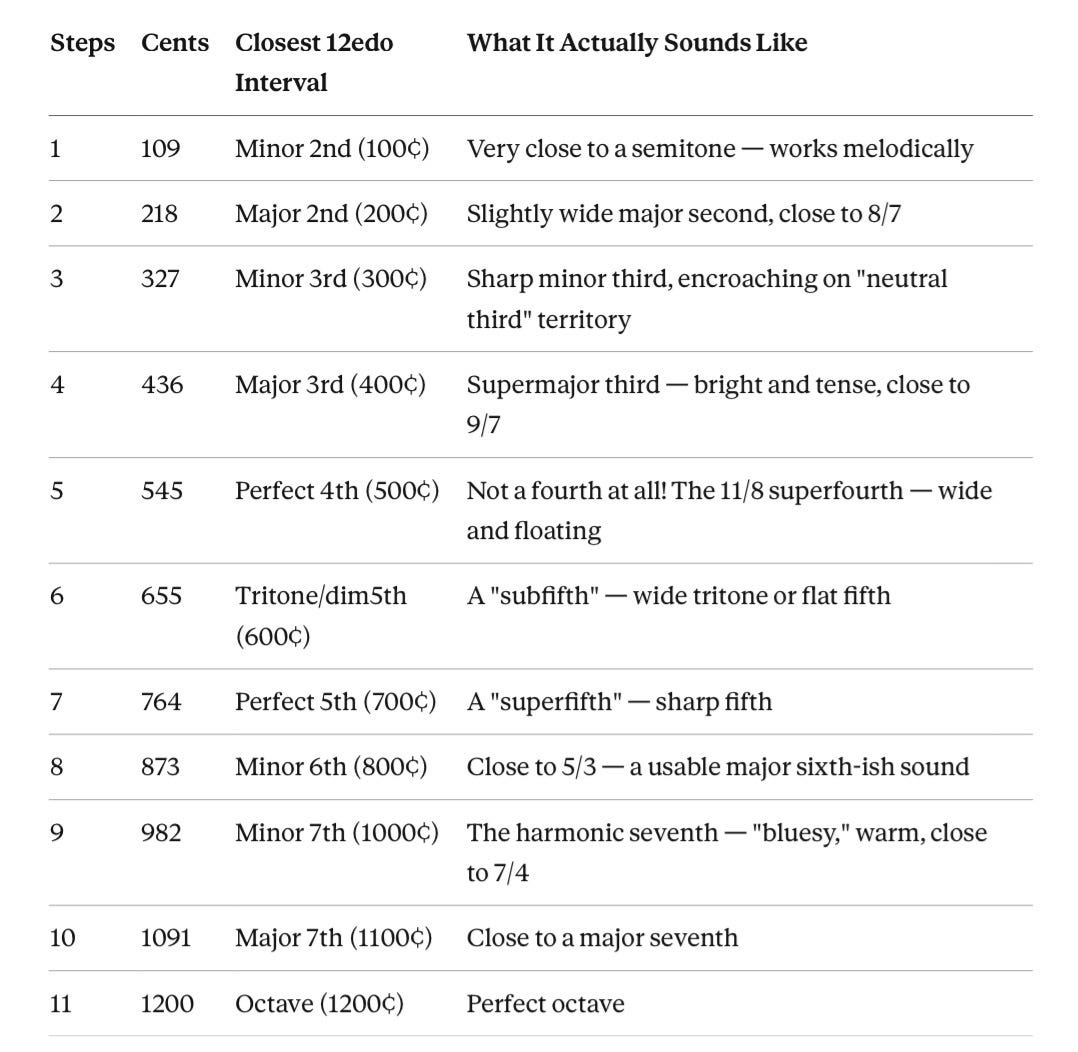
The most immediate perceptual challenge is that 11edo has no perfect fourth and no perfect fifth in the traditional sense. Steps 5 and 6 both sound neither like a fourth nor a tritone — they occupy the gap between the two. And steps 6 and 7 crowd around where a fifth should be without quite landing there.
If you try to play a I–IV–V–I progression, it’s going to sound deeply alien. That’s because you can’t do conventional diatonic harmony in 11edo. This is not a limitation — it’s an invitation.
New Scales for a New Sound World
Because 11edo’s prime factorisation is just 11 itself, and because it has no good fifth, you need entirely new scale structures. Fortunately, the xenharmonic community has developed rich and compelling ones.
The Orgone Scale (Smitonic Heptatonic) — Orgone[7]
The most celebrated scale in 11edo is the orgone heptatonic, also called “smitonic” (by analogy to “diatonic”). Just as the diatonic scale is generated by stacking perfect fifths (7 semitones), the smitonic scale is generated by stacking minor thirds — specifically the 3-step interval (327 cents).
Stack seven of those 3-step generators, wrap them around the octave, and sort: you get the pattern 2 1 2 1 2 1 2 (in steps), or alternating “large” and “small” steps. This is the symmetric mode of the 4L 3s scale structure.
On a standard keyboard, you can play this scale using the white keys only, ignoring the G#/Ab key. That makes 11edo surprisingly accessible — you effectively have a 7-note scale on the white keys with one key left over (which you can repurpose or ignore).
The intervals of the symmetric smitonic mode (starting on C) are:
- C (1/1)
- D (218¢ — like a wide major second)
- Eb^ (327¢ — a sharp minor third)
- F^ (545¢ — the superfourth, 11/8)
- Gv (655¢ — the subfifth, 16/11)
- Av (873¢ — close to 5/3, a major sixth)
- Bb (982¢ — the harmonic seventh, 7/4)
The characteristic triads of this scale are built on the 8:11:14 ratio — a chord consisting of the root, the 11th harmonic (a superfourth up), and the 7th harmonic (a harmonic seventh up). This chord has no real analogue in 12edo and sounds striking, open, and otherworldly. Rather than the tension-and-resolution drive of functional harmony, orgone harmony tends to have a more floating, drone-like quality.
The seven modes of the smitonic scale have been given evocative names by the xenharmonic community:
- Nerevarine (2212121) — brightest
- Vivecan (2122121)
- Lorkhanic (2121221)
- Sothic (2121212) — symmetric
- Kagrenacan (1221212)
- Almalexian (1212212)
- Dagothic (1212122) — darkest
These names come from the video game Morrowind, given by theorist Inthar, and they’ve stuck in the xenharmonic community. Each mode has its own distinct character, just as Dorian vs. Phrygian have different feels in the diatonic system.
The Machine Scale — Machine Hexatonic
Another important scale is the Machine hexatonic (6-note scale), generated by stacking 2-step intervals (218 cents). The pattern is 2 2 2 2 2 1 — five equal large steps and one small step. This gives you a scale that’s evenly spaced except for one slightly smaller gap, something like a hexatonic scale with a distinctive “lopsided” quality.
The Machine scale is built around 9/7 (the supermajor third, 436¢). Stacking 9/7 intervals gives you a compelling harmonic framework — one that some theorists describe as having a “bluesy but cosmic” quality. The Xenharmonic Wiki notes that stacking 9/7 and correcting its tuning to pure just intonation also accidentally improves the approximation of the 17th harmonic to near-perfect accuracy.
The Joan Scale — Joan Pentatonic, Heptatonic, and Nonatonic
The Joan family of scales is generated by 5-step (545¢) intervals — the superfourth. This is the scale family you get from the “circle of superfourths” in 11edo. The pentatonic version has a pattern of 1 4 1 4 1 — very uneven, with big and small leaps, giving it a spare, angular quality. The heptatonic Joan scale is 1 1 1 3 1 1 3, also quite uneven.
Joan scales are more exotic-sounding than the orgone/smitonic scales and are great for more experimental, abstract music.
The Harmonic Logic of 11edo
If you know anything about the harmonic series, you know that Western music is largely built around the 3rd, 4th, and 5th harmonics (perfect fifth, perfect fourth, major third). 11edo essentially skips over these and zooms in on the 7th, 9th, 11th, and 17th harmonics instead.
This is sometimes described as 11edo working well in the 2.7.9.11.15.17 subgroup — meaning those are the harmonic ratios it approximates usefully, while the traditional 3rd and 5th harmonics are approximated poorly.
The practical implication: don’t try to write diatonic music in 11edo. No major/minor triads, no ii–V–I, no circle of fifths progressions. Instead, lean into:
- The 8:11:14 triad (root + superfourth + harmonic seventh) as your primary consonance
- The 8:9:11 trichord for a bright, open sound
- Stacked 9/7 chords for a colourful, supermajor-flavoured sound
- Drone-based or modal harmony rather than functional chord progressions
Think of it less like Western classical or jazz harmony and more like medieval modal music, or certain gamelan textures — sustained, resonant, and not driven by dominant-tonic resolution.
Playing 11edo on a Standard Keyboard
One of 11edo’s great practical advantages is that it fits neatly onto a standard keyboard. Because 11 < 12, you simply drop one pitch. The standard approach is to drop the G#/Ab key and tune the remaining 11 keys equally. This leaves the white keys as the Orgone[7] scale, with the black keys filling in the remaining chromatic notes.
This means you can explore 11edo on any MIDI keyboard with retuning software. Some options:
- Surge XT — free synth with full microtonal support via Scala (.scl) files
- MTS-ESP — plugin that globally retunes your entire plugin rack
- Lumatone — an isomorphic keyboard with a dedicated 11edo mapping
- MuseScore — has a community plugin for 11edo Orgone tuning that retunes playback automatically
For guitarists, the easiest entry point is refretting a guitar for 11edo, which many DIY luthiers have done. There’s also an 11edo ukulele documented on the Xenharmonic Wiki.
Listening: Where to Start
The catalogue of 11edo music is small but growing. Here are some accessible starting points:
Bill Sethares — “The Turquoise Dabo Girl” (1997): One of the earliest 11edo pieces, from Sethares’ influential album Xentonality. Sethares is also known for writing Tuning, Timbre, Spectrum, Scale, an essential book on microtonal music.
Sevish — “Longwayaway People” and “Make a Dream”, from Rhythm and Xen (2015): Sevish is probably the most accessible gateway composer into xenharmonic music. His work is melodic, groove-oriented, and surprisingly approachable.
Francium — “Tostadosto” from The Decatonic Album (2024): A recent track exploring 11edo’s character.
Alexandru Ianu — “Divertimento in 11 tone Orgone” (2021): Sheet music is available, making it great for musicians who want to study the notation.
City of the Asleep — “She is My Lilac-Hued Obsession” (2007): A full song in 11edo, demonstrating the orgone scale in a more song-like context.
George Secor’s “First Piece Ever” (1970) is historically notable as apparently the first piece composed specifically for 11edo — though the link is currently dead on the Xen Wiki.
Getting Started Composing in 11edo
Here’s a practical workflow if you want to try writing in 11edo today:
- Download Surge XT (free). It supports Scala tuning files natively.
- Get or create an 11edo Scala file. A Scala file for 11edo looks like this:
! 11edo.scl
   11 equal divisions of the octave
    11
   !
    109.09091
    218.18182
    327.27273
    436.36364
    545.45455
    654.54545
    763.63636
    872.72727
    981.81818
   1090.90909
   2/1
Many Scala files are freely available at the Scala scale archive.
- Load the tuning, and ignore the G#/Ab key. Play on the white keys — you’re now playing the Orgone[7] smitonic scale.
- Find your intervals. Hit different combinations and listen. The notes a “third” (3 steps) apart will sound sharp and unusual. The “fourth” (5 steps) will sound wide and floating. The “seventh” (9 steps) will sound warm and bluesy. Get familiar with these sounds before trying to compose.
- Try drone-based composition. Pick a root note, sustain it, and explore melodic lines over it. Don’t try to build chord progressions yet — just let the scale’s melodic character emerge.
- When you’re ready for harmony, experiment with the 8:11:14 chord. On a keyboard mapped to the white keys, this is approximately C–F^–Bb (the root, the 5-step superfourth, and the 9-step harmonic seventh).
Why Bother?
That’s a fair question. If 11edo doesn’t have major chords, dominant sevenths, or circle-of-fifths progressions, why would a musician trained in Western theory want to explore it?
A few reasons:
It genuinely sounds unlike anything else. 11edo is not “12edo but slightly out of tune.” It has its own harmonic logic, its own characteristic sounds, its own emotional palette. The orgone triad doesn’t sound like a major chord or a minor chord — it sounds like itself, and that itself is compelling.
It liberates you from habit. Sevish, one of the most prominent xenharmonic composers, writes that when you move to a new tuning system, “old habits become unable to reinforce themselves.” You are genuinely a beginner again, which is creatively freeing.
It gives you new vocabulary. Even if you never write an 11edo piece, understanding how harmony can work without perfect fifths or major thirds changes how you hear and think about the intervals you take for granted.
It connects to the harmonic series in new ways. The 7th, 11th, and 9th harmonics that 11edo approximates well are precisely the harmonics that Western music has historically avoided — the “blue notes,” the “out of tune” partials. 11edo puts these at the centre of its harmonic language.
Further Reading
- Xenharmonic Wiki — 11edo: The definitive reference page. Dense but rewarding.
- Xenharmonic Wiki — 11edo Modes: Details on the smitonic, Joan, and Machine scales.
- Xenharmonic Wiki — Orgone temperament: The harmonic framework underlying the smitonic scale.
- Xenharmonic Wiki — 4L 3s: The scale structure (MOS) of the orgone heptatonic.
- Xenharmonic Wiki — Machine temperament: The theory behind the Machine hexatonic scale.
- Sevish’s blog: Practical advice on getting started with microtonal composition from one of its best practitioners.
- Bill Sethares — Tuning, Timbre, Spectrum, Scale: The essential book on the psychoacoustics of alternative tuning systems.
- The 11edo Zine: Yes, there’s a zine dedicated entirely to 11edo — apparently the first xenharmonic tuning system to have one.
11edo is not for every musician or every project. But if you’ve ever wondered what music could sound like if it were built on completely different harmonic foundations — if you’re curious about what “consonance” means when there’s no perfect fifth — then 11edo is one of the most interesting places to go looking for answers.
Comments
Post a Comment