The first electronic instruments didn’t just change the sounds we made — they exploded the very idea of what a “note” could be
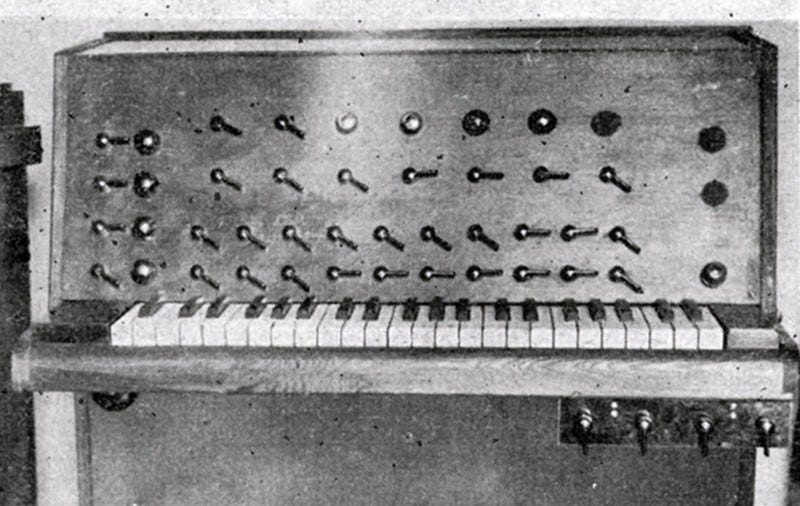
Wait — What’s a Microtone?
Before we get into history, let’s make sure we’re on the same page about what microtonality actually means, because it sounds more exotic than it is.
Every piano, guitar, and synthesizer you’ve ever played almost certainly uses a tuning system called 12-tone equal temperament (often shortened to 12-TET or just 12-ET). In this system, the octave is divided into 12 parts, all of equal size on a logarithmic scale. That’s your 12 semitones — the 12 notes on a piano keyboard before the pattern repeats. It has been the predominant tuning system of Western music since the 18th century. ChromatoneWikipedia
Here’s the thing: those 12 notes are a choice. A convenient, historically contingent, practical compromise — not a law of nature.
Equal temperament replaced earlier tuning systems that were based on acoustically pure intervals, that is, intervals that occur naturally in the overtone series. When you tune a string or blow a column of air, physics generates a whole cascade of pitches above the fundamental note — the so-called harmonic series. Those natural overtone relationships don’t land neatly on our 12 piano keys. Equal temperament slightly mistuned every interval (except the octave) so that instruments could play in any key without sounding catastrophically wrong in any of them. It’s a brilliant solution to a logistical problem. But it is also, undeniably, a compromise. Britannica
Microtonality is the broad practice of working with pitches outside or between those 12 equal steps. That can mean dividing the octave into 19, 31, or 72 equal pieces. It can mean using the pure, untempered intervals of just intonation — tuning based directly on those natural harmonic ratios. It can mean the fluid, continuous glide of a voice or a violin string, where pitch is a spectrum rather than a set of fixed points. Or it can mean inventing entirely new scales with different internal logic altogether.
Microtones aren’t weird sounds for weird people. They’re simply the vast majority of pitch space that Western music’s dominant tuning tradition decided to leave off the map.
Why Electronics Changed Everything
Acoustic instruments have physical constraints. A piano has hammers and strings. A fretted guitar has fixed frets. Building a keyboard instrument that could play in a tuning system other than 12-TET meant physically rearranging or duplicating hardware — a massive undertaking.
Electronics offered something radically different: the ability to generate any frequency you wanted, directly, from a circuit. No strings, no frets, no hammers. Just oscillators, and whatever pitch you dialed in.
This is why, from the very earliest days of electronic music, microtonality and electronic instruments were almost inseparable. The two ideas needed each other. Microtonal composers needed instruments that could actually play their music, and electronic instrument inventors needed a musical philosophy ambitious enough to justify what their machines could do.
The Prophet in Berlin: Ferruccio Busoni
The intellectual foundation was laid before a single electronic instrument existed. In 1907, the Italian-German composer and theorist Ferruccio Busoni published a short but incendiary essay called Sketch of a New Esthetic of Music. Busoni argued that the natural scale contained not twelve but “one hundred thirteen tones” and proposed the use of third-tones and sixth-tones. He imagined new electronic instruments that could render these fine gradations without the mechanical limitations of keyboard instruments. Medium
Busoni didn’t compose microtonally himself in any systematic way, but his essay became a philosophical license for a generation of experimenters. In Berlin, he gathered a small circle of microtonal musicians — including Jörg Mager, Alois Hába, Richard Stein, and Ivan Wyschnegradsky — who were united in their aim to liberate music from the tyranny of fixed-tonality. 120 Years of Electronic Music
Jörg Mager and the Sphärophon
Of that Berlin circle, Jörg Mager (1880–1939) was the one who turned the dream into hardware.
It was while working in a radio vacuum tube factory in post-WWI Berlin that Mager hit upon the idea of using vacuum tubes as the basis for his first electronic microtonal instrument, the Electrophon, in 1921. Readthedocs
Mager wasn’t interested in making a convenient instrument. He was interested in liberation. From around 1921 until his death in 1939, he created a family of electronic instruments that included the Electrophon (1921), Sphäraphon (1924), Kurbelsphärophon (1926), Klaviatursphäraphon (1928), Partiturophon (1930), and Kaleidophon (1939). Central to his design concept was the pursuit of a utopian perfect musical instrument, one that could deliver on the microtonal promises outlined in Busoni’s influential text. 120 Years of Electronic Music
The Sphärophon’s name came from the Pythagorean legend of the “music of the spheres,” and Mager’s ambitions matched the mythology. To achieve his utopian dream of socially transformative music, Mager planned to build “Sphäraphon Towers” in which his microtonal electronic music would be amplified and projected across Berlin, inspiring a mass communal awakening. 120 Years of Electronic Music
The instrument quickly gained notoriety throughout Germany; Paul Hindemith enthusiastically endorsed Mager’s instrument, and Mager’s fellow microtonalist Czech composer Alois Hába added: “This is a new era in the development, not only in building instruments, but in music in general.” 120 Years of Electronic Music
Despite the praise, the Sphärophon’s commercial story was a disappointment. Despite enthusiastic endorsements from musical luminaries such as Paul Hindemith, Georgy Rimsky-Korsakov, and Ferruccio Busoni, the Sphäraphon received a lukewarm reception when it was unveiled to the public in 1926 — particularly evident when Mager’s performances of his rather austere microtonal music were showcased alongside Leon Termen’s flashy yet kitschy renditions of popular classical hits. 120 Years of Electronic Music
Mager’s story is a recurring one in the history of microtonal electronic music: visionary ideas, genuine technological achievement, and an audience not yet ready to follow.
The Trautonium: Microtones You Could Play
While Mager was designing elaborate mechanisms for Berlin’s imagined utopia, a more practically-minded instrument emerged in 1930 from the Berlin Conservatory’s radio laboratory: the Trautonium, invented by engineer Friedrich Trautwein.
Instead of a keyboard, its manual is made of a resistor wire over a metal plate, which is pressed to create a sound. Expressive playing was possible with this wire by gliding on it, creating vibrato with small movements. Volume was controlled by the pressure of the finger on the wire and board. The pitch was determined by the position at which the performer pressed the resistive wire into contact with the plate beneath it, with suitable technique allowing vibrato, quarter tones, and portamento. Wikipedia
Like several electronic instruments in the first half of the 20th century, one of the goals of the Trautonium was to escape from the 12 discrete tones of a conventional piano keyboard, and enable the performer to play microtones, and also to slur between tones in the style of a violin. Electronic Music Wiki
The instrument found its greatest champion in physicist and composer Oskar Sala (1910–2002), who studied with Hindemith and essentially spent his entire life devoted to the Trautonium’s development. In 1952, Sala introduced the polyphonic Mixtur-Trautonium, incorporating subharmonic oscillators and ribbon controls for microtonal playing and glissandi, expanding its timbral range using vacuum tube technology. Grokipedia
Most people have heard the Trautonium without knowing it: Sala used his Mixtur-Trautonium to create the entire soundtrack for Alfred Hitchcock’s The Birds (1963) — those shrieking, inhuman bird sounds were produced on a ribbon-controlled electronic instrument capable of fluid microtonal movement. From his Berlin studio, Sala produced over 300 soundtracks for films and television, blending music, sound effects, and experimental techniques to redefine auditory storytelling in media. Grokipedia
The Ondes Martenot: Microtones for the Concert Hall
In the same year as the Sphärophon’s public debut, another instrument appeared that would prove far more durable: the Ondes Martenot, invented by French cellist and radio operator Maurice Martenot.
A cellist and radio operator during World War I, Martenot found a musicality in the overlapping tones of military radio oscillators, and sought to replicate them through an electrical device with the precision and sliding range of a string instrument. Royal Philharmonic Orchestra
The Ondes Martenot consists of a keyboard and a sliding metal ring connected to a wire, allowing the performer to create gliding pitches and precise, keyboard-like notes. Later models included options for fine-tuning, expanding its versatility across musical genres. Moving the metal ring along the wire produced continuous pitch variation — meaning that in performance, a skilled player could access the infinite pitch space between the standard 12 notes. Organology
A later version of the instrument featured microtonal tuning as specified by the Hindu poet Rabindranath Tagore and the musician Alain Danielou. Specifically, Martenot collaborated with the Indologist Alain Danielou to create a microtonal version of the instrument that included a set of control discs placed above the keyboard, allowing simultaneous tuning of notes to ensure that the overall keyboard tuning corresponded to the raga mode. Wordpress120 Years of Electronic Music
The Ondes Martenot succeeded where many microtonal instruments failed — it was adopted by mainstream composers. The Ondes Martenot is used in more than 100 orchestral compositions. The French composer Olivier Messiaen used it in pieces such as his 1949 Turangalîla-symphonie. It later appeared in film scores including Lawrence of Arabia (1962), and was used by Radiohead’s Jonny Greenwood on their records in the 2000s. Wikipedia
The Ondes Martenot demonstrates something important: microtonal capability doesn’t have to mean microtonal-onlymusic. The instrument’s ribbon controller gave players the option to explore pitch space beyond 12-TET, but they could also just play the keyboard in standard tuning. That flexibility was probably central to its survival.
Percy Grainger’s Dream of “Free Music”
While European composers were building instruments, the eccentric Australian-American composer Percy Grainger was pursuing something even more radical: the complete abolition of fixed pitch.
As early as the 1920s, Grainger was articulating his concept of “Free Music” — music that moved through pitch continuously, the way the sea moves, with no allegiance to any discrete scale at all. Grainger discovered for himself a number of techniques that were to become central to electronic music, including sequencing, continuous modulation, and timbral synthesis. Unimelb
Percy Grainger used the theremin to abandon fixed tonation entirely. He scored works for multiple simultaneous theremins — a notoriously difficult instrument to control precisely — precisely because their continuous pitch range allowed music to exist between and beyond the semitones of standard tuning. Wikipedia
But his most ambitious project was the Free Music Machine, built in 1948 in collaboration with Burnett Cross. The Free Music Machine controlled the pitch, volume, and timbre of eight oscillators. Two large rollers fed four sets of paper rolls over a set of mechanical arms that rolled over the cut contours of the paper and controlled the various aspects of the oscillators. In other words: a composer could draw the shape of a melody on paper — a smooth curve, a gentle wave — and the machine would play it, smoothly, without any steps or fixed notes. 120 Years of Electronic Music
Grainger wrote: “it seems to me absurd to live in an age of flying and yet not be able to execute tonal glides.” The Free Music Machine was his answer.
Stockhausen and the Science of Invented Tuning
By the early 1950s, the center of gravity in electronic music had shifted to the WDR Studio für elektronische Musik in Cologne, where Karlheinz Stockhausen was working with a very different approach to microtonality — not sliding pitch, but carefully calculated frequencies that fell entirely outside the 12-ET system.
Studie II is an electronic music composition by Stockhausen from 1954 and was the first published score of electronic music. Working with primitive oscillators and tape manipulation equipment at the WDR Electronic Music Studio, Stockhausen laboriously constructed every sound using electronically generated sine tones. WikipediaSoundohm
For Studie II, Stockhausen invented his own tuning system from scratch. Stockhausen’s goal was to create new timbres by using amalgamations of sine waves tuned not to the harmonic series, but rather to an unusual tuning of 25 equal divisions of the 5:1 ratio — what 21st-century tuning theorists would abbreviate as “25ed5” (equal divisions of the 5:1 interval). Tonalsoft
This is about as far from accidentally microtonal as you can get. Stockhausen wasn’t gliding around on a ribbon or wire hoping to land somewhere interesting. He was methodically building a new mathematical framework for pitch from the ground up, generating frequencies that had never existed in Western music before, and assembling them into textures using scissors and tape. Studie II abandons the harmonic series altogether, utilizing a serial algorithm to generate its collection of frequencies. Academia.edu
This approach — treating the frequency domain as a compositional parameter to be organized from first principles — was enormously influential on electronic music composition through the following decades.
Wendy Carlos: Bringing Microtones to the Synthesizer Age
If Stockhausen worked with microtonal frequencies in the academic studio, Wendy Carlos brought microtonal thinking to the synthesizer and to a broader public.
Carlos is best known for Switched-On Bach (1968), which demonstrated to the world that a Moog synthesizer could play classical music convincingly. But her most musically radical work came later. Beauty in the Beast (1986) uses alternate musical tunings and scales, influenced by jazz and world music. As the liner notes state, the entire album is synthesized — “All the music and sounds heard on this recording were directly digitally generated.” Wikipedia
The expanded liner notes included an essay by Wendy Carlos on her custom tunings like alpha, beta, and gamma scales, which divide the octave asymmetrically to mimic non-Western musical structures. Her alpha scale, for instance, divides the perfect fifth into nine proportionally equal parts (approximately 78 cents each) — a scale with no octave in the traditional sense, producing harmonics that feel both alien and strangely consonant. GrokipediaTuning
Following the commercial success of her Switched-On Bach series, Carlos sought to expand the synthesizer’s expressive potential by investigating non-Western musical systems and alternative tunings, aiming to demonstrate that synthesizers could transcend the limitations of the 300-year-old equal-tempered scale. Grokipedia
Carlos makes an observation in her liner notes that cuts to the heart of why this whole history matters: “It seems that for most users of synthesizers the extra freedom has not had much effect, in the sense that most music involving synthesizers is written using the equal tempered twelve tone scale.” The tools to explore pitch space freely had existed for decades. Most people still weren’t using them.
The Throughline
Looking across this history — from Busoni’s 1907 essay to Mager’s vacuum tube instruments, from the Trautonium’s ribbon to the Ondes Martenot’s ring, from Grainger’s paper-roll oscillator arrays to Stockhausen’s calculated sine tones and Carlos’s programmed alpha scales — a clear pattern emerges.
Electronic sound generation didn’t just create new timbres and new textures. It broke open the question of pitch itself. Every one of these composers and inventors looked at the 12-note octave and decided: this is a convention, not a constraint. The physics of sound offers an infinite continuum of frequency. Why should music only live at 12 addresses on that continuum?
They had wildly different answers. Mager wanted social transformation through microtonal spectacle. Grainger wanted music as free as the sea. Stockhausen wanted rigorous mathematical control over a new pitch universe. Carlos wanted to explore the tunings of non-Western musical traditions through the synthesizer’s precision. But they were all asking the same question.
And today, that question is easier to explore than ever. Modern software synthesizers can be retuned in seconds. Plugins like Surge XT support full microtuning via standard .tun files or MTS-ESP. DAWs can host instruments tuned to 31-ET, 19-ET, just intonation, or any other system you can describe mathematically.
The early electronic music pioneers broke down the door. The room beyond it is still mostly unexplored.
Further reading: The Xenharmonic Wiki is the best single resource for microtonal theory, tuning systems, and community. The 120 Years of Electronic Music site has detailed histories of every instrument mentioned in this article.
Comments
Post a Comment